What Breaks First When You’re Scaling a B2B Agency
Scaling agency? Learn what breaks first in a B2B agency, how margin leaks show up and which ops systems to fix before hiring.
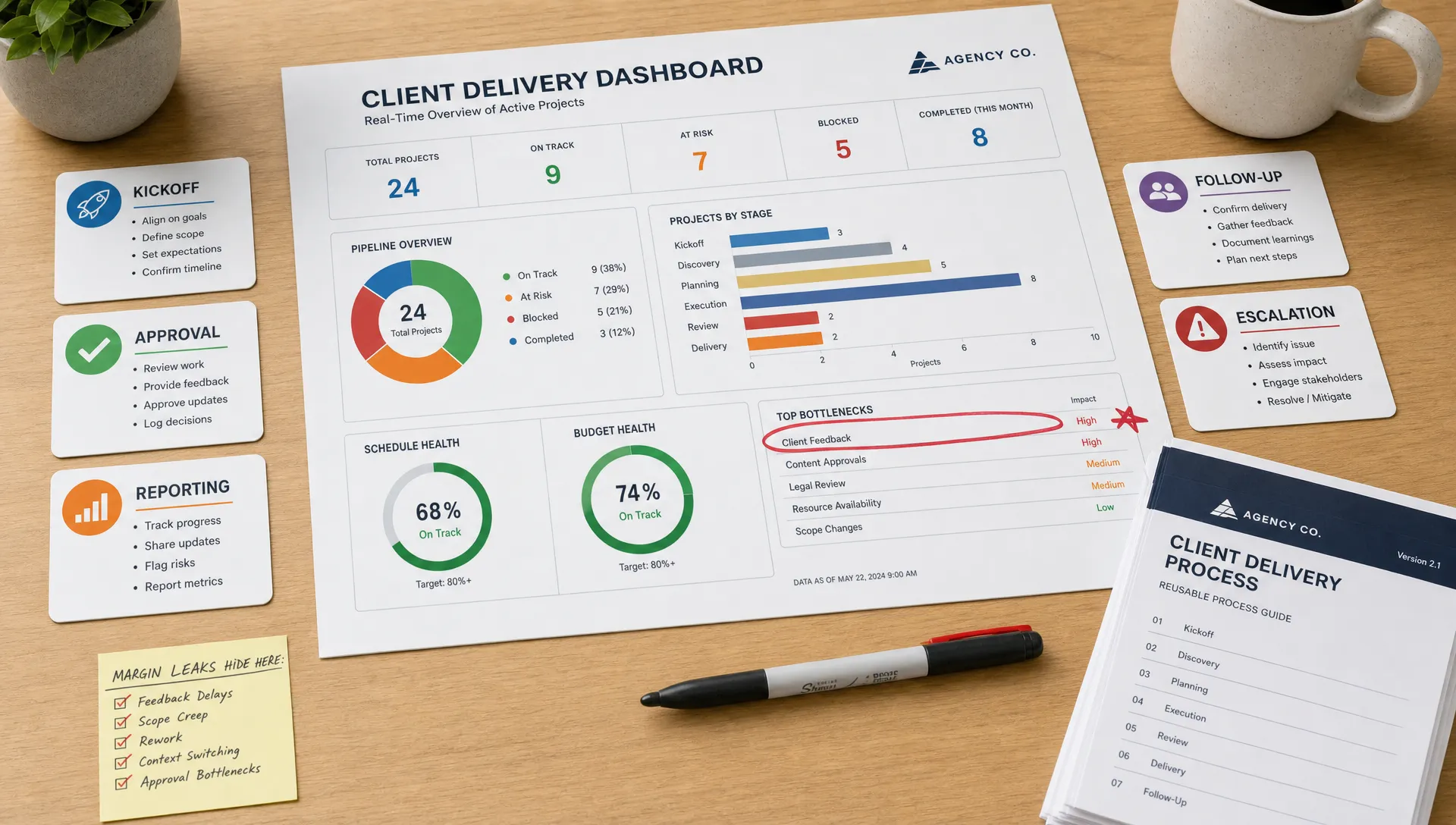
Growth rarely breaks a B2B agency in one dramatic moment. It usually breaks in a quieter way: a delayed kickoff, a senior strategist rewriting work at 9 p.m., a reporting deck that takes half a day longer than it should or a client asking a question your team already answered somewhere else.
When you are scaling a B2B agency, the first thing to break is not usually talent. It is the operating system underneath the talent.
The agency can still sell. The team can still deliver. Clients may still be happy enough. But every new account adds coordination weight, and that weight starts eating the margin that growth was supposed to create.
This is why many agency owners feel confused during the first serious scaling push. Revenue is up, the team is busier and the client roster looks healthier, yet profit feels strangely fragile. The problem is not that the agency cannot grow. The problem is that the work has outgrown the way it is being run.
The First Break Is Usually Visibility
Before fulfillment breaks, visibility breaks.
At a smaller size, the founder or delivery lead can hold the agency in their head. They know which client is anxious, which campaign is late, which account manager needs help and which strategist is quietly overloaded. That informal visibility feels efficient because it requires almost no tooling.
As the agency scales, the same habit becomes dangerous. Work is still moving, but the true state of the agency is scattered across Slack threads, project boards, call notes, inboxes, CRM fields, spreadsheets and personal memory.
The early symptoms are easy to dismiss:
- You need three people to explain the real status of one client account.
- The project management tool says work is on track, but the account manager knows it is not.
- Client risk is discussed only after a complaint, not before.
- Leadership meetings become status archaeology instead of decision-making.
- No one can quickly separate a delivery problem from a client communication problem.
This is the first break because every later scaling problem depends on visibility. If you cannot see where work is stuck, you cannot automate it cleanly, hire for it confidently or price it accurately.
The Second Break Is Handoff Quality
Once visibility gets fuzzy, handoffs become the next point of failure.
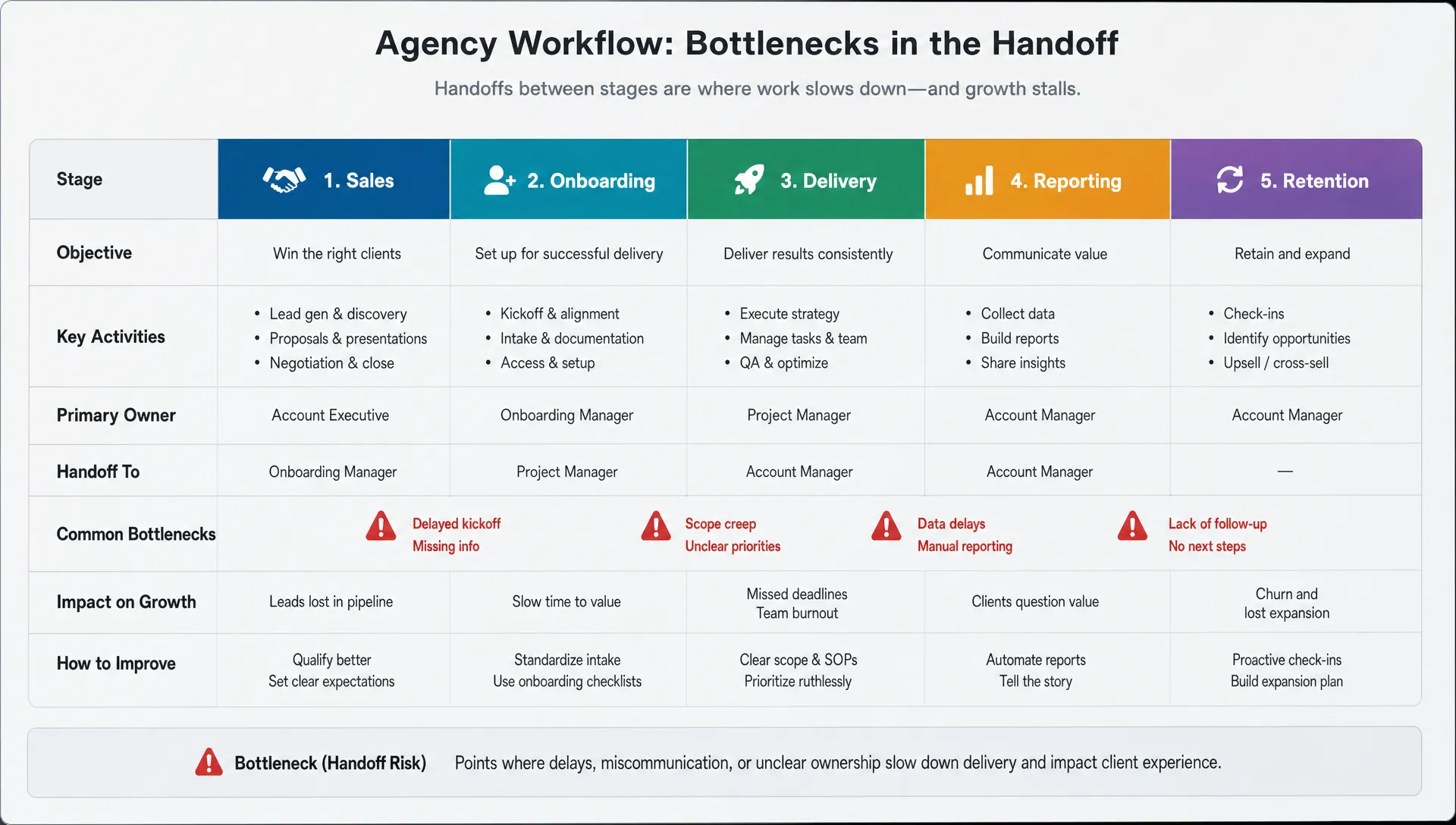
A B2B agency is full of handoffs: sales to strategy, strategy to execution, execution to reporting, reporting to account management, account management back to strategy. When the agency is small, people compensate for weak handoffs by talking constantly. They remember the prospect conversation. They know the client’s political context. They know why a campaign was scoped a certain way.
At scale, that informal transfer does not survive. The person who sold the work is not always the person leading delivery. The strategist cannot join every kickoff. The founder cannot personally decode every client’s expectations.
The result is rework. Not dramatic rework, just enough to erode margin. The team asks the same discovery questions twice. A campaign brief misses the nuance that closed the deal. A reporting narrative does not match the client’s real priority. A junior team member executes exactly what was written, but what was written was not enough.
If onboarding is where you feel this most, the fix is not another kickoff checklist alone. You need a cleaner sales-to-delivery transfer with required context, standard inputs and a defined moment where ownership truly changes hands. This is why scalable marketing agency client onboarding matters so much: it prevents the agency from starting each new account with hidden debt.
The Third Break Is Decision Rights
As the team grows, the question “who owns this?” becomes more expensive.
Small agencies often run on flexible ownership. Everyone helps. The founder jumps in. A senior operator fills gaps. Account managers chase answers. This flexibility can be a strength early on, but it becomes a scaling liability when decisions repeat.
Common decision-right failures include unclear authority around scope changes, unclear approval paths for creative, unclear ownership of client data, unclear responsibility for CRM updates and unclear escalation rules when delivery risk appears.
The work then slows down because people wait, ask around or make different decisions each time. Senior people become the routing layer for basic operational judgment. This makes the agency feel collaborative on the surface, but underneath it is burning expensive attention.
A useful test is simple: pick a recurring situation and ask five team members what should happen next. If you get five slightly different answers, you do not have an alignment problem. You have an operating system problem.
The Fourth Break Is Margin, Not Revenue
Many agencies do not notice the real damage until margin starts slipping.
Revenue can hide operational weakness for a while. New clients create momentum. Larger retainers make the dashboard look better. The team is busy, so the business feels healthy. But margin tells the truth.
Scaling adds friction before it adds efficiency. More clients mean more communication paths, more reporting variations, more QA, more internal meetings, more revisions and more edge cases. If the agency has not standardized the work that should be standard, each client adds a custom operating burden.
| What grows | What quietly grows with it | Margin risk |
|---|---|---|
| Client count | Account context, meeting load, reporting volume | Senior time gets consumed by coordination |
| Service lines | QA paths, dependencies, documentation gaps | Delivery becomes harder to forecast |
| Team size | Handoffs, management time, internal questions | More labor does not equal more throughput |
| Campaign volume | Setup tasks, naming conventions, data cleanup | Small errors multiply across accounts |
| Client complexity | Exceptions, custom decks, special requests | Scope creep becomes normalized |
This is the uncomfortable part of scaling an agency: the first version of growth often makes the agency less efficient, not more. Better operations are what convert growth into profit.
Why Hiring Does Not Fix the First Break
Hiring can absolutely be the right move. Agencies need capable people, especially for judgment-heavy work like strategy, client leadership and creative direction. But hiring into a broken operating system often spreads the mess across more people.
If the agency lacks clear inputs, clean handoffs, reusable templates, standard operating procedures and reliable reporting workflows, new hires spend too much of their time asking how things work. Existing team members then spend more time answering, reviewing and correcting. The agency pays for capacity but receives less leverage than expected.
This is where many owners misread the bottleneck. The team feels overloaded, so hiring appears to be the obvious solution. But if the overload comes from preventable admin, repeated research, manual reporting, messy CRM hygiene or inconsistent onboarding, automation and systemization may create more margin than another salary.
For a deeper breakdown of that decision, Archer Scaling AI has a useful framework on marketing agency hiring vs automation that separates judgment bottlenecks from workflow bottlenecks.
The Pattern Across Agency Types
The exact workflow differs by agency model, but the failure pattern is similar. Growth exposes the parts of the business that were being held together by memory, heroics and custom work.
A demand generation agency may break around campaign launch workflows. A content agency may break around briefing, SME extraction and editorial QA. A CRM agency may break around data cleanup, implementation documentation and reporting definitions. A paid media agency may break around creative request intake, tracking QA and performance commentary.
The pattern is not limited to marketing agencies. Specialized agencies in other sectors run into the same operational ceiling when core admin is left in generic tools. For example, a travel agency may need a dedicated platform like Elia Pay to manage payments, reconciliation and cash flow more reliably as volume increases. The principle is the same: once transaction or client complexity rises, the back office needs purpose-built systems instead of improvised manual work.
For B2B marketing agencies, the equivalent is not only better project management. It is a delivery operating layer that turns repeated work into controlled workflows.
The Hidden Break: Client Confidence
Clients often notice operational strain before the agency admits it internally.
They may not say, “Your operating system is broken.” They say things like:
- “Can you remind me where this stands?”
- “Who owns this on your side?”
- “Didn’t we already send that?”
- “Why does this report look different from last month?”
- “Can we get ahead of this next time?”
Each question seems manageable on its own. Together, they reveal a trust leak. The client starts to feel that the agency is reactive, even if the work quality is good.
This is especially painful in B2B, where client relationships depend on confidence as much as deliverables. Buyers do not only judge outputs. They judge whether the agency makes their life easier. If your team needs constant clarification, repeats requests or turns reporting into a monthly scramble, the client absorbs the operational drag.
This is why the warning signs in why agency clients notice broken ops before you do are worth taking seriously. Client confusion is not just a service issue. It is often an early margin signal.
What Should You Fix First?
The best first fix is rarely a large transformation project. It is usually the workflow where volume, repetition and margin leakage intersect.
A good candidate has three traits. It happens often, it requires multiple handoffs and it has a measurable cost when done poorly. That is why onboarding, reporting, lead routing, content production, campaign QA and CRM cleanup are common starting points.
Do not start with the workflow that annoys the founder most. Start with the workflow that constrains throughput or consumes expensive time.
Here is a practical prioritization view:
| Workflow | Fix first if... | What better looks like |
|---|---|---|
| Client onboarding | Kickoffs vary by account and context gets lost | Standard intake, clean handoff, clear first 30 days |
| Reporting | Decks require manual pulling and rewriting every cycle | Consistent data flow, reusable narrative structure, faster review |
| Lead routing | Follow-up depends on manual checks or memory | Clear routing rules, faster handoff, fewer dropped leads |
| Content ops | Briefs are inconsistent and edits repeat | Better source inputs, reusable briefs, defined QA stages |
| CRM hygiene | Data cleanup blocks campaigns or reporting | Required fields, validation steps, routine maintenance |
| SOP updates | Process knowledge lives in senior heads | Living documentation tied to real workflows |
The goal is not to automate everything. The goal is to remove the operational drag that keeps skilled people trapped in low-leverage work.
How AI Ops Changes the Scaling Curve
AI does not fix a messy agency by itself. If anything, adding AI tools without process clarity can create more noise. The advantage comes when AI is installed into a defined operating model.
In a B2B agency, AI ops can support the workflows that are repetitive, information-heavy or rules-based. That may include research synthesis, onboarding intake, CRM updates, reporting drafts, meeting summaries, content pipeline support, follow-up workflows and internal documentation.
The difference between “using AI” and having an AI ops layer is ownership. A scattered tool stack depends on individual adoption. An ops layer is designed around the way work should move through the agency.
Strong AI ops usually has a few characteristics:
- It starts with a margin problem, not a tool preference.
- It standardizes the inputs before automating the outputs.
- It keeps humans in judgment-heavy review points.
- It documents the workflow so the agency is not locked into one person’s head.
- It is maintained after launch, because agency workflows change.
That last point matters. Many automations fail not because the first build was bad, but because no one owns the system after the first version goes live. A scaling agency needs automation that is operated, not just installed.
A Simple Diagnostic for Agency Owners
If you are not sure what is breaking first in your agency, look at the last 30 days of delivery and ask where the same friction appeared more than once.
You are looking for patterns, not isolated mistakes. One late report may be a workload issue. Five late reports may be a reporting system issue. One confused client may be a communication issue. Several clients asking for status clarity may indicate that account visibility is weak.
Use these questions as a quick diagnostic:
- Where did senior people do work that a system should have handled?
- Which client requests created the most internal searching or rework?
- Which recurring task had the least consistent process?
- Where did information enter the agency but fail to reach the next person cleanly?
- Which workflow would create immediate margin relief if it took 30 percent less time?
The answer is often enough to identify the first operational move. Not the entire transformation, just the next system worth fixing.
What Not to Standardize Too Early
There is a risk in the other direction too. Some agencies try to systemize everything and accidentally flatten the judgment that clients pay for.
Do not over-standardize strategy, positioning, creative insight or client leadership. Those areas need principles, prompts, examples and decision frameworks, but they should not become rigid scripts. The best agencies protect human judgment by systemizing the repeatable work around it.
A strategist should not spend hours cleaning notes before they can think. An account manager should not rebuild a status update from scratch every week. A creative lead should not chase missing context that should have been captured during intake.
Systemization should make the best people more available for the work only they can do.
Frequently Asked Questions
What usually breaks first when scaling a B2B agency? Visibility usually breaks first. Leaders lose a clear real-time view of client status, delivery risk, team capacity and margin leakage because the work is scattered across tools, people and undocumented context.
Is scaling an agency mainly a hiring problem? Not always. Hiring helps when the bottleneck requires judgment, leadership or specialized skill. If the bottleneck is repetitive admin, weak handoffs, manual reporting or messy intake, better systems and automation may pay off first.
How do I know whether my agency has an operations problem? Look for repeated rework, unclear ownership, inconsistent onboarding, reporting scrambles, senior people stuck in coordination and clients asking for status clarification. These are signs that the operating model is under strain.
Can AI help a B2B agency scale without hurting quality? Yes, when it is built into clear workflows with human review at the right points. AI is best used to reduce repetitive, information-heavy work so your team has more time for strategy, client judgment and quality control.
What is the first workflow a B2B agency should automate? Start with the workflow that is frequent, handoff-heavy and expensive when done manually. For many agencies, that means onboarding, reporting, lead routing, CRM hygiene or content operations.
The Real Scaling Question
The question is not whether your agency can sell more work. It is whether your operating system can absorb more work without turning growth into margin pressure.
If you are scaling a B2B agency and the team feels busier but the business does not feel more profitable, the first move is to find the operational break. Archer Scaling AI starts with a paid Margin Teardown that identifies the margin leaks, maps the highest-leverage automation moves and gives you a practical roadmap. If there is no useful roadmap and three automation moves, it is on us.
You can start by reviewing how to scale marketing without adding headcount or see the AI ops approach at Archer Scaling AI.