Why Agency Clients Notice Broken Ops Before You Do
Agency clients spot broken ops through delays, repeated questions, and messy reporting. Learn how to detect the signals before churn starts.
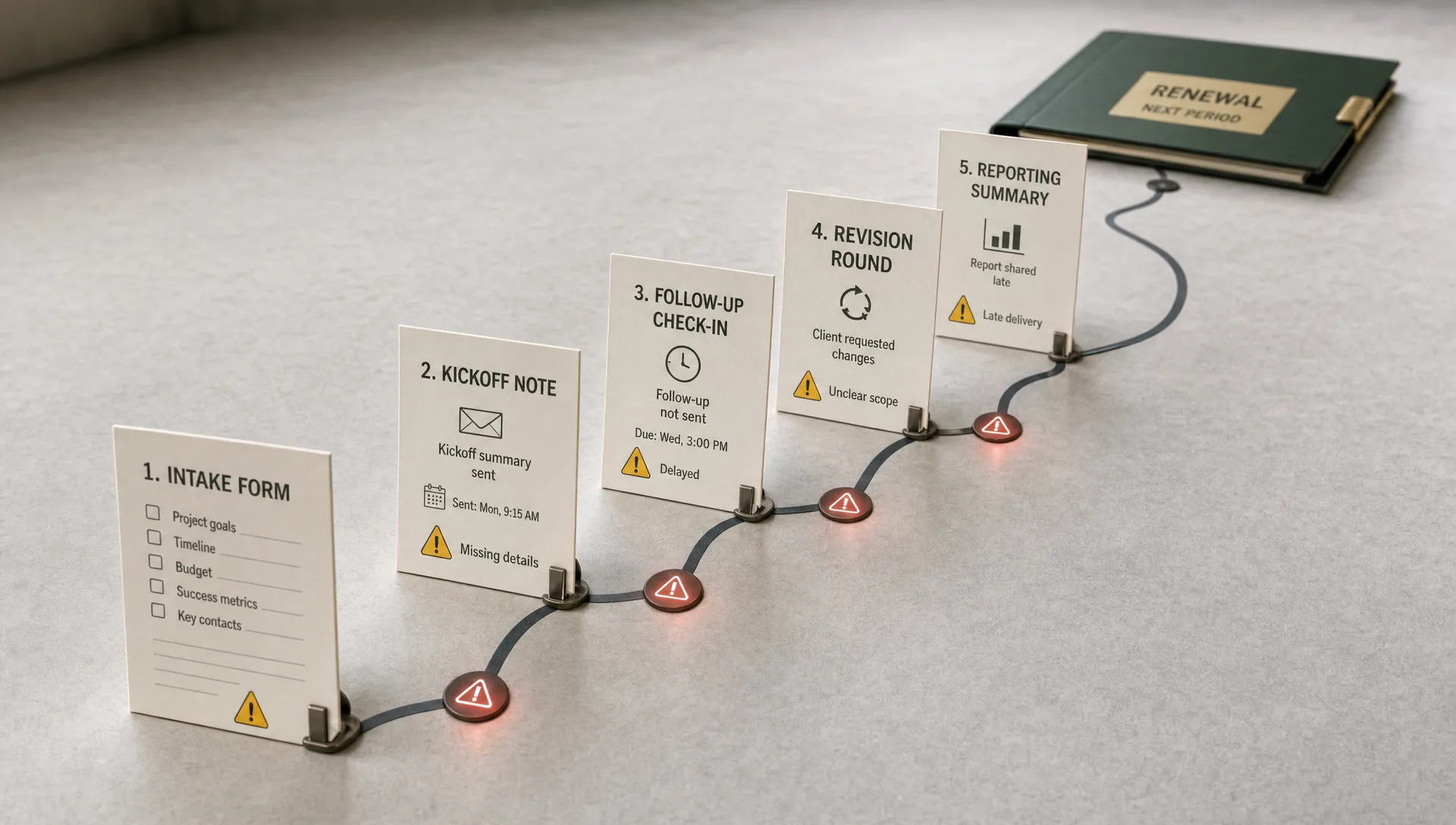
Agency owners usually discover operational problems in one of three painful places: a margin report, a team burnout conversation, or a client renewal call that suddenly turns cold.
The uncomfortable truth is that agency clients often notice broken ops before leadership does. Not because they understand your internal tools better than you. They notice because they live on the receiving end of the system.
They see the repeated questions. They feel the slow handoffs. They hear the slight mismatch between what sales promised and what delivery can consistently produce. They notice when a report creates more confusion than clarity. Internally, your team may call these things “just how this account works.” Externally, the client reads them as risk.
Broken ops rarely show up as one dramatic failure. More often, they appear as a pattern of small confidence leaks. A late recap here. A missing owner there. A campaign brief that has to be rewritten twice. By the time the client says, “We need to rethink this engagement,” they have usually been collecting evidence for months.
Broken ops are not the same as a bad team
When agencies hear “broken operations,” they often assume it means people are underperforming. In most B2B agencies, that is not the real issue.
Broken ops usually means the delivery system depends too heavily on memory, heroics, manual follow-up, and individual judgment where the process should be clear. Talented people can keep that system alive for a while, but clients still feel the friction.
A strong account manager can smooth over a messy onboarding. A strategist can rebuild a weak brief. A delivery lead can chase missing assets at night. But those fixes create invisible labor. The client may not see the rescue work, but they still experience the delay, inconsistency, or uncertainty that made the rescue necessary.
That is why operations are not just an internal efficiency concern. They shape client trust. If you want a deeper argument for this, Archer Scaling AI has covered why better operations are the real agency advantage in a market where strategy and creative claims often sound the same.
Why clients see the cracks first
Agency leaders typically inspect the business through dashboards, team updates, revenue forecasts, and delivery meetings. Clients inspect it through moments.
They do not see your whole process. They see the intake call, the follow-up email, the first deliverable, the revision loop, the reporting meeting, and the moments where something is unclear. Those moments become their mental model of your agency.
They experience handoffs, not org charts
Internally, a handoff might seem simple: sales passes notes to strategy, strategy briefs delivery, delivery sends assets to account management. But the client does not care which department dropped context. They only know they already answered that question last week.
Repeated discovery questions are one of the earliest signs of operational drag. They make the client wonder whether your team is aligned. Worse, they force the client to manage your internal knowledge transfer.
If your onboarding depends on scattered notes, Slack searches, or someone remembering what was said during sales, clients will notice fast. That is why scalable onboarding matters so much. A clean marketing agency client onboarding system protects the first impression and reduces the chance that clients become the source of truth for information you should already have.
They compare delivery against the sales promise
Your team may judge delivery against what is possible this week. The client judges delivery against what they bought.
If sales promised strategic leadership but the client receives task execution, they notice. If the proposal implied proactive recommendations but the weekly call is mostly status updates, they notice. If the kickoff felt premium but the following process feels improvised, they notice.
This gap does not always mean the agency oversold. Sometimes the service is sound, but the operational layer does not make the value visible. Strategic thinking buried in internal docs does not reassure the client. Neither does a campaign that performs well but arrives through a chaotic process.
They feel waiting time more than work time
Inside the agency, a deliverable might only be “in progress” for four hours. To the client, it may feel like it took nine days because there was no visible movement, no expectation reset, and no clear next step.
Clients do not measure your workload. They measure uncertainty.
A slow response is not always fatal. A slow response with no context is. A delayed report is manageable if the client knows why and when it will arrive. A delayed report that appears without explanation becomes a trust problem.
They see patterns your team has normalized
Teams get used to workarounds. Clients do not.
Your team might barely notice that every content brief needs a clarification thread, every report requires manual cleanup, or every launch includes last-minute asset chasing. Those patterns become background noise internally. To clients, they are evidence that the agency is not fully in control.
This is especially true in 2026 because B2B buyers bring consumer-grade workflow expectations into professional services. They can configure software, track shipping, approve documents, and even customize a home product online with clear options and visible steps. When an agency engagement feels less organized than everyday digital buying experiences, the contrast is obvious.
The client-side symptom map
Operational issues usually create different internal and external symptoms. The agency may feel pressure in capacity or profitability, while the client feels confusion or risk.
| Internal ops issue | What the agency feels | What the client notices |
|---|---|---|
| Weak sales-to-delivery handoff | Extra kickoff prep and repeated context gathering | “Why are they asking me this again?” |
| Unclear ownership | More Slack pings and duplicated follow-up | “Who is actually responsible for this?” |
| Manual reporting process | Late nights before reporting calls | “Why do these numbers keep changing?” |
| Poor brief quality | Rework, revision loops, and frustrated creatives | “Why is the output missing the point?” |
| No stage gates | Last-minute QA and preventable errors | “Why are we catching this?” |
| Tool sprawl | Context split across systems | “Why does every update live somewhere different?” |
This is where agency leaders often misread the situation. A client may not complain loudly about any single item in the table. They may simply become less responsive, ask for more justification, bring more stakeholders into calls, or start comparing alternatives.
Those are not random relationship dynamics. They are often symptoms of declining confidence.
Reporting is where broken ops become undeniable
Reporting is one of the fastest places clients detect operational weakness because it combines data, narrative, accountability, and decision-making.
A report that arrives late is not just late. It suggests the agency has to scramble to understand performance. A report with inconsistent definitions is not just messy. It makes the client question whether past recommendations were built on reliable information. A report that lists activity without explaining decisions makes the agency look busy but not strategic.
This is why reporting mistakes can damage trust even when campaign performance is acceptable. If clients cannot understand what happened, what it means, and what will change next, the report becomes a liability.
For a focused breakdown of this problem, see the guide to agency reporting mistakes that hurt client trust. The short version is simple: clients do not want more slides. They want clearer decisions.
The margin report tells you late
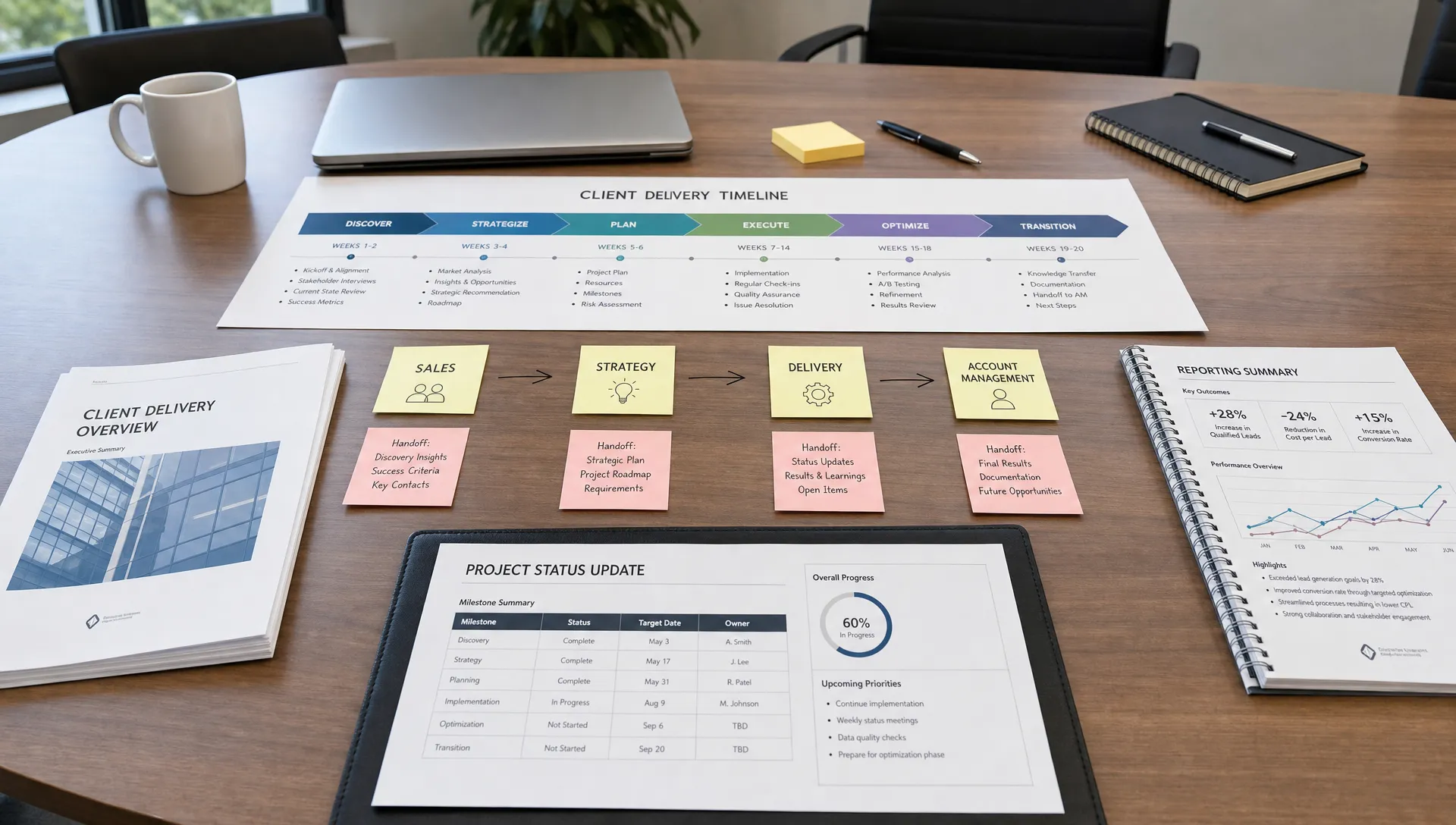
By the time broken ops appear in your margin numbers, the client has already felt them.
Margin erosion is a lagging indicator. It tells you that the team spent too much time somewhere, but it does not always tell you when the client first lost confidence. The client may have noticed the issue when kickoff felt disorganized. Your margin report may not show it until the third round of revisions or the fifth manual reporting cleanup.
This timing gap is dangerous because it encourages agencies to solve the wrong problem. If margin looks weak, the first instinct may be to push the team harder, reduce scope, hire another coordinator, or add another tool. But if the real issue is broken intake, unclear ownership, poor QA, or manual reporting, those moves only move the stress around.
A better question is not “Where did we lose time?” It is “Where did the client first have to compensate for our process?”
That question shifts the conversation from internal workload to client experience. It also reveals where operational fixes will have the biggest retention impact.
The quiet signals clients send before churn
Clients often signal operational concerns indirectly. They may not say, “Your ops are broken.” Instead, they change their behavior.
Watch for these signals:
- They ask for more frequent updates because they no longer trust the current cadence.
- They add more approvers because they are trying to reduce perceived risk.
- They start documenting decisions more aggressively because they expect context to get lost.
- They revisit scope language because delivery feels less predictable than the agreement.
- They become slower to approve because every approval feels like it needs extra inspection.
- They ask for raw data because the reporting narrative no longer feels sufficient.
- They stop sharing broader business context because they no longer see the agency as a strategic operator.
None of these signals automatically means the client is unhappy. But together, they suggest the client is adding control mechanisms around your agency. That is usually what happens before renewal risk becomes visible.
Why internal teams miss the same issues
If clients can see these problems, why do smart agency teams miss them?
First, internal teams are often rewarded for saving the day, not for removing the need to save it. The account manager who patches a broken handoff may be seen as excellent. The hidden problem is that the system required patching in the first place.
Second, operational debt is distributed. No single person owns all of it. Sales owns one part of the promise. Strategy owns the translation. Delivery owns production. Account management owns communication. Reporting owns the narrative. When friction appears across the chain, everyone sees a fragment and nobody sees the full cost.
Third, clients compare your agency to their desired outcome, while your team compares today to the last chaotic week. If delivery was slightly less painful than last month, the team may feel progress. If the client still had to chase three updates, they may feel disappointment.
Finally, most agency data is backward-looking. Utilization, margin, and delivery time matter, but they do not always capture trust decay in real time. You need leading indicators that reveal friction before it becomes a renewal conversation.
Leading indicators of client-visible ops problems
The best agencies do not wait for escalations. They measure the behaviors that predict them.
| Leading indicator | What it reveals | Healthy operating question |
|---|---|---|
| Duplicate client questions after kickoff | Handoff quality | Did delivery inherit the full sales context? |
| Revision reasons by category | Brief and QA strength | Are revisions caused by taste, strategy, missing inputs, or errors? |
| Time from client input to next action | Responsiveness | How long does the client wait before seeing movement? |
| Report QA corrections | Data reliability | Are definitions and sources standardized? |
| Number of owner changes per deliverable | Accountability clarity | Does the client know who owns the outcome? |
| Client-chased updates | Communication gaps | Are clients pulling information instead of receiving it? |
These indicators do not require a massive transformation program. In many agencies, you can start by tagging rework, tracking handoff misses, and reviewing client-chased updates every week.
The point is not to create another dashboard nobody uses. The point is to make friction visible early enough to fix it.
How to find the breakpoints before clients do
A practical ops review should follow the client journey, not your department chart. Start with the promise made in sales, then trace what happens through onboarding, strategy, production, reporting, and renewal.
At each stage, ask three questions.
First, what does the client believe should happen next? This reveals expectation gaps. If the client expects a strategic recommendation but receives a task list, the process may be technically complete but commercially weak.
Second, what information must move cleanly for this stage to work? This reveals handoff risk. If key context depends on someone summarizing a call from memory, the process is fragile.
Third, where does the team repeatedly use manual effort to protect the client experience? This reveals automation and system opportunities. Manual effort is not always bad, but repeat manual rescue work is usually a sign that the process needs redesign.
You can run this review on one account, but it becomes more valuable when you compare multiple accounts. If the same friction appears across clients, it is not an account problem. It is an operating model problem.
What to fix first
The right fix depends on where the client first feels uncertainty. That said, most agencies should prioritize operational points that affect trust and margin at the same time.
Client onboarding is usually high leverage because it sets expectations, captures context, and determines whether delivery starts with clarity or confusion. Reporting is also high leverage because it is a recurring proof point for competence. Intake and briefing matter because weak inputs create rework across strategy, creative, and production.
Automation can help, but only when the process is already understood. Automating a messy handoff simply makes the mess move faster. The better sequence is to standardize the workflow, define the decision points, create QA gates, then automate the repeatable parts.
Good first automation targets often include structured intake, meeting recap routing, report assembly, QA checks, CRM updates, client onboarding tasks, and follow-up reminders. These are not flashy, but they remove the repetitive gaps clients notice most.
If you are deciding where AI belongs in the workflow, Archer Scaling AI has a practical guide on what a marketing agency should automate first. The main principle is to automate delivery operations before chasing novelty.
The standard clients actually judge you against
Clients do not expect perfection. They expect control.
They want to believe your agency knows what has happened, what is happening, what happens next, who owns it, and what decisions need to be made. When your operations make those things obvious, clients relax. When your operations make those things ambiguous, clients lean in, inspect, question, and eventually reconsider.
Broken ops create a subtle role reversal. Instead of the agency leading the client, the client starts managing the agency. Once that happens, even good work feels expensive because the client is contributing hidden labor to keep the engagement on track.
That is the real reason agency clients notice broken ops before you do. They are not grading your internal process. They are measuring how much effort it takes to trust you.
Frequently Asked Questions
How do agency clients usually notice broken ops first? They usually notice through repeated questions, unclear ownership, delayed updates, inconsistent reporting, and revision loops that feel preventable. These moments make the client feel like they need to manage the agency instead of trusting the system.
Does broken ops always mean the agency needs to hire? No. Many issues blamed on capacity are actually workflow problems. Before hiring, agencies should inspect handoffs, intake quality, reporting processes, QA steps, and client communication patterns.
What is the fastest operational area to improve client trust? Onboarding and reporting are often the fastest trust levers. Onboarding shapes the first delivery experience, while reporting repeatedly proves whether the agency is organized, strategic, and accountable.
Can AI fix broken agency operations? AI can help when it is applied to a clear process. It can support intake, summaries, routing, QA, reporting, and follow-up. But if the workflow is undefined, AI may only accelerate confusion.
Make the invisible friction visible
If clients are noticing broken ops before you are, the problem is not effort. It is visibility.
Archer Scaling AI helps B2B marketing agencies identify where delivery margin is leaking, then installs and runs AI-powered operations systems across workflows like onboarding, reporting, CRM, content ops, and follow-up.
The starting point is a paid Margin Teardown: a practical roadmap and three automation moves, or it is on me. If you want to see where clients are feeling friction before it becomes churn risk, start with Archer Scaling AI.