Why the Real Agency Advantage Is Better Operations
The real agency advantage is better operations. Learn how stronger systems protect margins, improve delivery, and make AI useful.
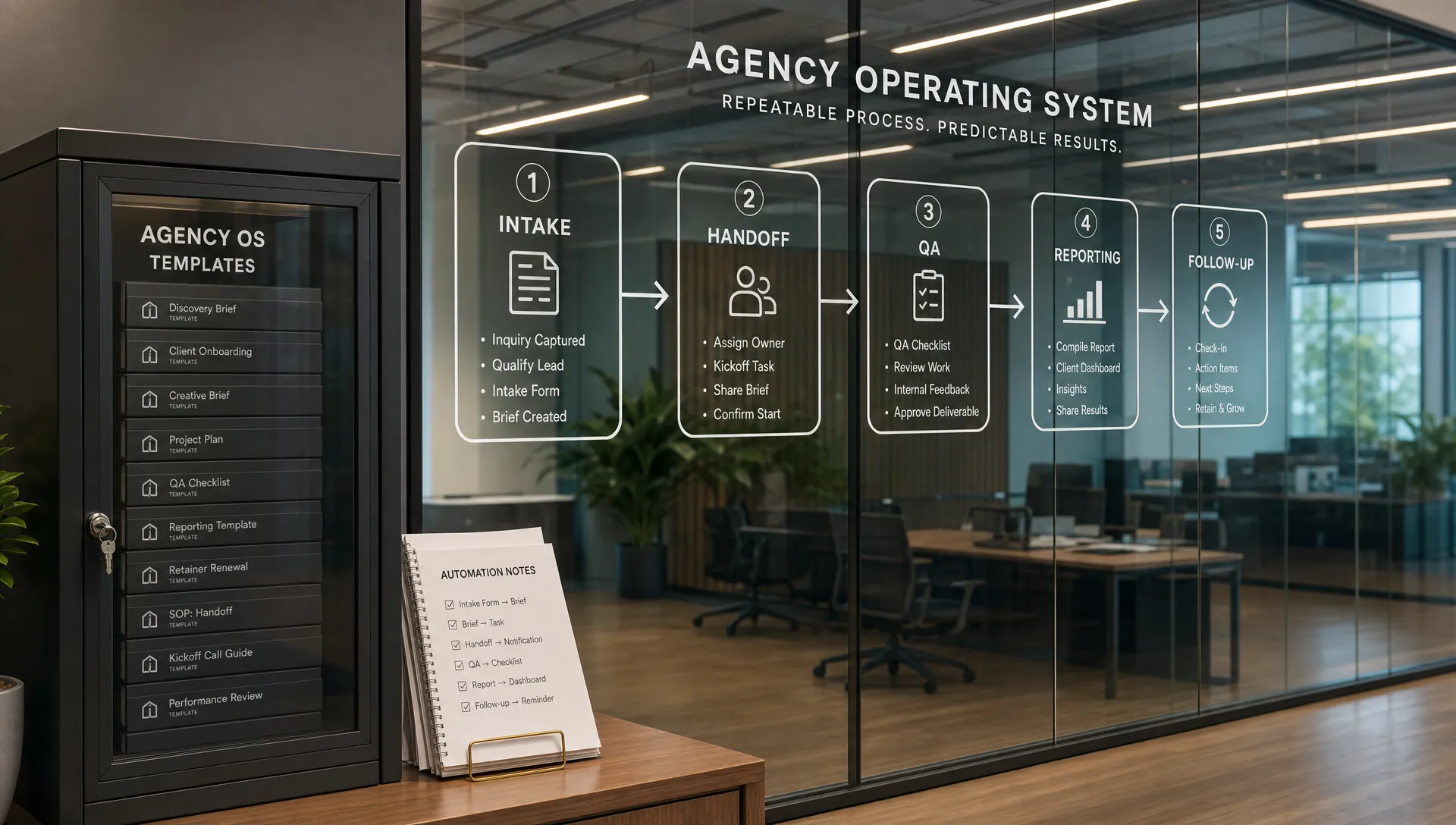
Most agencies know the usual pitch: better strategy, sharper creative, deeper channel expertise, stronger relationships, newer tools. Those things matter, but they rarely stay unique for long. Competitors can hire similar people, copy visible service lines, buy the same software, and make the same promises on a sales call.
The real agency advantage is not what an agency can do once when the founder is close to the work. It is what the agency can deliver repeatedly, across clients, without eroding margin or exhausting the team.
That is an operations problem.
Clients do not experience the real agency behind the sales deck through claims. They experience it through the quality of the kickoff, the speed of follow-up, the clarity of the brief, the consistency of reporting, the confidence of recommendations, and the lack of preventable mistakes. Better operations turn expertise into a client experience that feels calm, credible, and hard to replace.
The myth of the one big differentiator
Agency leaders are often pushed to find a single differentiator. Own a niche. Productize a service. Hire senior strategists. Add AI. Build a proprietary framework. Improve the website.
All of that can help with demand generation and sales. But after the contract is signed, the client mostly judges the agency by delivery. If work is late, handoffs are messy, reporting is unclear, or every request feels like it disappears into a black box, the positioning no longer matters.
The agency that wins long term is not always the one with the loudest point of view. It is often the one that makes clients feel, week after week, that the work is under control.
That control comes from operational design, not heroic effort. It comes from repeatable intake, clear ownership, visible work queues, reliable quality checks, documented decisions, and automation that removes low-value labor from the delivery process.
Operations are what clients actually feel
Clients rarely see your internal project boards, Slack channels, QA checklists, reporting processes, or handoff notes. Yet they feel the effect of all of them.
They notice when:
- A kickoff turns into a clear plan instead of a vague discovery recap.
- A strategist already has the context from the sales process.
- A creative brief answers the obvious questions before production starts.
- A report explains what changed, why it matters, and what happens next.
- A missed dependency is flagged early instead of becoming an urgent surprise.
This is why better operations are not back-office hygiene. They are part of the product. For a B2B marketing agency, the operating system behind the work shapes client trust as much as the visible output.
When ops are weak, the team compensates with meetings, messages, reminders, and late nights. When ops are strong, the agency creates a more consistent client experience with less internal drag.
Where the agency advantage usually leaks away
Most agencies do not lose margin because the team is lazy or the work is simple. They lose margin because the same avoidable friction repeats across accounts.
| Visible symptom | Operational cause | Better operations move |
|---|---|---|
| Strategy feels strong but delivery feels inconsistent | Knowledge is trapped in people, calls, and scattered documents | Standardize intake, handoffs, and decision logs |
| The team keeps reworking deliverables | Briefs lack constraints, examples, approval criteria, or client context | Build stronger brief templates and review gates |
| Reporting takes too long every month | Data assembly, analysis, and client narrative are blended into one manual task | Separate data prep, QA, insight writing, and approval |
| Senior people are always pulled into small issues | Escalation rules are unclear and junior team members lack operating guardrails | Define ownership, thresholds, and SOPs |
| The stack keeps growing but work is not faster | Tools overlap, adoption is uneven, and workflows are not mapped | Audit tools against actual workflows and consolidate |
This is the quiet margin problem. It does not always appear as one obvious failure. It appears as hundreds of small frictions that make every account slightly harder to serve than it should be.
A strong operations layer makes those frictions visible, then removes or automates the repeatable parts.
Better operations are not more bureaucracy
Agency teams often resist operations because they associate it with rigid process, extra admin, and slower creative work. That resistance is understandable. Bad process can absolutely slow an agency down.
But better operations are not about forcing every client into a lifeless template. They are about protecting the team from unnecessary ambiguity.
Good operations answer practical questions before they become interruptions. What information is required before work begins? Who owns the next step? What does good look like? Which tasks can be automated? Which decisions need a senior person? Where is the source of truth? What happens when scope changes?
The goal is not to remove judgment. The goal is to reserve judgment for the work that actually needs it.
The four systems behind a real agency advantage
There are many ways to improve agency operations, but most margin gains come from four core systems.
1. Intake that turns demand into scoped work
A weak intake process creates downstream confusion. The sales call says one thing, the kickoff captures another, the brief misses key constraints, and production starts before the team has the context it needs.
Strong intake collects the right information once, routes it to the right people, and turns it into scoped work. That includes client goals, audience context, previous performance, required assets, decision makers, approval timelines, risk factors, and what is explicitly out of scope.
This is also where agencies can prevent custom chaos. If every client begins with a completely different process, the team has to reinvent delivery each time. Standardized intake creates consistency without making the client experience feel generic. For a broader view of the systems that preserve profit as work scales, it is worth studying how agency marketing systems that protect your margin connect intake, production, reporting, and follow-up.
2. Delivery flow that reduces invisible handoffs
Many agencies underestimate the cost of handoffs. A strategist briefs a copywriter. The copywriter asks the account manager for clarification. The account manager checks with the client. The designer waits. The strategist reviews late. The project manager updates the timeline. Everyone did their job, but the system created waste.
Better delivery flow makes work visible before it becomes urgent. It defines stages, owners, entry requirements, review points, and final approval criteria. It also reduces dependence on memory by making the next action obvious.
The best agency workflows are not overly complex. They are simple enough for the team to follow under pressure and specific enough to prevent avoidable rework.
3. Reporting that drives decisions, not just updates
Reporting is one of the clearest places where operations become a client-facing advantage. A report that arrives late, changes definitions every month, or buries the recommendation under screenshots weakens trust. A report that explains performance, tradeoffs, and next steps strengthens it.
Operationally strong reporting separates four jobs: collecting data, checking accuracy, interpreting the results, and communicating the decision. When those jobs are blended into one last-minute scramble, quality drops and senior people become the bottleneck.
For agencies, the goal is not just faster reporting. It is repeatable insight production. Clients should know what happened, what it means, and what the agency recommends next.
4. Tool and knowledge discipline
Agencies accumulate tools quickly. A client requests one platform. A team member prefers another. A new AI tool looks promising. A reporting tool solves one problem but overlaps with three others. Before long, the stack creates more decisions than it removes.
Tool discipline is now part of operational advantage. If an agency does not know which tools are essential, redundant, underused, or risky, it cannot design efficient workflows around them. One useful starting point is to audit martech stack overlap so leaders can identify redundant capabilities, potential savings, and consolidation opportunities before adding more software.
Knowledge discipline matters just as much. SOPs, briefs, client notes, prompts, examples, QA rules, and decision logs need a usable home. If the team cannot find the answer, the agency effectively does not have the answer.
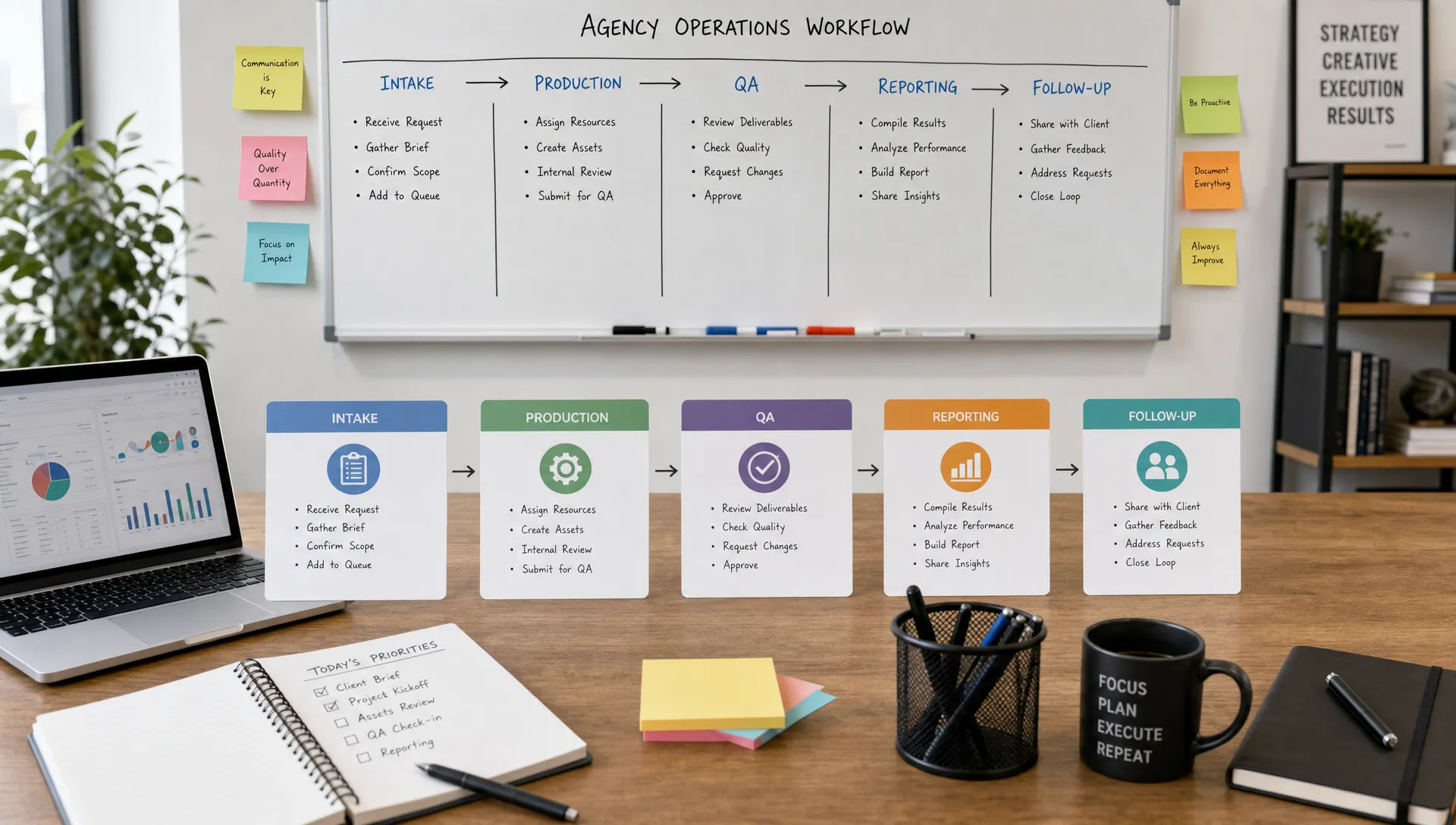
AI makes operations more important, not less
AI has changed agency delivery, but it has not eliminated the need for operational design. In fact, AI often exposes weak operations faster.
If a workflow is unclear, AI can produce more drafts, more data, more messages, and more versions of the wrong thing. That creates faster chaos. But when AI is placed inside a strong operating system, it can remove repetitive labor from research, onboarding, reporting assembly, CRM updates, lead routing, follow-up, SOP drafting, and content production support.
The key question is not, where can we use AI? The better question is, which repeatable tasks are consuming delivery margin without requiring human judgment?
| Work type | Better handled by automation | Better handled by humans |
|---|---|---|
| Research | Gathering inputs, summarizing sources, organizing findings | Deciding strategic implications |
| Reporting | Pulling recurring data, checking formats, drafting first-pass summaries | Explaining tradeoffs and recommendations |
| Client onboarding | Collecting forms, routing assets, creating internal tasks | Building trust and clarifying priorities |
| Content operations | Draft prep, repurposing, QA checklists, workflow routing | Positioning, taste, narrative, final judgment |
| CRM and follow-up | Routing leads, reminders, enrichment, next-step prompts | Sales judgment and relationship management |
This is also why hiring is not always the right fix. If the bottleneck is judgment, leadership, or client strategy, a hire may be the right move. If the bottleneck is repetitive coordination, manual reporting, or avoidable rework, automation and operations may pay off faster. The better decision comes from comparing hiring versus automation for agencies against the actual constraint, not the loudest symptom.
How to tell if operations are your real constraint
Agency leaders often know something is off before the numbers fully show it. The team is busy, clients are mostly happy, and revenue may even be growing, but profit does not improve. Delivery feels heavier than it should.
Common signs include:
- Account managers are constantly translating between clients and delivery teams.
- Senior people are reviewing work that should not need senior intervention.
- The same client questions repeat because documentation is weak.
- Reporting week disrupts the entire agency rhythm.
- New clients require too much custom setup.
- The team wants another hire, but cannot clearly explain which workflow the hire would fix.
If several of these are true, the agency may not have a talent problem. It may have an operating model problem.
That distinction matters because adding people to a broken workflow can make the workflow more expensive. Better operations make existing talent more effective before the agency commits to another fixed cost.
A 30-day reset for agency leaders
You do not need to transform every workflow at once. The fastest path is to identify the biggest margin leak, improve it, then reuse the pattern elsewhere.
| Timeframe | Focus | Practical output |
|---|---|---|
| Week 1 | Map delivery margin leaks | List the recurring tasks, delays, rework loops, and manual reporting steps that consume time |
| Week 2 | Pick one workflow | Choose a high-frequency workflow such as onboarding, reporting, lead follow-up, or content production |
| Week 3 | Standardize before automating | Define inputs, owners, rules, templates, QA checks, and handoff points |
| Week 4 | Automate the repeatable parts | Add automation only where the workflow is clear and the quality standard is defined |
The sequencing matters. Agencies often rush into automation before they have defined the operating logic. That can produce brittle systems, messy exceptions, and low adoption. Standardization first, automation second is usually the safer path.
A good test is simple: could a capable team member follow the process without asking five people for missing context? If not, the workflow is not ready to scale.
The advantage compounds when the founder is no longer the system
In many agencies, the founder or senior operator quietly acts as the operating system. They know which clients are sensitive, which strategist is overloaded, which report needs extra care, which promises were made in sales, and which deliverable is likely to create rework.
That works for a while. It also creates a ceiling.
The real agency advantage appears when the founder's judgment is embedded into systems, templates, rules, and automation. Not all of it, of course. Some judgment should remain human. But the repeatable parts should not depend on one person's memory.
This is how agencies increase margin without lowering standards. They stop asking senior people to personally rescue every workflow and start designing workflows that prevent rescue missions in the first place.
Frequently Asked Questions
Is better operations really a competitive advantage for agencies? Yes. Clients experience operations through speed, clarity, consistency, and confidence. Strong creative and strategy matter, but better operations make those strengths repeatable across accounts without damaging margin.
Does operational improvement make an agency less creative? Not when it is done well. Good operations remove avoidable ambiguity and admin so creative and strategic people can spend more time on judgment, ideas, and client outcomes.
Where should an agency start with AI operations? Start with repetitive, rules-based workflows that already happen often, such as onboarding tasks, reporting preparation, CRM updates, research summaries, follow-up reminders, or content workflow routing. Avoid automating unclear processes before the quality standard is defined.
How do I know whether to hire or improve operations first? If the problem requires more strategic judgment or client leadership, hiring may be right. If the problem is repeated handoffs, manual admin, reporting drag, or rework, operations and automation should usually be reviewed before adding headcount.
Build the advantage clients can feel
A stronger agency is not built only through better positioning or more tools. It is built through the operating layer that turns expertise into reliable delivery, protects margin, and gives clients fewer reasons to doubt the work.
If your agency is growing but delivery feels heavier than it should, Archer Scaling AI helps install and run AI-powered operations systems for B2B marketing agencies. The process starts with a paid Margin Teardown, built to identify the roadmap and three automation moves that can improve delivery margin without defaulting to another hire.