Marketing Agency Hiring vs Automation: What Pays Off
Marketing agency hiring vs automation: compare margin impact, bottleneck types, and ROI so you know when to hire and when to automate.
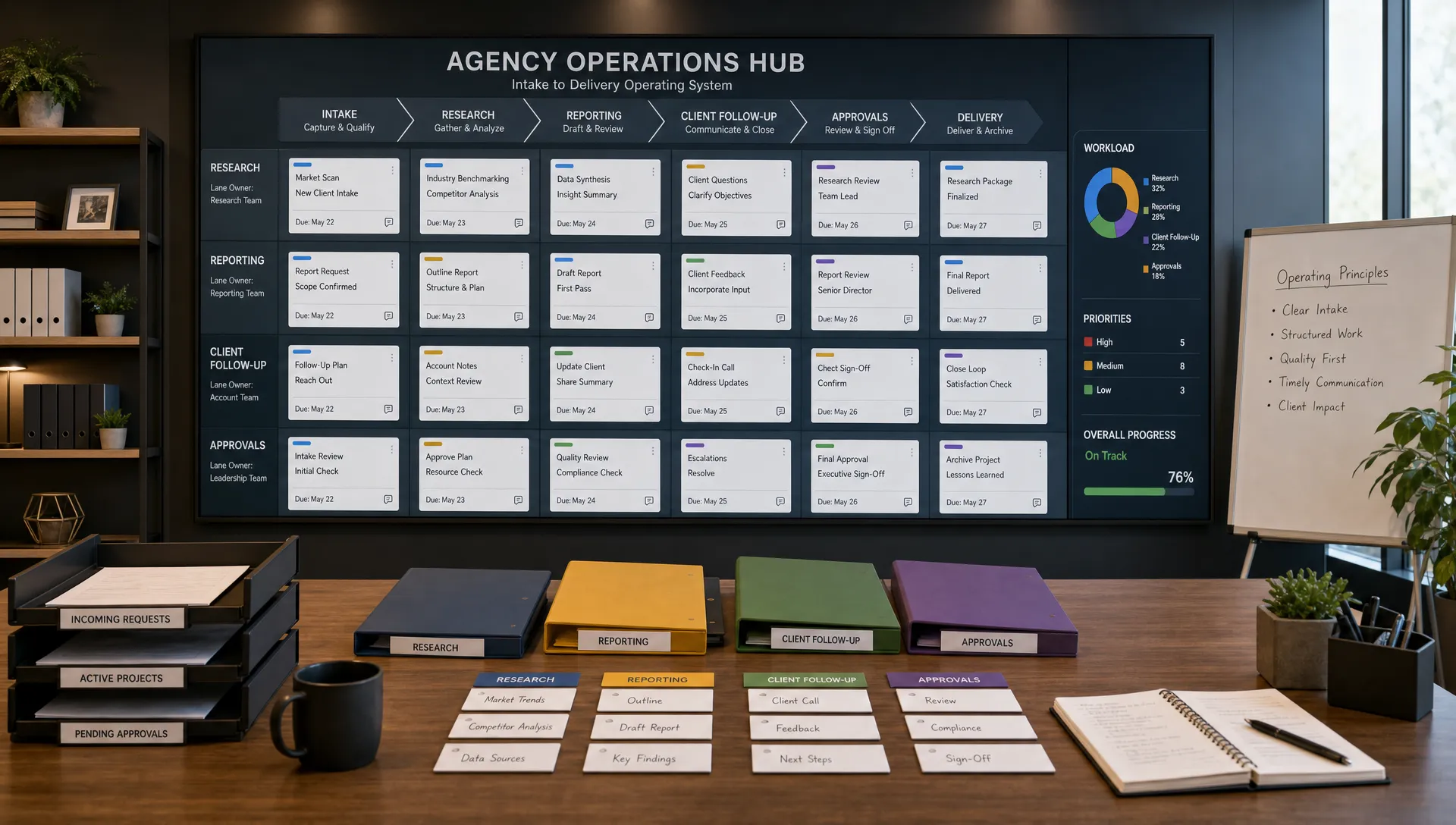
Most B2B agency owners do not start thinking about marketing agency hiring because their org chart looks incomplete. They start because delivery feels heavier than it should: reports take too long, account managers chase inputs, strategists are buried in research, and every new client seems to create another layer of coordination.
Hiring feels like the obvious answer. Add a project manager. Add a coordinator. Add another account lead. But if the bottleneck is repetitive operational work, a hire may only make the agency more expensive without making it more scalable.
Automation is not always the answer either. AI cannot own a client relationship, make nuanced strategic tradeoffs, or replace senior judgment. The profitable question is not whether people or automation are better. The profitable question is: which one pays off for this specific constraint?
For a B2B marketing agency, the right decision comes down to margin, repeatability, risk, and time to value.
The decision is not “people or AI.” It is constraint fit
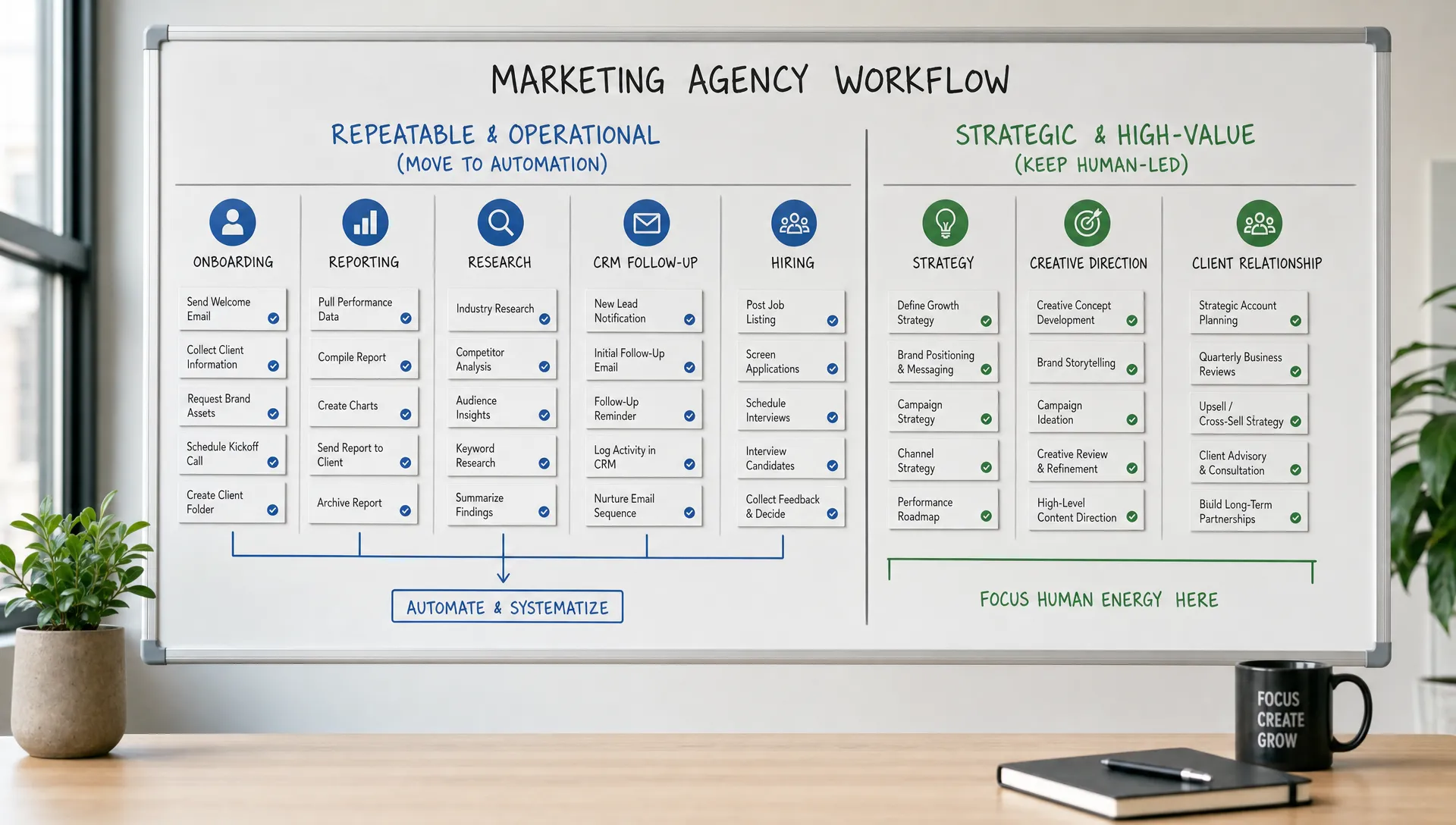
A hire pays off when the agency needs more judgment, leadership, relationship management, or specialized expertise. Automation pays off when the agency is asking expensive people to repeat the same steps, move the same data, format the same reports, or chase the same handoffs over and over.
The most common mistake is confusing busyness with capacity shortage. A team can be overloaded because demand has grown, but it can also be overloaded because the operating system is messy. If handoffs are unclear, inputs are inconsistent, or every deliverable requires a custom scramble, adding a person may only give the chaos one more place to go.
That is why marketing agency hiring should start with a workflow diagnosis, not a job description. Before you open a role, ask what work is actually blocking throughput.
| Bottleneck you feel | What it often means | Better first move |
|---|---|---|
| Senior people are doing repetitive setup work | Delivery ops are under-systemized | Automate and standardize |
| Clients need better strategic guidance | There is a judgment gap | Hire or promote senior talent |
| Reports are late every month | Data assembly and QA are manual | Automate reporting workflow |
| New clients take too long to activate | Onboarding inputs are inconsistent | Standardize, then automate intake |
| Account managers are chasing tasks | Handoffs and ownership are unclear | Fix the operating system first |
| Sales opportunities are going cold | Follow-up and routing are inconsistent | Automate lead routing and alerts |
This is also why a hiring agency can be the wrong fix when the root problem is operational debt. If the work is repetitive and already follows a pattern, your next best hire may not be a person. It may be a system that gives your existing team more leverage.
What a hire really costs an agency
A new employee is not just salary. The true cost includes recruiting time, interviews, onboarding, benefits or contractor management, software seats, management load, ramp time, and the risk of a poor fit.
For agencies, there is another cost that is easy to miss: the new hire often inherits broken workflows. If the workflow is not clear, the person spends their first months learning tribal knowledge, asking senior people for context, and creating their own version of the process. That can help in the short term, but it often creates more variation across delivery.
Hiring pays off when the role creates new value that could not be captured through better systems. For example, a senior account strategist who improves retention, expands accounts, and elevates client conversations can be a strong investment. A growth leader who builds partnerships or improves sales execution may unlock revenue that automation cannot create alone.
For business-critical roles, especially senior GTM, marketing, client services, or executive positions, using a specialist recruitment partner such as Optima Search Europe can make sense because the cost of a wrong hire is usually much higher than the cost of a disciplined search process.
But if the role you are about to hire for is mostly coordination, formatting, copying data, chasing status updates, or compiling inputs, pause. That is often where automation can produce a faster margin impact.
What automation really costs an agency
Automation is not free. It takes process clarity, workflow design, tool configuration, testing, documentation, and ongoing maintenance. A poorly designed automation can create hidden risk, especially if it touches client data, CRM records, reporting, or outbound follow-up.
The difference is that automation cost does not scale the same way payroll does. Once a workflow is reliable, the marginal cost of running it again is often much lower than adding another person to repeat the task.
That makes automation especially attractive for recurring agency operations such as:
- Client onboarding intake and asset collection
- ICP, account, and market research assembly
- CRM updates, lead routing, and follow-up reminders
- Reporting data pulls, formatting, and QA checks
- Content production coordination and briefing workflows
- SOP creation, internal knowledge retrieval, and handoff checklists
The key is not to automate everything. The key is to automate work that is frequent, rules-based, and expensive when done manually. If you are deciding where to begin, the safest starting point is usually delivery operations, not flashy AI content output. This guide on what a marketing agency should automate first explains why onboarding, reporting, research, and follow-up often beat one-off creative experiments.
The margin math: compare payback, not just cost
Hiring and automation should be compared using the same business logic. What is the bottleneck costing you, and how quickly will the fix return that value?
A simple agency payback model looks like this:
Monthly bottleneck cost = hours spent per month x fully loaded hourly cost + rework cost + opportunity cost
Then compare that against the expected cost and time to value of each option.
| Decision factor | Hiring | Automation |
|---|---|---|
| Best for | Judgment, leadership, relationships, creative direction | Repeatable workflows, data movement, formatting, reminders |
| Time to value | Slower if recruiting and ramp are required | Faster if workflow is already understood |
| Scaling behavior | Cost rises with headcount | Cost rises more slowly after setup |
| Management load | Requires coaching, reviews, and context | Requires monitoring, maintenance, and QA |
| Main risk | Bad fit, under-ramp, more process variation | Automating unclear or unstable processes |
| Margin impact | Strong when role drives revenue or retention | Strong when workflow repeats across clients |
Here is a practical example. Suppose a project manager spends five hours per client per month assembling reporting inputs, formatting slides, checking links, and chasing missing commentary. At ten clients, that is fifty hours per month. If the fully loaded cost of that time is $60 per hour, the agency is spending about $3,000 per month before counting delays, rework, or senior review time.
If that reporting workflow can be standardized and partially automated, the agency may recover a large share of those hours without hiring another coordinator. The payoff is not only cost savings. It is fewer deadline scrambles, more consistent client experience, and more room for senior staff to focus on insights instead of assembly.
When marketing agency hiring pays off
Hiring pays off when the constraint is human leverage. If the agency lacks strategic leadership, client trust, creative taste, sales execution, or management capacity, automation may support the work but cannot replace the core role.
A hire is usually the better investment when the work requires accountability for outcomes rather than completion of tasks. For example, an account director is not valuable because they send follow-up emails. They are valuable because they read the room, protect the relationship, steer priorities, and identify expansion opportunities. An experienced strategist is not valuable because they can gather research. They are valuable because they interpret the research and turn it into a market position that wins.
Hiring also makes sense when demand is stable, margins support the role, and the agency has already documented the process the person will inherit. A strong hire placed into a strong system can create compounding value. A strong hire placed into a messy system often becomes an expensive firefighter.
Before you hire, check whether the role will own decisions or simply absorb repetitive work. If the answer is mostly repetitive work, automation should be evaluated first.
When automation pays off faster
Automation pays off faster when the agency has a repeatable delivery motion but the team is still manually pushing work through it. This is common in B2B agencies because client work often looks custom from the outside while the internal workflow is highly repeatable.
For example, every client may have a different ICP, offer, sales cycle, and messaging challenge. But the research workflow may still involve the same steps: collect inputs, summarize calls, review CRM notes, analyze competitors, extract customer language, create briefs, and route findings to strategy or content.
That does not mean AI should make the strategy for you. It means automation can prepare the raw material so your strategists are not spending their best hours copying, cleaning, and organizing inputs.
The same logic applies to reporting. Clients need insight, not manual screenshots. If your team spends most of reporting week gathering numbers and formatting slides, you are spending strategic payroll on clerical production. A more scalable system pulls the data, structures the report, flags anomalies, and leaves humans to explain what matters.
This is the operating principle behind agency marketing systems that protect your margin: standardize the repeatable parts so your people can spend more time on the work clients actually value.
The decision tree for agency owners
Use this sequence before approving a new role or automation project.
First, identify the bottleneck. Is the team waiting on decisions, data, assets, approvals, QA, or client context? Be specific. A vague statement like the team is overloaded is not enough.
Second, separate judgment from repetition. If the work requires taste, negotiation, strategic prioritization, or relationship ownership, you likely need human capacity. If the work follows the same steps every week or month, automation is a candidate.
Third, check process stability. Automation works best when the workflow has clear triggers, inputs, rules, and outputs. If every person runs the process differently, document and standardize before building anything.
Fourth, calculate the payback. Estimate hours saved, errors reduced, cycle time improved, and revenue protected. Do the same for a hire. Compare expected margin impact over the next six to twelve months.
Fifth, decide whether the fix should be managed internally or externally. Some agencies can build and maintain their own automation layer. Others need a partner to install it, document it, and run it so the team does not inherit another tool to manage.
If your goal is to scale marketing without adding headcount, this decision tree should become part of your operating cadence, not a one-time exercise.
Common mistakes that make both options underperform
The first mistake is hiring for symptoms. If account managers are overwhelmed because reporting, onboarding, and CRM updates are manual, adding another account manager may only increase overhead. The better move is to remove low-value work from the account management role.
The second mistake is automating chaos. If the workflow is unclear, automation will make the confusion faster. You need defined inputs, ownership, approvals, and QA before the system can be trusted.
The third mistake is measuring only payroll. A $70,000 role and a workflow automation project are not directly comparable unless you include management time, ramp time, rework, client experience, and margin impact.
The fourth mistake is treating AI as a replacement for standards. Automation should enforce the best version of your process. It should not become a workaround for missing SOPs, unclear client promises, or inconsistent delivery expectations.
A practical sequence: systemize, automate, then hire
For many agencies, the best answer is not hire or automate. It is both, in the right order.
Start by mapping the workflow that creates the most delivery drag. Look for repeatable work across onboarding, research, reporting, lead routing, CRM hygiene, or content operations. Document the current state, including who touches the work, where delays happen, and what quality checks are required.
Next, standardize the workflow. Remove unnecessary steps, clarify ownership, and define the output. This alone often improves capacity because it reduces the amount of interpretation required from the team.
Then automate the repeatable parts. Use automation to collect inputs, move data, generate first-pass summaries, trigger reminders, assemble reports, and route tasks. Keep humans responsible for judgment, QA, client communication, and final decisions.
Finally, hire into the improved system if the bottleneck remains. At that point, the new person ramps faster, produces more consistently, and spends less time reinventing the process. That is when hiring compounds instead of covering up operational debt.
Frequently Asked Questions
Should a marketing agency hire or automate first? Start by diagnosing the bottleneck. If the constraint is repetitive workflow execution, automate first. If the constraint is strategy, leadership, client trust, or sales ownership, hiring is usually the better move.
What agency tasks should not require a new hire? Reporting assembly, onboarding intake, CRM cleanup, lead routing, research collection, status reminders, and first-pass SOP creation are often better candidates for automation than new headcount.
Can automation replace account managers or strategists? Not fully. Automation can remove repetitive admin from those roles, but it should not replace relationship ownership, strategic judgment, client communication, or high-stakes decision-making.
How do I know if automation will actually improve margin? Calculate the hours spent on a workflow each month, multiply by fully loaded cost, then add rework, delays, and opportunity cost. If the workflow is frequent and stable, automation can often produce measurable payback.
Find the margin before you add payroll
Before you open another role, make sure you are solving the right problem. If the agency truly needs senior judgment, hire well. If the team is buried in repeatable delivery work, automation may improve margin faster and give your existing people more room to perform.
Archer Scaling AI helps B2B marketing agencies install and run the AI ops layer behind delivery. The process starts with a paid Margin Teardown: a roadmap and three automation moves, or it is on me. You see the actual system running live before you commit, with documentation and no lock-in approach built into the engagement.