Scale Marketing Without Adding Headcount
Learn how to scale marketing without adding headcount using AI ops, better workflows, automation, and margin-focused agency systems.
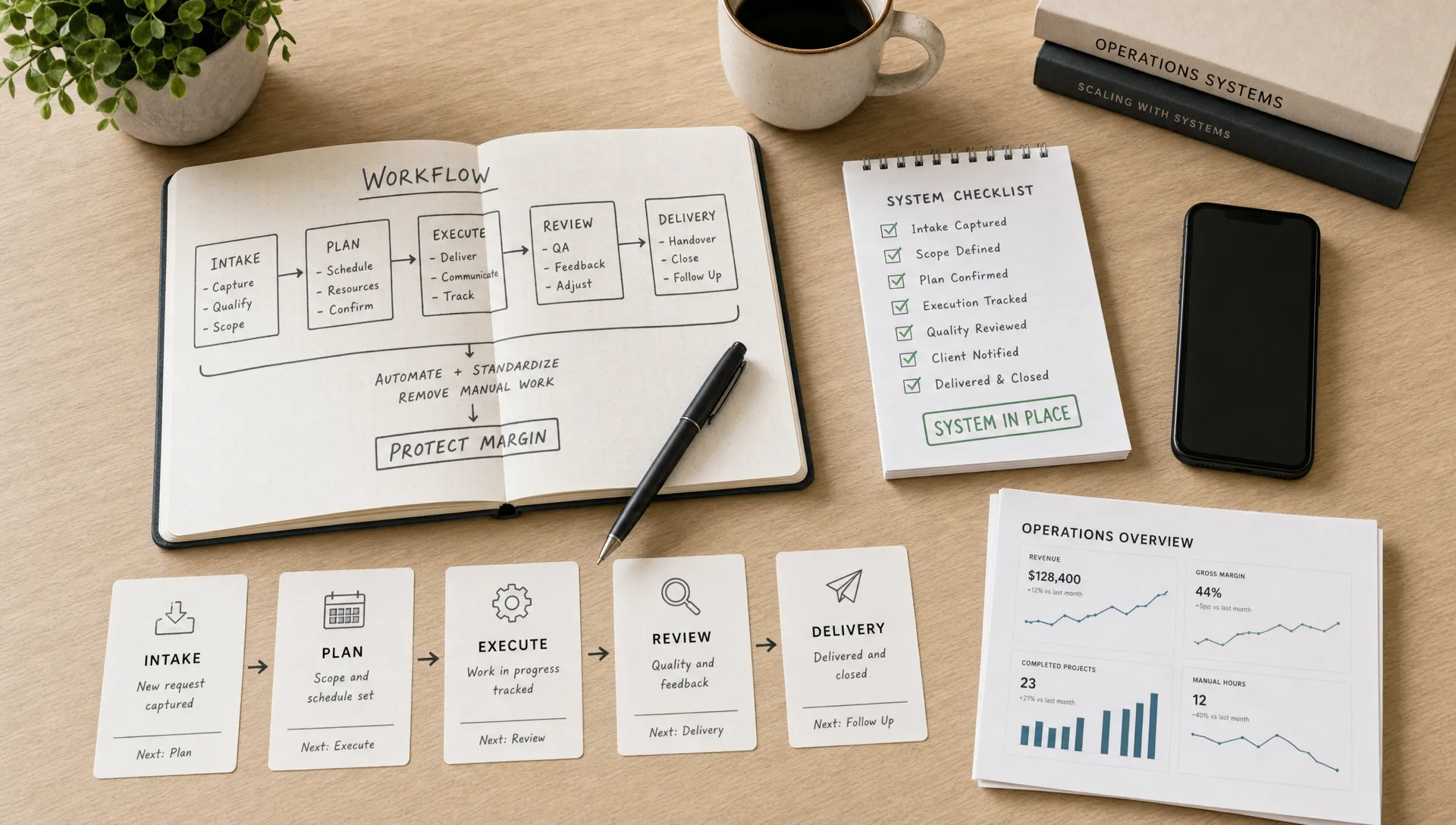
For a B2B marketing agency, growth often creates a trap: every new client brings more meetings, more research, more briefs, more reporting, more follow-up, and more coordination. Revenue goes up, but so does the amount of delivery labor required to keep promises.
That is why “scale marketing” cannot just mean “sell more retainers.” If every new account requires another strategist, account manager, analyst, or copywriter to keep the machine moving, the agency is not really scaling. It is hiring in parallel with revenue.
The better goal is to increase delivery capacity without adding headcount. That does not mean replacing your team with AI. It means removing low-margin work from your team’s week so skilled people spend more time on judgment, strategy, client communication, and creative direction.
In 2026, the agencies that scale profitably will not be the ones with the most AI tools. They will be the ones with the clearest operating system for where AI belongs, where humans review, and how repeatable work moves from request to output without constant manual chasing.
Why headcount is the wrong first lever
Hiring can be the right move when you have a clear bottleneck that requires human expertise. But hiring too early often hides broken operations.
If onboarding is custom every time, hiring another account manager only gives you one more person to manage inconsistency. If reporting takes hours because data is scattered, hiring another analyst only increases reporting cost. If content production stalls because briefs are incomplete, adding another writer only creates more downstream rework.
Before adding headcount, agency leaders should ask a more uncomfortable question: which parts of our delivery model should not require senior human attention in the first place?
Common symptoms of a headcount-dependent agency include:
- Senior team members repeatedly answering the same internal questions
- Account managers rebuilding status updates manually each week
- Strategists doing basic research that could be structured in advance
- Creative work delayed by incomplete briefs or unclear approvals
- Reporting decks assembled by hand from multiple tools
- Client onboarding dependent on one person’s memory
- New hires taking months to understand “how we do things here”
None of these are signs that the agency needs more people immediately. They are signs that the agency needs stronger systems.
The real constraint: delivery throughput
Marketing agencies often think about growth in terms of pipeline, close rate, and average contract value. Those matter, but they are not the only constraints. Delivery throughput is equally important.
Delivery throughput is the amount of client work your team can complete at the required quality level within a given period. If throughput does not increase, growth becomes painful. Your team starts stretching deadlines, clients feel the drag, and margin erodes because more hours are required to deliver the same outcome.
To scale marketing without adding headcount, you need to improve throughput in three ways:
- Standardize the work that should be repeatable: Intake, onboarding, research, reporting, QA, and approvals should not be reinvented for every client.
- Automate the work that is rules-based: Tasks with clear inputs, predictable transformations, and repeatable outputs are strong automation candidates.
- Protect human judgment for high-value decisions: Positioning, strategy, messaging tradeoffs, client nuance, and final creative judgment should remain human-led.
This is where AI operations becomes more useful than random AI experimentation. A chatbot prompt may save someone 10 minutes. A workflow that consistently routes inputs, produces drafts, updates records, flags gaps, and prepares outputs can save hours every week across the team.
Start with margin leaks, not shiny tools
Most agencies make the same mistake when they begin using AI: they start with visible outputs. They ask AI to write posts, generate images, summarize calls, or draft ads.
Those use cases can help, but they are rarely the biggest margin opportunity.
The highest-leverage automations often sit behind the scenes. They live in the work clients do not see, but absolutely pay for: research, coordination, documentation, QA, handoffs, reporting, CRM updates, and follow-up.
A practical way to find margin leaks is to review your delivery workflow and identify tasks that meet at least three of these criteria:
- They happen every week or every client cycle
- They follow a consistent process
- They rely on information already available in your tools
- They are necessary but not strategically differentiated
- They are often delayed because no one owns them clearly
- They create downstream problems when completed poorly
This is also why automation priority matters. If you want a deeper starting framework, Archer Scaling AI has a useful breakdown of what a marketing agency should automate first before moving into more complex AI workflows.
What to automate when you want to scale marketing
The right automation roadmap depends on your agency model, services, tools, and client mix. Still, several workflows consistently create leverage for B2B marketing teams.
| Workflow | Why it slows scaling | What AI ops can improve |
|---|---|---|
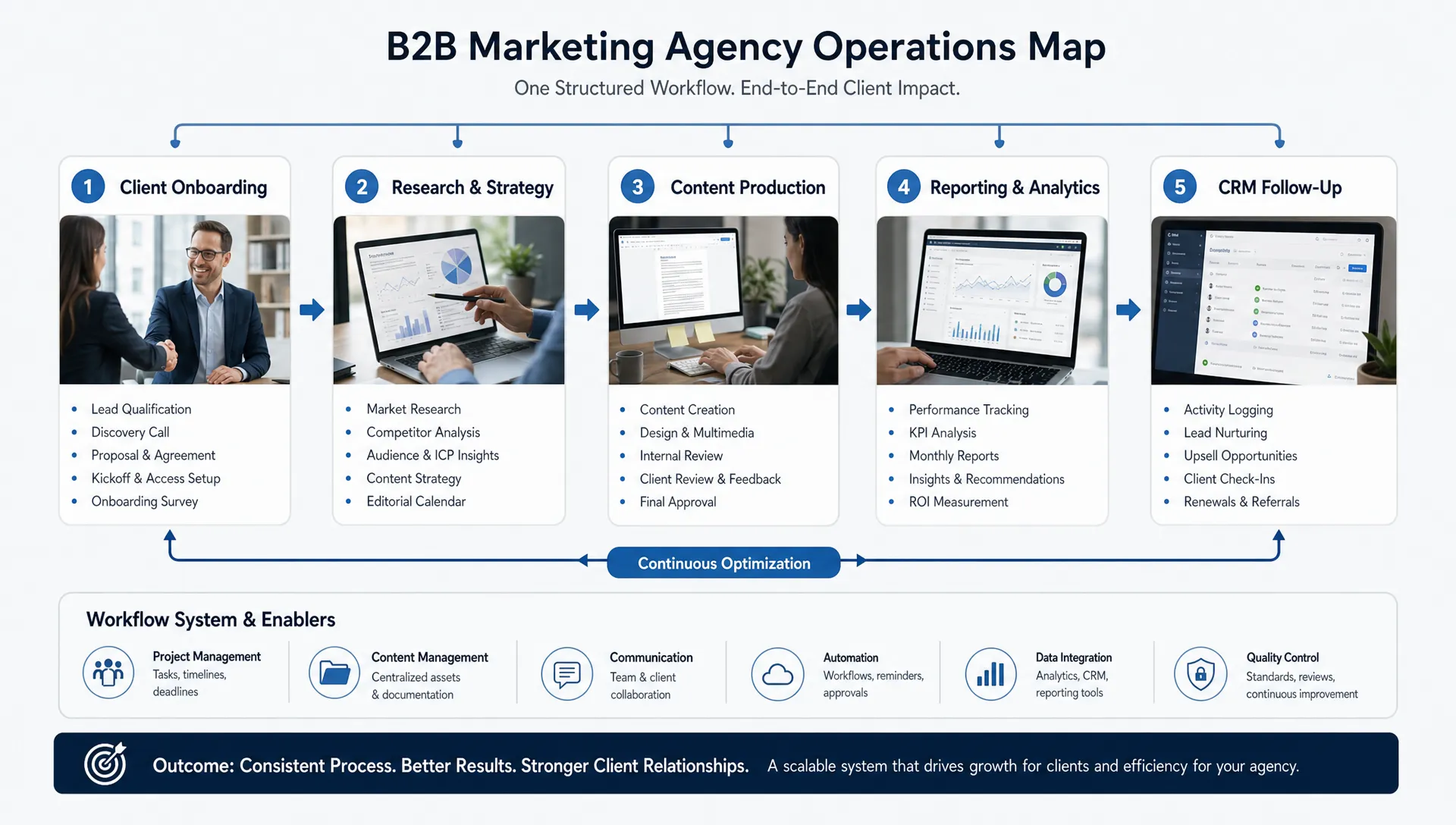
| Client onboarding | Repeated intake, missing access, unclear handoffs | Structured intake, task routing, onboarding checklists, document generation |
| ICP and account research | Strategists spend hours gathering baseline context | Research briefs, account summaries, competitor snapshots, source organization |
| Content operations | Briefs, drafts, reviews, and approvals get scattered | Brief templates, draft routing, revision tracking, QA prompts |
| Reporting | Manual screenshots, spreadsheet updates, narrative writing | Data pulls, insight summaries, anomaly flags, first-draft commentary |
| CRM hygiene | Leads and tasks fall through gaps | Field updates, lead routing, follow-up triggers, status checks |
| SOP documentation | Process knowledge stays inside senior employees’ heads | SOP drafts, workflow capture, training docs, role-based instructions |
The pattern is simple: do not automate chaos. First clarify the workflow, then add AI where it reduces friction.
For example, automating content production before improving briefs often increases rework. Automating reporting before defining what clients actually need to know creates faster noise. Automating CRM follow-up before cleaning lifecycle stages can create embarrassing handoffs.
Scaling comes from better operating design, not from sprinkling AI over broken processes.
Build an AI ops layer, not another tool pile
Many agencies already have too many tools. Adding more AI apps can make work feel faster locally while making operations worse globally.
A writer uses one AI assistant. The strategist uses another. The account manager summarizes calls somewhere else. Reporting lives in a dashboard. CRM tasks live in a separate system. The result is fragmented output, inconsistent quality, and no reliable way to know what happened.
An AI ops layer solves a different problem. It connects the workflow across tools, roles, and review points. Instead of asking, “Which AI app should we buy?” the better question is, “How should work move through the agency?”
A strong AI ops layer defines:
- Inputs required before work begins
- Which steps are automated and which require human review
- Where client context is stored and reused
- How outputs are checked for quality
- Which systems are updated automatically
- How exceptions are routed to the right person
- What documentation exists if the agency changes tools or vendors
This matters especially as creative production becomes more AI-assisted. For studios or teams producing at high volume across media formats, a governed creative AI operating system like Virtuall’s Creative AI OS shows how orchestration, approvals, context, and compliance become essential when AI moves from experimentation into production workflows.
For B2B agencies, the same principle applies even if the outputs are strategy decks, campaigns, nurture sequences, and client reports rather than 3D assets or videos. AI needs operating rules.
The human role gets more important, not less
The goal is not to remove humans from agency delivery. The goal is to stop wasting skilled human capacity on repetitive coordination.
When AI ops is implemented well, humans become more focused on the work that actually benefits from experience:
- Interpreting the client’s business context
- Challenging weak assumptions
- Deciding which insights matter
- Adjusting messaging for nuance and positioning
- Handling sensitive client communication
- Approving outputs before they reach the client
- Improving the system based on edge cases
This distinction is important because clients do not pay agencies simply to produce more assets. They pay for progress, clarity, expertise, and confidence. AI can accelerate production, but your agency’s judgment is still the differentiator.
A scalable agency system makes that judgment easier to apply consistently.
A practical 30-day plan to increase capacity
You do not need a year-long transformation project to begin. A focused 30-day effort can reveal where AI ops will create the most leverage.
Week 1: Map the delivery workflow
Choose one core service line, such as paid media management, SEO content, lifecycle marketing, or CRM implementation. Map the work from signed contract to recurring delivery.
Capture each handoff, recurring task, approval point, and system update. Do not overcomplicate this. The goal is to see where work slows down, where information gets lost, and where senior people repeatedly intervene.
Week 2: Identify repeatable inputs and outputs
For each major step, define the inputs required and the expected output. For example, a content brief may require ICP notes, offer details, search intent, product positioning, competitor angles, and internal links. A monthly report may require performance data, campaign changes, client goals, anomalies, and recommended next actions.
This step often exposes the real bottleneck. Many agencies do not have a production problem. They have an input quality problem.
Week 3: Automate one margin-heavy workflow
Pick one workflow that is frequent, painful, and measurable. Avoid starting with a complex end-to-end system. Instead, build one automation that removes a recurring burden.
Good first candidates include onboarding task creation, research brief generation, weekly reporting summaries, CRM follow-up routing, or SOP drafting from recorded process walkthroughs.
If you want to compare these opportunities, Archer Scaling AI’s article on AI in marketing agency workflows outlines several practical areas where automation can protect delivery margin.
Week 4: Add review, documentation, and measurement
Automation without review creates risk. Automation without documentation creates dependency. Automation without measurement becomes a novelty.
By the end of the first month, define who reviews AI-assisted outputs, where the workflow is documented, what happens when the automation fails, and which metric will prove the system is working.
Useful metrics include hours saved per client, cycle time reduction, number of manual handoffs removed, reporting turnaround time, onboarding completion time, and rework rate.
What not to automate too early
Some workflows should wait until your operations are more mature. If the work is highly ambiguous, politically sensitive, or dependent on strategic tradeoffs, AI can assist but should not own the process.
Be careful with automating:
- Final client strategy recommendations without senior review
- Sensitive client emails during conflict or renewal discussions
- Complex positioning decisions based on incomplete market context
- Budget allocation changes without clear guardrails
- Creative approvals where brand risk is high
The more visible or consequential the output, the more important your review layer becomes. This does not mean you should avoid AI in these areas. It means AI should prepare, summarize, check, and accelerate, while humans decide.
How to know if your agency is ready
You are ready to scale marketing through AI ops if your agency has repeatable services, recurring delivery workflows, and a clear need to protect margin. You do not need perfect documentation. In fact, creating documentation is often part of the process.
You may not be ready if every client engagement is entirely bespoke, your service offering changes every month, or no one can agree on what “good” delivery looks like. In that case, the first step is standardization, not automation.
A good rule of thumb: if a capable team member can explain the process in 20 minutes, it can probably be documented, improved, and partially automated. If the process only exists as intuition inside one person’s head, start by extracting that knowledge.
For more on the systems side of profitable agency growth, see this guide to agency marketing systems that protect your margin.
The strategic payoff: capacity without complexity
Scaling without headcount is not about forcing your team to do more with less. That usually leads to burnout and declining quality.
The real goal is to create capacity without adding operational complexity. When onboarding is standardized, research is accelerated, reporting is assisted, CRM updates happen reliably, and SOPs stay current, your team can handle more work without feeling like every new client adds another layer of chaos.
This is also how agencies become more resilient. New hires ramp faster because the system explains the work. Senior people spend less time rescuing broken processes. Clients get more consistent communication. Leaders gain visibility into where delivery is smooth and where it is still too manual.
That is what it actually means to scale marketing in a margin-conscious agency: not more people doing more tasks, but better systems producing more consistent outcomes.
Frequently Asked Questions
Can a marketing agency really scale without hiring? Yes, but only to a point. The goal is not to avoid hiring forever. The goal is to increase capacity and margin before hiring, so each new role adds expertise rather than compensating for broken workflows.
What should agencies automate first? Start with repeatable operational workflows such as onboarding, research prep, reporting summaries, CRM updates, and SOP documentation. These areas usually create margin improvement without putting client-facing strategy at unnecessary risk.
Will AI reduce the quality of agency work? AI can reduce quality if it is used without clear inputs, review steps, and standards. When implemented as part of an AI ops layer, it can improve consistency by making briefs, handoffs, checks, and documentation more reliable.
How do you measure whether AI ops is working? Track operational metrics such as hours saved, turnaround time, rework rate, manual handoffs removed, onboarding completion time, and reporting cycle time. The strongest signal is improved delivery margin without a decline in client experience.
Is this only for large agencies? No. Smaller B2B agencies often benefit faster because they feel delivery bottlenecks sooner. A lean team with repeatable workflows can use AI ops to increase capacity before committing to another full-time hire.
Ready to find the margin hiding in your workflows?
If your agency is growing but every new client adds more manual delivery work, the next move may not be another hire. It may be a clearer operating system.
Archer Scaling AI helps B2B marketing agencies install and run AI-powered operations systems across workflows like research, reporting, CRM, onboarding, content ops, and follow-up. The process starts with a paid Margin Teardown that identifies the roadmap and three automation moves, with a risk-reversed offer if the teardown does not produce value.
If you want to see where your agency can scale marketing without adding headcount, start with Archer Scaling AI.