Agency Reporting Mistakes That Hurt Client Trust
Avoid agency reporting mistakes that damage client trust. Learn how to fix messy metrics, vague narratives, late reports, and manual QA gaps.
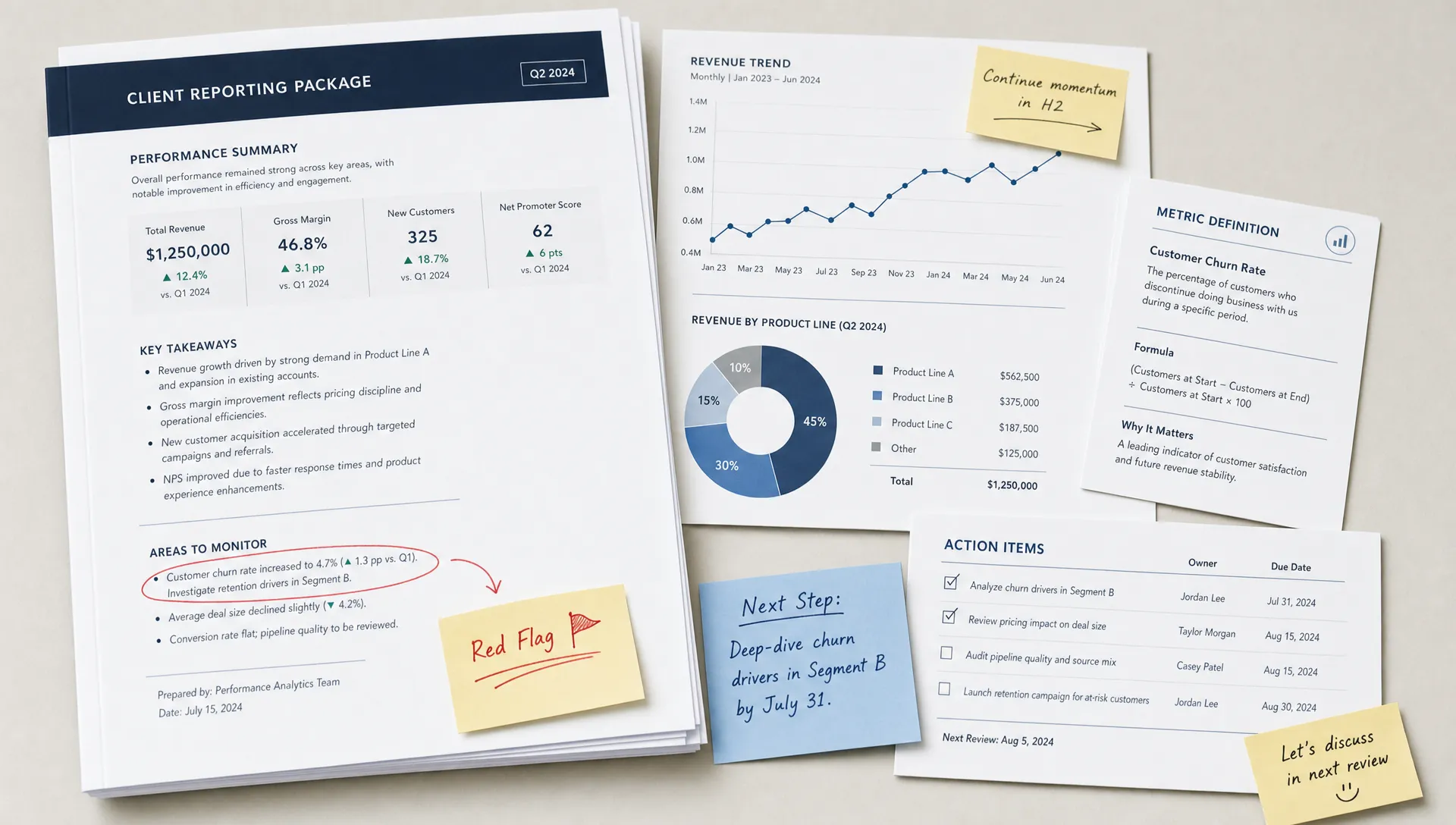
Clients rarely lose trust in an agency because one metric dips for a week. They lose trust when the report makes the agency look reactive, unclear, or careless.
That is why agency reporting is not just a deliverable. It is a trust mechanism. A good report reassures clients that you know what is happening, why it is happening, and what you are doing next. A weak report creates the opposite feeling, even when the underlying work is solid.
For B2B marketing agencies, this matters even more. Your clients often have longer sales cycles, multiple stakeholders, messy CRM data, and leadership teams that judge marketing through pipeline, revenue, and risk. If reporting does not connect activity to decisions, clients start filling the gaps themselves.
Below are the agency reporting mistakes that quietly erode client trust, plus practical ways to fix them without turning reporting into another margin-killing manual process.
1. Reporting activity instead of decisions
The most common reporting mistake is treating the report like a proof-of-work document.
You show impressions, clicks, leads, email sends, landing page visits, ad spend, content published, and meetings booked. Technically, the report is full. Strategically, it may still be empty.
Clients do not hire an agency because they want a monthly archive of tasks. They want better decisions, better execution, and fewer surprises. If the report does not answer “what should we do next?” it forces the client to interpret the data themselves.
A better reporting structure starts with decisions, not dashboards. Before you build or automate anything, define the decision each section is supposed to support.
For example:
| Report section | Weak version | Trust-building version |
|---|---|---|
| Paid media | Spend, clicks, CTR, CPL | Which audiences, offers, and channels should get more or less budget |
| SEO | Rankings and traffic | Which content themes are creating qualified demand and which need revision |
| CRM | Lead volume and source | Which handoff issues are delaying follow-up or misclassifying opportunities |
| Opens and clicks | Which segments are showing buying intent and need sales action | |
| Executive summary | Generic performance recap | What changed, why it matters, and what the agency will do next |
The fix is not to remove data. The fix is to make every metric earn its place.
If you want a deeper framework for turning reporting into a decision document, Archer Scaling AI has a separate guide on building B2B reporting clients actually read.
2. Using inconsistent metric definitions
Nothing damages reporting credibility faster than numbers that do not match.
The client sees 143 leads in the dashboard, 128 in the CRM, 117 in the slide deck, and 96 in the sales team’s spreadsheet. The agency may have valid reasons for the difference, such as date ranges, filters, attribution windows, lifecycle stages, deduplication, or form spam removal. But if those definitions are not documented, the client reads inconsistency as sloppiness.
This is especially dangerous in B2B reporting because metrics often cross systems. A single lead journey may touch ad platforms, analytics tools, enrichment tools, marketing automation, CRM, sales engagement software, and manual sales notes.
To fix it, create a reporting metric dictionary that defines:
- The source of truth for each metric
- The exact filter logic used
- The reporting date range and time zone
- The difference between raw leads, qualified leads, meetings, opportunities, and pipeline
- Which numbers are directional and which are board-ready
You do not need a 40-page governance document. A clear one-page metric dictionary can prevent hours of confusion. It also protects your team when a client asks, “Why does this number not match HubSpot?” or “Why is Google Ads showing more conversions than the report?”
This is one of the reasons Archer recommends standardizing metric definitions before adding automation. Automation accelerates whatever system you already have. If the definitions are messy, automation makes the mess faster.
3. Hiding bad news until the client notices
Clients can usually handle bad news. They struggle with late bad news.
If performance drops and the report buries it on slide 17, trust takes a hit. If the client spots the issue before the agency raises it, trust takes a bigger hit. The client starts wondering what else is being softened, delayed, or omitted.
The mistake is not underperformance itself. Every strategy has tests that fail. The mistake is making the client feel like the agency is managing perception instead of managing performance.
A trust-building report names the problem early and frames it professionally:
- What changed?
- When did it change?
- How big is the impact?
- What are the likely causes?
- What has already been checked?
- What action will be taken next?
- When will the next readout happen?
This approach shows control. It also shifts the conversation from blame to response.
For example, instead of writing “LinkedIn performance declined this month,” write: “LinkedIn demo request CPL increased 38 percent month over month, mainly due to reduced conversion rate on the enterprise landing page. Spend has been capped while we test the shorter form and adjust audience exclusions. We will review early results on Friday before scaling budget again.”
That kind of reporting does not hide the issue. It proves the agency is awake.
4. Sending reports too late to be useful
A late report is not just an operational problem. It changes how the client experiences your agency.
If the month ends and the report arrives two weeks later, the client is already in a new planning cycle. Sales has moved on. Leadership has asked questions. Budgets may already be adjusted. Your report becomes a historical artifact instead of a management tool.
Late reporting usually comes from hidden manual work:
- Copying data between tools
- Rebuilding slides from scratch
- Waiting for account managers to write commentary
- Chasing specialists for channel updates
- Manually checking screenshots, charts, and formulas
- Customizing every client report in a different format
The client does not see those internal bottlenecks. They only see delay.
The fix is to separate reporting into three layers: data collection, analysis, and narrative. Data collection should be standardized and automated where possible. Analysis should follow a repeatable review checklist. Narrative should be tailored, but not reinvented every reporting cycle.
This is where agency operations directly affect client trust. The better your reporting system, the more consistently your team can show up with clear insight while the information still matters.
5. Letting dashboards replace interpretation
Dashboards are useful. They are not the same as reporting.
A dashboard tells the client what happened. A report explains what it means. When agencies send dashboards with minimal commentary, clients often experience it as abdication. They may think, “Why are we paying an agency if we have to interpret this ourselves?”
This is a common problem when agencies overcorrect toward automation. They connect tools, build live dashboards, and assume transparency has been solved. But transparency without interpretation can create more anxiety, not less.
A strong reporting cadence can include dashboards, but it should also include written analysis. The client needs context, especially when metrics conflict.
For example, a lower lead volume may be good if lead quality improved. A higher CPL may be acceptable if opportunity conversion increased. A traffic decline may not matter if unqualified traffic was intentionally reduced.
Dashboards cannot reliably make those judgment calls. Your agency has to.

6. Reporting vanity metrics to revenue-focused stakeholders
Different stakeholders read reports through different lenses.
A marketing manager may care about campaign diagnostics. A VP of Sales may care about opportunity quality and follow-up speed. A CEO may care about pipeline, forecast confidence, and strategic risk. If every stakeholder receives the same report, at least one audience is probably underserved.
The most damaging version of this mistake is over-reporting vanity metrics to executives. Impressions, followers, clicks, and open rates may have diagnostic value, but they rarely build executive confidence on their own.
For B2B clients, executive reporting should usually elevate metrics such as:
- Qualified opportunity creation
- Pipeline influenced or sourced
- Sales cycle movement
- Cost per qualified opportunity
- Conversion by segment or channel
- Lead to meeting speed
- Campaign learnings tied to budget decisions
This does not mean every report should pretend marketing controls revenue alone. It means your agency should connect marketing activity to the commercial system the client actually manages.
Expansion accounts are a good example. If your agency supports brands entering new regions or channels, reporting should not flatten market context into generic campaign metrics. A platform like EcoVelos' AI-powered global expansion system can help teams ground international expansion reporting in market readiness, opportunity scoring, channel selection, and partner-matching context rather than unsupported assumptions.
The larger point is simple: report in the language of the decision-maker.
7. Failing to explain assumptions and limitations
Clients do not expect perfect data. They do expect intellectual honesty.
B2B attribution is rarely clean. Buying committees are complex. CRM hygiene varies. Offline conversations matter. Sales teams forget to update fields. Dark social and word of mouth influence demand. Privacy changes affect tracking. Platform attribution often overclaims impact.
When agencies present reporting with false precision, trust becomes fragile. The client may accept the numbers for a while, but once an inconsistency appears, the entire reporting system can be questioned.
A more trustworthy approach is to clearly label assumptions and limitations. For example:
| Reporting area | Assumption or limitation to disclose |
|---|---|
| Paid attribution | Platform conversions may include view-through or modeled conversions depending on settings |
| CRM pipeline | Opportunity source depends on sales team field completion and lifecycle stage accuracy |
| Website analytics | Consent settings and cookie restrictions may reduce observed sessions or conversions |
| Content performance | Organic impact may lag publication by several months |
| Multi-touch influence | Reports show directional contribution, not perfect causality |
This does not weaken your authority. It strengthens it. Sophisticated clients know data has constraints. They trust agencies that explain those constraints before using the numbers to make recommendations.
8. Making every report too custom
Custom reporting feels client-centric at first. Over time, it can become an operational trap.
One client gets a slide deck. Another gets a spreadsheet. Another wants a Notion page. Another wants a live dashboard plus a Loom-style walkthrough. Every account manager writes commentary differently. Every specialist formats channel updates differently. Every client has unique naming conventions.
The agency believes it is being flexible. The team experiences chaos. QA becomes harder. Reports take longer. New hires take months to learn client-specific quirks. Eventually, mistakes slip through.
This is one of the quiet ways reporting hurts margin and trust at the same time.
The better model is standardized core, customized edge. The core report structure should be consistent across clients: executive summary, performance against goals, channel analysis, pipeline impact, risks, decisions, and next actions. Customization should happen where it genuinely improves decision-making, not because every account started from a blank page.
For agencies trying to protect delivery margin, reporting should be treated as part of the operating system, not as a heroic monthly sprint. That same principle applies across onboarding, research, content ops, CRM workflows, and QA, which is why Archer frames reporting as one piece of broader agency marketing systems that protect margin.
9. Skipping QA because the team is busy
Reporting errors are small moments with large consequences.
A mislabeled chart, wrong date range, broken formula, duplicated lead count, or outdated screenshot may look minor internally. To the client, it raises a bigger question: “If this is wrong, what else is wrong?”
Busy agencies often rely on the account manager to catch everything at the end. That is risky. The person closest to the client relationship is not always the best final QA layer, especially when they are also writing commentary, preparing for the call, and managing client requests.
A reliable reporting QA process should check at least four things:
- Data accuracy: numbers match the agreed source of truth and date range
- Narrative accuracy: commentary reflects the data and does not overstate causality
- Client context: recommendations match the client’s current goals, constraints, and priorities
- Presentation quality: charts, labels, screenshots, and formatting are clean and current
This is a perfect candidate for partial automation. AI and workflow automation can flag missing sections, inconsistent naming, unexpected metric changes, broken links, and incomplete commentary. Humans should still own judgment, but they should not have to manually hunt for every preventable error.
10. Ending with observations instead of ownership
A report that ends with “performance was mixed” or “we will continue monitoring” does not create confidence.
Clients want to know who owns the next move. If the report does not clarify actions, owners, and timing, the meeting after the report becomes a debate instead of a decision point.
A strong close should include:
- The agency’s recommended next steps
- What the client needs to approve or provide
- What will be paused, continued, or scaled
- What will be reviewed before the next report
- Who owns each action
This is where reporting becomes an operating rhythm. The report should not be the end of the month’s work. It should be the bridge into the next cycle of execution.
A simple trust audit for your next client report
Before your next report goes out, ask these questions:
| Trust question | If the answer is no, fix this first |
|---|---|
| Can a client understand the main takeaway in five minutes? | Rewrite the executive summary around decisions and implications |
| Do all key metrics have documented definitions? | Create or update the metric dictionary |
| Are negative trends clearly explained? | Add cause analysis, action taken, and next review date |
| Does the report match the client’s commercial priorities? | Remove low-value vanity metrics and elevate business outcomes |
| Has the report passed QA before the account lead reviews it? | Add a separate accuracy and formatting checklist |
| Does every recommendation have an owner and timeline? | Turn observations into assigned next steps |
This audit is intentionally simple. The goal is not to create more reporting bureaucracy. The goal is to remove the trust leaks that make clients question good work.
How AI ops improves agency reporting without removing human judgment
The best use of AI in agency reporting is not to generate generic commentary. Clients can spot vague AI summaries quickly, and they do not build confidence.
The better use is operational. AI ops can help agencies standardize inputs, detect anomalies, draft first-pass commentary from structured data, check reports against QA rules, summarize channel updates, and route follow-up tasks after client reviews.
That gives account managers and strategists more time for the work clients actually value: interpretation, prioritization, and strategic judgment.
For example, an AI-enabled reporting workflow might pull approved metrics from the right source, compare results against targets, flag unusual changes, draft a structured summary, check for missing explanations, and create follow-up tasks in the CRM or project management system. The human team then reviews the analysis, adds client context, and owns the recommendation.
That combination is powerful because it improves both margin and trust. The agency spends less time assembling reports and more time making them useful.
Frequently Asked Questions
What is the biggest agency reporting mistake? The biggest mistake is reporting data without explaining what it means or what should happen next. Clients do not just need metrics. They need interpretation, decisions, and clear ownership.
How often should a B2B agency send client reports? Most B2B agencies need a monthly strategic report, supported by weekly or biweekly performance check-ins for active campaigns. The right cadence depends on spend, sales cycle length, and how quickly decisions need to be made.
Should agency reporting be automated? Parts of it should be automated, especially data collection, formatting, anomaly detection, and QA checks. Strategic interpretation should still involve human review because client context, risk, and prioritization require judgment.
How can agencies make reports feel more trustworthy? Use consistent metric definitions, disclose assumptions, explain negative trends early, connect results to business outcomes, and end with specific next steps. Trust comes from clarity and consistency, not from making every number look positive.
Why do clients stop reading agency reports? Clients stop reading reports when they are too long, too tactical, too late, or disconnected from business decisions. If a report does not help a stakeholder act, it becomes background noise.
Turn reporting into a trust-building operating system
If client reporting is eating margin, arriving late, or creating avoidable trust issues, the problem is usually operational rather than strategic.
Archer Scaling AI helps B2B marketing agencies install and run the AI ops layer behind delivery workflows, including reporting, CRM, onboarding, research, and content operations. The process starts with a paid Margin Teardown that identifies the roadmap and the first automation moves before a build or managed automation retainer begins.
If your agency wants clearer reporting, fewer manual QA gaps, and stronger client confidence without adding another hire, start by reviewing the operational system behind the report, not just the report itself.