Marketing Agency Client Onboarding That Actually Scales
Build marketing agency client onboarding that scales with cleaner handoffs, automation, QA gates, and fewer margin-killing kickoff delays.
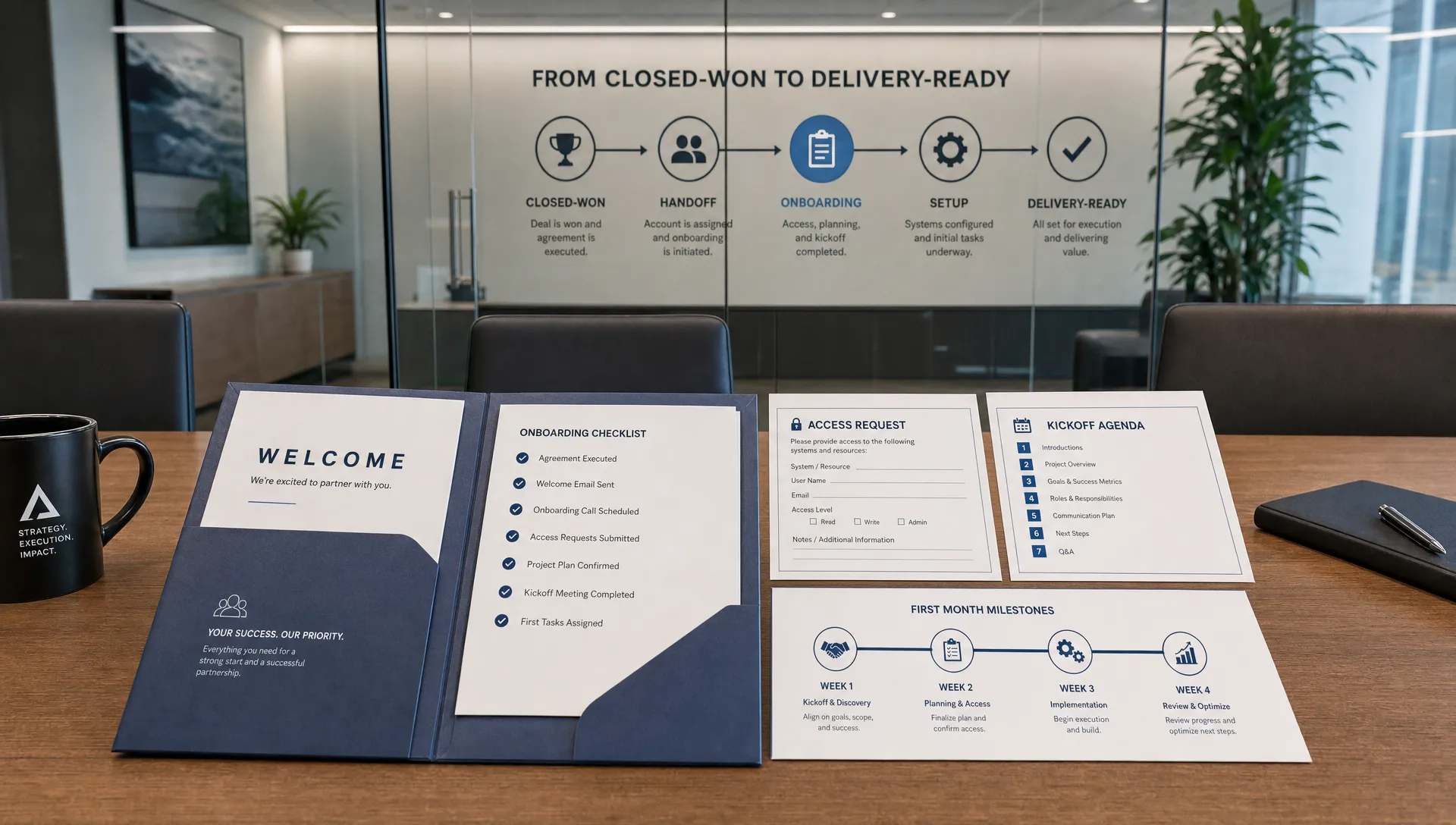
Most agencies do not lose margin because the team is lazy or the clients are unreasonable. They lose it in the handoff between “closed won” and “ready to deliver.” That is where vague promises, missing assets, unclear owners, and rushed kickoff calls quietly turn a profitable account into a custom rescue mission.
Scalable marketing agency client onboarding is not a prettier welcome email. It is an operating system for turning a new client into a properly briefed, fully equipped, delivery-ready account without requiring senior people to chase details manually.
The goal is simple: every new client should experience a high-touch start, while your internal team follows a repeatable path that protects scope, quality, and margin.
Why Agency Onboarding Breaks as You Grow
When an agency is small, onboarding often works because the founder or a senior strategist fills the gaps. They remember what was promised in sales. They know which questions to ask. They notice when the client has not shared access. They translate vague intake answers into useful direction.
That approach feels efficient at first because it relies on experience rather than process. But it does not scale. As more clients come in, the same senior people become bottlenecks. New account managers ask the same questions repeatedly. Creative teams start work with partial information. Reporting expectations get set too late. The first month becomes a blur of “just checking in” emails.
The warning signs are usually obvious:
- Kickoff calls feel different depending on who runs them.
- Clients are asked for the same information more than once.
- Work begins before positioning, ICP, offers, access, or approval paths are clear.
- Delivery teams discover sales promises after the account is already active.
- The first report requires manual context gathering because tracking was not set up early.
If that sounds familiar, the fix is not simply hiring another account manager. Before you add people, it is worth asking whether the process itself can absorb more volume. That is the same logic behind building systems that let agencies scale marketing without adding headcount: remove repeatable drag before assuming capacity is a staffing problem.
What Scalable Client Onboarding Actually Means
Scalable onboarding does not mean treating every client the same. It means standardizing the path while personalizing the substance.
A B2B SaaS demand generation client will not need the same context as a rebrand project, a paid media account, or an ABM pilot. But each engagement still needs a clear transfer from sales, clean asset collection, documented strategy inputs, access control, expectation setting, delivery kickoff, and reporting baseline.
The scalable part is the sequence, the ownership, and the quality gates. The personalized part is what your team does with the information.
A strong onboarding system answers five questions before delivery begins:
| Question | Why it matters | Common failure when ignored |
|---|---|---|
| What exactly did we sell? | Prevents scope drift from day one | Delivery inherits unclear or inflated expectations |
| What do we need from the client? | Reduces delays and follow-up loops | Work stalls while teams wait for access or assets |
| What strategic context must be captured? | Improves quality of first deliverables | Teams produce generic work based on assumptions |
| Who approves what? | Protects timelines and reduces revision loops | Feedback arrives late or from the wrong stakeholder |
| How will success be measured? | Aligns delivery with retention from the start | Reporting becomes reactive instead of strategic |
This is where onboarding becomes a margin tool, not just a client experience tool.
The Six-Part Onboarding System Every Growing Agency Needs
A scalable onboarding process should be designed as a connected system, not a collection of templates. Each part should hand clean information to the next step.
1. The Sales-to-Delivery Transfer
The most important onboarding step happens before the client ever sees a welcome email.
A sales-to-delivery transfer captures what was promised, why the client bought, what objections came up, what outcomes matter, who holds budget power, and what risks are already visible. Without this step, your delivery team starts from the contract, not the buying context.
At minimum, the transfer should document:
- Commercial terms, package, scope, start date, and renewal or review points.
- Client goals, current pain, urgency, and internal success criteria.
- Key stakeholders, decision-makers, influencers, and blockers.
- Promises made during sales, including timelines, deliverables, and strategic assumptions.
- Red flags, constraints, sensitive topics, and dependencies.
This should not live in someone’s memory, Slack thread, or call recording alone. It should be structured in your CRM, project management tool, or onboarding workspace so the account team can use it immediately.
2. The Client Intake Layer
Most intake forms are either too shallow or too exhausting. A shallow form creates follow-up work. An exhausting form makes the client delay completion.
The solution is progressive intake. Ask for the essentials first, then collect deeper inputs based on service line or engagement type.
For example, a paid media account needs ad account access, conversion tracking details, budget constraints, offer information, audience exclusions, and historical performance. A brand or go-to-market engagement needs positioning history, customer research, competitive context, voice guidelines, buyer objections, and launch goals. Look at how a challenger-brand growth agency frames brand, web, app, and GTM work, and it is clear why the first intake layer must capture strategic context, not just logos and login details.
The intake layer should also separate “required to start” from “useful later.” If everything is marked urgent, nothing is.
3. Access and Asset Collection
Access collection is one of the easiest parts of onboarding to standardize, yet it is often one of the messiest.
Every agency should have a service-specific access checklist. Not a generic “send us your logins” email, but a precise guide that tells the client what to share, why it is needed, who needs access, and what permission level is appropriate.
For B2B marketing agencies, this may include CRM access, analytics, ad platforms, CMS, marketing automation, call tracking, sales enablement tools, content libraries, brand assets, product documentation, and historical reports.
The best systems also track status automatically. Instead of account managers manually checking whether HubSpot, Google Analytics, LinkedIn Ads, and shared drive access have arrived, the onboarding workspace should show what is complete, what is missing, who owns it, and when the next reminder goes out.
4. The Strategy Packet
The strategy packet is the bridge between intake and execution. It turns scattered information into a usable brief for the team.
This is where AI can help, but only if the source inputs are clean. A good AI-assisted onboarding workflow can summarize sales calls, extract buyer pain points, cluster ICP notes, identify missing context, and create a first-pass internal brief. A strategist should still review the output, correct assumptions, and add judgment.
The strategy packet should give delivery teams enough context to start intelligently. It may include the client’s positioning, ICP, offers, funnel stage, sales cycle, competitors, channel history, content themes, approval structure, risks, and first 30-day priorities.
This prevents the classic agency problem where the kickoff call sounds strategic, but the execution team still starts with a blank page.
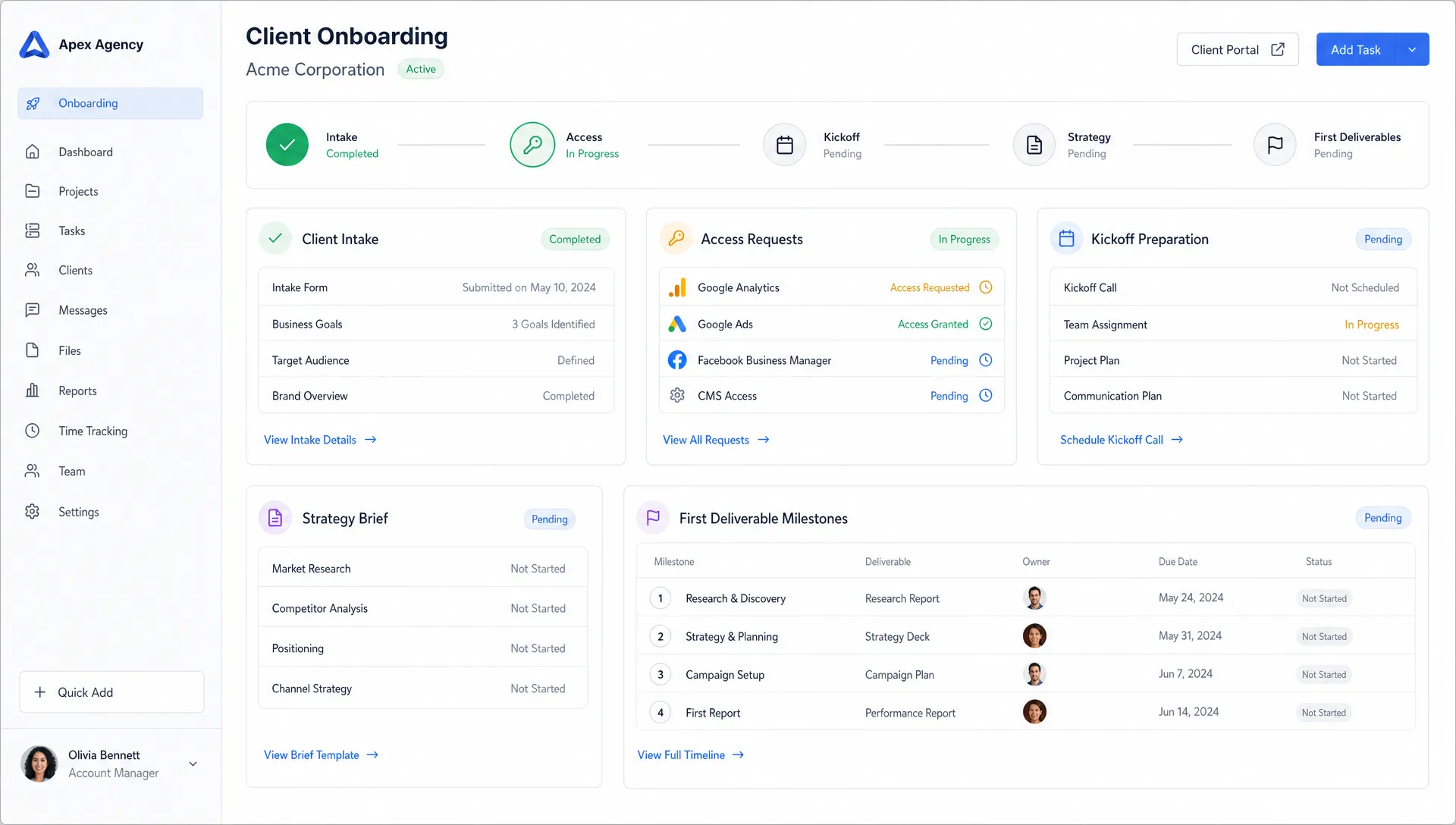
5. The Kickoff Call That Confirms, Not Discovers
A kickoff call should not be the first time your team learns the basics. It should confirm alignment, clarify nuance, and create confidence.
If the call is spent asking for company background, target audience, login details, and “what are your goals,” your onboarding system has already failed. Those inputs should be collected and synthesized before the meeting.
A scalable kickoff agenda usually covers:
- Why the client hired you and what success looks like.
- What your team understood from sales, intake, and research.
- What will happen in the first 30 days.
- What you need from the client and when.
- How approvals, communication, and reporting will work.
- What risks or dependencies could affect timeline.
The client should leave thinking, “They already understand us.” Your team should leave with fewer unknowns, not more.
6. The First Deliverable and Reporting Baseline
Onboarding is not finished when the kickoff call ends. It is finished when the first deliverable can be produced without avoidable confusion and the reporting baseline is in place.
This matters because the first month shapes trust. If the first deliverable is late, off-brief, or hard to approve, the client begins the relationship with doubt. If reporting is not set up until the end of the month, your team scrambles to explain work instead of showing progress.
A scalable process defines the first meaningful deliverable by service line. That could be an audit, campaign plan, messaging map, analytics baseline, creative direction, SEO roadmap, paid media restructure, or content calendar. The key is that your team knows what “ready to produce” means before the account begins.
Reporting should also be part of onboarding. If reporting is already a bottleneck in your agency, fix the definitions and workflow before automating the dashboard. This is the same principle covered in the guide to fixing marketing agency reporting bottlenecks: reporting gets easier when inputs, ownership, QA, and metric definitions are standardized first.
What to Automate in Marketing Agency Client Onboarding
Automation should not replace client trust. It should remove the repetitive coordination work that makes trust harder to deliver consistently.
Good onboarding automation handles reminders, routing, summaries, checklists, status updates, and structured handoffs. Humans should still own judgment, relationship nuance, strategic decisions, and expectation management.
Here is a practical way to separate the two:
| Onboarding activity | Automate? | Human ownership |
|---|---|---|
| Welcome email and next-step sequence | Yes | Account lead approves tone and timing |
| Intake form routing by service type | Yes | Ops owns form logic and field quality |
| Access request reminders | Yes | Account lead escalates sensitive delays |
| Sales call summary into internal brief | Partially | Strategist validates conclusions |
| Kickoff agenda creation | Partially | Account lead adjusts for client context |
| Risk flag detection from intake gaps | Partially | Senior operator decides action |
| Scope clarification | No | Commercial or account lead owns it |
| Strategic recommendation | No | Strategist owns judgment |
The biggest mistake is automating a broken process. If your team cannot describe the onboarding path clearly, AI will only help you create confusion faster.
A better starting point is to choose the highest-friction workflow and standardize it first. For many agencies, onboarding is the right first target because it affects delivery, reporting, retention, and capacity. If you are deciding where AI should enter the business, this breakdown of what a marketing agency should automate first gives a useful prioritization lens.
The Scalable Onboarding Workflow: A 30-Day Model
Every agency will need to adjust timing based on its service model, but the structure below works well for B2B marketing teams that need a repeatable first-month operating rhythm.
Days 0 to 2: Internal Alignment
The deal is marked closed, the sales-to-delivery brief is completed, the onboarding workspace is created, and the account owner is assigned. The team reviews scope, risks, stakeholders, and the client’s reason for buying.
No client-facing kickoff should be scheduled until internal alignment is complete. Otherwise, your team is performing confidence instead of operating with it.
Days 2 to 5: Client Welcome and Intake
The client receives a clear welcome sequence with the onboarding timeline, intake link, access checklist, kickoff scheduling link, and communication expectations.
This is also where automated reminders help. They should be polite, specific, and tied to progress. “Please complete the form” is weaker than “We still need CRM access and your top three sales objections before we can finalize the kickoff brief.”
Days 5 to 10: Strategy Brief and Access QA
Your team reviews intake responses, checks access, identifies missing information, and creates the internal strategy packet. AI can assist with summarization and gap detection, but a human should approve the final brief.
This stage is where many agencies should add a QA gate. If required inputs are missing, the account should not silently move forward. The system should flag the gap and assign an owner.
Days 10 to 14: Kickoff and Confirmation
The kickoff call confirms what your team has learned, aligns expectations, and locks in the first 30-day plan. The meeting should produce decisions, not just notes.
After the call, the client receives a concise recap with next steps, owners, dates, and dependencies. Internally, the onboarding workspace updates automatically so delivery can begin from the latest confirmed context.
Days 14 to 30: First Deliverable and Operating Cadence
The agency produces the first meaningful deliverable, sets the reporting baseline, confirms approval flows, and establishes the recurring meeting or async update cadence.
By the end of day 30, the account should have a clear operating rhythm. If your team is still chasing basics at that point, onboarding is not done.
Metrics That Show Whether Onboarding Is Scaling
You cannot improve onboarding if you only measure whether the client “seemed happy.” Client sentiment matters, but operational metrics reveal where margin is leaking.
Track a small set of numbers consistently:
| Metric | What it tells you |
|---|---|
| Time from closed-won to kickoff | How quickly the account enters structured motion |
| Time from kickoff to first deliverable | Whether onboarding enables delivery or delays it |
| Intake completion rate | Whether clients understand and finish required steps |
| Access completion time | How much coordination drag exists before work begins |
| Number of clarification loops | Whether intake and briefs are specific enough |
| First deliverable revision rate | Whether the team started with the right context |
| Onboarding hours per client | Whether process cost is rising with volume |
The most important metric is onboarding hours per client. If revenue is growing but onboarding hours rise at the same pace, you have not created leverage. You have created a busier version of the same agency.
Scalable onboarding should reduce avoidable coordination while improving client confidence. That is the margin win.
Common Mistakes That Keep Onboarding Manual
The first mistake is confusing documentation with operations. A checklist in a Google Doc is useful, but it is not a system unless it triggers action, assigns ownership, and shows status.
The second mistake is treating every delay as a client problem. Sometimes clients are slow. Often, they are confused. If your intake asks for “brand assets” without specifying file types, locations, examples, and why they matter, expect delays.
The third mistake is letting sales promise one process while delivery runs another. If the buyer was sold a fast strategic sprint but delivery starts with a three-week discovery process, trust erodes immediately.
The fourth mistake is automating before cleaning inputs. AI can summarize a call, draft a brief, and create next steps, but it cannot reliably fix contradictory scope, missing access, or unclear ownership without human review.
The fifth mistake is failing to define exceptions. Not every client will fit the system perfectly. That is fine. But exceptions should be visible and intentional, not hidden in account manager heroics.
How to Make Onboarding Feel Personal Without Making It Custom
Clients do not need a custom process. They need a process that clearly understands their situation.
The difference is important. Custom process means your team reinvents steps for every client. Personalized experience means the same system adapts based on what the client bought, what risks are present, and what context matters.
You can make onboarding feel personal by referencing the sales conversation, tailoring the kickoff agenda, pre-filling known information, asking smarter follow-up questions, and showing the client what you have already understood.
For example, instead of sending a blank intake form that asks, “Who is your target audience?” you might preface it with, “Based on our sales conversations, we understand your primary audience is Series A to C SaaS founders and marketing leaders. Please confirm or refine the segments below.”
That small shift tells the client you listened. It also reduces their workload.
The Role of AI Ops in Scalable Onboarding
AI ops is not about sprinkling AI into random tasks. It is about designing the operational layer that lets your agency deliver more consistently with the same team.
In onboarding, that layer can connect CRM fields, sales notes, intake forms, asset requests, internal briefs, project setup, kickoff preparation, and reporting baselines. The value is not the tool itself. The value is the reduction of handoff loss.
For a B2B marketing agency, a well-built AI ops layer can help:
- Turn sales notes and call transcripts into structured delivery briefs.
- Route clients into the correct onboarding path based on service line.
- Flag missing access, assets, or strategic inputs before kickoff.
- Draft kickoff agendas and recap emails from approved templates.
- Create first-pass research summaries for strategist review.
- Keep onboarding status visible across account, ops, and delivery teams.
The agency still needs human judgment. AI should make the team sharper, not invisible.
Frequently Asked Questions
What is marketing agency client onboarding? Marketing agency client onboarding is the structured process that moves a new client from signed agreement to delivery-ready account. It usually includes internal handoff, client intake, access collection, kickoff, strategy briefing, first deliverable planning, and reporting setup.
How long should agency client onboarding take? For many B2B marketing agencies, the core onboarding process should take 10 to 14 days, with the first meaningful deliverable completed within the first 30 days. Complex engagements may need longer, but delays should come from real strategic complexity, not missing access or unclear ownership.
What should be automated in client onboarding? Automate repeatable coordination tasks such as welcome sequences, intake routing, access reminders, checklist updates, brief drafting, and status notifications. Keep humans responsible for strategy, scope clarification, client nuance, and relationship management.
How do you make onboarding scalable without making it feel generic? Standardize the workflow, then personalize the content. Use the same operational path for handoffs, intake, access, kickoff, and QA, but tailor the questions, examples, and recommendations to the client’s service line, market, and goals.
Why does onboarding affect agency margin? Onboarding affects margin because poor handoffs create rework, delays, extra meetings, revision loops, and senior-team intervention. A clean onboarding system reduces non-billable coordination and helps delivery teams start with better information.
Build an Onboarding System That Protects Margin
If every new client still requires manual chasing, repeated questions, and senior-level rescue work, your onboarding process is not scaling. It may be functional, but it is expensive.
Archer Scaling AI helps B2B marketing agencies install and run AI-powered operations systems for workflows like client onboarding, reporting, CRM, research, and content ops. The starting point is a paid Margin Teardown: a practical roadmap and three automation moves, risk-reversed.
If you want to see where onboarding is leaking delivery margin, start with Archer Scaling AI and review the actual system before you commit.