When a Closed-Loop Agency Model Creates Delivery Drag
A closed loop agency can protect margin or create delivery drag. Learn where loops break and how to reduce handoffs, rework and admin.

Your agency probably likes closed loops because they protect quality: intake informs strategy, performance informs the next round of work and client feedback makes the service better. The trouble starts when closing the loop means chasing notes, cleaning fields, rewriting reports and reminding the same people again.
At $50K to $500K a month, that drag rarely shows up as one obvious failure. It shows up as thinner margin while everyone looks busy.
A closed loop agency model is supposed to reduce guesswork
A closed loop agency model means the agency does not treat strategy, delivery, reporting and follow-up as disconnected work. What you learn in one stage feeds the next stage.
That is the right idea. A paid media shop should use last month’s performance notes to shape the next testing plan. A content agency should feed search findings, editorial feedback and publishing friction back into the next brief. A PR firm should turn pitch response, client approvals and media notes into a better outreach rhythm.
The model becomes expensive when the loop depends on memory.
If the account lead has to remember what sales promised, the strategist has to dig through call recordings, the delivery team has to ask for access again and the founder has to interpret every report before it goes out, the loop is technically closed but operationally heavy. The information moved, but it moved through people instead of through a repeatable system.
A healthy closed loop should reduce repeat questions. A dragging one creates more of them.
Delivery drag begins when every loop needs a human push
Most agencies do not feel delivery drag during the obvious production work. They feel it in the push work around production: nudging clients for assets, moving notes from Slack into a task, checking whether the CRM was updated, asking who owns the next step and rebuilding context before a meeting.
The agency may have good tools. That is not enough. The issue is usually the gap between tools, rules and handoffs.
Other service businesses run into the same pressure when work, clients, contracts, teams and payments all touch each other. For example, an all-in-one platform for event professionals is useful because the event details, client portal, team coordination and payments belong in one operating flow. Agencies often try to recreate that same kind of closed loop across Slack, ClickUp, Asana, HubSpot, Google Drive, Looker Studio, spreadsheets, email and meetings.
That can work if someone owns the operating layer. Without it, each added client adds another set of manual pushes.
The painful part is that none of those pushes look wasteful in isolation. A quick Slack reminder seems fine. Copying notes into a brief takes a few minutes. Fixing a report label feels normal. But across active retainers, those small handoffs become the hidden tax on growth.
The drag is usually between artifacts, not inside them
Agencies usually have artifacts: kickoff forms, creative briefs, research docs, reporting decks, client notes, SOPs and task templates. Delivery drag happens when those artifacts do not hand off cleanly.
A brief may exist, but the production team does not trust it. A report may exist, but the next month’s task queue does not reflect the findings. A client request may exist in Slack, but the project board never gets updated. A CRM note may exist, but nobody knows whether follow-up happened.
Use this table as a quick diagnostic:
| Closed loop | Common drag signal | Cleaner operating move |
|---|---|---|
| Sales to onboarding | Delivery asks questions sales already answered | Turn call notes into a structured kickoff packet |
| Onboarding to production | Work waits on access, assets or unclear scope | Use an access checklist with one owner per missing item |
| Delivery to reporting | Report week becomes a scramble | Separate data assembly, analysis and QA |
| Reporting to next cycle | Insights do not change the next work queue | Add a decision log tied to the production board |
| Client requests to fulfillment | Requests disappear between Slack, email and meetings | Capture every request in one status routine |
This is where agency economics get affected. A senior person does not lose margin only by doing low-value work. They lose margin when they repeatedly rebuild context that should have traveled with the work.
Reporting exposes a broken loop faster than almost anything else
Reporting is supposed to close the loop. The client sees what happened, the agency explains what matters and the team decides what changes next.
In a dragging agency, reporting becomes a monthly reset. People hunt for screenshots, argue over metric definitions, clean messy exports, chase notes from specialists and rewrite the narrative late in the cycle. The report gets delivered, but the loop does not really close because the insight never becomes a clean next action.
If reporting consumes the people who should be interpreting the work, the loop is too manual. The fix usually starts with deciding which metrics belong in each service line, which fields are allowed to change, who writes the narrative and what has to be checked before the report reaches the client. If this is the loudest pain in your shop, the deeper breakdown is often the same one covered in fixing marketing agency reporting bottlenecks: the agency has mixed data collection, analysis, QA and client communication into one stressful motion.
Closed-loop reporting should create fewer open loops after the meeting. If every report creates a new pile of vague follow-ups, the reporting process is acting like a client service ritual instead of an operating system.
Intake decides whether the loop starts clean
A closed loop starts breaking before delivery ever begins. If intake is loose, every downstream workflow becomes custom.
This is why the sales-to-delivery handoff matters so much. The delivery team needs to know what was promised, what the client cares about, which constraints are real, what access is still missing and where the first risks sit. When that context lives in a call recording, a salesperson’s memory or scattered notes, your team starts the relationship by excavating.
A scalable client onboarding system does not need to be complicated. It needs to turn the sale into usable delivery inputs. That means a clear intake form, a kickoff packet, an access tracker, a research brief and a visible owner for every missing item.
AI can help here when the workflow has rules. It can summarize sales calls, extract open questions, draft a market research brief and compare the intake packet against your required access list. But it cannot decide what “ready for strategy” means unless your agency has defined that state first.
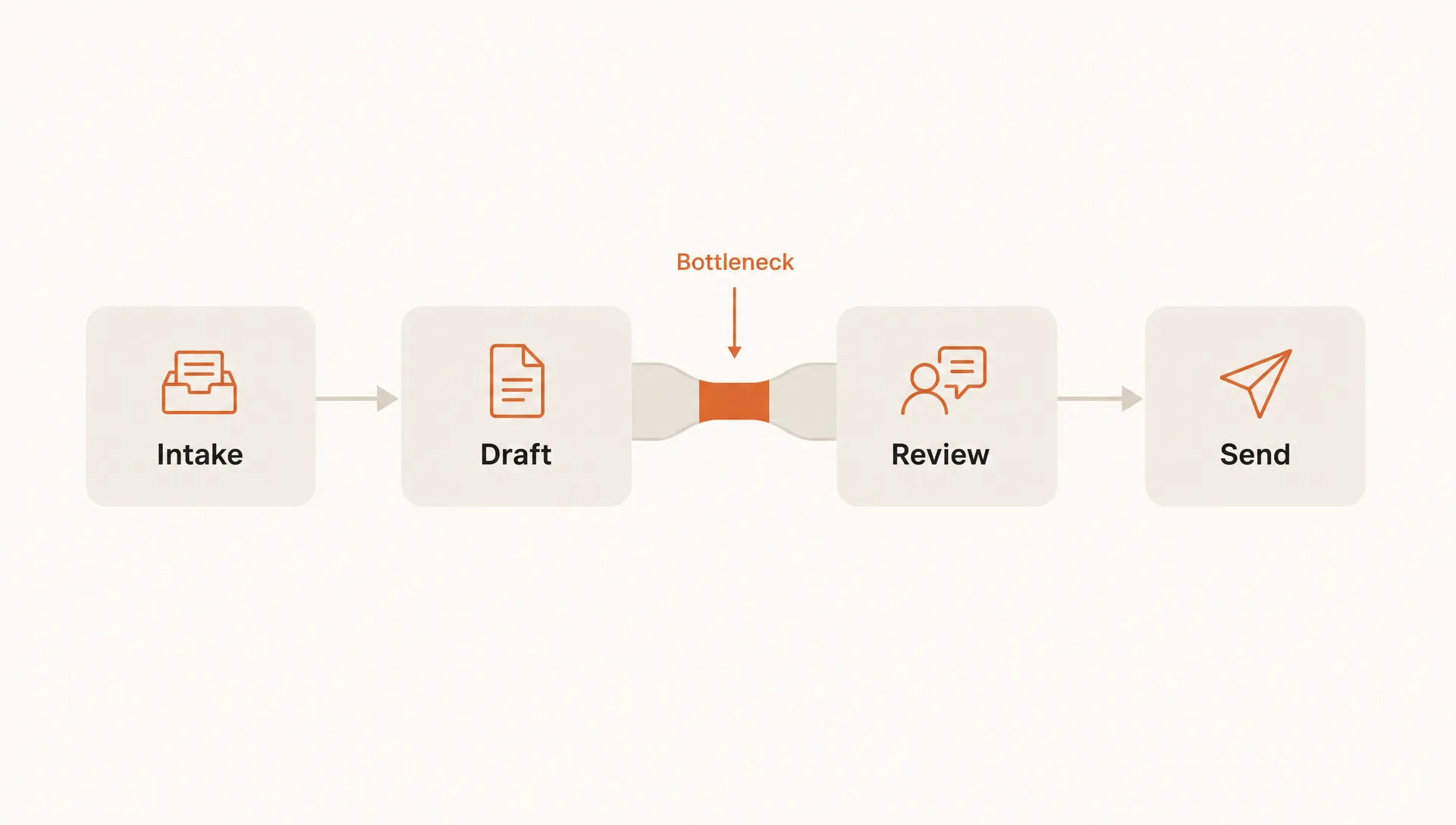
AI helps when the agency has rules, not just tools
Most agency owners have already tried a few tools. A strategist used one for first drafts. An account lead used one to summarize a call. Someone made a prompt library that nobody visits anymore. The tool was not useless, but it did not stick because it was never wired into the way work moves.
A chat window can create a draft, but it cannot protect margin if nobody decides where the draft goes, what source material is allowed, who approves it and how the result updates the task record.
The useful use cases are usually small and specific:
- Turn a sales call transcript into an onboarding brief
- Compare a client intake form against a required access checklist
- Convert meeting notes into tasks with owners and due dates
- Draft a reporting narrative from approved metric notes
- Flag unanswered client requests sitting in email or Slack
- Turn a finished process into a plain-language SOP
These mechanisms reduce push work. They do not replace judgment, client taste, channel expertise or senior decision-making.
They also need a QA gate. If every AI-generated draft needs a senior person to rewrite it from scratch, you have not reduced drag. You have created another review queue. The goal is not to produce more material. The goal is to move approved context to the next step with less manual handling.
A healthy closed loop has fewer meetings, not more feedback
Agencies sometimes respond to delivery drag by adding meetings: more internal standups, more client check-ins, more retros, more status calls. Some meetings help. Many become loop theater.
If the only way to close the loop is to get everyone in a room and retell the story, the system is too dependent on narration. The work should carry enough context that meetings can focus on judgment, tradeoffs and decisions.
A closed-loop workflow should answer basic questions without a meeting. What was requested? Who owns it? What is blocked? What changed after the report? Which approval is missing? What is ready for production? What is ready for the client?
That does not mean every agency needs a giant operations rebuild. It means each loop needs a few clear parts: a trigger, a required input, an owner, an output, a QA check and a next action. If any of those are missing, people fill the gap with meetings, messages and memory.
Use a drag map before you add headcount
When delivery starts feeling heavy, hiring can look like the responsible move. Sometimes it is. If client volume truly exceeds capacity and the work requires human judgment, you may need another person.
But if the pain is repeated questions, unclear ownership, messy handoffs, late reporting, weak intake or admin scattered across tools, hiring can hide the problem without fixing it. That is the same pattern behind many cases where a marketing hiring agency is the wrong fix: the agency treats operational debt like a staffing shortage.
Before you hire, draw a drag map for one recent client and one recent reporting cycle.
Start with the first sales promise and follow the work all the way to the next client-facing deliverable. Mark every point where someone waited, copied information, asked a repeat question, corrected data, rewrote a document, chased an approval or clarified ownership. Do not judge the people involved. You are looking for friction in the loop.
Then choose one friction point that repeats across clients. That is where systemizing pays first. Not the fanciest automation. Not the most impressive demo. The repeatable drag point.
Frequently asked questions
What is a closed loop agency model? A closed loop agency model is an operating model where information from intake, delivery, reporting and client feedback feeds the next round of work. The goal is to reduce guesswork and make each cycle smarter than the last.
Why can a closed loop agency create delivery drag? It creates drag when the loop depends on manual updates, meetings, memory and repeated handoffs. The agency may have feedback, but if people have to push every piece of context forward, the model becomes expensive to run.
Can AI fix closed-loop agency operations? AI can help with bounded, repeatable tasks like summarizing calls, drafting briefs, checking intake completeness, preparing report narratives and turning notes into tasks. It works best when the agency already has clear rules, owners and QA steps.
Should an agency hire or systemize first? If the work requires more expert judgment than your current team can provide, hiring may be right. If the pain comes from repeated admin, unclear handoffs, scattered context and rework, systemizing the loop should usually come first.
What to do this week
Pick one loop that is costing attention right now. For most agencies, the best starting point is onboarding, reporting or client request follow-up because those workflows touch clients and internal delivery at the same time.
Write down the trigger, input, owner, output, QA check and next action for that loop. If you cannot name one of those parts, you have found a source of drag. Then remove one manual push. That might mean turning sales call notes into a kickoff packet, adding a missing-access owner, standardizing report notes before report week or routing client requests into one visible queue.
Do this whether you build internally or bring in outside help. Tool selection comes after the loop is clear.
If you want help from someone who builds the operating layer instead of handing your team more homework, Archer Scaling AI installs and runs AI ops systems for marketing agencies. You can book a free 30-minute intro call to talk through where delivery drag is showing up in your agency. It is a conversation about your operations, not a sales call.