When a Marketing Hiring Agency Is the Wrong Fix
Before using a marketing hiring agency, learn when your agency needs ops, automation, and margin repair instead of another hire.
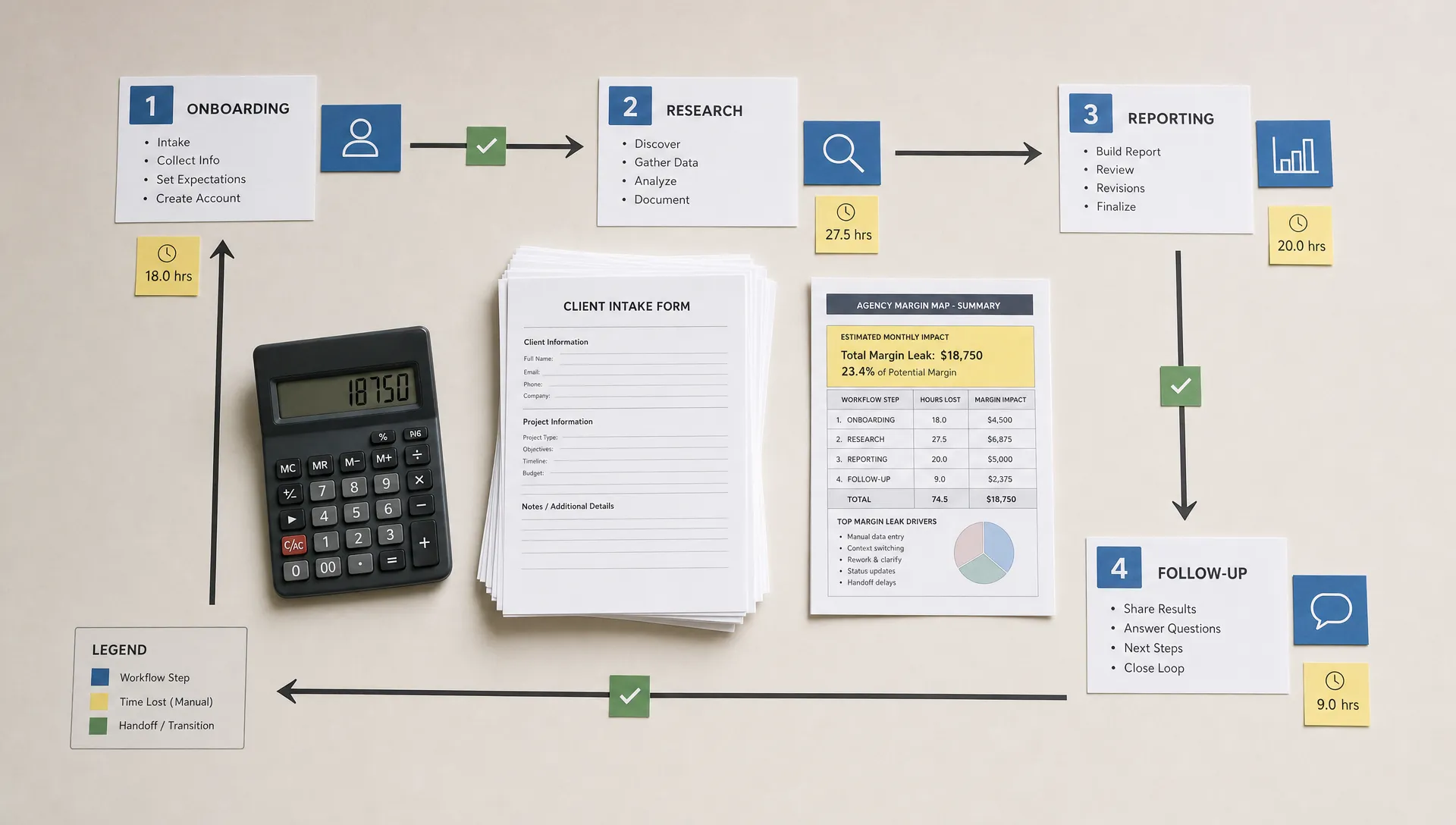
A marketing hiring agency can be useful when you have a clear role, a real capacity gap, and a delivery system that already works. But if your B2B agency is drowning in manual reporting, messy handoffs, custom onboarding, and senior people doing junior work, recruiting is often the expensive way to preserve the problem.
The hard part is that both situations feel the same from the owner’s seat. Clients are waiting. Account managers are overloaded. Strategists are stuck in Slack threads. A new hire seems like the obvious move.
Sometimes it is. Often, it is not.
The question is not, “Do we need more people?” The better question is, “Are we missing talent, or are we leaking margin through work that should not require another person?”
What a marketing hiring agency can actually fix
A marketing hiring agency helps you find people. That is valuable when the constraint is talent access, role definition, or recruiting bandwidth.
For example, a hiring partner can help when you need a demand generation lead with deep LinkedIn Ads experience, a senior strategist who can own enterprise accounts, or a marketing operations specialist who has already managed HubSpot or Salesforce complexity. If the role is clearly defined and the work is worth a full-time human, recruitment makes sense.
But a marketing hiring agency cannot fix the operating system underneath your delivery. It cannot make inconsistent client onboarding consistent. It cannot turn scattered research into reusable inputs. It cannot make reporting profitable if every monthly update still requires manual data pulls, screenshots, formatting, and account manager interpretation.
Hiring adds capacity. Systems increase throughput. If your agency’s problem is throughput, another salary may only give you a larger version of the same margin problem.
The mistake: treating operational debt like a headcount gap
Agency owners usually reach for hiring when they see symptoms like late deliverables, quality misses, team burnout, or clients asking for updates that should already be visible. Those symptoms are real, but they do not always point to a hiring problem.
A headcount gap sounds like this: “We have a defined service, a repeatable workflow, strong demand, and one role is truly over capacity.”
Operational debt sounds like this: “Every client is different, every report takes too long, every strategist has their own process, and nobody knows where the latest version lives.”
The second problem gets worse with hiring. New people inherit the chaos, then add their own workarounds. Within a few months, you have more meetings, more coordination, more QA, and more management load. The team feels bigger, but the delivery margin does not improve.
If that sounds familiar, the better first step may be to scale marketing without adding headcount by removing manual work before you expand the team.
Signs a marketing hiring agency is the wrong fix
Use the table below as a quick diagnostic. If several of these sound familiar, the next move should probably be systems work, automation, or process redesign before recruiting.
| Symptom inside the agency | Why hiring will not fix it | Better first move |
|---|---|---|
| Every client onboarding starts from scratch | A new hire will still need to collect the same inputs manually | Standardize intake, access requests, kickoff notes, and next steps |
| Monthly reporting consumes account manager time | More people will create more reports, not better leverage | Automate data collection, summary drafts, and QA checks |
| Senior strategists are doing research cleanup | The wrong work is sitting with the most expensive people | Build research workflows that hand strategists clean inputs |
| Client updates live across Slack, docs, CRM, and email | A new hire adds another person to the coordination web | Create a single source of truth and clear handoff rules |
| QA depends on one founder or senior operator | Hiring adds more work to review | Turn quality standards into checklists, examples, and review gates |
| The role description is a pile of leftover tasks | You are hiring around mess, not for a real seat | Split tasks into automate, delegate, eliminate, and hire |
| Delivery varies by account manager | The client experience depends on personality, not system design | Standardize repeatable client-facing moments |
The most dangerous line in agency hiring is, “We just need someone to take things off everyone’s plate.” That usually means the plate has not been sorted.
Before you pay a recruiter to find that person, identify which tasks should disappear, which should be automated, which should be delegated to an existing role, and which truly require a new hire.
The margin math behind the decision
Hiring feels productive because it is visible. You can open a role, interview candidates, and imagine the relief. Operations work feels less obvious because the payoff comes from time saved across dozens of recurring actions.
But margin is usually won in those recurring actions.
Consider the difference between these two problems:
| Problem | Hiring response | Ops response |
|---|---|---|
| A strategist spends 8 hours per client preparing research | Hire another strategist | Automate research collection and synthesis so strategists review instead of assemble |
| Account managers rebuild reports every month | Hire a reporting coordinator | Automate report inputs and create a standard narrative framework |
| Creative briefs are inconsistent | Hire a creative project manager | Standardize briefing inputs and approval gates |
| Leads sit too long before follow-up | Hire a sales assistant | Automate routing, reminders, enrichment, and first follow-up tasks |
The hiring response may help for a while. The ops response changes the economics of the work.
A new employee also creates hidden load. Someone has to onboard them, answer questions, review work, clarify expectations, and manage performance. If your internal systems are already weak, your best people will spend more time supporting the hire than reclaiming leverage from the hire.
That does not mean you should avoid hiring. It means you should avoid hiring into a delivery machine that is already leaking.
The role-definition test
Before you contact a marketing hiring agency, write the role as if the person starts tomorrow. Then answer these questions honestly.
- Can you define the role’s weekly outputs without using vague phrases like “support the team” or “own growth”?
- Can you show the person examples of good work, bad work, and acceptable work?
- Do you have a documented onboarding path for the first 30 days?
- Will the person spend most of their time doing judgment-heavy work, or mostly moving information between tools?
- Can you measure whether the hire improves margin, client outcomes, or delivery speed?
- Is there a manager with enough time to coach and review them properly?
If you cannot answer these, you may not have a role yet. You may have a bundle of operational friction that needs to be unpacked.
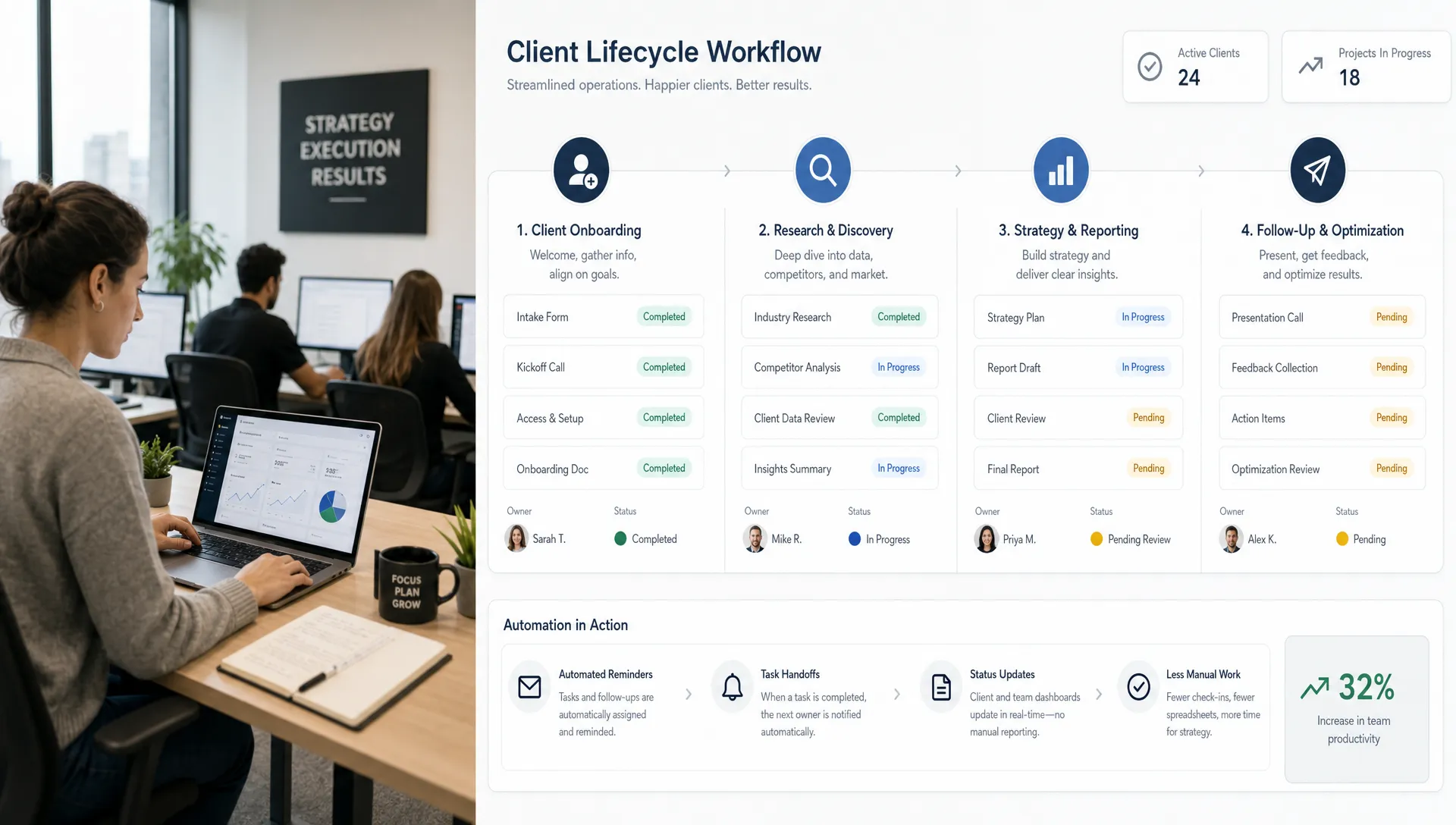
What to fix before you hire
The best pre-hiring work is not a six-month transformation. It is a focused pass at the workflows that create the most drag.
Start with client onboarding. If every kickoff requires custom emails, manual access chasing, scattered intake forms, and repeated questions, fix that before adding another account manager. A clean onboarding system shortens time to value and reduces early client anxiety.
Next, look at research. B2B agencies often burn hours gathering ICP details, competitor notes, sales call insights, review mining, and content examples. Humans should interpret the research, but they should not have to assemble the same raw material from scratch every time.
Then inspect reporting. Reporting is one of the most common margin traps because it looks strategic from the outside but contains a lot of repetitive assembly. Data pulls, screenshot collection, formatting, variance checks, and first-draft summaries are all candidates for automation or tighter workflow design.
Finally, review content and creative operations. If your team is using AI to produce more drafts, the bottleneck often moves to quality control. Quality risk is also why hiring a “humanizer” is rarely the right fix. The market now includes tools and prompt resources such as AI rewriting and detector-workaround libraries, but agency owners should solve the underlying governance problem: originality, client voice, substantiation, and editorial review.
If you are not sure where to begin, a practical starting point is to identify what a marketing agency should automate first instead of trying to automate everything at once.
When a marketing hiring agency does make sense
A marketing hiring agency is not the villain. It is simply the wrong tool when the real problem is delivery design.
Recruiting makes sense when the work is strategic, specialized, or relationship-driven enough that automation cannot replace the role. It also makes sense when your existing systems are strong and the business case for added capacity is clear.
Good reasons to use a marketing hiring agency include hiring for a specialized channel lead, replacing a senior operator, building a leadership layer, adding client strategy capacity, or filling a role where judgment matters more than task movement.
The key is sequencing. Build enough operational clarity that the new person steps into leverage, not ambiguity.
A healthy hiring brief should include:
- The business constraint the role solves
- The core outputs the role owns
- The tools and systems the person will use
- The decisions they can make without approval
- The metrics that define success after 30, 60, and 90 days
- The workflows that are already documented or automated
If the brief mostly describes firefighting, coordination, and catching up, pause the search.
A simple decision framework
Here is a cleaner way to decide whether to call a hiring firm or fix operations first.
| If this is true | Your next move |
|---|---|
| Demand is growing, delivery is standardized, and one role is clearly maxed out | Hire |
| Work is late because inputs are missing or scattered | Fix intake and handoffs first |
| Senior people are doing repeatable junior tasks | Automate or delegate before hiring |
| Clients need more strategic guidance | Hire or promote for judgment-heavy work |
| Reports, research, and follow-up are eating the week | Build an AI ops layer first |
| Quality is inconsistent across the team | Standardize examples, QA, and review gates before adding volume |
The rule of thumb is simple: hire for judgment, relationships, and specialized expertise. Systemize repetitive movement of information.
When you follow that rule, new hires become more profitable because they spend more time on high-value work. They also ramp faster because the agency can show them how work gets done instead of expecting them to invent the process.
The 30-day pre-hiring plan
Before you sign with a marketing hiring agency, spend 30 days proving whether hiring is the right fix.
- Week 1: Map the work: Choose one overloaded role and track where time goes across onboarding, research, client communication, reporting, QA, and internal coordination.
- Week 2: Remove obvious waste: Eliminate duplicate status updates, unused deliverables, unnecessary approvals, and manual copy-paste work that nobody should own.
- Week 3: Automate one recurring workflow: Pick one workflow with clear inputs and outputs, such as onboarding, reporting prep, lead routing, or research collection.
- Week 4: Rewrite the hiring brief: After the workflow changes, define what work remains and decide whether it still justifies a new role.
This plan does not delay growth. It protects growth from becoming unprofitable.
If the role is still necessary after 30 days, you will have a sharper hiring brief, a cleaner onboarding path, and a better chance of retaining the person. If the role is no longer necessary, you just saved the agency from adding fixed cost to solve a fixable systems problem.
For agencies that want to protect delivery margin long term, the deeper play is building agency marketing systems that protect your margin across the recurring parts of client delivery.
Frequently Asked Questions
Is a marketing hiring agency ever worth it? Yes. A marketing hiring agency is worth it when you have a clear role, a strong business case, and a need for specialized talent you cannot easily source yourself. It is less useful when the real issue is messy delivery operations.
Should agencies automate before hiring? Agencies should automate repetitive, rules-based workflows before hiring for more capacity. This helps ensure new hires focus on strategic work instead of inheriting manual tasks that could have been removed.
What roles should a B2B marketing agency hire for instead of automate? Hire for roles that require judgment, client trust, strategy, creative direction, leadership, or specialized channel expertise. Automate the repetitive movement, formatting, routing, summarizing, and assembly work around those roles.
How do I know if my agency has a hiring problem or an operations problem? If the work is clearly defined and one person is simply over capacity, you may have a hiring problem. If the work is unclear, inconsistent, duplicated, or dependent on manual handoffs, you likely have an operations problem.
Can AI replace agency staff? AI should not be treated as a blanket replacement for agency staff. Its best use is removing repetitive operational work so skilled people can spend more time on strategy, client judgment, creative thinking, and growth.
Before you hire, find the margin leak
A marketing hiring agency can help you find talent. It cannot tell you which parts of your delivery model should not need talent in the first place.
That is the gap Archer Scaling AI is built to solve. I install and run the AI ops layer that helps B2B marketing agencies improve delivery margin without defaulting to another hire. The process starts with a paid Margin Teardown, including a roadmap and three automation moves, or it is on me.
If you are debating whether your next move should be recruiting or operations, start with the system. See what can be automated, standardized, or removed before you add another salary. You can review the approach at Archer Scaling AI.