What an Account Manager in a Marketing Agency Should Own
Clarify what an account manager in a marketing agency should own, from client trust to scope, reporting, renewals, and margin.
In many agencies, the account manager role becomes a catch-all for everything that falls between sales, strategy, delivery, and client service. That is exactly why the role gets overloaded.
A good account manager in a marketing agency should not be the person who remembers every loose thread, rewrites every brief, chases every teammate, explains every delay, and absorbs every client emotion. That version of the role creates burnout, weakens delivery margins, and hides the real operational problems inside the agency.
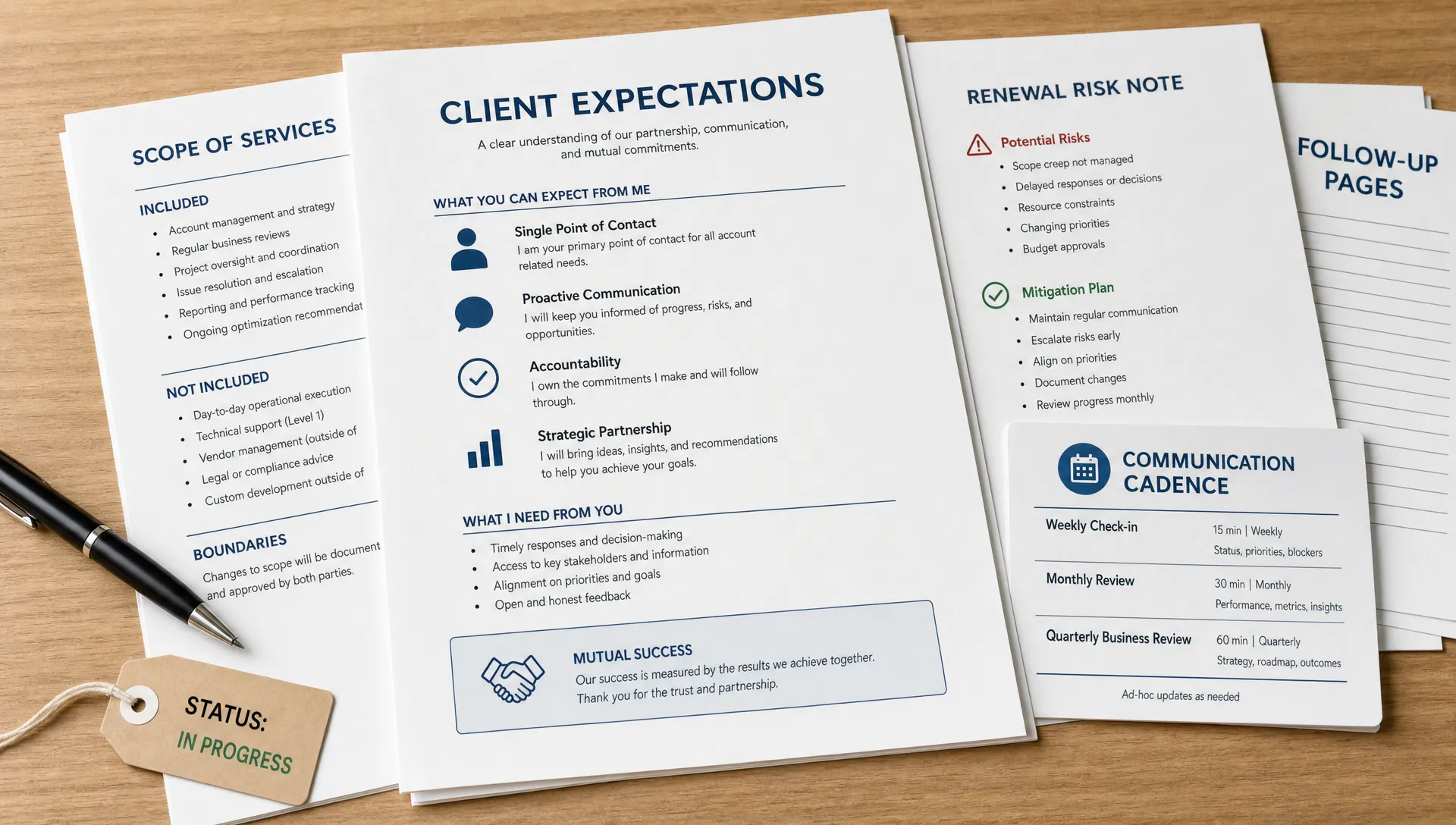
The account manager should own the client relationship and the commercial health of the account. They should own clarity, expectations, scope, communication, risk visibility, and the narrative around results. They should not own every task, every deadline, every asset, or every internal process.
The difference matters. When account managers own the right things, clients feel guided, delivery teams have context, and agency leaders can see which accounts are healthy before renewal week arrives. When account managers own the wrong things, the agency becomes dependent on heroics.
The core job of an agency account manager
At its simplest, the account manager is the bridge between the client and the agency. But bridge is too passive a word. The best account managers actively translate business goals into delivery context, then translate delivery work back into client value.
That means the account manager should be responsible for answering three questions at all times:
- What does the client care about right now?
- What did the agency commit to delivering?
- What needs to happen next to protect trust, performance, and profitability?
This is different from project management. A project manager typically owns the internal plan, dependencies, deadlines, resource coordination, and task flow. An account manager owns the client-facing meaning of that work: why it matters, what is changing, what tradeoffs exist, and how the engagement should evolve.
In smaller agencies, one person may wear both hats. That can work for a while, but the responsibilities still need to be separated on paper. If one person is both account manager and project manager, they need a clear split between client ownership and production ownership, otherwise everything becomes urgent and nothing is truly owned.
For a wider breakdown of where account management sits beside strategy, creative, media, and operations, Archer Scaling AI has a practical guide to marketing agency roles and what they do.
What the account manager should own
1. Client relationship health
The account manager owns the day-to-day health of the client relationship. This does not mean they are responsible for making the client happy at any cost. It means they are responsible for knowing whether trust is increasing, neutral, or declining.
That includes tracking whether the client understands what the agency is doing, whether stakeholders are aligned, whether the agency is communicating proactively, and whether there are unresolved concerns. Many client problems do not start as performance problems. They start as uncertainty problems.
If the client does not know what is happening, they assume nothing is happening. If they do not understand the reason behind a recommendation, they assume the agency is guessing. If they feel surprised by timelines, they assume the agency is disorganized.
The account manager should notice these signals early and address them before they become renewal risk.
2. Expectations and communication cadence
Every client relationship needs a communication operating system. The account manager should own the cadence, format, and purpose of client communication.
This includes recurring calls, agenda ownership, action summaries, escalation paths, stakeholder updates, and decision documentation. The account manager should be able to answer questions like:
- When does the client hear from us?
- What do we send before each meeting?
- What decisions are needed from the client this week?
- Where are open questions documented?
- Who is responsible for following up?
Clients should never have to guess where things stand. A good account manager creates a rhythm that makes progress visible.
This does not require over-communication. In fact, excessive communication can create more confusion. The goal is not more messages. The goal is fewer surprises.
3. Scope clarity
Scope is one of the most important things an account manager should own because it directly affects margin.
The account manager should understand what is included, what is not included, what has changed, and what needs a change order or reprioritization conversation. They do not need to be the only person who enforces scope, but they should be the person who sees scope creep forming.
Common scope issues include extra revisions, additional reporting requests, unplanned meetings, new stakeholder demands, extra campaign versions, and strategic requests that were not part of the original engagement.
The account manager should not shut these conversations down automatically. Sometimes an out-of-scope request is a sign of expansion opportunity. The job is to name it clearly: this is a new request, it has delivery implications, and we can handle it by adjusting priorities, timeline, or budget.
4. Business context
A strong account manager knows more than the campaign deliverables. They understand the client's business model, revenue goals, sales process, market pressure, internal politics, and decision-making structure.
This business context is what allows the account manager to make delivery work feel relevant. A report is not just a report. It is an explanation of whether the client is closer to pipeline, revenue, retention, or market share goals.
This is also where account managers become more valuable in B2B agencies. B2B clients often have longer sales cycles, multiple stakeholders, handoffs between marketing and sales, and pressure to prove pipeline impact. If the account manager only talks in marketing activity, they lose influence. If they can connect work to business movement, they become trusted.
5. Strategic alignment, not solo strategy
The account manager should own strategic alignment, but they should not be expected to create strategy alone unless that is explicitly part of their role.
Strategic alignment means making sure the strategy is understood, documented, translated into delivery priorities, and revisited when conditions change. The account manager should know whether the work being produced still maps to the client's goal.
For example, if a client's sales team starts pushing a new vertical, the account manager should catch that shift and bring it into planning. If a campaign is generating leads that sales cannot work, the account manager should surface the gap. If the client is changing their positioning, the account manager should make sure creative and content teams are not working from stale assumptions.
They do not need to be the deepest technical expert in SEO, paid media, lifecycle, or creative. They do need to make sure the experts are solving the right problem.
What the account manager should not own
Role clarity requires defining the negative space too. In many agencies, account managers become the default owner of anything that lacks a system. That is not account management. That is operational debt with a friendly face.
An account manager should not own every internal deadline. They should understand delivery status and communicate implications, but project owners should manage the production plan.
They should not own every asset review. They can review for client context, tone, and alignment, but channel specialists, strategists, editors, and creative leads should own the quality of their work.
They should not own rescuing broken handoffs. If sales-to-delivery handoff is weak, the fix is a better onboarding system, not asking the account manager to reconstruct the deal from Slack messages and memory. If this is a recurring issue, improving marketing agency client onboarding will do more for account health than another status meeting.
They should not own unapproved scope. If the client wants something new, the account manager should facilitate the commercial conversation. They should not quietly absorb the work into the team.
They should not own being constantly available. Responsiveness is important, but unlimited access trains clients to bypass process. Healthy account management has clear response expectations, escalation rules, and working agreements.
A practical ownership map for agency account managers
A simple ownership map helps prevent confusion. The table below is not universal, but it is a useful starting point for B2B marketing agencies.
| Area | Account manager owns | Other team owns |
|---|---|---|
| Client relationship | Trust, expectations, stakeholder management, communication cadence | Leadership supports executive relationships when needed |
| Scope | Visibility, client conversation, change request framing | Agency leadership approves commercial terms |
| Strategy | Alignment, context, client goal translation | Strategist or channel lead owns technical direction |
| Delivery status | Client-facing summary and risk explanation | Project manager or delivery lead owns task plan and deadlines |
| Reporting | Narrative, implications, next steps | Analysts or channel owners own data accuracy and analysis inputs |
| Renewal | Health signals, relationship insight, expansion needs | Leadership or sales owns proposal and commercial close |
| Documentation | Client decisions, meeting outcomes, account context | Operations owns system structure and templates |
This structure prevents the account manager from becoming the agency's human router. They still coordinate, but they are not the only system holding the account together.
The account manager's role in onboarding
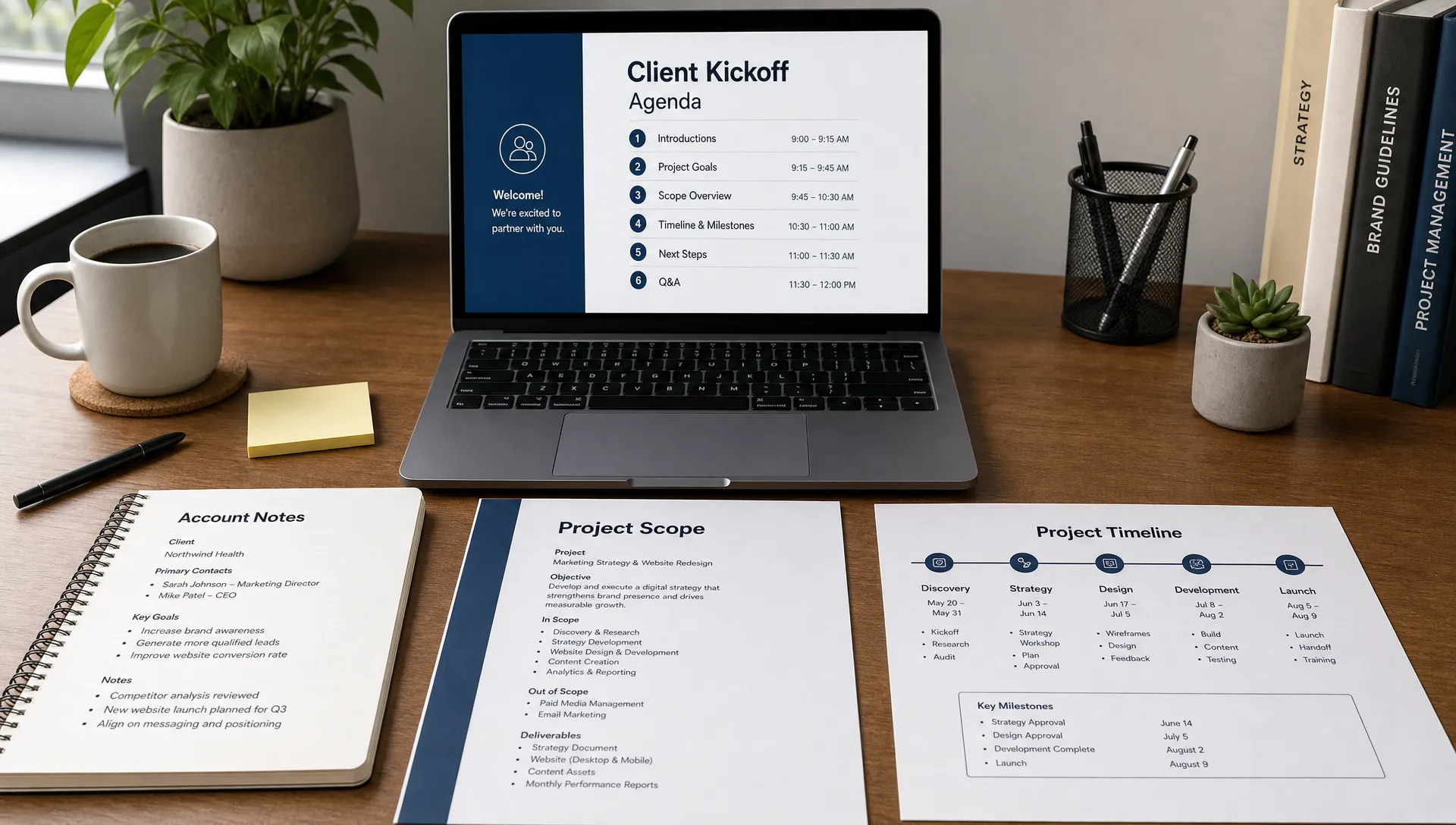
The first 30 days of a client relationship often determine whether the account will be calm or chaotic. The account manager should own the client's experience of onboarding, even if operations owns the workflow.
That means the account manager ensures the client knows what is needed, why it matters, when it is due, and what happens next. They should also confirm that internal teams have the context they need to begin work correctly.
A strong onboarding process gives the account manager a reliable foundation. It should capture goals, stakeholders, access needs, brand assets, CRM context, sales process details, reporting requirements, approval workflows, and communication preferences.
Without that foundation, the account manager spends the next three months filling gaps. They ask for missing access. They restate the same goals. They clarify who approves what. They explain delays caused by incomplete information. The client sees friction, and the agency loses margin.
The account manager's role in reporting
Reporting is one of the highest leverage areas for account management because it shapes how clients perceive value.
The account manager does not need to pull every metric manually. In fact, they usually should not. But they should own the story of the report. What changed? Why did it change? What should the client pay attention to? What is the agency doing next?
A dashboard full of numbers does not create confidence on its own. The account manager's job is to turn data into a useful client conversation.
This is where many agencies lose time. Account managers chase channel owners for updates, copy metrics into slide decks, rewrite commentary late at night, and manually format the same reports every month. That is not strategic account management. That is reporting operations.
If reports regularly arrive late or require too much manual effort, the agency has a systems problem. Archer Scaling AI has covered this more deeply in its guide on how to fix marketing agency reporting bottlenecks.
A useful account manager reporting rhythm includes a short performance summary, a clear explanation of changes, a view of progress against goals, risks or blockers, decisions needed, and next actions. The account manager should leave the client feeling oriented, not buried in metrics.
The account manager's role in retention and expansion
Retention is not something that happens at renewal. It is built through every expectation kept, every risk surfaced early, and every moment where the client feels the agency understands their world.
The account manager should own retention signals. These signals include slower client responses, new executive scrutiny, repeated budget questions, stakeholder turnover, declining meeting attendance, unresolved dissatisfaction, or an increase in urgent requests.
They should also own expansion signals. If the client repeatedly asks for support outside scope, introduces a new business unit, mentions a new goal, or struggles with a related workflow, the account manager should capture that opportunity and bring it to leadership.
This does not mean every account manager must be a salesperson. But they should be commercially aware. They are often the first person to see when an account is ready to grow, and the first person to see when it is at risk.
The best account managers protect both client trust and agency margin. They do not promise free work to preserve the relationship. They guide the client toward the right next commercial step.
What to measure in an agency account manager role
If you only measure account managers on client happiness, you encourage people-pleasing. If you only measure them on revenue, you encourage overpromising. The scorecard needs balance.
Useful account manager metrics include:
- Client retention rate by account cohort
- Expansion or upsell opportunities identified
- Scope creep flagged before delivery impact
- Client response time and decision turnaround
- Meeting follow-up completion rate
- Onboarding completeness before work begins
- Report readiness and on-time delivery
- Account margin or delivery efficiency by client
- Client satisfaction trends, not just one-off scores
The most important metric is often the one agency leaders avoid: margin by account. An account can look healthy from the outside and still be quietly unprofitable because of excess meetings, revisions, custom reporting, poor handoffs, and untracked internal effort.
Account managers should not be blamed for margin problems they cannot control. But they should have visibility into them. If an account is becoming unprofitable, the account manager needs to know so they can help reset expectations, reframe scope, or escalate the issue.
How AI ops changes the account manager role
AI should not replace the account manager's judgment. It should remove the repetitive coordination work that prevents them from using that judgment.
In 2026, the agencies that get the most leverage from AI are often not the ones generating the most content. They are the ones using automation to reduce operational drag around delivery.
For account managers, that can include summarizing client calls, extracting action items, updating CRM fields, preparing onboarding checklists, drafting status updates, routing requests to the right internal owner, flagging missing inputs, compiling report inputs, and maintaining account documentation.
The account manager still owns the relationship, interpretation, and decision-making. The system handles the repetitive motion.
A useful analogy comes from local service businesses that make the customer journey obvious. A repair shop that publishes clear intake steps, repair options, and service expectations, like this iPhone repair service in Marktredwitz, reduces uncertainty before the customer ever asks a question. Agencies need the same kind of operational clarity for clients: what happens next, who owns it, how long it takes, and what information is required.
When an agency installs that clarity into its workflows, account managers stop acting as the only source of truth. They become strategic operators instead of professional chasers.
A simple weekly operating rhythm for account managers
The account manager's week should not be a random mix of calls, Slack pings, fire drills, and status updates. A basic rhythm helps them stay ahead of risk.
A strong weekly rhythm might include a Monday account review, client communication planning, delivery risk check, scope change review, reporting input check, and Friday account health update. The exact format matters less than consistency.
The key is that account managers should be looking forward, not just reporting backward. They should know what could slip, what the client is waiting on, what decision is needed, what might affect margin, and what leadership needs to know.
This rhythm also helps agency leaders. Instead of asking account managers for updates in scattered messages, leadership can rely on a structured account health view. That reduces interruptions and makes escalation cleaner.
Common mistakes agencies make with account managers
The first mistake is hiring an account manager when the real problem is delivery chaos. If briefs are unclear, templates are inconsistent, reporting is manual, and onboarding is broken, a new account manager will only make the chaos more visible.
The second mistake is using the account manager as a buffer between the client and poor operations. This protects the agency temporarily, but it trains the team to rely on emotional labor instead of better systems.
The third mistake is giving account managers responsibility without authority. If they are accountable for client health but cannot push back on scope, influence delivery priorities, or escalate margin issues, the role becomes impossible.
The fourth mistake is confusing friendliness with account leadership. Clients can like an account manager and still lose confidence in the agency. The role requires warmth, but it also requires clarity, boundaries, and commercial maturity.
The fifth mistake is letting every account manager invent their own process. Personal style is fine. Personal operating systems are risky. The agency should have common standards for onboarding, meeting notes, status updates, reporting, scope changes, and account health tracking.
The ideal account manager profile
A strong account manager in a marketing agency is organized, commercially aware, calm under pressure, and able to translate between business goals and delivery realities.
They do not need to be the loudest person on the call. They do need to be the person who can create clarity when everyone else is moving fast.
The best account managers usually share a few traits: they ask precise questions, document decisions, notice emotional shifts, understand the agency's business model, protect the team's focus, and communicate tradeoffs without sounding defensive.
They are not simply client service people. They are operators of trust.
Frequently Asked Questions
What does an account manager do in a marketing agency? An account manager owns the client relationship, communication cadence, expectations, scope visibility, account health, and the client-facing narrative around work and results. They coordinate with delivery teams, but they should not be the sole owner of every task or deadline.
Should an account manager also be a project manager? In smaller agencies, one person may handle both roles, but the responsibilities should still be clearly separated. Account management owns client trust and commercial context. Project management owns the internal delivery plan, dependencies, and task execution.
What should an account manager not be responsible for? They should not be responsible for rescuing broken processes, absorbing unapproved scope, manually rebuilding reports, chasing every internal deadline, or compensating for weak onboarding. Those are systems problems, not account management problems.
How can agencies make account managers more effective? Agencies can make account managers more effective by standardizing onboarding, reporting, meeting notes, scope change workflows, CRM updates, and account health tracking. AI ops can remove repetitive coordination work so account managers can focus on judgment, client trust, and retention.
What KPIs should an agency account manager have? Useful KPIs include retention, expansion opportunities identified, scope creep flagged, onboarding completeness, report readiness, meeting follow-up completion, client satisfaction trends, and account margin visibility. The best scorecards balance client health with profitability.
Make the account manager role easier to win
If your account managers are constantly chasing updates, rebuilding reports, filling onboarding gaps, and absorbing scope creep, the role is probably not the real problem. The operating system around the role is.
Archer Scaling AI installs and runs AI-powered operations systems for B2B marketing agencies, including workflows for onboarding, reporting, CRM, lead routing, SOPs, and content operations. The process starts with a paid Margin Teardown, where you get a roadmap and three automation moves, or it is on Archer.
If you want to see where your account managers are carrying work that should be handled by systems, visit Archer Scaling AI and start with the Margin Teardown.