Marketing What Do They Do? Agency Roles Explained
Marketing what do they do? Learn key agency roles, workflows, and where AI ops helps teams deliver better work without adding headcount.
If you have ever asked, marketing what do they do? the simple answer is this: marketing helps the right people understand, trust, and choose a business before they ever speak to sales.
In an agency setting, that work is split across strategy, research, content, campaigns, reporting, operations, and client communication. The confusing part is that all of those functions can look very different depending on the client, industry, budget, and growth stage.
A B2B SaaS agency, for example, may spend most of its time on positioning, LinkedIn content, conversion pages, and sales enablement. An agency serving local service businesses may focus more on paid search, landing pages, reviews, and lead follow-up. The job is not just to make things look good. The job is to create a repeatable path from attention to revenue.
What marketing actually does
Marketing connects a company’s offer to a market that needs it. That includes understanding the customer, shaping the message, choosing the right channels, producing assets, launching campaigns, and measuring whether those efforts are turning into pipeline or sales.
A strong marketing function usually answers five core questions:
- Who are we trying to reach?
- What problem do they care about enough to act on?
- Why should they trust this company over alternatives?
- Where do we reach them most efficiently?
- What evidence shows the work is creating business value?
That is why marketing is broader than advertising. Advertising is one way to distribute a message. Marketing includes the research, positioning, creative, operational, and analytical work that makes advertising effective in the first place.
Marketing vs sales vs advertising
These terms often get used interchangeably, but they are not the same.
Marketing creates awareness, interest, trust, and demand. It prepares the market so the right people are more likely to engage.
Sales converts qualified interest into revenue through direct conversations, proposals, demos, negotiation, and closing.
Advertising is paid promotion. It can be part of marketing, but marketing can also include organic content, SEO, email, webinars, referral programs, events, customer stories, and partner campaigns.
The cleanest way to think about it is this: marketing creates and captures demand, sales turns qualified demand into customers, and advertising is one channel marketing may use to accelerate that process.
The main roles inside a marketing agency
A marketing agency usually brings together specialists who own different parts of the growth system. In smaller agencies, one person may cover several roles. In larger agencies, each role may be a full department.
| Agency role | What they do | Common outputs |
|---|---|---|
| Strategist | Defines positioning, campaign direction, channel focus, and success metrics | Strategy docs, messaging frameworks, campaign plans |
| Account manager | Owns the client relationship and keeps communication clear | Client updates, meeting notes, scope alignment |
| Project manager | Keeps work moving on time and coordinates internal handoffs | Timelines, task boards, production schedules |
| Researcher | Studies customers, competitors, keywords, market trends, and sales insights | ICP research, competitor notes, voice-of-customer findings |
| Copywriter | Turns strategy into persuasive written assets | Ads, landing pages, emails, sales pages, content briefs |
| Designer or creative | Builds visual assets that support the message and brand | Ad creative, social graphics, landing page visuals |
| Media buyer | Plans, launches, and optimizes paid campaigns | Campaign builds, budget pacing, performance tests |
| SEO or content lead | Improves organic visibility and builds topic authority | Blog briefs, SEO audits, content calendars |
| Marketing operations specialist | Connects tools, workflows, tracking, forms, CRM, and automation | Automations, CRM updates, attribution workflows |
| Analyst | Interprets performance and turns data into recommendations | Dashboards, reports, testing insights |
The most effective agencies do not treat these roles as isolated seats. They create a system where research informs strategy, strategy informs creative, creative is distributed through the right channels, and performance data feeds the next round of decisions.
What marketers do before any campaign launches
The visible part of marketing is the campaign. The valuable part often happens before launch.
Before writing copy or building ads, marketers need to understand the market. That means identifying the ideal customer, their buying triggers, their objections, and the alternatives they compare against. In B2B marketing, this often includes reviewing sales calls, CRM notes, customer interviews, competitor positioning, and keyword demand.
This stage prevents random execution. Without it, teams can produce a lot of content that sounds polished but does not connect to the buyer’s real problem. With it, the agency can build messaging that feels specific, credible, and commercially relevant.
For example, a high-consideration financial services brand such as New Era Lending’s smart mortgage solutions needs more than attractive creative. It needs trust-building education, clear explanations, strong compliance awareness, and a message that helps people feel confident about complex financial decisions.
That is what good marketing does. It translates complexity into clarity.
What marketers do during campaign execution
Once strategy is clear, the team turns it into assets and actions. This might include landing pages, email sequences, paid ads, social posts, long-form articles, sales enablement materials, webinars, lead magnets, or nurture campaigns.
Execution is where many people think marketing starts, but it is really the middle of the process. Good execution depends on tight briefs, clear review cycles, clean handoffs, and quality control. If those operational pieces are weak, even talented specialists can waste hours waiting for feedback, hunting for context, or rebuilding work that was unclear from the start.
This is where agency roles overlap. A strategist may define the angle, a copywriter may write the landing page, a designer may create the visuals, a media buyer may launch traffic, and an analyst may track conversion quality. The client sees one campaign, but behind the scenes there is a chain of decisions and handoffs.
Agencies that want to protect profitability need those handoffs to be repeatable. That is why building agency marketing systems that protect margin matters as much as hiring talented marketers.

What marketers do after launch
Marketing does not end when a campaign goes live. In many ways, the most important work starts after launch.
The team reviews what is happening in the market. Are people clicking? Are they converting? Are the leads qualified? Are sales conversations improving? Are certain messages outperforming others? Are prospects engaging but not booking calls?
This is where reporting and optimization come in. A weak agency sends a report filled with numbers and leaves the client to interpret it. A strong agency explains what changed, why it likely changed, what the team learned, and what should happen next.
Useful reporting should connect activity to business outcomes. Impressions, clicks, and open rates can be helpful diagnostic metrics, but they are not the full story. In B2B, the more important questions are usually tied to pipeline quality, sales readiness, conversion rates, buying committee engagement, and revenue influence.
The hidden role: marketing operations
Marketing operations is the role many clients never see, but every agency feels.
Marketing ops is responsible for the systems that make marketing work reliably. This includes CRM fields, forms, lead routing, campaign tracking, onboarding workflows, reporting templates, naming conventions, data hygiene, and automation.
When marketing ops is strong, the agency moves faster and makes fewer mistakes. Leads go to the right place. Reports do not require hours of manual spreadsheet work. Client onboarding does not depend on scattered emails. Campaign briefs are complete. Repetitive tasks get handled consistently.
When marketing ops is weak, everything feels heavier. The agency may believe it has a staffing problem when the real issue is operational drag. Senior people spend time chasing assets, copying data, fixing reports, and rebuilding processes that should have been standardized.
That is why many agencies should look at workflow design before adding another hire. If your team is drowning in repetitive delivery tasks, start by examining what a marketing agency should automate first instead of assuming more headcount is the only answer.
What clients should expect from a marketing agency
A good marketing agency should bring both expertise and structure. Clients should not expect instant results from every tactic, but they should expect clarity around the plan, the process, and the measurement model.
At minimum, a client should understand what the agency is doing, why it matters, who owns each part of the work, and how success will be evaluated. If the agency cannot explain those things plainly, there is likely a strategy or operations gap.
Healthy agency-client relationships usually include:
- A clear onboarding process that gathers context before execution starts
- Defined goals, target audiences, channels, and success metrics
- A realistic timeline for testing, learning, and improvement
- Consistent reporting that explains decisions, not just data
- Transparent communication about scope, tradeoffs, and priorities
The agency does not need to do everything. In fact, the best agency relationships are often focused. A specialist agency that understands one market, one channel, or one stage of growth may outperform a generalist team trying to cover every possible tactic.
What agency owners should understand about marketing roles
For agency owners, the question is not only what marketers do. It is how much of that work actually requires human judgment.
Some marketing tasks need experience, taste, and strategic thinking. Positioning decisions, creative direction, client advisory, offer strategy, and interpretation of complex market signals should not be reduced to button-clicking.
Other tasks are repetitive and rules-based. These are often strong candidates for automation or AI-assisted workflows. Examples include intake sorting, research summaries, report drafting, CRM updates, content brief assembly, meeting note extraction, follow-up reminders, and first-pass data cleanup.
The mistake is treating all marketing work the same. If senior strategists are spending hours formatting reports, moving data between tools, or rebuilding the same client onboarding steps, the agency is burning margin on work that should be systemized.
Modern agencies need a clear separation between judgment work and operational work. The more repeatable the operation becomes, the more capacity the team has for strategy, creative quality, and client leadership.
A simple way to explain marketing roles to a client
If a client asks what your marketing team actually does, avoid giving them a long list of job titles. Explain the flow of value.
Start with research. The agency learns who the buyer is, what they care about, and what is blocking action.
Then explain strategy. The agency decides which message, offer, and channel mix gives the client the best chance of reaching the right people.
Then explain production. The team creates the assets needed to bring that strategy to market.
Then explain distribution. The agency uses paid, organic, email, partner, or sales-supported channels to get the message in front of the right audience.
Then explain measurement. The team studies what happened, learns from the market, and improves the next cycle.
That explanation is simple, but it is also accurate. Marketing is not one task. It is a system of connected decisions and actions.
Where AI fits into marketing agency work
AI does not remove the need for marketers. It changes where marketers spend their time.
In an agency context, AI is most useful when it supports repeatable workflows with human review. It can help summarize research, draft first-pass briefs, organize reporting inputs, route leads, prepare client onboarding materials, and turn raw information into structured starting points.
The key is governance. AI should not be a pile of disconnected prompts that every team member uses differently. It should sit inside the agency’s operating system, with clear inputs, review steps, documentation, and ownership.
That is the difference between experimenting with AI and using AI to improve delivery margin. The first may save a few minutes. The second changes how work moves through the agency.
Frequently Asked Questions
What does marketing do in simple terms? Marketing helps a business attract the right audience, explain its value, build trust, and create demand that can turn into customers or revenue.
Is marketing the same as advertising? No. Advertising is paid promotion. Marketing includes advertising, but it also includes research, positioning, content, email, SEO, reporting, customer insights, and operations.
What does a marketing agency do for a business? A marketing agency plans and executes growth activities such as strategy, campaigns, content, paid media, SEO, reporting, and marketing operations, depending on its specialty.
What is the most important role in a marketing agency? There is no single most important role. Strategy, execution, client management, and operations all need to work together. If one part breaks, the whole delivery system suffers.
Can AI replace marketing agency roles? AI can automate or assist repetitive tasks, but it does not replace strategic judgment, client advisory, creative direction, or accountability. The best use of AI is to support marketers so they can focus on higher-value work.
Build the agency system behind the roles
Understanding marketing roles is useful. Making those roles work profitably is the harder part.
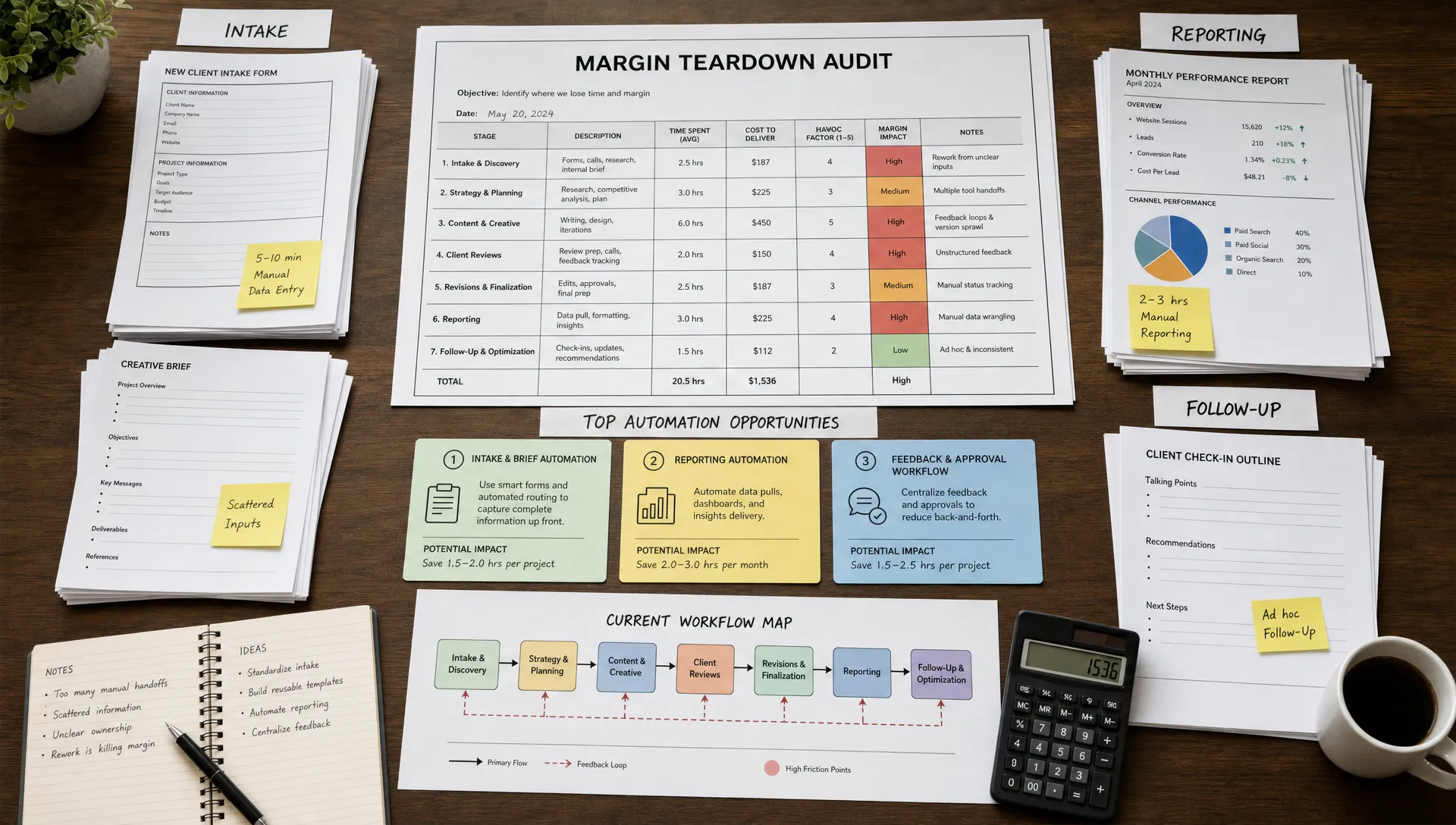
If your agency has strong people but messy handoffs, slow reporting, manual onboarding, inconsistent follow-up, or too much senior time stuck in repetitive delivery work, the issue may be your operating system, not your talent.
Archer Scaling AI installs and runs the AI ops layer for B2B marketing agencies, starting with a paid Margin Teardown that identifies the roadmap and three automation moves. If you want to see the actual system before committing, start there and find out where your delivery margin is leaking.