How to Systemize B2B Market Research for Faster Delivery
Systemize B2B market research with repeatable intake, source rules, AI workflows, QA, and delivery metrics that help agencies ship faster.

Fast B2B market research is rarely a talent problem. It gets slow because every project starts from a blank page: a new intake format, a new source list, a new spreadsheet, a new synthesis method, and a new review process.
Systemizing B2B market research does not mean making the work generic. It means making the path from business question to defensible recommendation repeatable, so your analysts spend more time interpreting evidence and less time rebuilding the same process under deadline pressure.
For B2B marketing agencies, this matters directly to delivery margin. Research sits upstream of positioning, messaging, campaign strategy, content, paid media, sales enablement, and account-based marketing. When research drags, everything downstream either waits or moves forward on assumptions. A good research operating system helps teams deliver faster without treating AI output as a substitute for judgment.
What systemized B2B market research actually means
A systemized research function has a defined way to receive requests, classify the work, collect evidence, synthesize findings, check quality, and package recommendations. The system is not just a template library. It is the operating layer that tells the team what good looks like at each stage.
At minimum, it should define:
- Which business question the research is answering
- Which research lane the request belongs to
- Which sources are acceptable for that lane
- How evidence is captured and cited
- How insights are scored for confidence
- Who reviews the work before it reaches the client
- Which final format the client needs to make a decision
The distinction matters. Templates make documents look consistent. Systems make decisions, handoffs, and quality standards consistent.
This is why research teams often improve speed dramatically before adding any new tool. When intake, source rules, and review gates are clear, automation has something reliable to plug into.
Start by sorting research requests into lanes
Many agencies slow themselves down by treating every research request as unique. A customer pain analysis, a competitor messaging scan, and a market landscape review may all require judgment, but they do not require the same workflow.
Create a small set of research lanes that cover most of your recurring work. Five to seven lanes is usually enough for a B2B agency. The goal is not to capture every edge case. The goal is to stop reinventing the process for the 80 percent of requests that repeat.
| Research lane | Typical trigger | Standard deliverable | What can be reused |
|---|---|---|---|
| ICP and account fit | New campaign, new offer, repositioning | ICP brief with fit criteria and disqualifiers | Segment taxonomy, firmographic fields, buying committee roles |
| Voice of customer | Messaging refresh, content strategy, sales enablement | Pain points, desired outcomes, objections, proof themes | Interview guide, quote tagging system, objection library |
| Competitor positioning | Category audit, campaign planning, website refresh | Competitor matrix and differentiation notes | Competitor profile template, messaging dimensions, claim categories |
| Market landscape | New vertical, expansion planning, thought leadership | Market forces, demand drivers, barriers, category language | Source hierarchy, trend capture template, evidence scoring rubric |
| Account or segment research | ABM, sales support, vertical campaign | Account intelligence brief or segment brief | Enrichment fields, buying trigger taxonomy, CRM update rules |
| Win loss synthesis | Sales improvement, messaging refinement | Reasons for selection, loss patterns, decision criteria | Interview coding framework, outcome tags, summary format |
Once you define the lanes, each new request becomes easier to scope. The project manager does not need to ask what process to use. The analyst does not need to create a new structure. The reviewer knows what to check.
This is the same operational principle behind broader agency efficiency work. If you want to connect research systemization to delivery operations more broadly, Archer Scaling AI has a practical breakdown of how B2B marketing firms improve delivery efficiency.
Fix intake before you collect data
Most research delays are created in the first 30 minutes of a project. If the intake is vague, the team will collect too much information, synthesize around the wrong question, or discover late that the client wanted a different level of depth.
A strong research intake should force clarity before work begins. It should capture the decision the research will support, the stakeholder who will use the output, the audience or segment being studied, the assumptions already in play, the sources that must be included or avoided, the deadline, and the required final format.
One useful intake question is simple: what will the client do differently if this research is useful? If the answer is unclear, the research brief is not ready.
Another useful intake question is: what confidence level is required? A fast directional scan for campaign angles does not need the same evidence standard as a board-level market entry recommendation. Without this distinction, teams either over-research low-stakes work or under-research high-stakes work.
A systemized intake should also include kill criteria. For example, if the team cannot find enough credible evidence for a segment, the output should say that clearly instead of filling the gap with weak assumptions. Speed improves when uncertainty is surfaced early rather than hidden until review.
Build a source hierarchy instead of relying on search habits
If every analyst uses a different search process, research quality will vary even when the team is skilled. A source hierarchy makes evidence collection faster and more consistent.
For most B2B market research, the hierarchy should start with client-owned evidence where available: CRM notes, sales call transcripts, customer interviews, support tickets, closed lost reasons, customer success notes, and campaign performance data. These sources often contain the most useful buyer language.
Next comes primary research, such as interviews, surveys, expert calls, and win loss conversations. Then come credible secondary sources, including analyst reports, industry publications, government data, job postings, public filings, review sites, and competitor materials. Community discussions and social posts can be useful for language mining, but they should be treated as signals rather than proof unless verified.
| Source type | Best use | Main risk | Required capture |
|---|---|---|---|
| First-party client data | Buyer language, sales friction, account patterns | Messy fields or biased notes | Source location, date range, segment, context |
| Customer interviews | Motivations, objections, decision criteria | Small sample size | Interview date, persona, company type, exact quote |
| Competitor materials | Positioning, claims, offers, proof points | Marketing exaggeration | URL, access date, claim category |
| Industry data | Market trends, benchmarks, category shifts | Outdated or too broad | Publisher, date, geography, methodology if available |
| Community and social signals | Emerging language, frustrations, informal objections | Anecdotal evidence | Thread context, date, relevance note |
Agencies serving clients in finance, healthcare, security, climate, or other regulated categories should add a stricter evidence trail. The same operational thinking behind AI-powered compliance workflows is useful here: automate data collection where possible, but keep policies, evidence, and remediation steps visible to reviewers.
This prevents a common failure mode in AI-assisted research: a polished recommendation with a weak or untraceable evidence base.
Define the workflow as gates, not a loose task list
A task list tells people what to do. A gated workflow tells them when work is ready to move forward.
That difference is critical for faster delivery. Without gates, unfinished thinking leaks into client-facing drafts. Reviewers spend time untangling scope, evidence, synthesis, and formatting all at once. Analysts get feedback too late. The project feels busy but not controlled.
A simple gated workflow for B2B market research can look like this:
| Gate | What must be true before moving forward | Primary owner |
|---|---|---|
| Intake accepted | Decision, audience, lane, deadline, and output format are clear | Strategist or project lead |
| Research plan approved | Source hierarchy, search queries, interview plan, and exclusions are defined | Research lead |
| Evidence captured | Notes are tagged, sources are cited, and gaps are visible | Analyst |
| Synthesis drafted | Findings are grouped into themes with confidence levels | Analyst or strategist |
| QA complete | Claims, citations, contradictions, and implications are reviewed | Senior reviewer |
| Delivery packaged | Output is formatted for the decision the client needs to make | Strategist or account lead |
Each gate should have a short checklist. The checklist should be specific enough that a new team member can follow it, but not so rigid that senior researchers cannot use judgment.
The goal is not bureaucracy. The goal is to reduce rework by catching ambiguity when it is cheapest to fix.
Create reusable assets that compound over time
Research becomes faster when every project leaves behind an asset, not just a finished deliverable.
A voice-of-customer project should add to the agency's objection library. A competitor scan should update competitor profiles. An ICP project should refine the segmentation taxonomy. A market landscape project should add to the source library and trend database.
Over time, the agency develops a reusable knowledge base that reduces future research effort. The first project in a lane may take longer because the system is being built. The fifth project should be noticeably faster because the team is enriching existing assets instead of starting from zero.
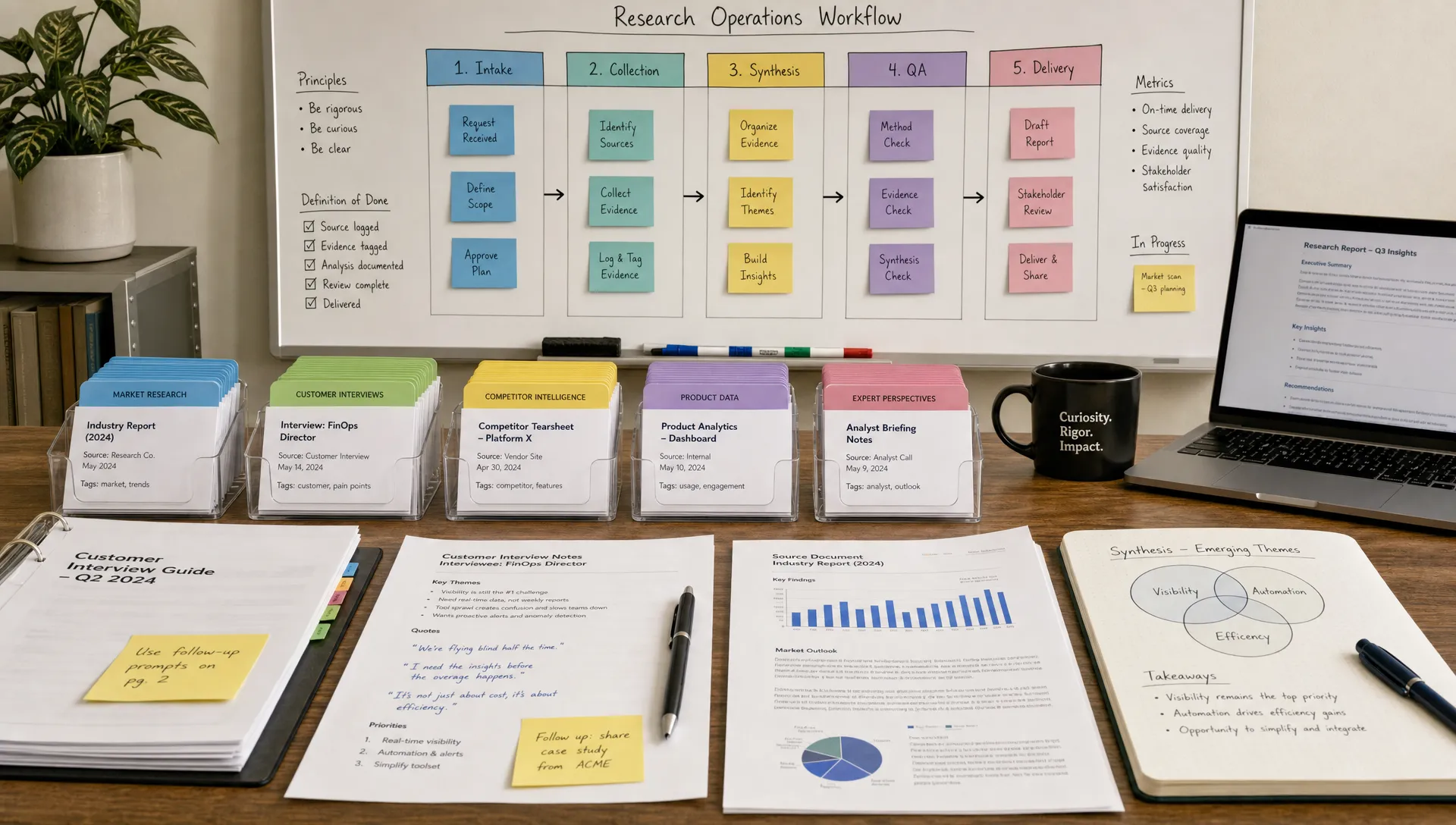
The most useful reusable assets usually include a standardized intake form, source library by industry, interview guide bank, tagging taxonomy, competitor profile template, claim and proof library, objection library, persona language bank, and final deliverable templates.
If you are deciding which parts of research operations to automate first, prioritize repetitive capture and organization work. Archer Scaling AI covers several examples in its guide to research marketing workflows you can automate now.
Use AI to accelerate the system, not replace it
AI can make B2B market research faster, but only when it operates inside a controlled workflow. If the input is unclear, the source rules are loose, or the QA process is weak, AI simply helps the team produce uncertain work faster.
The safest use of AI is to accelerate tasks that are repetitive, structured, and reviewable. For example, AI can help clean transcripts, extract themes from interviews, summarize long source documents, cluster open-ended survey responses, draft competitor claim tables, identify repeated objections, and turn notes into a first-pass brief.
Humans should still own the research question, source selection, interpretation, contradiction handling, commercial implications, and final recommendation. This is especially important in B2B, where a small sample of high-value buyers can be more meaningful than a large volume of generic public data.
| AI can accelerate | Humans should own |
|---|---|
| Transcript cleanup and tagging | Interview quality and follow-up judgment |
| Source summarization | Source credibility and relevance |
| Theme clustering | Final theme naming and prioritization |
| Competitor claim extraction | Strategic interpretation of differentiation |
| Draft brief generation | Recommendations and client-ready narrative |
| Data normalization | Edge cases, exceptions, and confidence levels |
The practical rule is simple: AI can prepare the workbench, but a researcher must still decide what the evidence means. For a deeper look at this balance, see how a B2B market research agency can use AI well.
Add a QA layer that checks claims, not just formatting
Many agencies treat QA as a final polish step. In research, QA has to be more than formatting, grammar, and slide consistency. It has to test whether the recommendation is supported by evidence.
A strong research QA process checks four things: traceability, accuracy, synthesis, and usefulness. Traceability means the reviewer can follow every important claim back to a source. Accuracy means the source actually says what the draft claims it says. Synthesis means the findings are not just a pile of facts. Usefulness means the output helps the client make a decision.
| QA check | Question to ask | Pass standard |
|---|---|---|
| Evidence traceability | Can we find the source behind each major claim? | Key claims include source notes or citations |
| Segment relevance | Does this evidence apply to the target audience? | Findings are tied to persona, company size, industry, or use case |
| Contradiction review | Did we look for evidence that challenges the conclusion? | Major opposing signals are included or explained |
| Confidence scoring | Do we know which findings are strong and which are directional? | Each insight has a clear confidence level |
| Actionability | Can the client use this to make a next decision? | Recommendations connect to campaign, messaging, product, or sales action |
For larger engagements, add a red-team pass. Ask a senior strategist to challenge the top three conclusions and identify what evidence would change the recommendation. This step can feel slower in the moment, but it often prevents late-stage rewrites and client skepticism.
Package research for decisions, not slide volume
Faster delivery is not only about how quickly the team researches. It is also about how quickly the client understands and acts on the findings.
Many B2B research deliverables are too long because they try to prove how much work was done. A better system separates decision content from evidence content. The decision-maker gets a concise narrative. The appendix holds the supporting detail.
A practical delivery structure is:
- Executive summary: the decision, answer, and recommended action
- Key findings: the few insights that matter most
- Evidence snapshots: quotes, data points, examples, and source notes
- Implications: what this changes for messaging, targeting, content, sales, or product
- Confidence notes: what is well supported, what is directional, and what needs more evidence
- Appendix: detailed source log, interview notes, tables, and raw synthesis
This structure helps clients move faster because it reduces cognitive load. It also protects the agency. If a stakeholder wants to inspect the evidence, the trail is available. If an executive wants the answer, they do not need to dig through 70 slides.
Measure research operations like a margin system
If you want B2B market research to become faster, measure the workflow like an operations system rather than a creative black box.
Useful metrics include cycle time by research lane, time to first insight, analyst hours versus estimate, number of revision rounds, percentage of reusable assets updated, QA defect rate, client clarification requests after delivery, and downstream adoption of the research in campaigns or sales materials.
These metrics show where margin is leaking. If cycle time is high but QA defects are low, the team may be over-researching. If cycle time is low but revisions are high, the intake or synthesis process is weak. If reusable asset updates are rare, the agency is failing to compound its learning.
The most important metric is not raw speed. It is reliable speed. A systemized research function should deliver faster while making quality easier to inspect.
A practical 30-day rollout plan
You do not need a six-month transformation to systemize B2B market research. Start with the workflows that repeat most often and build from there.
- Week 1: Audit the last ten research projects and group them into lanes. Note cycle time, revision causes, common sources, repeated deliverables, and where the team lost time.
- Week 2: Standardize intake and source rules for the two highest-volume lanes. Create a simple brief, source hierarchy, evidence capture format, and confidence scoring method.
- Week 3: Build the first reusable asset library. Start with interview guides, competitor profiles, source lists, tagging taxonomy, and deliverable outlines.
- Week 4: Add AI-assisted steps and QA gates. Automate transcript cleanup, theme clustering, source summarization, and first-pass brief drafting, then require human review at each gate.
- After 30 days: Review metrics and expand only what works. Add another research lane once the first two are faster, cleaner, and easier to review.
This staged approach keeps the system grounded in real delivery work. It also avoids the common trap of building a complex research operations playbook that no one uses under deadline pressure.
Common pitfalls to avoid
The first pitfall is automating ambiguity. If the research question is unclear, AI will not fix it. It will only produce a faster pile of semi-relevant material.
The second pitfall is building templates without enforcement. A template that analysts can ignore is not a system. Assign ownership, define gates, and review adherence during project retrospectives.
The third pitfall is hiding uncertainty. B2B research often deals with incomplete information, small samples, and fast-changing markets. A useful system makes uncertainty visible through confidence scoring and evidence notes.
The fourth pitfall is treating every project as a deliverable instead of a learning asset. If the team does not update reusable libraries after each project, future work will stay slower than it needs to be.
Frequently Asked Questions
What does it mean to systemize B2B market research? It means creating a repeatable operating process for intake, source selection, evidence capture, synthesis, QA, and delivery. The goal is to reduce rework and speed up delivery while preserving expert judgment.
Can AI replace B2B market researchers? No. AI can accelerate repetitive research tasks, such as summarization, tagging, clustering, and first-pass drafting. Human researchers still need to own scope, source quality, interpretation, and recommendations.
What should an agency standardize first? Start with intake and source hierarchy. These two areas create most downstream delays. If the question and evidence rules are clear, workflow automation becomes much safer and more useful.
How do you make research faster without lowering quality? Use research lanes, gated workflows, reusable assets, AI-assisted preparation, and claim-level QA. Speed comes from removing repeated setup work, not from skipping evidence review.
How is a research system different from a template? A template standardizes the output format. A research system standardizes the decisions, handoffs, source rules, review gates, and quality checks that produce the output.
Turn research into a delivery advantage
B2B market research should not be the bottleneck that delays strategy, content, campaigns, or sales enablement. With the right operating system, it becomes a margin advantage: faster inputs, clearer decisions, less rework, and more reusable knowledge after every engagement.
If your agency is doing too much research, reporting, onboarding, or content operations by hand, Archer Scaling AI can help install and run the AI ops layer behind your delivery system. The process starts with a paid Margin Teardown that maps the roadmap and identifies three automation moves, with a risk-reversed structure if the roadmap is not there.