How a B2B Market Research Agency Can Use AI Well
Learn how a B2B market research agency can use AI for faster research, cleaner insights, better QA, and higher-margin delivery.
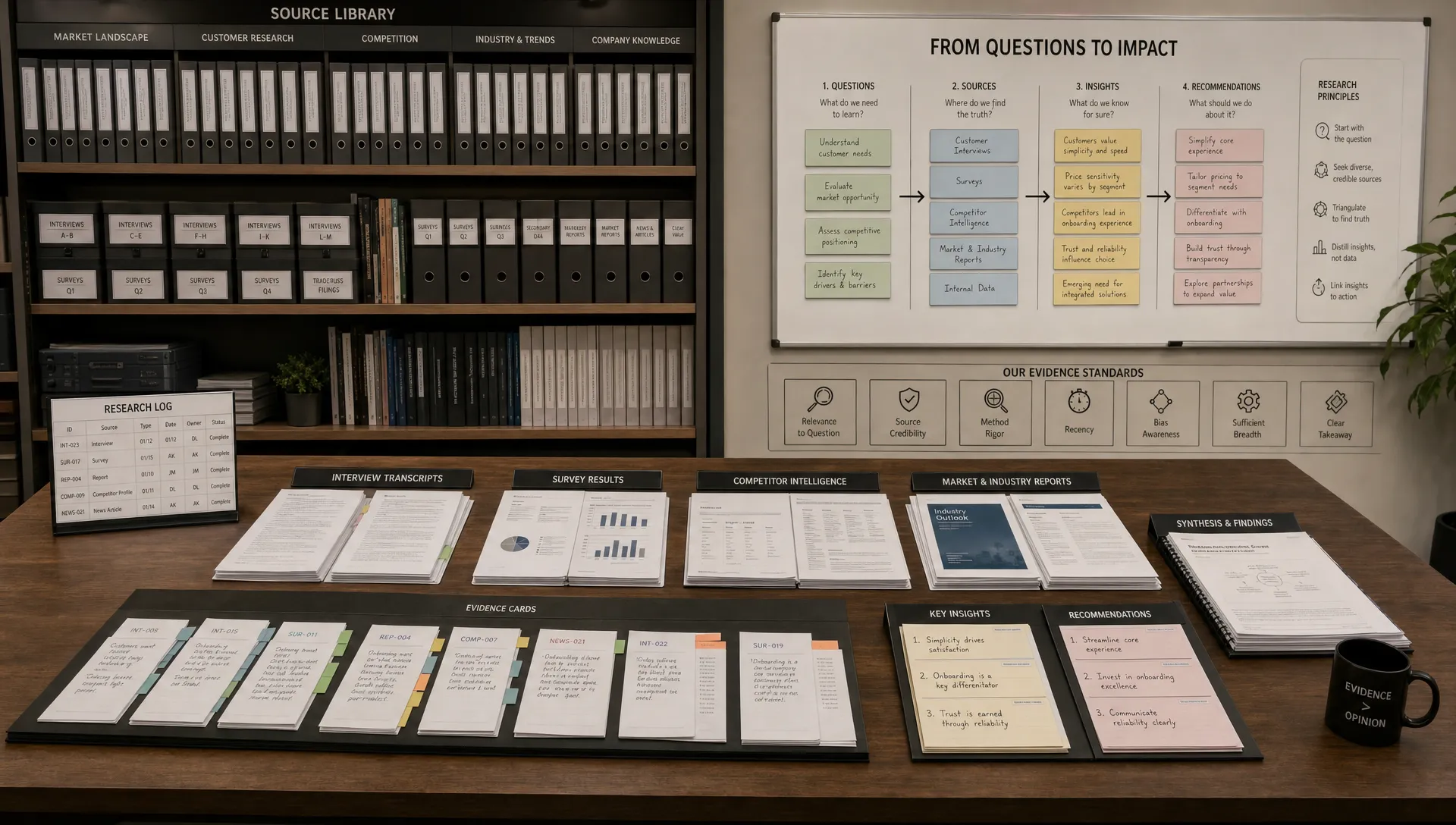
For a B2B market research agency, AI is most valuable when it improves the operating system around research, not when it pretends to be the researcher.
That distinction matters. Clients do not pay for a faster pile of summaries. They pay for sharper answers to commercial questions: Which segment should we prioritize? Why are deals stalling? What do buyers believe before they speak to sales? How is the category shifting? Where is the positioning gap?
AI can help answer those questions faster, but only when it is wrapped in strong process, source discipline, human review, and clear decision rights. Used casually, it creates generic insight, shaky claims, and client risk. Used well, it reduces delivery drag, protects margin, and gives senior researchers more time for judgment.
What “using AI well” actually means
A B2B market research agency uses AI well when the system makes the research process more repeatable without flattening the nuance that clients hired the agency to find.
In practice, that means AI should support four outcomes:
- Faster preparation, so researchers start with better context before interviews, surveys, or analysis.
- Cleaner evidence handling, so transcripts, survey responses, desk research, and CRM exports are easier to organize.
- Better synthesis support, so themes, objections, and buying triggers surface faster.
- Stronger quality control, so claims are tied back to sources and client-facing reports are easier to verify.
The mistake is treating AI as an autonomous strategist. Large language models are excellent at pattern recognition, summarization, classification, drafting, and transformation. They are not inherently reliable judges of sample quality, market significance, commercial priority, or whether a finding is truly new to the client.
The human researcher still owns the research design, the interpretation, the confidence level, and the recommendation.
Where AI fits in the research workflow
Most agencies should not begin by asking, “Which AI tool should we buy?” A better question is, “Which parts of our research delivery are repetitive, time-consuming, and rules-based enough to standardize?”
The table below shows where AI can help without taking over the work that requires expert judgment.
| Research stage | Good AI use | Human responsibility |
|---|---|---|
| Client intake | Summarize briefs, extract goals, flag missing inputs | Clarify the real business question and scope |
| Desk research | Find patterns across public sources and organize source notes | Decide which sources are credible and relevant |
| ICP research | Cluster firmographic, technographic, and pain-point signals | Validate the ICP against sales reality and market constraints |
| Interview prep | Draft discussion guide options and role-specific probes | Choose the final questions and sequencing |
| Transcript analysis | Tag themes, objections, language patterns, and emotional intensity | Refine the codebook and interpret what matters |
| Competitor review | Compare positioning, offers, proof points, and calls to action | Judge strategic gaps and likely buyer perception |
| Report drafting | Create first-pass outlines, charts captions, and executive summaries | Own the narrative, recommendations, and caveats |
| QA | Check source coverage, naming consistency, and unsupported claims | Approve final deliverables and client guidance |
This is also where a B2B research agency can start building leverage. The work does not become lower quality because AI is involved. It becomes lower quality when AI is used without a workflow.
If you want a broader list of research-adjacent processes that can be systemized, Archer Scaling AI has a practical breakdown of research marketing workflows you can automate safely.
Start with a research operating system, not a prompt library
A prompt library helps, but it is not the foundation. The foundation is a research operating system that defines how inputs move from client context to evidence to insight to deliverable.
Before introducing automation, document the minimum viable workflow:
- The exact inputs required before a project starts.
- The standard source log format for desk research.
- The taxonomy for buyer pains, objections, triggers, competitors, and decision criteria.
- The rules for transcript naming, tagging, and quote extraction.
- The difference between an observation, an insight, and a recommendation.
- The QA checklist every deliverable must pass before the client sees it.
Once those pieces exist, AI becomes easier to control. Instead of asking a model to “analyze this market,” you can ask it to extract competitor positioning from a defined source set, classify findings using your taxonomy, and return outputs in a format your researchers already use.
For example, suppose an agency is researching healthcare services in a regional market. AI can help scan public websites and categorize positioning, service lines, proof points, and conversion paths. A page such as Louisville Web Lab’s healthcare marketing agency page could be logged as one source in a competitive or category review, then coded against the same criteria as other market examples. The researcher still decides whether that evidence is representative, relevant, or strategically important.
That is the difference between AI as a shortcut and AI as an operations layer.
High-value AI use cases for a B2B market research agency
1. Intake and project scoping
Research projects often lose margin before the research even begins. A vague client brief leads to extra calls, shifting goals, and analysis that has to be reworked later.
AI can review intake forms, call transcripts, CRM notes, and proposals to identify missing details. It can flag unclear target segments, undefined buying committees, weak success criteria, or conflicting assumptions. That gives the research lead a cleaner agenda for the kickoff call.
This is not about removing the kickoff. It is about making the kickoff sharper.
2. Desk research and source organization
B2B research often begins with a messy collection of websites, analyst reports, review platforms, LinkedIn profiles, job posts, earnings calls, webinars, and competitor pages. The time-consuming part is not only finding sources. It is organizing them in a way that supports later synthesis.
AI can help extract structured fields from source material, including target audience, positioning claim, use cases, pricing signals, integrations, proof points, and repeated language. It can also identify where sources disagree, which is often more useful than a simple summary.
The key control is a source log. Every AI-assisted summary should point back to the original source, date accessed, and the specific claim it supports. If a claim cannot be traced, it should not appear in the final report.
3. Voice-of-customer mining
This is one of the strongest use cases for AI in B2B research. Agencies often have access to sales calls, customer interviews, support tickets, win-loss notes, review data, and survey responses. Hidden inside that material are the phrases buyers actually use.
AI can group recurring themes, extract quotes, compare language by persona, and identify patterns across deal stage or company size. It can also separate functional pain from emotional pain, such as “our reporting is manual” versus “I do not trust the numbers enough to present them to leadership.”
The researcher’s job is to decide what the language means in context. A phrase that appears five times may be less important than one quote from a high-value segment that reveals a major buying trigger.
4. Competitive positioning analysis
AI can speed up the mechanical parts of competitor review: collecting claims, comparing messaging, identifying repeated keywords, mapping offers, and highlighting gaps in proof.
But competitive analysis is especially vulnerable to false confidence. If every competitor says they are “data-driven,” AI may summarize that as a market norm. A researcher should ask the harder question: Does anyone prove it? Is the claim meaningful to the buyer? Is there a positioning angle the market has ignored?
AI can show the pattern. The agency creates the point of view.
5. Report assembly and narrative support
Research reporting is not just documentation. It is a decision tool. AI can help turn source notes into first-pass outlines, executive summary drafts, chart captions, and stakeholder-specific versions of the same findings.
This is useful because many agencies spend too much senior time assembling decks rather than sharpening the story. The risk is that AI-generated reports often sound confident but generic. To avoid that, require every major takeaway to include evidence, implication, and recommended action.
If reporting is a bottleneck in your agency, it is worth designing reports around decisions first. Archer’s guide to B2B reporting clients actually read is useful for thinking beyond dashboards and into decision-ready narratives.
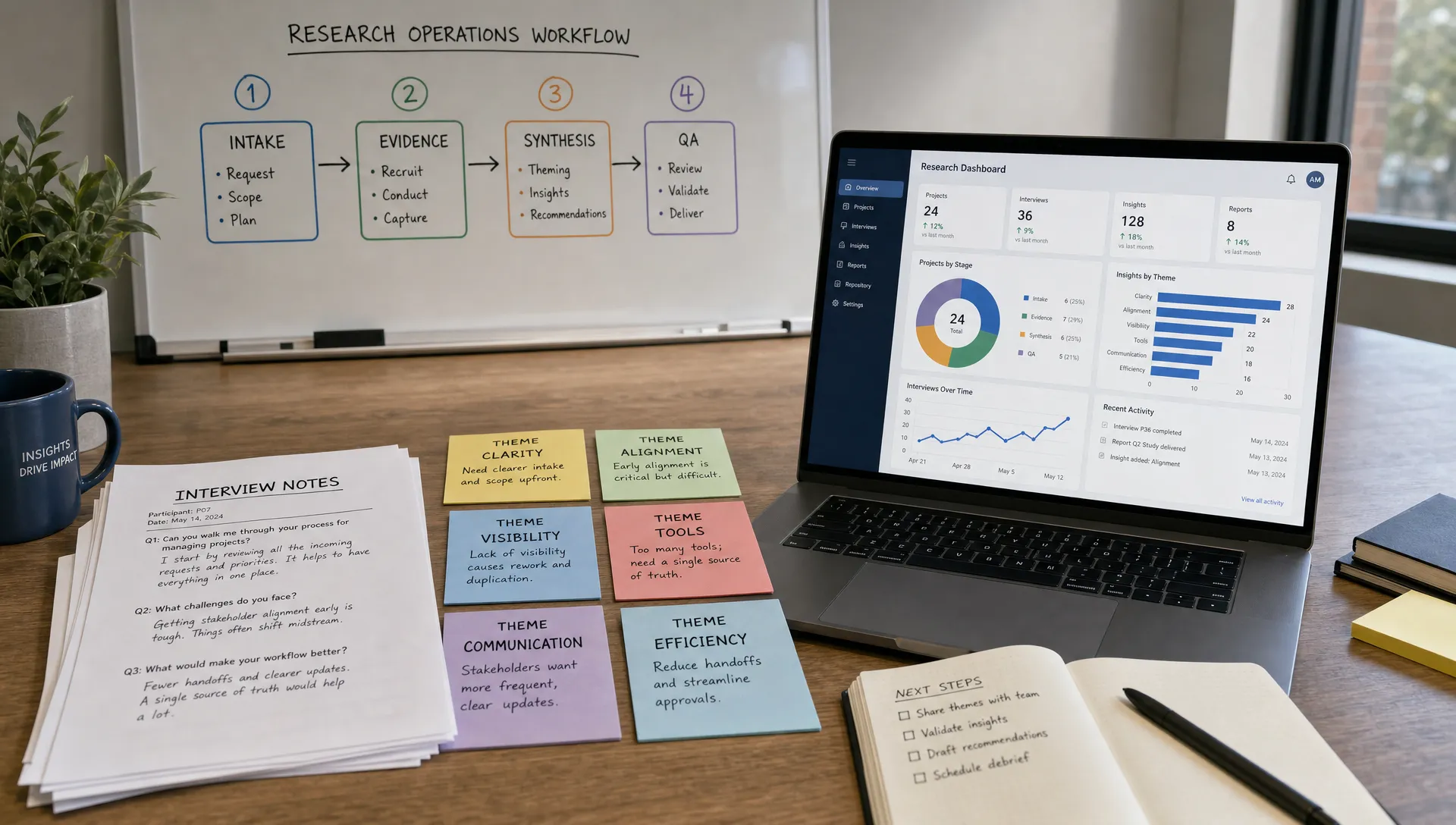
Build quality control into the AI workflow
AI quality control should not happen only at the end. It should be built into every stage where information is transformed.
A simple rule works well: the more a task affects client recommendations, the more human review it requires.
| Risk | What can go wrong | Control to add |
|---|---|---|
| Hallucinated claims | AI invents a fact, source, or implication | Require source citations for every factual claim |
| Overgeneralization | A small sample is treated like a market-wide truth | Label confidence levels and sample limitations |
| Lost nuance | Buyer quotes are flattened into generic themes | Preserve verbatim quotes and speaker context |
| Bias amplification | The model reinforces assumptions in the brief | Add contradiction prompts and alternative hypotheses |
| Confidentiality exposure | Sensitive client data is pasted into unsafe tools | Use approved tools, anonymization, and data handling rules |
| Weak recommendations | AI drafts plausible but shallow advice | Require researcher-owned implications and next steps |
For agencies building AI governance, the NIST AI Risk Management Framework is a helpful reference point because it emphasizes mapping, measuring, managing, and governing AI-related risk.
A practical agency policy does not need to be complicated. It should define which tools are approved, what data can be used, when anonymization is required, who reviews outputs, and which parts of the deliverable can never be published without human approval.
Protect client trust with transparency
Research agencies operate on trust. If a client suspects that AI is producing the thinking, confidence drops quickly. If the client sees that AI is improving speed, consistency, and evidence handling under expert supervision, confidence usually increases.
The best approach is simple transparency. Explain that AI may be used for operational support, such as organizing sources, summarizing transcripts, classifying themes, drafting outlines, or checking consistency. Also explain that research design, interpretation, recommendations, and final quality control remain human-led.
This framing matters because many clients are not anti-AI. They are anti-carelessness. They want to know that confidential data is protected, findings are traceable, and recommendations are not copied from a generic model output.
How AI improves agency economics
A B2B market research agency has two margin problems. First, senior people often do too much low-leverage work. Second, custom research can become operationally unique every time, even when the underlying process is similar.
AI helps when it turns repeated work into a system. Intake summaries, source extraction, transcript tagging, quote libraries, competitive grids, report QA, and draft assembly can all be partially standardized. That does not eliminate expertise. It protects it.
The financial upside usually appears in four places:
- Fewer hours spent cleaning and organizing inputs.
- Faster movement from raw evidence to first synthesis.
- Less rework caused by inconsistent reports or unsupported claims.
- More senior time available for interpretation and client advisory.
This is why AI should be evaluated as an operating margin tool, not just a productivity tool. The goal is not to make researchers busier. The goal is to make delivery more consistent, profitable, and defensible.
For a broader view of how operational systems protect profitability, see Archer’s article on agency marketing systems that protect your margin.
What not to automate
Some parts of B2B research should stay firmly human-led, even when AI supports the surrounding work.
Do not automate final research design decisions without expert review. Sampling, segmentation, question design, and methodology choices shape the entire project. A bad design cannot be fixed by faster analysis.
Do not automate the final strategic point of view. AI can draft options, but the agency must decide what the client should believe and do next.
Do not automate sensitive interpretation in regulated or high-stakes contexts without strict review. If findings affect healthcare, finance, legal, employment, or investor-facing decisions, the review standard should be higher.
Do not automate client communication in moments that require trust. AI can prepare briefing notes, but difficult conversations about weak data, changed recommendations, or unexpected findings need a human advisor.
A practical 30-day rollout plan
You do not need to transform the whole agency at once. Start with one workflow where AI can reduce delivery drag without creating major client risk.
- Week 1, map the workflow: Choose one process, such as transcript coding or competitor review, and document every step from input to deliverable.
- Week 2, standardize the inputs: Create templates for file naming, source logs, tagging categories, and the expected output format.
- Week 3, build the AI assist: Create prompts or automations that perform one narrow task, such as extracting buyer objections from transcripts into a structured table.
- Week 4, run a parallel test: Compare the AI-assisted workflow against the old workflow for speed, accuracy, completeness, and researcher satisfaction.
- After the test, decide: Keep, revise, or discard the workflow based on evidence, not enthusiasm.
The strongest early wins are usually boring. That is good. Boring workflows are easier to control, easier to QA, and more likely to improve margin without creating client risk.
Frequently Asked Questions
Can AI replace a B2B market research agency? No. AI can summarize, classify, draft, and accelerate analysis, but it does not replace research design, commercial judgment, client advisory, or accountability for recommendations.
What is the safest first AI use case for a research agency? Start with structured, low-risk internal work such as intake summarization, source logging, transcript tagging, or report QA. Avoid starting with final client recommendations.
How can agencies prevent AI hallucinations in research? Require source logs, link every factual claim to evidence, preserve original quotes, label confidence levels, and make human review mandatory before client delivery.
Should agencies tell clients they use AI? Yes, in plain language. Clients should understand that AI supports workflow efficiency and evidence organization, while human experts own research design, interpretation, and final recommendations.
Does AI mainly save time or improve quality? It can do both, but only with a controlled workflow. Without standards and QA, AI may save time while lowering quality. With good systems, it can reduce rework and improve consistency.
Turn AI into a research delivery advantage
AI works best when it is installed into the agency’s operating system, not scattered across disconnected tools and individual habits.
If your agency wants to improve delivery margin without adding another hire, Archer Scaling AI can help identify the workflows worth automating first, then install and run the AI ops layer behind them. The process starts with a risk-reversed Margin Teardown that maps the opportunity and the first automation moves before you commit to a larger build.