How B2B Marketing Firms Improve Delivery Efficiency
Learn how B2B marketing firms improve delivery efficiency with smarter intake, automation, AI ops, reporting, and margin-focused workflows.
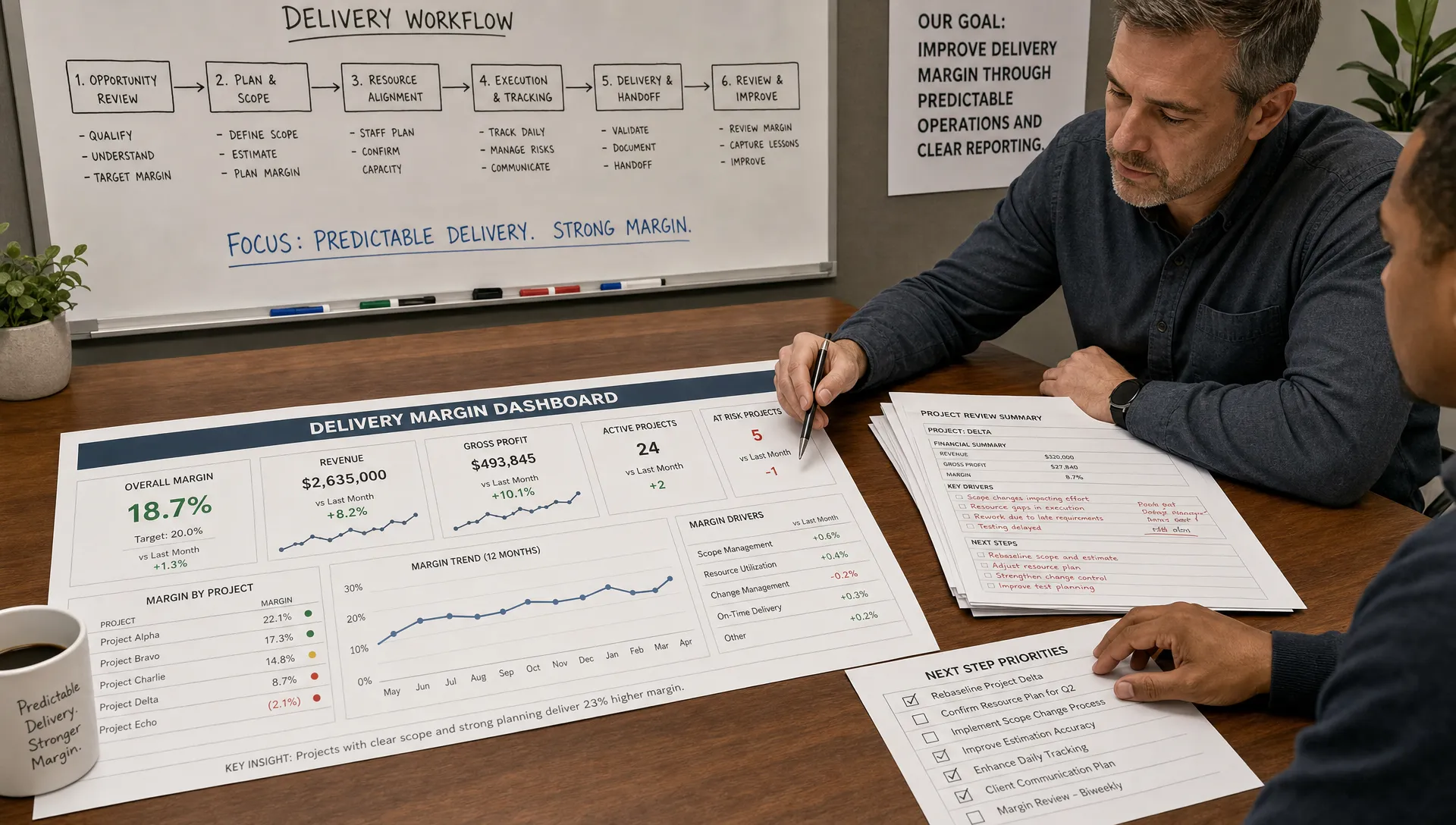
Most B2B marketing firms do not lose delivery efficiency because their teams are lazy or under-skilled. They lose it because delivery work grows faster than the operating system behind it.
A small agency can get away with heroic effort. A strategist remembers client preferences, a project manager fixes unclear briefs, a senior specialist rewrites weak work before it reaches the client, and reporting gets finished late because someone cares enough to stay online. That works until the agency adds more clients, more channels, more stakeholders, and more custom promises.
At that point, efficiency is no longer about working faster. It is about making delivery predictable. The firms that improve margins without lowering quality usually do three things well: they standardize the repeatable parts of delivery, automate the handoffs that create drag, and keep human judgment where it actually improves outcomes.
Define delivery efficiency by margin, not activity
A busy agency is not always an efficient one. If the team ships a lot of work but every deliverable requires too many meetings, revisions, Slack messages, and manual reports, the agency may be growing revenue while quietly shrinking margin.
Delivery efficiency should be measured around the relationship between client value, team time, and operational consistency. For B2B marketing firms, the most useful question is not, “How much did we produce?” It is, “How reliably did we produce the right work with the least avoidable effort?”
| Metric | What it reveals | Improvement signal |
|---|---|---|
| Gross delivery margin | Whether client work is profitable after labor and delivery costs | Margin rises while client outcomes stay stable or improve |
| Cycle time | How long work takes from request to approval | Work moves faster without more last-minute pressure |
| Rework rate | How often deliverables need major revision | Fewer avoidable edits, clearer briefs, better stage gates |
| On-time reporting | Whether client communication is predictable | Reports go out consistently with less manual assembly |
| Utilization quality | Whether senior talent is used on high-value work | Experts spend less time on admin and more time on judgment |
This matters because agencies often confuse utilization with efficiency. A strategist at 95 percent utilization may look productive on paper, but if half of that time is spent cleaning up handoffs, rebuilding reports, and answering repetitive client questions, the delivery model is fragile.
Map the delivery chain before fixing symptoms
Before adding tools or AI, map the work from the moment a client signs to the moment they receive a result. Most delivery leaks happen in the gaps between teams, not inside a single task.
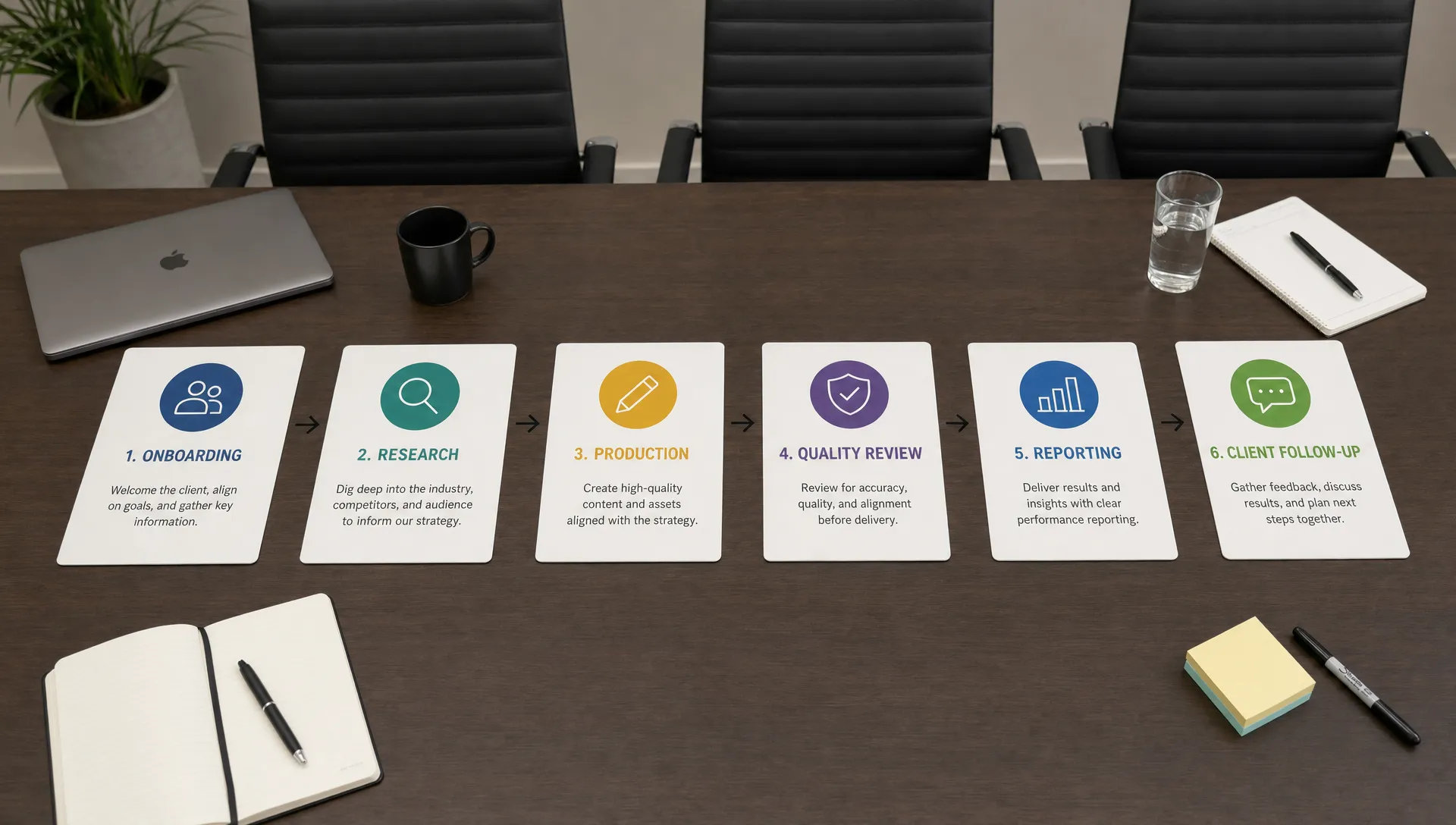
A typical B2B agency delivery chain includes sales handoff, onboarding, discovery, research, strategy, production, quality review, client approval, reporting, and renewal planning. Each step has inputs, owners, decisions, and outputs. When any of those are unclear, the next person compensates manually.
Common bottlenecks include:
- Sales promises that do not translate into delivery scope.
- Kickoff forms that collect information but do not create usable briefs.
- Research repeated from scratch for every client.
- Custom report decks rebuilt manually each month.
- Feedback arriving in scattered channels.
- Senior team members becoming the only quality control mechanism.
- CRM updates and client follow-ups relying on memory.
The goal is not to make every client engagement identical. It is to create a reliable operating spine, then allow expert customization where it matters. If your agency is already feeling margin pressure, it may help to look at how stronger agency marketing systems protect your margin before deciding whether the problem is staffing, pricing, or process.
Standardize before you automate
Automation only helps when the underlying process is worth repeating. If a workflow is unclear, automation can make the confusion faster. This is why the first efficiency move is usually standardization, not software.
Start by defining the minimum viable standard for your most repeated delivery motions. For most B2B marketing firms, that includes client onboarding, campaign intake, account research, content briefs, creative requests, QA, and reporting.
A good standard should answer four questions:
- What information is required before work begins?
- Who owns the next action?
- What does “done” mean at this stage?
- What should happen if inputs are missing or low quality?
For example, a specialist SEO provider may have different strategies for local businesses, ecommerce sites, and B2B service companies. Still, many delivery steps repeat, such as technical checks, keyword research, local visibility review, content planning, link opportunity tracking, and monthly reporting. A monthly rolling SEO agency such as SEO Bridge has to make those recurring steps efficient while still tailoring recommendations to each client’s market.
That same logic applies across demand generation, paid media, lifecycle marketing, RevOps, content, and creative agencies. The repeatable parts should be structured. The strategic parts should remain thoughtful.
Automate where repetition meets risk
The best early automation opportunities are not always the flashiest. Many agencies jump straight to AI content creation, but the highest-margin improvements often come from automating operational drag.
Look for workflows that are frequent, rules-based, and easy to review. These are usually better candidates than complex strategic tasks. If the work happens every week, requires the same inputs, follows predictable decision rules, and creates delays when missed, it belongs on the automation shortlist.
| Workflow | What to automate | What to keep human |
|---|---|---|
| Client onboarding | Form routing, folder creation, CRM updates, kickoff reminders | Relationship context and expectation setting |
| Research | Data collection, source organization, first-pass summaries | Strategic interpretation and recommendation |
| Content operations | Brief assembly, status tracking, internal reminders | Positioning, narrative, and editorial judgment |
| Reporting | Data pulls, recurring charts, draft commentary, anomaly flags | Client-facing insight and next-step prioritization |
| Lead routing | Qualification rules, assignment, follow-up reminders | Sales conversation quality and deal strategy |
| SOP management | Process documentation drafts, update reminders, searchable knowledge base | Final approval and operational nuance |
If you are unsure where to start, prioritize the workflows that touch every client and create the most context switching. This is why many agencies begin with onboarding, reporting, and CRM follow-up rather than isolated creative tasks. For a deeper breakdown, see this guide on what a marketing agency should automate first.
Build an AI ops layer, not a pile of AI prompts
AI can improve delivery efficiency, but only when it is embedded into the agency’s operating system. A shared prompt library may help individuals move faster, but it does not automatically improve delivery across the firm.
An AI ops layer is different. It connects tools, data, workflow rules, templates, and human review points into a repeatable system. Instead of asking each team member to remember how to use AI correctly, the system guides the work.
For example, an AI ops layer might take a completed onboarding form, create a structured internal brief, enrich the company profile, generate a first-pass research summary, assign kickoff tasks, and prepare the account lead with questions to validate. The human still owns the client relationship and strategy. The system removes the repetitive setup work.
The strongest agency AI workflows usually include:
- A clear trigger, such as a new deal marked closed-won or a reporting period ending.
- A defined input source, such as CRM fields, client forms, campaign data, or approved documents.
- A structured output, such as a brief, task list, QA checklist, report draft, or follow-up sequence.
- A human review point before anything client-facing is sent.
- Documentation so the workflow is not trapped in one person’s head.
This is the difference between “we use AI” and “AI reliably improves delivery margin.”
Reduce rework with better intake and stage gates
Rework is one of the most expensive forms of inefficiency because it looks like normal delivery activity. A second draft, another internal review, a revised report, an extra client call, a late-night “quick fix,” all of it consumes margin.
Some rework is healthy. Great strategy and creative work require iteration. The problem is avoidable rework caused by missing inputs, vague briefs, unclear approvals, or late stakeholder feedback.
B2B marketing firms can reduce avoidable rework by adding stage gates at the points where mistakes are cheapest to catch. A campaign brief should be approved before production starts. A report narrative should be reviewed before the deck is formatted. A content angle should be validated before drafting begins. A paid media test plan should be checked before launch, not after spend is already live.
Good stage gates are lightweight. They do not create bureaucracy. They prevent expensive backtracking by making sure the team has the right inputs before moving forward.
A simple stage gate might ask:
- Is the objective clear?
- Is the audience defined?
- Is the offer or message approved?
- Are required assets available?
- Is the owner of final approval named?
- Is the deadline realistic based on the current workload?
When these questions are answered early, delivery moves faster later.
Make reporting faster and more useful
Reporting is one of the biggest recurring efficiency drains inside B2B agencies. It is also one of the most important client retention moments. A report that takes hours to build but does not clarify what happens next is not just inefficient, it is a missed opportunity.
Efficient reporting systems separate data assembly from insight. Data assembly should be automated as much as possible. Insight should remain owned by the account lead or strategist.
The system can gather performance data, refresh dashboards, flag unusual changes, draft summaries, and populate a white-label report structure. The human then reviews what matters, connects performance to the client’s goals, and recommends next actions.
This shift improves delivery in two ways. First, it reduces the manual work required to produce reports. Second, it makes client conversations more strategic because the team is not spending all its energy assembling screenshots and charts.
The best reports answer three questions clearly: what happened, why it matters, and what we are doing next. If your current reporting process mostly explains activity, there is likely room to improve both efficiency and perceived value.
Use capacity signals before hiring
Many agencies hire too early because they treat operational friction as a staffing problem. More people can help, but hiring into a broken process often spreads the inefficiency across a larger team.
Before adding headcount, review capacity signals. Which roles are overloaded? Which clients consume more time than their retainer supports? Which deliverables regularly exceed estimate? Which workflows depend on one person? Which tasks could be batched, templated, delegated, or automated?
A simple capacity review can reveal whether the agency needs a new hire, a scope adjustment, a better process, or an automation layer. For example, if account managers are overwhelmed because they are manually chasing approvals, creating recurring reports, and updating CRM fields, a new account manager may only delay the problem. Automating those workflows may free meaningful capacity without changing the team structure.
This is especially important for agencies with senior specialists. If high-cost talent is spending time on admin, formatting, task chasing, and first-pass research, the agency is paying expert rates for operational work. Improving delivery efficiency means returning those people to the work that actually requires their expertise.
Create a 30-day delivery efficiency plan
You do not need to rebuild the entire agency at once. In fact, trying to redesign every process at the same time usually creates more friction. Start with one high-volume workflow and improve it end to end.
- Week 1, audit the workflow: Pick one recurring process such as onboarding, reporting, or content briefing. Map every step, owner, input, output, tool, and delay.
- Week 2, standardize the inputs: Create the required form fields, templates, naming conventions, definitions of done, and review points.
- Week 3, automate the repetitive handoffs: Add automation for task creation, reminders, file setup, CRM updates, draft summaries, or reporting pulls.
- Week 4, test with real client work: Run the workflow on active delivery, measure time saved, collect team feedback, and document what changes before expanding.
By the end of 30 days, you should have one workflow that is cleaner, faster, and easier to delegate. More importantly, you will have a model for improving the next workflow.
What efficient B2B marketing firms do differently
The most efficient agencies are not necessarily the ones with the most tools. They are the ones with the clearest operating rhythm.
They know what should happen when a lead becomes a client. They know what information is needed before work starts. They know which parts of delivery should be automated and which require senior judgment. They review work before errors become expensive. They document processes so quality does not depend on memory. They use AI to support delivery, not to create uncontrolled output.
In practice, that means the agency can scale without every new client creating a new operational burden. Delivery becomes less dependent on heroics and more dependent on systems.
That is where margin improves. Not from asking the team to move faster forever, but from removing the avoidable work that slows them down.
Frequently Asked Questions
What does delivery efficiency mean for B2B marketing firms? Delivery efficiency means producing strong client outcomes with less avoidable effort, fewer delays, and better margin control. It is not just speed. It includes clearer handoffs, less rework, faster reporting, better use of senior talent, and more predictable client delivery.
Where should a B2B marketing agency improve efficiency first? Start with high-volume workflows that touch most clients, such as onboarding, reporting, CRM follow-up, research, and content briefs. These areas usually create recurring manual work and are easier to standardize than complex strategic decisions.
Can AI improve agency delivery without lowering quality? Yes, if AI is used inside a controlled workflow with structured inputs, defined outputs, and human review. AI should handle repetitive preparation, organization, summarization, and routing, while people remain responsible for strategy, client context, and final judgment.
How do you measure whether delivery efficiency is improving? Track gross delivery margin, cycle time, rework rate, on-time reporting, workload balance, and how much senior time is spent on strategic versus administrative work. Efficiency is improving when the agency delivers equal or better outcomes with less operational drag.
Should agencies automate before hiring? Not always, but agencies should audit workflows before assuming they need another hire. If the team is overloaded because of repetitive admin, poor handoffs, or manual reporting, automation and process redesign may create capacity faster than hiring.
Want to find the margin leaks in your agency delivery system?
If your agency is growing but delivery feels heavier every month, the problem may not be your team. It may be the operating layer underneath the work.
Archer Scaling AI helps B2B marketing agencies improve delivery margin by installing and running AI-powered operations systems for workflows like onboarding, research, reporting, CRM, content ops, lead routing, SOPs, and follow-up. The process starts with a paid Margin Teardown, giving you a roadmap and three automation moves, or it is on me.
If you want to see where efficiency is leaking before you hire again, start with the teardown and see the actual system running live before you commit.