Branding for B2B Companies That Need Sales Alignment
Branding for B2B companies needs sales alignment. Learn how to turn positioning into usable sales assets, CRM inputs, and pipeline clarity.
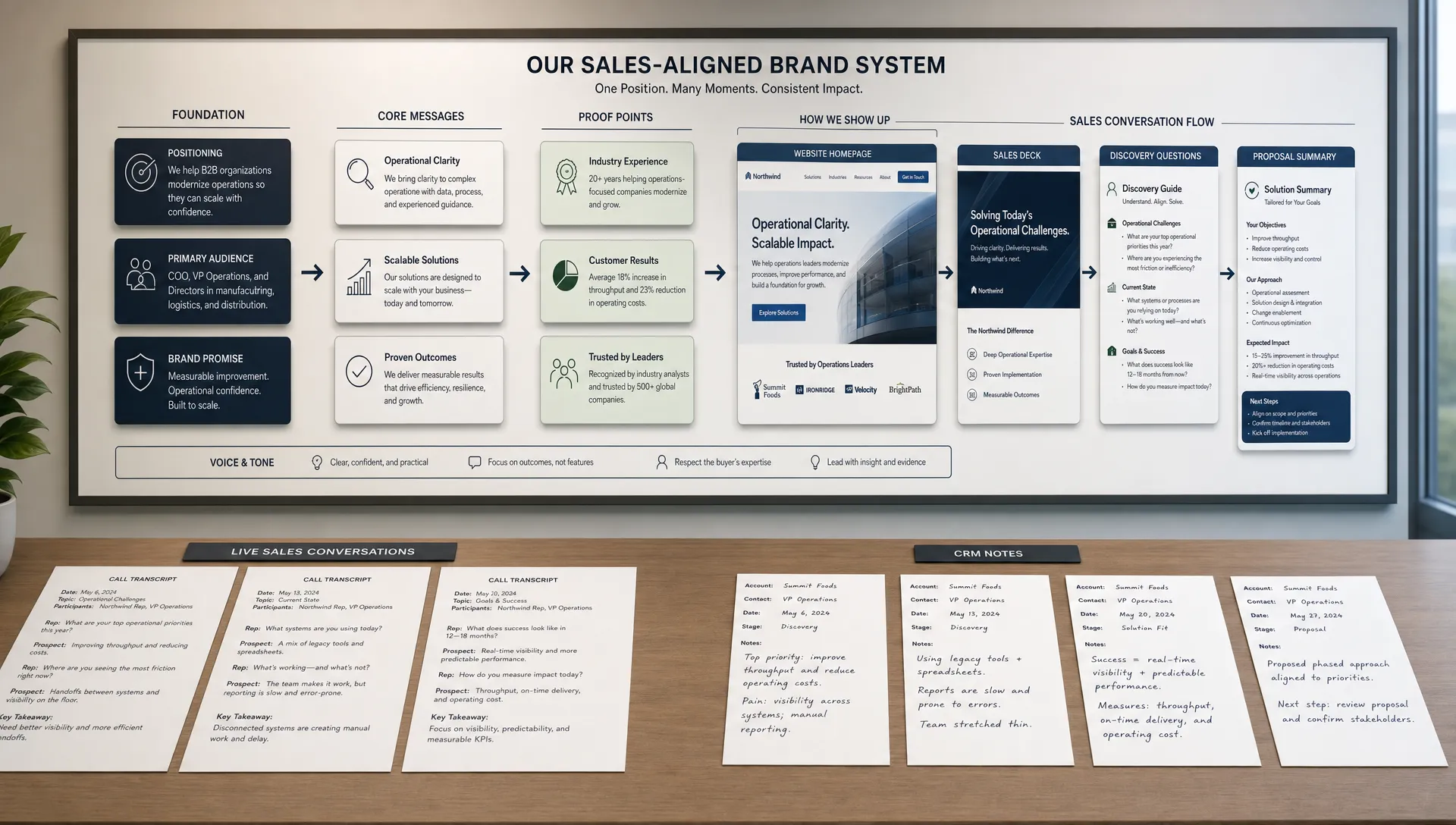
Branding for B2B companies becomes far more valuable when it helps Sales create urgency, handle objections, and move the right opportunities forward. If the new positioning looks sharp on the website but reps keep using the old pitch on calls, the brand has not really launched. It has been published.
For B2B marketing agencies, consultants, and internal marketing leaders, the real challenge is not just creating a distinctive identity. It is building a brand system that Sales can trust under pressure, especially in long buying cycles with multiple stakeholders, budget scrutiny, and complex handoffs.
Sales-aligned branding does not mean Sales gets to dictate the logo, tagline, or creative direction. It means the brand strategy is built from market truth, translated into usable sales language, and reinforced through the workflows where revenue actually happens.
What sales alignment really means in B2B branding
Sales alignment is often misunderstood as a workshop where Sales gives feedback on messaging. That is a start, but it is not enough.
A sales-aligned B2B brand answers the questions prospects ask before they are ready to buy, the questions reps face during active opportunities, and the questions buyers take back to their internal teams after the call ends. It gives the company a shared commercial language.
That shared language should show up in:
- The website and landing pages
- Sales decks and one-pagers
- Discovery questions and qualification criteria
- Case studies and proof points
- CRM fields, lifecycle stages, and follow-up sequences
- Onboarding, proposals, and customer success handoffs
The goal is consistency without making everyone sound robotic. A good B2B brand gives Sales enough structure to stay on message and enough flexibility to adapt to the buyer in front of them.
| Branding question | Sales-aligned version | Why it matters |
|---|---|---|
| Who are we for? | Which accounts, roles, triggers, and use cases are the best fit? | Sales can qualify faster and avoid low-fit opportunities. |
| What do we promise? | Which business outcome does the buyer believe is worth changing for? | Messaging connects to urgency, not just preference. |
| Why are we different? | Which alternative do buyers compare us against, and why do we win? | Reps can compete against the real status quo. |
| What proof do we have? | Which evidence supports each claim by segment, problem, or stage? | Sales can use the right proof at the right time. |
| How should we sound? | Which language feels credible in a sales conversation? | Brand voice becomes usable, not ornamental. |
Why brand and sales drift apart
Most B2B brand projects do not fail because the strategy is weak. They fail because the strategy is never operationalized.
Marketing creates the narrative, Sales keeps learning from live conversations, leadership has strong opinions, and customer success hears the pain that appears after implementation. If those inputs never become part of a shared system, every team starts speaking a slightly different language.
This creates familiar symptoms. The homepage says one thing, the sales deck says another, and the proposal uses language from a previous positioning cycle. Reps customize slides because they do not trust the official material. Marketing blames Sales for going off-script. Sales blames Marketing for sounding too abstract.
For agencies, this disconnect often shows up as endless feedback cycles. A brand concept gets approved in theory, then stalls when stakeholders see how it would actually be used in sales conversations. If that is a recurring issue, the operational approach behind reducing B2B branding revision loops is worth applying early, before creative review becomes the battleground.
The fix is not more opinions. It is better inputs, clearer decision rights, and assets built for real sales situations.
The inputs every sales-aligned brand needs
Before writing positioning or refreshing the visual identity, gather the evidence that reveals how buyers actually think. This is especially important in B2B because the buyer is rarely a single person. A CFO, VP, technical evaluator, end user, and executive sponsor may all need different reasons to believe.
Start with five inputs.
First, analyze recent sales calls and demos. Look for repeated pain language, misconceptions, objections, urgency triggers, and phrases buyers use when the problem becomes financially important.
Second, review closed-won and closed-lost notes. The most useful insights are often hidden in why deals moved, stalled, or disappeared. If loss reasons are vague, such as no budget or not a priority, the brand work should also improve the way those reasons are captured.
Third, map the buying committee. A brand that only speaks to the champion may fail when procurement, finance, or the executive sponsor enters the conversation.
Fourth, audit the proof library. Many B2B companies have case studies, testimonials, statistics, and customer quotes, but they are not organized by use case or buying stage. Sales needs proof that matches the conversation, not a folder full of disconnected assets.
Fifth, inspect CRM and follow-up workflows. If the brand promise is about speed, precision, trust, or expertise, the sales process needs to demonstrate those qualities after the first conversion. This is where brand becomes behavior.
In PE-backed or portfolio environments, the same logic becomes even more commercial: firms that advise on revenue acceleration and commercial infrastructure often start by tightening positioning, sales motion, and operational follow-through together, because brand only compounds when the revenue system can use it.
Build a message architecture reps can actually use
A message architecture is the bridge between brand strategy and sales execution. It should not be a 40-page deck that only marketers understand. It should be a practical hierarchy of claims, language, proof, and use cases.
A strong architecture includes these layers:
| Layer | What it defines | Sales use case |
|---|---|---|
| Market point of view | What is changing in the market and why it matters now | Opening conversations with relevance |
| ICP pain | The specific operational, financial, or strategic pain the buyer recognizes | Discovery and qualification |
| Primary promise | The outcome the company can credibly help create | Positioning the offer clearly |
| Differentiators | The reasons the company is meaningfully different from alternatives | Competitive conversations |
| Proof points | Evidence that supports each claim | Objection handling and internal buy-in |
| Disqualifiers | Who the company is not built for | Protecting pipeline quality |
| Voice principles | How the company should sound in high-stakes conversations | Keeping reps consistent without scripting them |
The most overlooked layer is disqualification. A brand that is afraid to exclude bad-fit buyers becomes vague. Sales alignment improves when the company can clearly say who it serves best, who it does not, and what conditions need to exist for the solution to work.
That clarity protects both revenue and margin. It reduces poor-fit opportunities, prevents over-customized proposals, and helps reps focus on accounts where the brand promise can actually be delivered.
Turn brand strategy into revenue assets
Branding for B2B companies should produce more than a website, logo system, and style guide. Those matter, but Sales needs assets that help them navigate real buyer moments.
The most useful deliverables are often simple. A one-page positioning guide. A discovery question bank. A proof matrix by segment. A short objection library. A proposal introduction that matches the new narrative. A sales deck that follows the buyer journey instead of the company org chart.
| Revenue moment | Brand asset needed | What good looks like |
|---|---|---|
| First call | Talk track and discovery prompts | Reps can connect the problem to business impact quickly. |
| Post-demo follow-up | Email snippets and proof links | Follow-up reinforces the core narrative without manual rewriting. |
| Internal buyer sharing | One-page business case | Champions can explain the value without improvising. |
| Competitive evaluation | Differentiator matrix | Sales can compare without sounding defensive. |
| Proposal stage | Branded proposal narrative | The proposal repeats the buying logic, not just the scope. |
| Handoff to delivery | Customer onboarding summary | Delivery understands what was promised and why the client bought. |
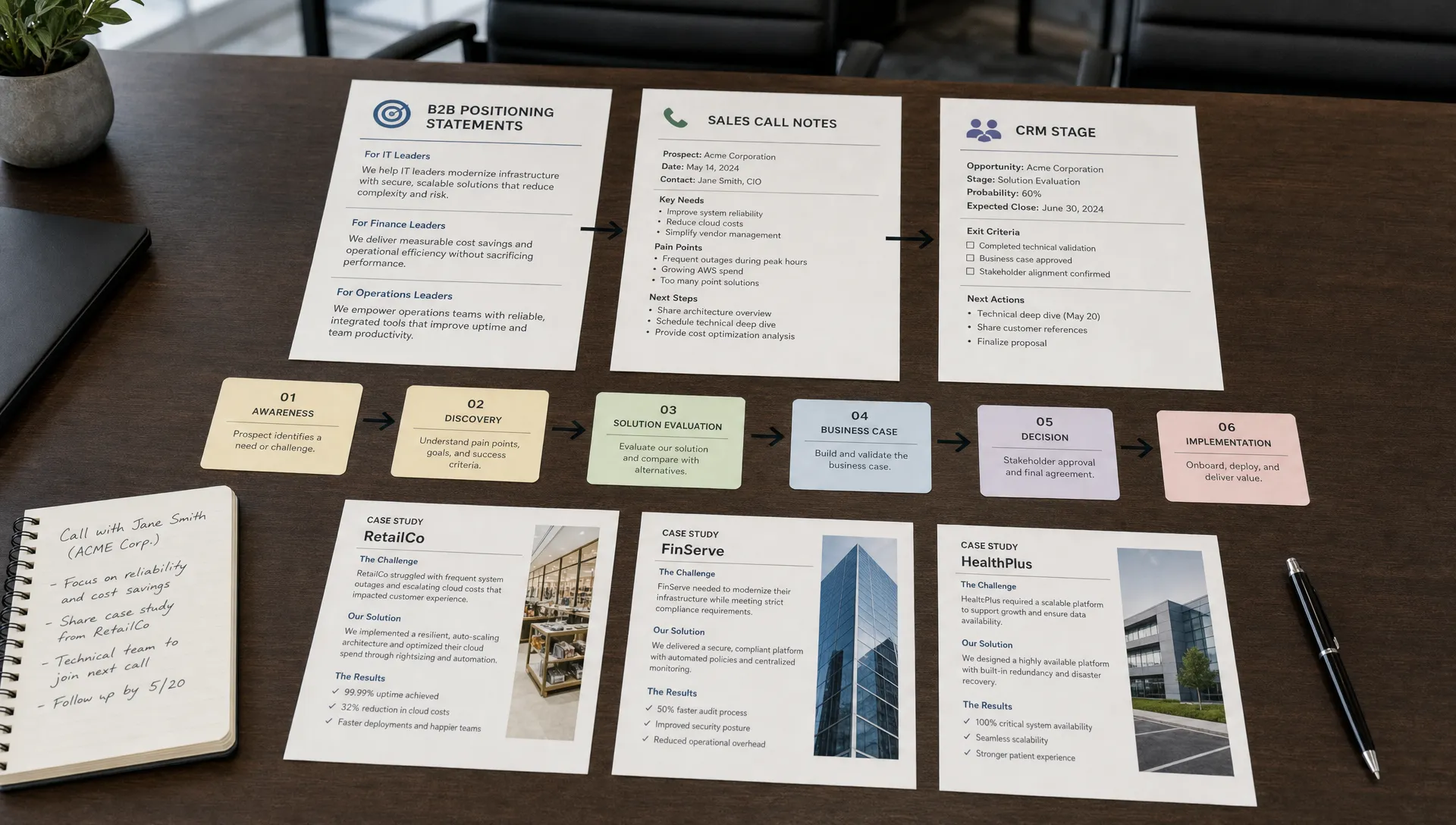
This is where many B2B companies lose momentum. The brand launch happens publicly, but the sales enablement layer is left for later. By the time Sales receives the new assets, reps have already built their own workarounds.
Agencies can avoid this by planning brand deliverables and sales assets together. The brand system should not be handed off as a finished campaign. It should be installed into the commercial workflow.
Launch the brand like an operating system
A sales-aligned brand launch needs more than an all-hands presentation. It needs a rollout plan that changes the way teams work.
Start by deciding which materials become the source of truth. If the positioning guide, website copy, sales deck, CRM notes, and onboarding templates all contain slightly different language, misalignment will return within weeks.
Next, define decision rights. Sales should influence how messaging works in conversations, but not every rep should be able to rewrite the brand. Marketing should own consistency, but not ignore what buyers are saying. Leadership should approve strategic choices, but not reopen every word after testing begins.
Then build feedback loops. After launch, review call snippets, deal notes, and rep feedback at scheduled intervals. Look for patterns, not isolated preferences. If three reps report that buyers do not understand a phrase, fix the phrase. If one rep dislikes the tone, investigate before changing the system.
Finally, connect the brand to operational workflows. CRM fields, lead routing, reporting templates, content briefs, and follow-up sequences should reflect the same positioning. Otherwise, the brand stays in the presentation layer while the revenue team operates from old habits.
This is where AI operations can help, especially for agencies managing multiple B2B clients. AI can assist with transcript mining, brief creation, reporting summaries, first-draft content variations, and QA checks. The key is to systemize before automating. If the inputs are messy, automation simply scales the mess. That is the same operating principle behind improving delivery efficiency for B2B marketing firms.
Measure whether the brand is helping Sales
You cannot measure B2B brand alignment only by looking at logo feedback, website traffic, or campaign engagement. Those can be useful signals, but they do not prove that Sales can use the brand.
Use a mix of adoption metrics, conversation quality indicators, and pipeline signals.
| Metric | What it tells you | How to use it |
|---|---|---|
| Sales asset adoption | Whether reps use the new materials | Identify which assets are useful and which need revision. |
| Message consistency in calls | Whether the core narrative survives live conversation | Coach reps and refine language. |
| Objection frequency | Which concerns still block deals | Improve proof, positioning, or qualification. |
| Stage conversion rate | Whether opportunities progress more cleanly | Compare before and after launch where possible. |
| Deal quality | Whether the brand attracts better-fit opportunities | Monitor fit, margin, and delivery risk. |
| Follow-up speed and relevance | Whether the post-conversion experience matches the brand | Strengthen routing, CRM hygiene, and nurture. |
Be careful not to over-attribute every sales improvement to branding. Markets shift, reps improve, offers change, and campaigns vary. The better question is whether the brand creates clearer conversations and fewer avoidable disconnects.
If warm opportunities often go quiet after initial interest, the issue may not be the brand message alone. It may be follow-up operations. In that case, the same discipline used to stop losing warm B2B leads should be part of the brand rollout.
Common mistakes to avoid
The biggest mistake is treating sales alignment as a single approval step. Sales should not first encounter the brand when asked to approve final copy. Bring sales evidence into strategy early, then use reps to pressure-test usability before launch.
Another mistake is confusing clarity with blandness. Sales teams often ask for simple language because they need to be understood quickly. That does not mean the brand should sound generic. The best B2B positioning is clear enough for a sales call and sharp enough to be remembered.
A third mistake is launching the website before the sales system is ready. Buyers who convert from the new site should experience the same message in the first response, meeting agenda, sales deck, proposal, and onboarding handoff. If they do not, trust erodes.
Finally, do not automate sales assets before the message architecture is stable. AI can speed up production, but it needs rules, examples, and review points. Otherwise, each asset becomes a slightly different interpretation of the brand.
Frequently Asked Questions
What is sales-aligned branding for B2B companies? Sales-aligned branding is a brand strategy that connects positioning, messaging, proof, and voice to the way Sales qualifies, educates, and converts buyers. It ensures the brand is usable in real revenue conversations, not just in marketing materials.
Should Sales control B2B brand messaging? No. Sales should provide market evidence, buyer language, objections, and feedback from live conversations. Marketing should translate that input into a consistent brand system that supports the company strategy.
Which sales assets should come from a B2B branding project? Useful assets include a positioning guide, discovery prompts, sales deck, proof matrix, objection library, follow-up snippets, proposal narrative, and onboarding handoff language. The exact mix depends on the sales motion.
How do you know if a B2B brand is working for Sales? Look for asset adoption, consistent messaging in calls, improved qualification, clearer follow-up, fewer repeated objections, and better-fit opportunities. Pipeline metrics matter, but they should be interpreted alongside sales behavior.
Can AI help with B2B brand and sales alignment? Yes, if the strategy and workflows are already clear. AI can help analyze call transcripts, summarize objections, generate asset drafts, route follow-up tasks, and maintain consistency. Human review is still essential for judgment and brand quality.
Build a brand Sales can actually run with
A B2B brand becomes commercially useful when it is installed into the sales motion, not just announced to the market. That means clearer inputs, sharper positioning, practical sales assets, consistent workflows, and feedback loops that keep the system current.
If you run a B2B marketing agency and your team is doing too much of this alignment work manually, Archer Scaling AI can help install and run the AI ops layer behind research, reporting, onboarding, content ops, and follow-up. The process starts with a paid Margin Teardown that identifies the roadmap and three automation moves, with a risk-reversed structure.
When the brand, sales process, and operating system reinforce each other, alignment stops being a meeting topic. It becomes the way revenue work gets done.