How B2B Branding Agencies Reduce Revision Loops
Learn how B2B branding agencies reduce revision loops with clearer briefs, stage gates, structured feedback, and AI-supported operations.
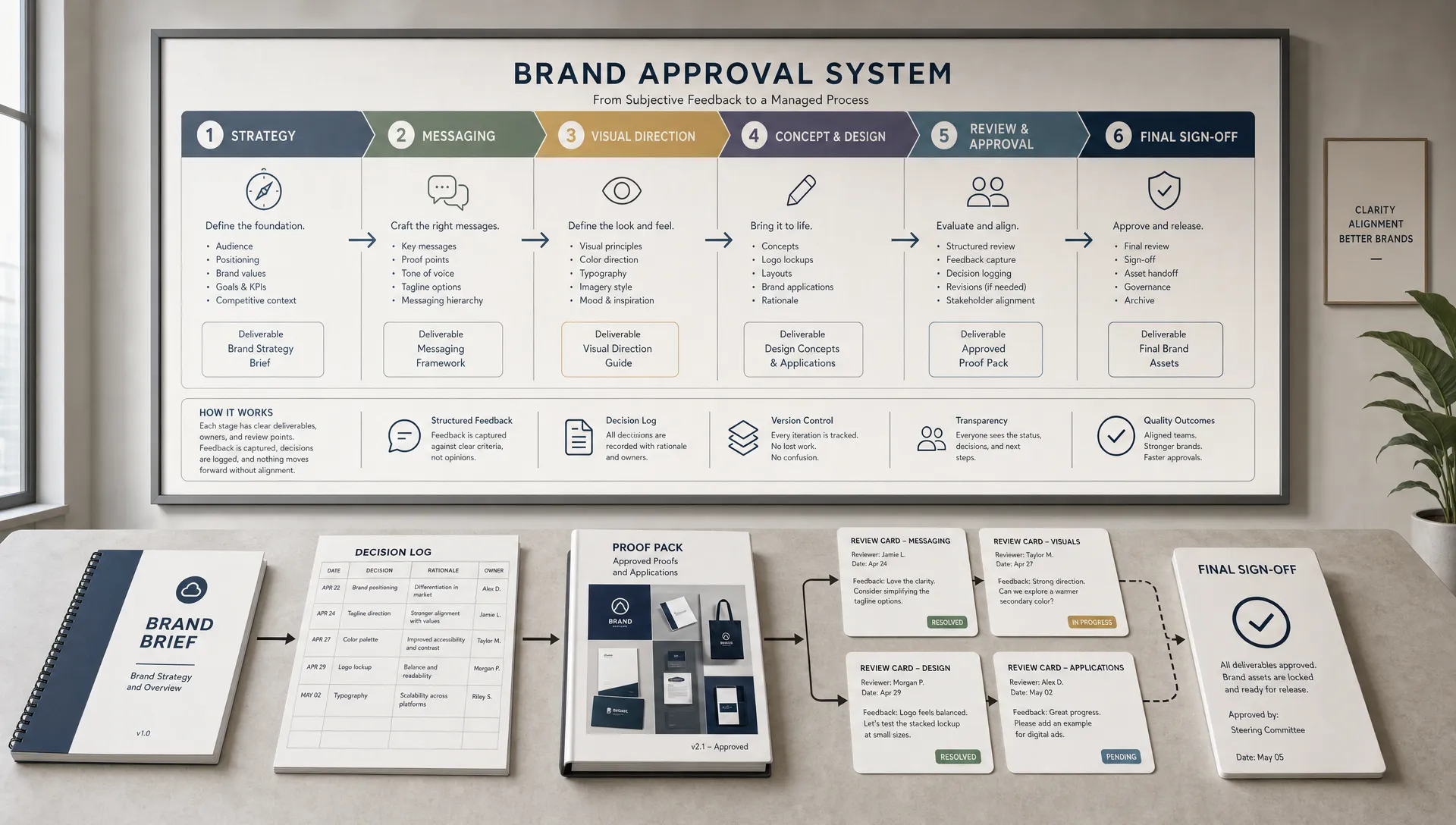
Revision loops rarely start because a client “doesn’t know what they want.” In B2B branding, they usually happen because the agency has not turned subjective creative decisions into an operationally managed approval system.
That distinction matters. B2B branding agencies are not just choosing colors, typography, messaging, and campaign-ready assets. They are helping companies reduce sales friction, clarify positioning, align internal teams, and look credible to buyers who may involve finance, security, procurement, product, and the C-suite. More stakeholders means more opinions. More opinions means more chances for the project to drift.
The fix is not to make the creative process rigid. The fix is to protect the creative process with better intake, clearer decision rights, stronger stage gates, and smarter automation around the repetitive parts of review management.
Why revision loops happen in B2B branding projects
A revision loop is not the same as a normal revision round. Normal revision rounds sharpen the work. Revision loops reopen decisions, repeat conversations, and send the team back to the same problem without new information.
For branding agencies, the most expensive loops often come from hidden misalignment that only surfaces once the client sees creative work. A homepage hero statement becomes a debate about category strategy. A logo direction becomes a proxy battle over whether the company wants to feel enterprise-grade or challenger-led. A tone-of-voice comment turns into a disagreement between sales and product marketing.
The visible feedback is usually about the asset. The real issue is often upstream.
| Revision loop symptom | Likely root cause | Operational fix |
|---|---|---|
| “Can we make it feel more premium?” appears late in design | Positioning and audience expectations were not locked | Approve positioning criteria before visual exploration |
| Multiple executives give conflicting comments | No single decision owner | Assign one consolidated client-side approver |
| Messaging keeps changing after design starts | Strategy and copy were reviewed together too loosely | Separate strategy, verbal identity, and visual identity approvals |
| Feedback is mostly taste-based | No agreed evaluation criteria | Review work against ICP, market context, and business goals |
| Previously approved work is reopened | No stage gate or decision log | Lock decisions by stage and require new evidence to reopen |
The pattern is clear: revision loops are operational failures before they are creative failures. That is why agencies that treat feedback as a managed system tend to protect both quality and margin.
Define “done” before the first concept
The fastest way to reduce revisions is to stop starting creative work with an incomplete definition of success.
A strong brand brief should not only describe the company. It should define what the work must accomplish, who it must persuade, what constraints matter, and which subjective preferences should not override strategy. The brief becomes the standard against which ideas are judged.
For a B2B brand project, “done” should be defined across several areas:
- Target buyer and buying committee
- Primary category or market frame
- Positioning statement and strategic tradeoffs
- Messaging hierarchy and proof points
- Personality traits and tone boundaries
- Competitor differentiation
- Sales, website, and campaign use cases
- Decision owner and required reviewers
The most useful part of the brief is often the tradeoff section. If a client says they want to feel “bold, trusted, premium, human, technical, simple, category-defining, and approachable,” the agency has not received direction. It has received a pile of adjectives.
A better brief forces choices. Should the brand feel more established or more disruptive? Should messaging prioritize operational value or strategic transformation? Should the visual identity reassure conservative buyers or signal category change? If the client cannot answer those questions before concepting, they will answer them through revision comments later.
Separate strategy, verbal identity, and visual approval
Many branding projects create revision loops because too many decision types are reviewed at once.
When a client sees a full concept presentation, they may react to strategy, messaging, design, naming, voice, hierarchy, photography, and execution details in the same meeting. That sounds efficient, but it often creates confusion. If the positioning is not settled, every headline is vulnerable. If the messaging hierarchy is unclear, every layout feels wrong. If the audience is still debated, every design direction becomes subjective.
A cleaner process separates approvals into stages.
First, approve the strategic foundation. This includes audience, positioning, market frame, differentiation, and core narrative. Do not move forward if the client is still debating the business direction.
Second, approve verbal identity. This includes messaging architecture, value proposition, voice principles, key phrases, and language to avoid. This gives the visual team a clear content system to design around.
Third, approve visual direction. This includes identity concepts, design principles, art direction, and examples of application. At this stage, feedback should be evaluated against already-approved strategy and messaging.
Fourth, approve asset adaptation. This is where the system gets applied to website sections, sales decks, social templates, event materials, paid media, or internal rollout pieces. Feedback here should mostly be about fit, usability, and consistency, not whether the brand strategy is correct.
This is the same operational principle behind broader creative delivery systems: protect each stage from unresolved decisions in the stage before it. For a related perspective, Archer Scaling AI has written about how better agency operations reduce creative rework by improving intake, handoffs, and review discipline.
Replace open-ended feedback with structured review prompts
Open-ended feedback invites open-ended revisions.
If the review prompt is “What do you think?”, the client will give reactions. Some reactions will be useful. Others will be personal, political, incomplete, or contradictory. The agency then has to interpret comments, reconcile conflicts, and decide which opinions matter.
A stronger review process asks the client to evaluate the work through specific lenses. For example:
- Does this direction reflect the approved positioning?
- Does it speak to the primary buyer, not just internal stakeholders?
- Does it create enough separation from named competitors?
- Does it support the agreed use cases?
- Is the concern strategic, factual, legal, or preferential?
- Is this feedback blocking approval, or is it a refinement?
The last question is especially powerful. Many revision loops happen because agencies treat every comment as equally important. A CEO’s preference, a legal correction, a sales team concern, and a junior stakeholder’s design taste may all appear in the same comment thread. They should not carry the same weight.
Structured feedback should also require consolidation. Instead of collecting comments from ten people across email, Slack, Figma, Google Docs, and meeting notes, ask the client to provide one consolidated response from the approved decision owner. That does not silence stakeholders. It makes the client resolve internal disagreement before it becomes agency rework.
Use proof packs to reduce taste-based debates
Taste is not the enemy. Taste becomes expensive when it is disconnected from evidence.
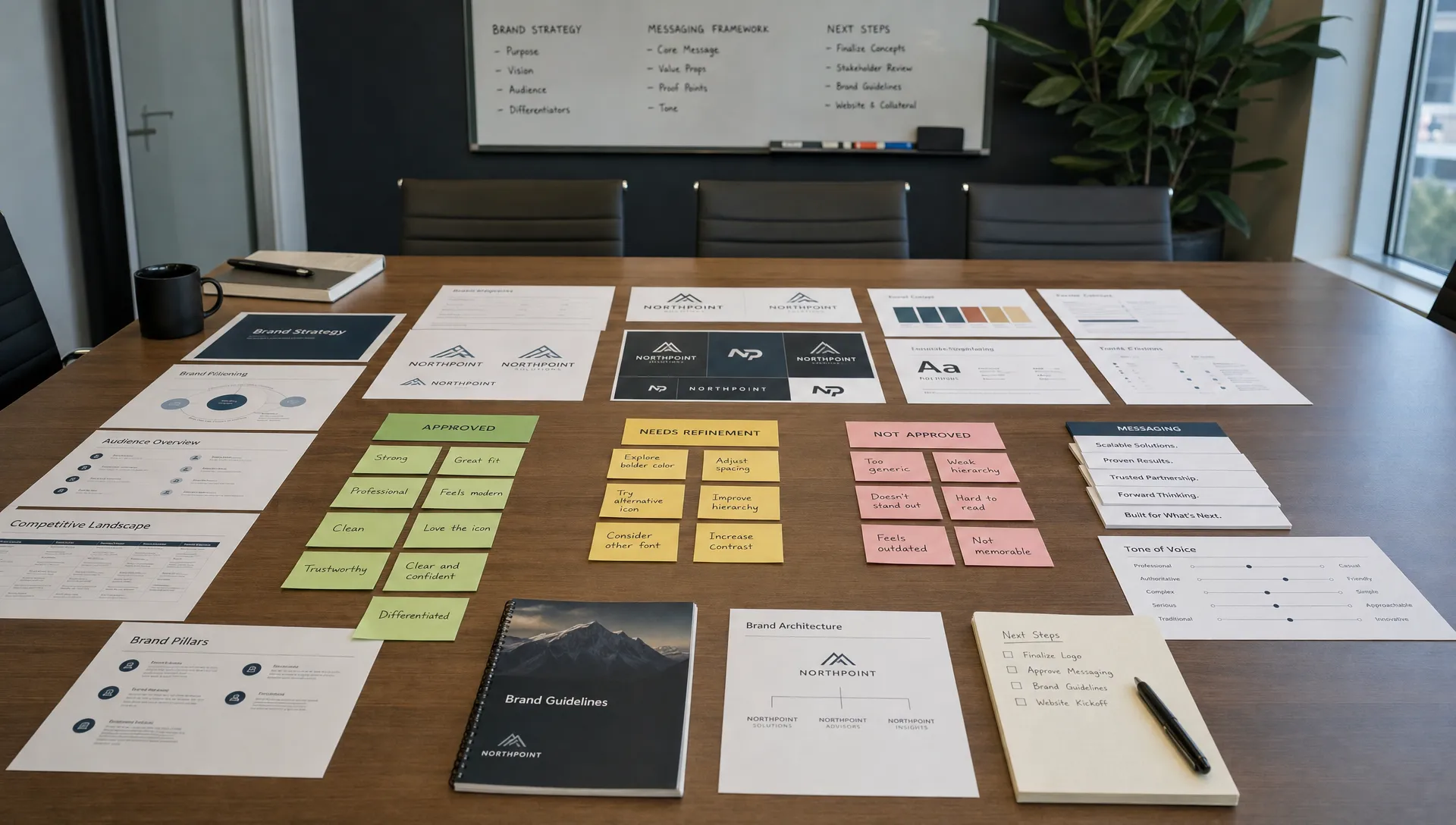
A proof pack is a short evidence layer that supports your strategic and creative recommendations. It is not a giant research appendix. It is a practical tool that helps stakeholders understand why a direction exists.
For B2B branding agencies, a useful proof pack may include competitor patterns, buyer language from sales calls, category clichés to avoid, examples of overused visual conventions, messaging gaps, and customer proof points. The goal is to move the conversation from “I like it” to “This supports the strategy because...”
Proof packs are especially valuable when working with technical, enterprise, or founder-led companies. These clients may have strong internal opinions, but they often respond well to evidence. If you can show that every competitor uses the same “AI-powered platform for modern teams” language, your recommendation for sharper messaging feels less risky. If you can show that the buying committee cares about implementation certainty, your case for clearer proof points becomes easier to approve.
The proof pack should travel with the work. Do not only present it once during strategy. Bring it back during creative reviews, messaging discussions, and final approvals. Revision loops shrink when everyone can see the decision criteria at the moment they are making decisions.
Install stage gates that prevent approved work from being reopened
Stage gates sound bureaucratic until you calculate the cost of not having them.
A stage gate is a clear approval point that says, “This decision is now locked unless new information changes the brief.” Without that rule, every future review can become a chance to relitigate the past. That is how a visual identity review turns into a positioning debate, or a website copy review turns into a naming discussion.
A practical stage gate does not need to be complicated. It should capture four things: what was approved, who approved it, what assumptions it depends on, and what would justify reopening it.
| Stage gate | What gets locked | What can still change later |
|---|---|---|
| Strategy approval | ICP, positioning, market frame, differentiation | Minor wording if meaning stays intact |
| Messaging approval | Narrative, value proposition, message hierarchy | Short-form adaptations for channels |
| Visual direction approval | Core identity principles and selected direction | Production details and application refinements |
| Asset system approval | Templates, usage rules, rollout structure | Individual asset tweaks within the system |
The phrase “new information” is important. A client can reopen a decision if there is a real reason, such as a legal issue, product shift, executive mandate, customer insight, or market change. But “we had another thought” should not automatically restart the project.
This is not about being difficult. It is about making tradeoffs visible. If a client wants to reopen an approved decision, they should understand the impact on timeline, budget, and downstream work.
Automate the uncreative parts of revision control
The agency’s best creative talent should not be spending hours chasing comments, cleaning up feedback threads, checking whether stakeholders responded, or manually summarizing contradictions.
This is where AI operations can help. The goal is not to let AI replace creative judgment. The goal is to automate the repetitive workflow around creative judgment so humans spend more time making good decisions.
For revision control, automation can help with intake, meeting recap, stakeholder reminders, feedback categorization, decision logs, asset checklists, and handoff updates. For example, an AI-assisted workflow can collect all review comments, tag them as strategic, factual, legal, preference-based, or executional, then draft a summary for the account lead to approve. Another workflow can compare new comments against the approved brief and flag when feedback appears to contradict a locked decision.
Agencies can also automate operational QA around the tools that support client review. If your process includes client portals, approval notifications, test accounts, or signup verification flows, programmable temporary inboxes for AI agents and QA automation can help teams capture email events as structured data instead of manually checking inboxes during workflow tests.
The best automation lives around the process, not inside the final creative decision. AI can prepare, route, summarize, compare, remind, and document. The agency still owns judgment, strategy, taste, and client trust.
If your agency is already feeling the drag from manual handoffs, it may help to step back and look at where systems can improve delivery efficiency across repeatable workflows before adding more people to compensate for broken process.
Make stakeholder management part of the scope
B2B branding projects fail when stakeholder management is treated as informal account service rather than a scoped delivery function.
Different stakeholders evaluate the brand through different lenses. The founder may care about ambition and narrative. Sales may care about buyer clarity. Marketing may care about campaign usability. Product may care about technical accuracy. Legal may care about risk. Customer success may care about whether the promise matches delivery.
Those perspectives are legitimate, but they should not all enter the process at the same time or with the same authority.
A strong project plan defines who participates in each stage. Executives may need to approve strategic direction, but they may not need to comment on every icon. Sales may need to validate messaging resonance, but not choose typography. Legal may need a review window for claims, but should not be introduced after the final presentation.
This is where agencies can protect both the relationship and the work. Instead of saying, “Too many people are giving feedback,” say, “To keep the project moving, we need each stakeholder involved at the stage where their input has the most leverage.”
That framing makes the process feel like risk management, not gatekeeping.
Track revision data like a margin metric
Most agencies know when revisions feel painful. Fewer agencies measure the patterns.
If you want to reduce revision loops consistently, track the data behind them. You do not need a complex dashboard to start. Even a simple project retrospective can reveal where margin is leaking.
Useful revision metrics include average number of review rounds by deliverable type, percentage of comments that contradict approved strategy, number of stakeholders commenting after the review deadline, amount of time spent consolidating feedback, and number of approved decisions reopened later.
Over time, these metrics show whether the problem is client-specific or systemic. If one project had chaotic feedback, you may have had a difficult client. If every brand project has late strategy revisions, the agency has a stage-gate problem. If every website rollout creates rework, the issue may be handoff quality or asset documentation.
This is also how agency leaders connect creative operations to profitability. Revision loops are not just annoying. They consume senior time, delay invoicing, create opportunity cost, and reduce the margin on fixed-fee work. Strong systems are one of the simplest ways to protect agency margins without lowering quality or overloading the team.
What a low-revision brand project cadence looks like
A low-revision project is not one with no feedback. It is one where feedback arrives at the right time, from the right people, against the right criteria.
A healthy cadence might look like this:
| Project moment | Agency action | Client action |
|---|---|---|
| Kickoff | Confirm goals, stakeholders, constraints, and decision rights | Name one decision owner and required reviewers |
| Discovery synthesis | Present insights and strategic tensions | Validate what is true, missing, or misunderstood |
| Strategy approval | Lock ICP, positioning, differentiation, and narrative direction | Approve or resolve strategic tradeoffs |
| Verbal identity | Present messaging system and voice principles | Review for clarity, accuracy, and buyer relevance |
| Visual direction | Present concepts tied to approved strategy | Evaluate against criteria, not personal taste alone |
| System rollout | Apply approved identity across priority assets | Request refinements within the locked system |
| Final handoff | Deliver guidelines, assets, and decision documentation | Confirm adoption needs and remaining edge cases |
This cadence reduces the emotional weight of big reveal moments. Clients still get strong creative work, but each presentation builds on a decision they already made. That makes approval feel safer and revisions more focused.
Frequently Asked Questions
How many revision rounds should a B2B branding agency include? Many agencies include two structured rounds per major phase, but the exact number matters less than how feedback is managed. A single unstructured round can create more rework than three well-scoped rounds with clear criteria and one decision owner.
What is the biggest cause of revision loops in branding projects? The biggest cause is usually unresolved strategy showing up as creative feedback. If positioning, audience, differentiation, or stakeholder authority is unclear, the project will likely absorb that uncertainty during messaging and design reviews.
Should agencies charge for extra revision rounds? Yes, but only after the scope and approval process are clear. Charging for extra rounds works best when the agency has documented what was approved, what changed, and why the new request sits outside the agreed process.
Can AI reduce branding revisions? AI can reduce the operational causes of revisions by summarizing feedback, tagging comment types, maintaining decision logs, checking comments against briefs, and automating reminders. It should support human creative judgment, not replace it.
Turn revision control into an operating system
Reducing revision loops is not about making clients easier. It is about making the work easier to approve.
When your agency defines success early, separates decision stages, structures feedback, documents approvals, and automates the repetitive coordination around reviews, revision loops become less frequent and less expensive.
If revision drag is eating into delivery margin, Archer Scaling AI helps B2B marketing agencies install and run the AI ops layer behind workflows like onboarding, reporting, research, follow-up, and creative operations. The process starts with a paid Margin Teardown: a roadmap and three automation moves, or it is on me.