How Creative Agencies Cut Rework With Better Ops
Learn how creative agencies cut rework with better ops, clearer briefs, review gates, AI workflows, and margin-protecting systems.
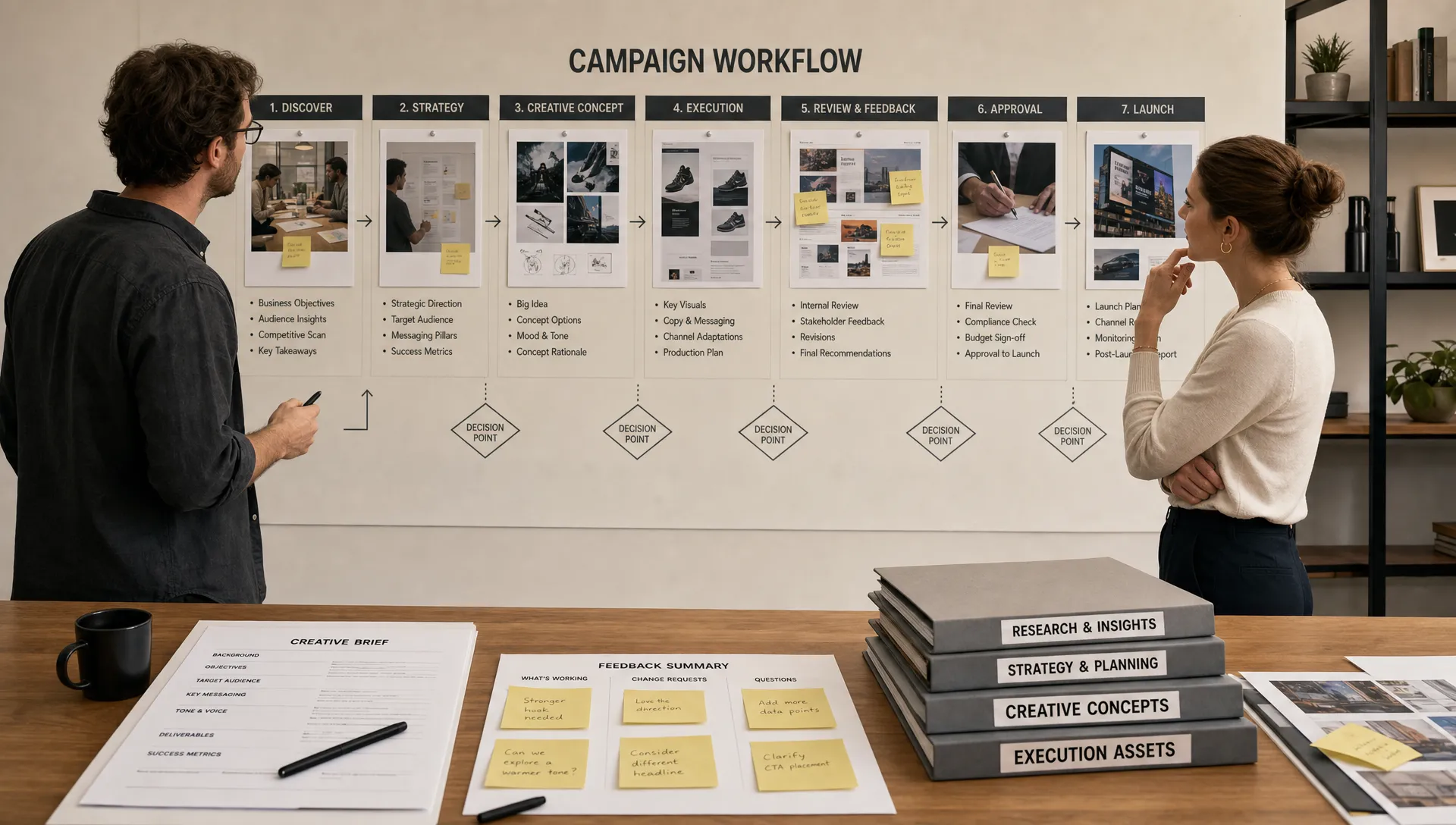
Rework is one of the quietest margin leaks in a creative agency. It rarely arrives as a single dramatic failure. It shows up as “one more version,” a second kickoff because the first one missed context, a designer waiting on feedback, a strategist rewriting copy after the client finally shares the real positioning, or an account manager stitching together updates from six tools before a status call.
Some revision is part of creative work. The problem is preventable rework, the work your team repeats because inputs were unclear, decisions were undocumented, approvals were vague, or the workflow let the wrong people review the wrong thing at the wrong time.
For creative agencies, better ops are not about turning the team into a factory. Better ops create the conditions for better creative work: cleaner briefs, fewer interruptions, clearer decision rights, stronger handoffs, and a shared definition of “done.” The result is simple: fewer rounds, faster delivery, and more margin without asking everyone to work nights.
Why rework happens in creative agencies
Rework is usually treated as a client management problem or a talent problem. Sometimes it is. More often, it is an operating system problem.
A creative team can only move fast when the agency has an intentional path from strategy to execution. If the sales call, discovery notes, brand guidelines, campaign goals, audience insights, and approval criteria live in different places, every deliverable becomes a reconstruction project. The team is not starting from truth. They are starting from fragments.
This is why agencies that feel “busy but stuck” often have talented people and decent demand, yet still lose money in delivery. The work is not flowing. It is bouncing.
| Rework pattern | Common cause | Better ops fix |
|---|---|---|
| The first draft misses the mark | The brief captures tasks, not decisions | Require strategy context, audience, offer, constraints, and success criteria before production starts |
| Clients give contradictory feedback | Too many reviewers with unclear roles | Define one decision owner and separate opinion gathering from approval |
| Creative gets revised late | Internal QA happens after client review | Add review gates before anything leaves the agency |
| The team recreates assets | Past work is hard to find or poorly named | Standardize folders, naming conventions, and reusable components |
| Reports trigger new debates | Metrics are pulled manually and inconsistently | Use repeatable reporting templates and automated data collection |
The pattern is predictable: when ops are informal, rework becomes the coordination method. People compensate with more Slack messages, more meetings, and more heroic effort. That may work for a small team, but it breaks as soon as the agency takes on more accounts, more channels, or more complex retainers.
Better ops start before the creative brief
Many agencies try to reduce rework by improving the creative brief. That helps, but the brief is not the beginning of the workflow. It is the output of everything that happens before production.
A strong brief depends on a strong intake process. Intake should translate scattered inputs into usable direction. That means the agency needs a consistent way to capture the client’s goal, the target audience, the offer, the competitive context, the approval path, the brand constraints, the available source material, and the business outcome the work is meant to influence.
The best intake systems also make missing information visible. If the team cannot identify the decision owner, the main call to action, or the source of truth for messaging, that should be caught before a designer opens Figma or a copywriter starts a draft.
A practical intake standard can include:
- A single client source of truth for goals, positioning, audience, and assets
- Required fields for offer, channel, deadline, decision owner, and approval criteria
- A pre-production checklist that blocks work until critical inputs are present
- A short assumptions section that shows what the team is proceeding with if information is incomplete
- A documented handoff from account strategy to creative execution
This is not bureaucracy. It is margin protection. Every unclear input that enters production becomes an expensive clarification later.
If your agency is deciding where to begin, the highest leverage starting point is usually not AI-generated content. It is operational drag. Archer Scaling AI covers this prioritization in more depth in its guide on what a marketing agency should automate first, especially for teams that want automation to protect delivery capacity rather than create more noise.
Define “done” at every stage, not just at the end
Creative agencies often treat “done” as a final approval state. That is too late. By then, the team may have already spent hours moving in the wrong direction.
Better ops define “done” at each stage of the work. A concept can be done before it becomes a polished design. A strategy can be done before it becomes copy. An internal review can be done before anything reaches the client. Each stage should answer a different question.
For example, a campaign landing page might move through these gates:
| Stage | The question it answers | Who should approve it |
|---|---|---|
| Strategy | Are we solving the right problem for the right audience? | Strategist and account lead |
| Structure | Does the page flow support the offer and conversion goal? | Strategist, copy lead, design lead |
| Creative direction | Does the concept match the brand and campaign angle? | Creative director or senior reviewer |
| Production quality | Is the work accurate, polished, and ready to send? | Internal QA owner |
| Client approval | Does the client accept the recommendation or request changes? | Named client decision owner |
This staged approach reduces the most painful type of rework: late-stage strategic change. If a client challenges the core message after a page is designed, the team loses more than copy time. It loses design time, QA time, project management time, and often trust.
Stage gates also protect senior people. Without them, creative directors and strategists get pulled into every emergency. With them, they can review the right decisions at the right moment.
Make feedback operational, not emotional
Feedback is where many creative workflows fall apart. Not because clients are unreasonable, but because agencies often do not define what kind of feedback is useful at each stage.
A client reviewing a first concept should not be line-editing button copy. A client reviewing final production should not be reopening positioning. Internal reviewers should not be giving taste-based comments without tying them to the brief. When feedback is not constrained by stage, every review becomes a chance to restart the work.
Better ops turn feedback into a structured process. The agency should clarify who can comment, who can decide, where feedback lives, when it is due, and what happens if feedback conflicts. This is especially important for creative agencies serving teams with multiple stakeholders, such as founders, revenue leaders, product marketers, and brand managers.
A simple rule works well: feedback should be tied to the objective, the audience, the brief, or a documented brand standard. If the feedback is only a personal preference, it can still be considered, but it should not automatically become a revision.
This approach does not make the agency rigid. It makes the recommendation stronger. The agency can say, “We can make that change, but here is the tradeoff against the goal we agreed on.” That changes the conversation from subjective taste to business alignment.
Use visibility to cut diagnostic waste
A surprising amount of rework comes from not knowing what changed, who changed it, or why. This happens in creative files, project boards, CRM records, reporting dashboards, content calendars, and client onboarding documents.
When a workflow is a black box, the team spends time diagnosing before it can fix anything. That diagnostic time feels productive because people are working hard, but it is usually margin leakage.
The same principle applies outside agency operations. In complex business systems, visibility into changes can prevent expensive troubleshooting. If your agency works around complex client systems, the same lesson appears in ERP environments, where AI and NetSuite consulting teams reduce diagnostic guesswork by making system changes and operational risks easier to isolate before they become bigger problems.
For an agency, the takeaway is straightforward: make the workflow inspectable. If a campaign has gone off track, you should be able to see the original brief, the approved strategy, the versions sent, the feedback received, the owner of each decision, and the current status without asking five people.
Visibility is not just about tools. It is about designing the system so the important context cannot disappear.
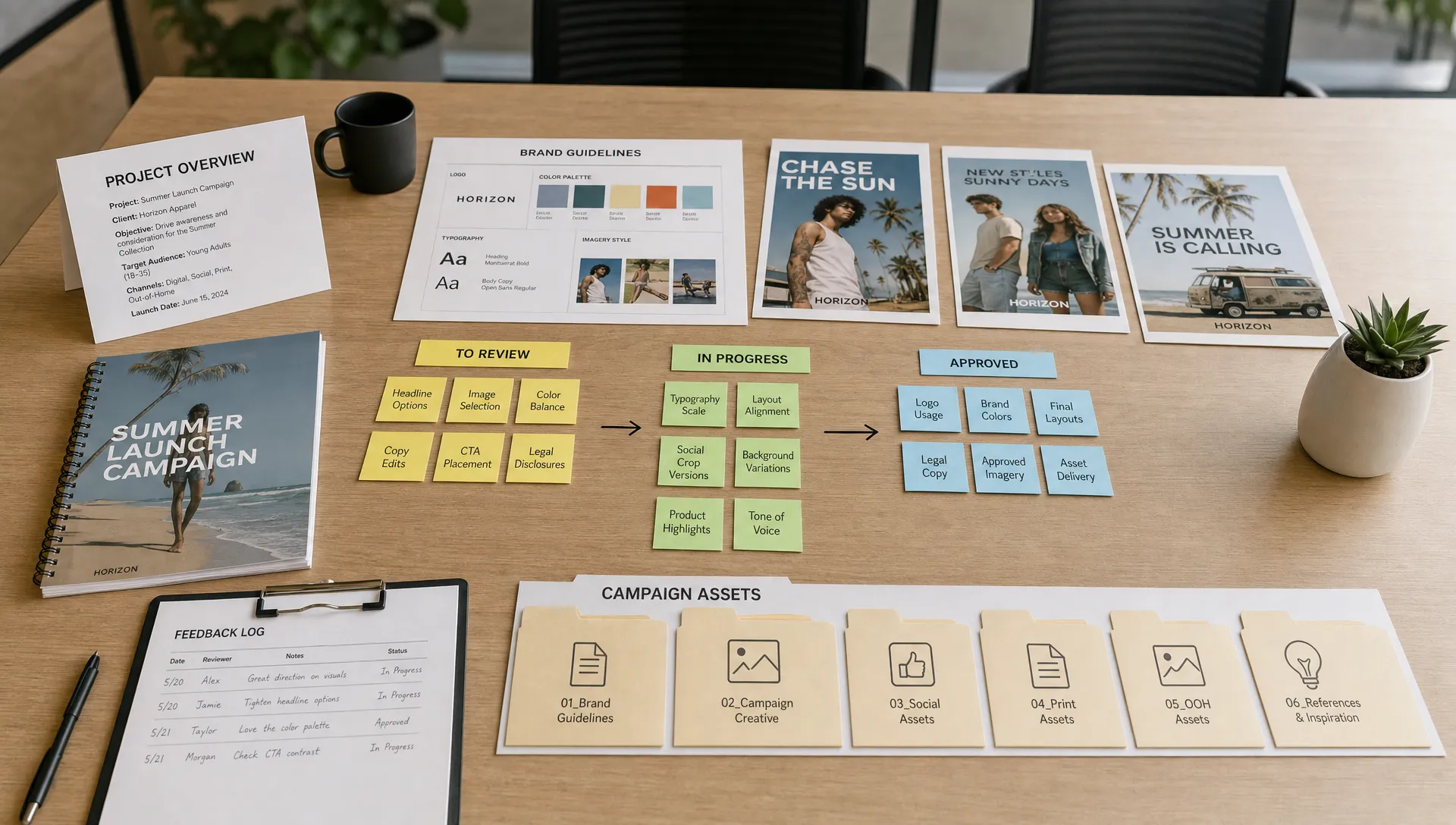
Where AI ops can reduce rework without flattening creativity
AI should not replace creative judgment. In a strong agency, it should remove the repetitive operational work that keeps creative people away from judgment.
The best use of AI ops is not “write everything for us.” It is “make sure the team has the right context, in the right format, at the right time.” That might mean turning discovery call transcripts into structured briefs, summarizing client feedback against the original objective, checking whether a draft includes required offer points, generating reporting narratives from approved metrics, or routing follow-up tasks after a client meeting.
This is where an AI ops layer becomes valuable. It connects the tools, data, workflows, and human review points that already exist inside the agency. Instead of adding another app for the team to manage, it makes the operating rhythm more consistent.
According to Asana’s Anatomy of Work research, knowledge workers spend a large share of their time on “work about work,” such as searching for information, switching between apps, chasing status, and coordinating tasks. Agencies feel this pain intensely because delivery depends on both collaboration and precision.
AI ops can help creative teams by handling repeatable coordination tasks such as:
- Converting sales and discovery notes into first-draft onboarding records
- Checking briefs for missing inputs before work begins
- Summarizing meeting notes into decisions, risks, and next steps
- Creating internal QA checklists based on service type
- Drafting client status updates from project data
- Routing approved deliverables into the right reporting or handoff workflow
The point is not to make the agency more mechanical. The point is to stop using senior talent as human glue.
For a broader view of how this works across marketing teams, Archer Scaling AI explains the concept in its article on why marketing departments need an AI ops layer. The same logic applies inside agencies, where tool sprawl and manual coordination quickly become delivery bottlenecks.
Measure rework like a margin metric
If rework is not measured, it gets explained away. The team says the client was difficult, the scope was unclear, or the creative needed more polish. Those things may be true, but they do not help the agency improve unless they are captured as operational data.
You do not need a complicated analytics system to start. Track a few simple metrics for each client or project type.
| Metric | What it reveals | How to use it |
|---|---|---|
| Revision rounds per deliverable | Whether review cycles are expanding | Compare by client, service, and project manager |
| Rework hours | How much margin is lost after first delivery | Separate planned revisions from preventable rework |
| Brief completeness score | Whether missing inputs predict revisions | Improve intake questions and pre-production checks |
| Approval cycle time | Where work waits or stalls | Identify slow reviewers and unclear decision paths |
| Internal QA defects | Whether mistakes are caught before client review | Strengthen templates, checklists, and ownership |
| Scope change frequency | Whether strategy shifts after work begins | Improve discovery, pricing, and change control |
The goal is not to shame the team. It is to find patterns. If one service line consistently needs four rounds while another needs two, the problem may be in the offer, the brief, the template, or the client education process. If one client always reopens strategy at the final review, the approval process needs to change.
Once rework is visible, the agency can fix the system instead of asking people to “be more careful.”
A 30-day plan to cut rework
You do not need to redesign the whole agency in one week. Start with one recurring deliverable that creates visible rework, such as landing pages, ads, email campaigns, monthly reports, or content packages. Then tighten the operating path around that deliverable.
- Days 1 to 7: Map the current workflow: Document every step from intake to final approval. Include tools, owners, handoffs, review points, and places where the team usually waits or revises.
- Days 8 to 14: Identify the top three rework triggers: Review recent projects and label why revisions happened. Common causes include missing inputs, late stakeholder feedback, unclear strategy, QA misses, and scope changes.
- Days 15 to 21: Install stage gates and checklists: Add pre-production requirements, internal QA, and client feedback rules. Keep the process lightweight enough that the team will actually use it.
- Days 22 to 30: Automate one repeatable handoff: Choose a workflow that already has clear rules, such as brief generation, meeting recap routing, reporting prep, or onboarding task creation.
This sequence works because it avoids automating chaos. You clarify the work first, then automate the parts that repeat.
If you want to go deeper on the margin side, the article on agency marketing systems that protect your margin covers how repeatable systems across onboarding, research, production, reporting, and follow-up create more durable delivery economics.
The real goal: protect creative energy
The strongest creative agencies do not cut rework by squeezing people harder. They cut rework by making the right work easier to do.
That means fewer vague kickoffs. Fewer mystery approvals. Fewer late strategic reversals. Fewer manual status hunts. Fewer “where is the latest version?” moments. Fewer reports rebuilt from scratch every month.
Better ops give creative teams more space for the work clients actually value: sharper thinking, stronger concepts, better storytelling, and more confident recommendations. When the operating system is clean, creativity has room to compound.
Frequently Asked Questions
What is considered rework in a creative agency? Rework is any repeated effort caused by unclear inputs, missed requirements, poor handoffs, late approvals, conflicting feedback, or quality issues. Planned revisions can be healthy, but preventable rework reduces margin and slows delivery.
How can creative agencies reduce client revisions? Agencies can reduce revisions by improving intake, defining approval owners, using stage-based reviews, tying feedback to objectives, and adding internal QA before client delivery. The goal is not zero revisions, but fewer avoidable loops.
Should agencies use AI to reduce rework? Yes, when AI is used for operational support rather than replacing creative judgment. AI can summarize calls, check briefs, route tasks, prepare reporting narratives, and highlight missing information before production starts.
What should an agency automate first to cut rework? Start with the workflow that causes the most repeated coordination, such as client onboarding, brief creation, reporting prep, or meeting follow-up. Avoid automating a broken process before the rules and owners are clear.
Ready to find the rework hiding in your agency?
If preventable revisions, manual handoffs, and unclear workflows are eating into delivery margin, Archer Scaling AI can help you find the highest leverage fixes.
The process starts with a paid Margin Teardown: a risk-reversed audit that identifies where your agency is losing margin and maps three automation moves to improve delivery operations. From there, Archer Scaling AI can build and run the AI ops layer across workflows like onboarding, reporting, CRM follow-up, SOPs, and content operations.
Start with Archer Scaling AI if you want better agency ops without adding another full-time hire.