What Marketing Work Should Agencies Automate First?
Learn what marketing work agencies should automate first to protect margin, reduce rework, and scale delivery without unnecessary hires.
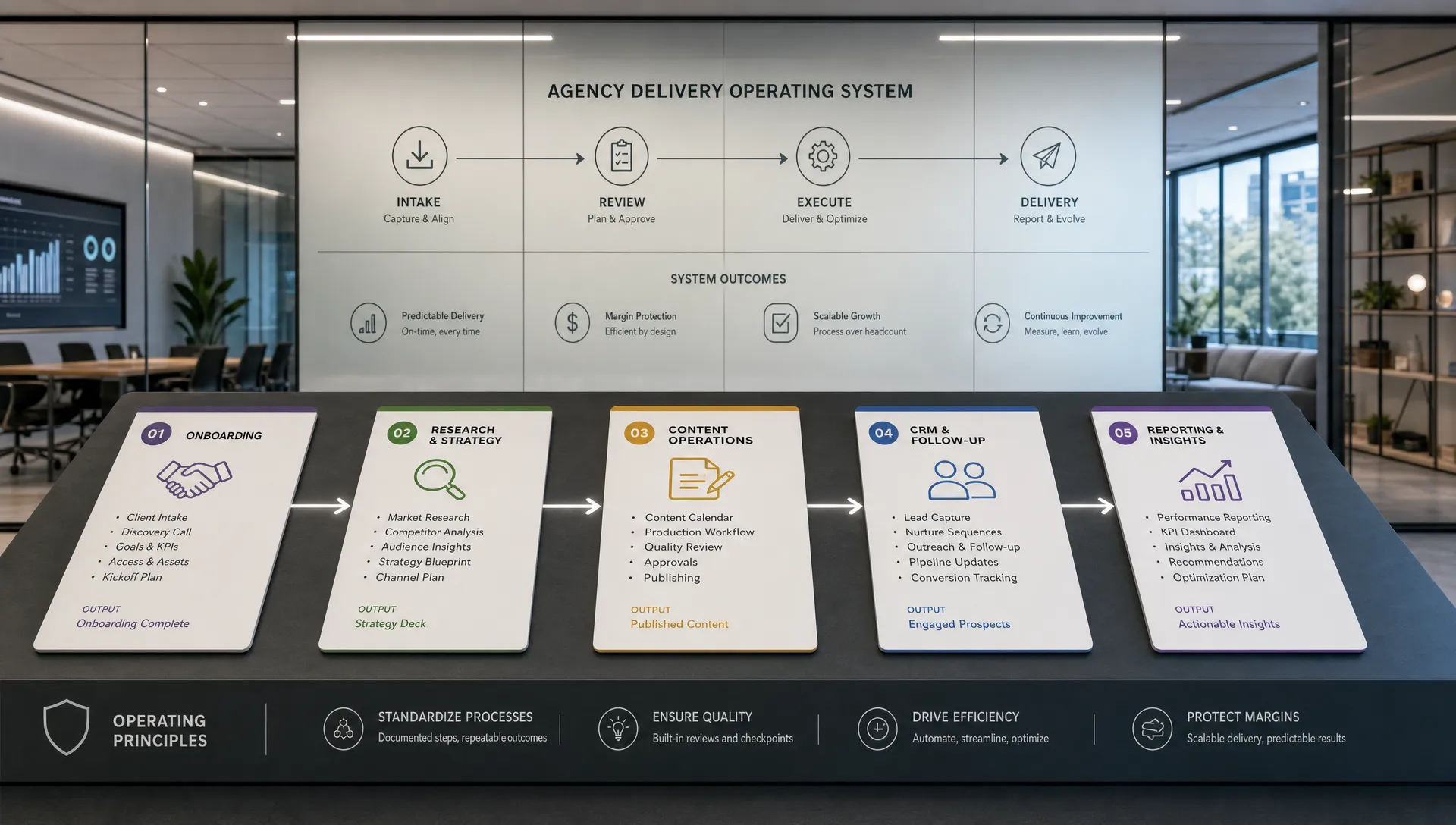
If your agency is asking what marketing work to automate first, resist the urge to start with the task that feels most annoying or the AI demo that looks most impressive.
The best first automation is usually not a content generator, a chatbot, or a giant end-to-end agent. It is the repeatable operational work that sits around delivery: the handoffs, intake, cleanup, routing, QA, reporting prep, and follow-up that drain margin without making the work more strategic.
That distinction matters. Automating the wrong workflow makes chaos move faster. Automating the right one gives your team more capacity, fewer dropped balls, and cleaner delivery without hiring another coordinator just to keep the machine moving.
Start with the work around the work
In most B2B marketing agencies, delivery breaks into three layers.
Strategic work is where humans should stay close: positioning, messaging, campaign strategy, offer thinking, client recommendations, and creative judgment. Production work turns strategy into assets and execution. Operational work keeps everything moving between people, tools, clients, and deadlines.
The first automation target should almost always come from the operational layer.
Why? Because operational work has the best mix of high repetition, clear rules, low strategic risk, and measurable margin impact. It is also where senior people quietly lose hours every week. They are not doing strategy, they are chasing logins, cleaning spreadsheets, formatting updates, recapping calls, finding missing assets, and translating messy inputs into a usable brief.
That is the marketing work agencies should automate first: not the work that defines quality, but the work that prevents quality from happening efficiently.
The first automation filter: margin, repetition, and judgment
Before choosing a workflow, score it against a simple filter. A good first automation candidate should meet most of these conditions:
- It repeats across clients, campaigns, or reporting cycles.
- It has a clear trigger, such as a new client, new lead, weekly report, or approved brief.
- It depends on structured inputs or inputs that can be standardized.
- Mistakes create rework, delay, or client frustration.
- It requires coordination more than strategic judgment.
- The output can be reviewed quickly by a human before it reaches the client.
The opposite is also true. If a workflow depends on taste, client politics, budget tradeoffs, or a nuanced strategic call, do not automate the decision. Automate the prep work around that decision instead.
| Filter question | Strong first automation candidate | Weak first automation candidate |
|---|---|---|
| Does it repeat often? | Happens weekly or with every client | Happens occasionally or is highly custom |
| Are the inputs predictable? | Inputs can be captured in a form, CRM, doc, or template | Inputs vary wildly and require interpretation |
| Is the work mostly coordination? | Routing, formatting, summarizing, checking, reminding | Strategy, negotiation, judgment, final approval |
| Does it leak margin? | Causes delays, rework, extra meetings, or senior admin time | Saves only a few minutes with little business impact |
| Can a human review it? | Output can be checked before the client sees it | Output goes live without a safety gate |
If a workflow scores high on repetition and margin leakage, but low on human judgment, it belongs near the top of your automation backlog.
1. Client onboarding and sales-to-delivery handoff
Client onboarding is often the best place to start because it sets the tone for the entire engagement. It also exposes every operational weakness in the agency: scattered sales notes, missing access, unclear scope, undocumented promises, duplicate kickoff questions, and delivery teams starting with partial context.
The goal is not to automate the relationship. Your team should still lead kickoff calls, clarify expectations, and build trust. The goal is to automate the parts that make kickoff messy.
A strong onboarding automation can help turn sales notes into an internal delivery brief, request missing assets, create project tasks, route access needs, standardize kickoff agendas, and flag incomplete information before delivery begins.
This is especially valuable when the agency sells similar engagements repeatedly. Paid media retainers, SEO programs, content engines, ABM campaigns, and lifecycle marketing projects all benefit from cleaner intake. If this is your biggest friction point, a more detailed breakdown of marketing agency client onboarding that scales can help you see what to standardize before you automate.
The human-owned pieces remain scope judgment, relationship context, kickoff facilitation, and strategic diagnosis. Automation should make those human moments sharper, not replace them.
2. Reporting assembly and QA prep
Reporting is another high-value early target because clients care deeply about the outcome, but most of the reporting process is not the outcome.
Clients pay for insight, interpretation, and the next move. They do not pay for your account manager to hunt through dashboards, paste screenshots, reconcile inconsistent metrics, reformat slides, or manually check whether numbers changed from last month.
Reporting automation should start with assembly and QA, not final recommendations. Useful first moves include pulling data into a consistent structure, checking whether required metrics are present, flagging anomalies, preparing a draft summary, and reminding owners when commentary is missing.
That creates a better human review process. Instead of spending the reporting block gathering information, the strategist can spend it explaining what happened, why it matters, and what should change next.
If reporting is where your team loses the most time at month-end, it is worth fixing the workflow before layering on more AI. This guide on fixing marketing agency reporting bottlenecks covers the standardization work that usually needs to happen first.
3. Research collection and synthesis prep
Research is a strong automation candidate when the agency has a repeatable research motion. That might include ICP research, voice-of-customer mining, competitor monitoring, ad library reviews, content gap analysis, call transcript tagging, or market scan summaries.
The trap is trying to automate the conclusion too early. The better first step is automating collection, cleaning, clustering, and preparation.
For example, an automation can gather recent competitor messaging, organize customer quotes by theme, summarize sales call objections, or prepare a source-backed brief for a strategist. The strategist still decides what matters, what angle is useful, and what the client should do with the information.
This is a good fit for agencies that frequently produce strategy docs, content briefs, landing page copy, paid social concepts, or sales enablement assets. Research quality affects everything downstream, but raw research tasks are often repetitive enough to systemize.
4. CRM hygiene, lead routing, and follow-up
If your agency manages demand generation for clients, CRM and lead management work can become a quiet margin killer. The same is true for the agency’s own growth engine.
Leads come in from forms, webinars, paid campaigns, partner referrals, outbound replies, and manual imports. Then someone has to enrich records, assign ownership, set lifecycle stages, create follow-up tasks, notify the right person, and make sure no opportunity disappears in the gap between marketing and sales.
That is exactly the kind of marketing work that should not depend on memory.
Early CRM automation can route leads by segment, source, company size, or campaign. It can flag missing fields, create tasks based on lead status, remind owners about stale opportunities, and draft follow-up context for a human to personalize.
The key is to keep sales judgment human. Automation should not decide the entire relationship strategy. It should make sure the right person has the right context at the right time.
5. Content operations, not content strategy
Many agencies want to automate content first because generative AI makes it look easy. But content generation is rarely the safest first move if the surrounding workflow is messy.
If briefs are vague, approvals are slow, sources are scattered, client feedback lives in five places, and editors have no consistent QA standard, faster drafting will only create faster rework.
A better first content automation is the operating system around production. Automate brief creation from approved inputs, source gathering, SME question prompts, status updates, internal review checklists, repurposing instructions, and handoff notes between strategist, writer, designer, and client lead.
This improves throughput without sacrificing taste. Your team still owns the point of view, narrative, final edit, and client nuance. The automation keeps the assembly line from depending on heroic project management.
A practical priority order for most agencies
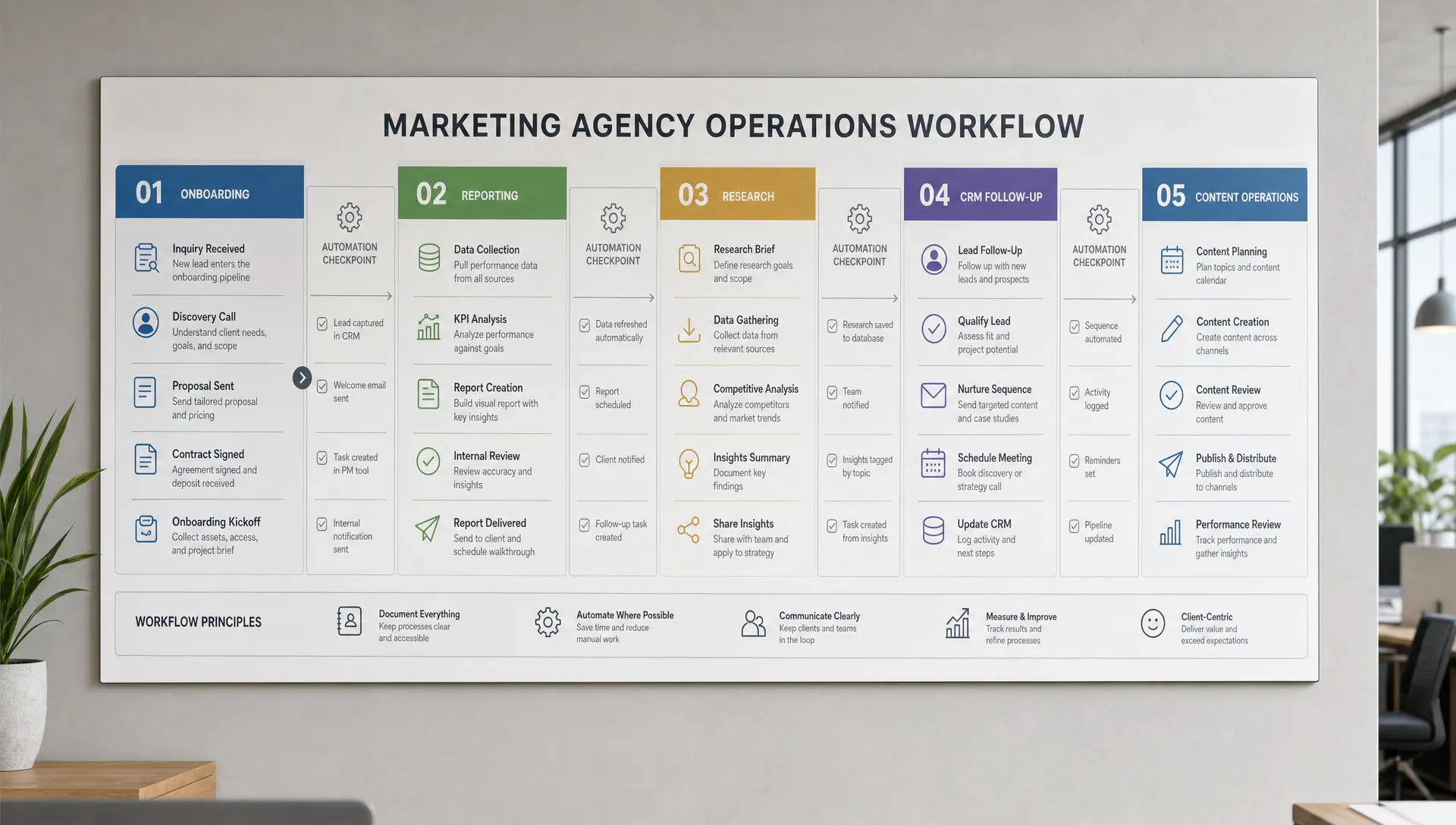
There is no universal first workflow, but most B2B marketing agencies can use this order as a starting point.
| Priority | Workflow | Why it often comes first | Keep human ownership over |
|---|---|---|---|
| 1 | Client onboarding | Prevents downstream rework and delays before delivery starts | Expectations, scope, kickoff, strategic diagnosis |
| 2 | Reporting prep | Repeats constantly and consumes senior time near deadlines | Insight, recommendations, client narrative |
| 3 | Research prep | Improves briefs and strategy without automating judgment | Positioning, angle selection, final conclusions |
| 4 | CRM routing and follow-up | Reduces leakage between marketing, sales, and account teams | Relationship strategy and personalization |
| 5 | Content operations | Speeds production coordination without flooding the team with drafts | POV, creative quality, final approval |
This order changes if one workflow is clearly costing more than the others. For example, an agency with excellent onboarding but painful reporting should start with reporting. An agency drowning in campaign research should start with research prep. The right first automation is the one that removes the biggest recurring constraint without adding quality risk.
What not to automate first
Do not start by automating brand strategy, offer positioning, client escalations, budget allocation decisions, or final creative approval. Those areas may benefit from AI assistance, but they should not be handed over to automation early.
A useful comparison comes from high-touch service businesses that use systems to support a human expert rather than replace one. For example, personalized online coaching works because structure, check-ins, and guidance can be systemized while the coach still provides context and accountability. Agency automation should follow the same principle: automate the structure, not the responsibility.
The highest-risk automation mistake is removing human judgment from the moment where the client expects judgment. A report can be assembled automatically, but the recommendation should be owned by a strategist. A brief can be drafted automatically, but the angle should be approved by someone who understands the client’s market. A lead can be routed automatically, but the conversation should be handled by someone who understands the deal.
How to choose your first workflow in one meeting
You do not need a six-month transformation plan to choose the first automation. You need a clear view of where margin is leaking.
Bring together the agency owner, ops lead, account lead, and one person close to delivery. Pick three recurring workflows that are visibly painful. For each one, estimate how often it happens, who touches it, how long it takes, what usually goes wrong, and what happens when it is late or inaccurate.
Then ask one deciding question: if this workflow became 70 percent cleaner next month, would the agency feel it in capacity, client experience, or margin?
If the answer is yes, you have a candidate. If the answer is no, it may still be annoying, but it is not the first automation.
Build the first automation like an operating system, not a hack
The first automation should be small enough to ship, but serious enough to trust. A fragile shortcut that only one person understands will become another operational liability.
Start by documenting the trigger, required inputs, decision rules, output format, owner, review step, and failure path. The failure path matters. Every automation needs a clear answer to what happens when data is missing, a tool breaks, or the output is uncertain.
Then pilot it on one workflow segment. That might mean onboarding only new paid media clients, automating only monthly reporting prep for one service line, or routing only inbound demo requests before expanding to all lead sources.
| First 30 days | Main goal | Useful output |
|---|---|---|
| Week 1 | Map the workflow and find the margin leak | Workflow map, owner list, failure points |
| Week 2 | Standardize inputs and outputs | Intake form, brief template, report format, routing rules |
| Week 3 | Build the first automation | Working workflow with human review gate |
| Week 4 | Pilot and refine | Time saved, errors caught, missing edge cases, next automation decision |
This approach avoids the common mistake of buying tools before the workflow is ready. The tool matters, but the operating logic matters more.
How you know the first automation worked
A successful first automation should produce visible operational relief. You should see fewer missing inputs, fewer repetitive Slack questions, fewer manual status updates, faster handoffs, shorter reporting prep cycles, or less senior time spent formatting and chasing.
It should also make the next automation easier. Once your team has a clean onboarding workflow, reporting workflow, or routing workflow, you have reusable patterns: triggers, forms, QA gates, ownership rules, and exception handling.
That is how AI ops compounds. The first workflow creates the standard. The second workflow gets faster. The third starts to feel like an operating layer instead of a collection of disconnected automations.
Frequently Asked Questions
Should agencies automate content creation first? Usually not. Content creation is tempting because AI tools are visible, but if briefs, approvals, research, and QA are messy, faster drafting creates more review work. Start with content operations before automating content output.
What is the safest marketing work to automate first? The safest first target is usually a repeatable operational workflow with clear inputs and a human review step. Client onboarding, reporting prep, research organization, CRM routing, and content handoffs are common examples.
How do I know if a workflow is ready for automation? A workflow is ready when you can define its trigger, inputs, rules, owner, output, and review step. If your team cannot explain the process consistently, standardize it before you automate it.
Will automation replace account managers or strategists? It should not replace the judgment work that account managers and strategists do. Good automation removes repetitive coordination so client-facing people can spend more time on insight, communication, and decision-making.
What if every client has a custom process? Start by standardizing the parts that should not be custom, such as access collection, internal briefs, status updates, reporting QA, and approval tracking. Custom strategy can sit on top of standardized operations.
Make the first automation count
The best first automation is not the flashiest one. It is the one that gives your agency capacity back, protects delivery quality, and stops margin from leaking through repetitive coordination work.
If you want a clear answer for your agency, Archer Scaling AI starts with a paid Margin Teardown: a roadmap and three automation moves to lift delivery margin, or it is on me. The goal is simple: install the AI ops layer where it pays off first, then run it without adding another hire.