What a Marketing Agency Really Does Behind the Scenes
See what a marketing agency really does behind the scenes, from research and campaign setup to reporting, QA and smoother operations.
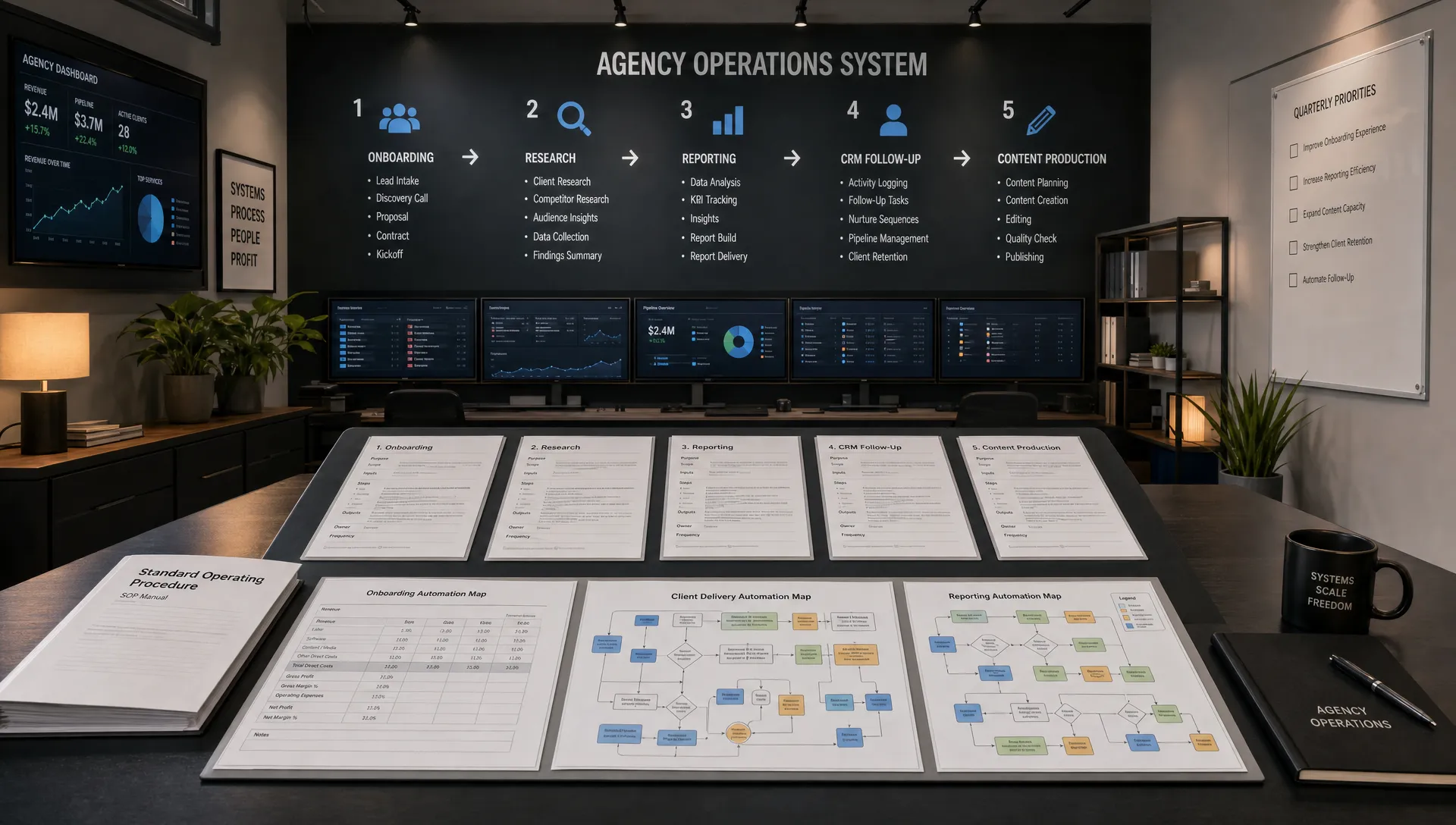
Most people judge a marketing agency by what appears in front of them: ads, landing pages, blog posts, campaign decks, social content and monthly reports. That is understandable. Those are the visible outputs clients approve, share and measure.
But the real work of a strong agency happens before and around those outputs. If your search started with the question, marketing agency what do they do, the honest answer is that a good agency turns messy business context into a repeatable system for acquiring, converting and retaining the right customers.
That system includes research, planning, project management, creative production, data QA, reporting, client communication and operational discipline. When it is done well, clients feel like marketing is moving smoothly. When it is missing, even talented teams get trapped in delays, vague feedback loops and expensive rework.
The visible work is only the final layer
Clients usually see the final 20 percent of agency work. They see the polished campaign brief, the ad creative, the email sequence or the report. Behind that is a chain of decisions and handoffs that determine whether the work is actually useful.
A marketing agency is not just a group of specialists completing isolated tasks. It is an operating system for deciding what to do, getting it done, learning from results and improving the next round. That is why two agencies can offer the same services on paper but deliver completely different outcomes.
| Behind the scenes work | What the client sees | Why it matters |
|---|---|---|
| Discovery and diagnosis | A clearer strategy | Prevents random tactics and misaligned campaigns |
| Audience and market research | Sharper messaging | Makes content and offers feel relevant |
| Project planning | Predictable delivery dates | Reduces confusion, delays and scope creep |
| Quality assurance | Cleaner launches | Protects tracking, brand standards and campaign performance |
| Reporting and analysis | Better decisions | Turns activity into learning, not just screenshots |
The agency’s real value is often its ability to make all of that feel simple. Simplicity for the client usually requires structure behind the scenes.
First, the agency diagnoses the actual business problem
Good agencies do not start by asking what channel the client wants. They start by figuring out what business problem marketing is supposed to solve.
A company might say it needs more leads, but the real issue could be poor lead quality, weak positioning, a slow sales follow-up process or a landing page that fails to convert qualified traffic. If the agency jumps straight into campaign production, it may create more activity without solving the constraint.
Behind the scenes, this diagnosis can include reviewing the current funnel, sales cycle, customer segments, CRM data, conversion rates, past campaign results and competitive positioning. In B2B, the agency also needs to understand how buying decisions happen, who influences the deal and what objections slow momentum.
This is the stage where agencies separate symptoms from root causes. More traffic is not always the answer. Sometimes the first fix is a clearer offer. Sometimes it is faster lead routing. Sometimes it is tighter sales and marketing alignment.
Then strategy gets translated into a delivery plan
A strategy deck is not a plan until someone turns it into work. One of the most overlooked things a marketing agency does behind the scenes is translating high-level direction into a delivery system.
That means deciding which campaigns matter first, what assets are required, who owns each step, what the approval process looks like and which metrics will define success. This is where many agencies either protect or lose margin. If the plan is vague, every task becomes a discussion. If ownership is unclear, approvals stall. If inputs are missing, the team creates work twice.
For B2B agencies, this translation layer often includes channel planning, messaging architecture, content calendars, paid media setup, landing page requirements, reporting definitions and sales handoff rules. The client may only see a roadmap, but the agency team needs a working operating model.
This is also why a scalable client onboarding system matters so much. Many delivery problems are seeded in the first few weeks, when access, goals, stakeholders, brand context and success metrics are not captured cleanly.
Research is the quiet engine of better marketing
Research rarely gets the spotlight, but it shapes almost every good campaign. Agencies use research to understand what customers care about, what competitors claim, which objections appear in sales conversations and where the market has become numb to generic messaging.
This can involve interviewing customers, mining sales calls, reviewing support tickets, studying search behavior, analyzing competitor landing pages and looking at performance data from past campaigns. The point is not to collect research for its own sake. The point is to make better choices about offers, hooks, creative angles and campaign structure.
A useful comparison is how growth marketing and innovation firms position marketing as a process of finding new customers through experimentation and innovation, not just a set of campaign deliverables. That mindset is close to what strong agencies do internally: form a hypothesis, test it in the market, learn from the response and refine the next move.
Without this research loop, marketing becomes opinion-driven. The loudest person in the room wins, not necessarily the best argument.
Production is more than making assets
The creative output of an agency can look straightforward from the outside. A post gets written. An ad gets designed. A landing page goes live. Behind the scenes, production is a workflow with several quality gates.
A usable brief usually locks down the following inputs before work begins:
- The audience segment and buying stage
- The offer or message being tested
- The desired action for the prospect
- The channel and format requirements
- The proof points, constraints and brand rules
- The approval owner and deadline
When those inputs are missing, copywriters guess, designers wait, strategists re-explain and account managers chase context. The visible problem may look like slow creative production, but the real problem is usually weak input quality.
Strong agencies make production repeatable without making it generic. They create templates, standards and review processes so specialists can spend more time on judgment and less time hunting through Slack threads, old documents and half-finished briefs.
Launch setup is where small mistakes get expensive
A campaign can look finished before it is ready to launch. The assets may be approved, but the campaign still needs tracking, naming conventions, audience rules, budget checks, CRM routing and final QA.
This is the operational layer clients rarely see unless something breaks. A missing UTM parameter, broken form, incorrect audience exclusion or poorly mapped CRM field can distort reporting and waste spend. In B2B campaigns, a lead that routes to the wrong owner or receives the wrong follow-up can erase the value of a good campaign.
| Launch component | Behind the scenes check | Risk if skipped |
|---|---|---|
| Tracking | UTMs, pixels, events and conversion goals are verified | Performance data becomes unreliable |
| Creative | Copy, design, links and brand rules are checked | Errors go live in front of prospects |
| CRM handoff | Forms, fields and routing rules are tested | Qualified leads are delayed or lost |
| Budget and targeting | Spend limits, exclusions and audiences are reviewed | The campaign reaches the wrong people |
| Reporting setup | Metrics and data sources are aligned before launch | The team argues about numbers later |
This is one reason agency operations matter so much. The work that feels administrative often protects the performance of the work that feels strategic.

Client communication is also delivery work
Account management is sometimes misunderstood as just keeping the client happy. In reality, good client communication protects the quality and speed of delivery.
The account lead translates client feedback into usable direction for the internal team. They clarify priorities, surface blockers, manage approval timelines and keep decisions from getting lost across email, Slack, meetings and project tools. When this role is weak, specialists receive conflicting instructions and clients feel like they need to repeat themselves.
Good communication also protects scope. Agencies often lose margin through small, repeated asks that seem harmless in isolation. Another revision. Another meeting. Another report format. Another urgent request that bypasses the normal workflow. A strong agency does not need to be rigid, but it does need a clear system for deciding what is in scope, what has changed and what tradeoff is required.
Behind the scenes, the best client communication is not reactive. It is built into cadence: status updates, decision logs, next steps, blockers and clear owners.
Reporting turns activity into learning
A report is not just a recap. At least, it should not be. A useful agency report answers three questions: what happened, why it happened and what the team will do next.
Behind the scenes, reporting includes data collection, cleaning, reconciliation, commentary and decision-making. The messy part is usually not building slides. It is making sure the numbers mean the same thing across platforms, that definitions are consistent and that the analysis connects to business goals.
This is where many agencies hit a margin wall. Reporting becomes a monthly scramble, with team members pulling data manually, checking screenshots, rewriting commentary and chasing missing context. If that sounds familiar, the better fix is often operational standardization before automation. This guide on fixing agency reporting bottlenecks goes deeper into that problem.
The strongest reports create a learning loop. They do not just prove that the agency worked. They help the client and agency decide what to stop, what to improve and what to scale.
The hidden work determines agency margin
For agency owners, the behind the scenes work is not just a service quality issue. It is a margin issue.
Every unclear brief, manual report, delayed approval, messy onboarding process and repeated internal explanation costs time. That time may not appear as a separate line item, but it shows up in delivery margin. Agencies often think they need another hire when the real constraint is operational debt.
| Agency activity | Manual version | Systemized version |
|---|---|---|
| Client intake | Repeated questions and missing access | Standard forms, checklists and handoffs |
| Research | Scattered notes across tools | Reusable research structure and summaries |
| Content ops | Each asset starts from scratch | Brief templates, QA gates and production stages |
| Reporting | Month-end scramble | Standard metric definitions and repeatable assembly |
| Follow-up | Leads and tasks depend on memory | Routing rules, reminders and documented ownership |
This is why agencies that scale well are not always the ones with the biggest creative team. They are often the ones with the cleanest delivery system. Talent still matters, but talent performs better inside a system that removes avoidable friction.
Why clients rarely see the full backstage
Clients do not hire an agency because they want to inspect internal workflows. They hire an agency because they want results, clarity and momentum. So agencies naturally package the work around visible outputs.
That creates a problem. The parts clients are least likely to notice are often the parts that keep performance stable. Naming conventions are boring until the report is unusable. Intake forms are boring until the team misses critical context. QA checklists are boring until a broken link burns paid traffic.
A healthy agency-client relationship makes enough of the backstage visible to build trust without making the client manage the agency. Clients should understand the process, the decision points and the standards. They should not need to chase every task.
Questions to ask before hiring a marketing agency
If you are evaluating an agency, ask about the operating system behind the work, not just the portfolio. Strong answers will be specific. Weak answers will rely on charm, vague experience or promises of flexibility.
| Ask this | A strong answer should include |
|---|---|
| How do you turn discovery into execution? | A clear handoff from strategy to briefs, tasks and owners |
| What must be true before a campaign launches? | A QA process for tracking, creative, CRM and approvals |
| How do you handle client feedback? | Defined approval owners, revision rules and decision logs |
| How do you report results? | Standard metric definitions, commentary and next actions |
| What is standardized and what is custom? | A balance between repeatable process and strategic judgment |
These questions reveal whether the agency has a real delivery engine or depends on heroic effort from individual team members.
What agency owners should take from this
If you run an agency, your product is not only the strategy, content or campaigns your team creates. Your product is the full experience of getting work done reliably.
That means your backstage deserves as much attention as your client-facing work. Standardize the repeatable parts. Document the handoffs. Clean up reporting definitions. Reduce manual status chasing. Automate the repetitive workflows that do not require senior judgment.
AI can help here, but only when it is applied to the right layer. The goal is not to make the agency look more technical. The goal is to remove operational drag from research, onboarding, reporting, CRM follow-up, SOP documentation and production support so your team has more room for strategic work.
Frequently Asked Questions
What does a marketing agency do day to day? A marketing agency plans campaigns, researches audiences, creates content, manages channels, coordinates approvals, launches campaigns, tracks performance and reports on what should happen next. Much of the day-to-day work is coordination and decision-making, not just asset creation.
Why does agency work take longer than clients expect? Delays often come from missing inputs, unclear approvals, compliance reviews, tracking setup, creative revisions and stakeholder feedback. Good agencies reduce these delays with better onboarding, clearer briefs and stronger project management.
What happens after a client approves a campaign? The agency still needs to prepare the launch setup. That can include final QA, tracking checks, CRM routing, audience targeting, budget setup, link testing, reporting configuration and internal handoff to the person monitoring performance.
How can you tell if a marketing agency has good operations? Look for clear onboarding, documented processes, specific launch checklists, consistent reporting definitions and proactive communication. If the agency cannot explain how work moves from strategy to delivery, execution may depend too much on individual effort.
Should agencies automate behind the scenes work? Yes, when the work is repeatable, rules-based and time-consuming. Onboarding tasks, research collection, report assembly, lead routing, follow-up reminders and SOP updates are often better starting points than trying to automate core strategy.
Turn the backstage into a margin advantage
If you run a B2B marketing agency, the work behind the scenes may be where your delivery margin is leaking. Archer Scaling AI installs and runs the AI ops layer that helps automate repetitive agency workflows across research, reporting, CRM, onboarding and content operations.
The starting point is a paid Margin Teardown: a roadmap and three automation moves, or it is on me. If you want to see the actual system running before you commit, start with Archer Scaling AI and find the operational work your team should not be doing manually anymore.