The B2B Agency Handoff Map That Prevents Delivery Drift
Build a B2B agency handoff map that protects margin, reduces rework and keeps client delivery from drifting as volume grows.
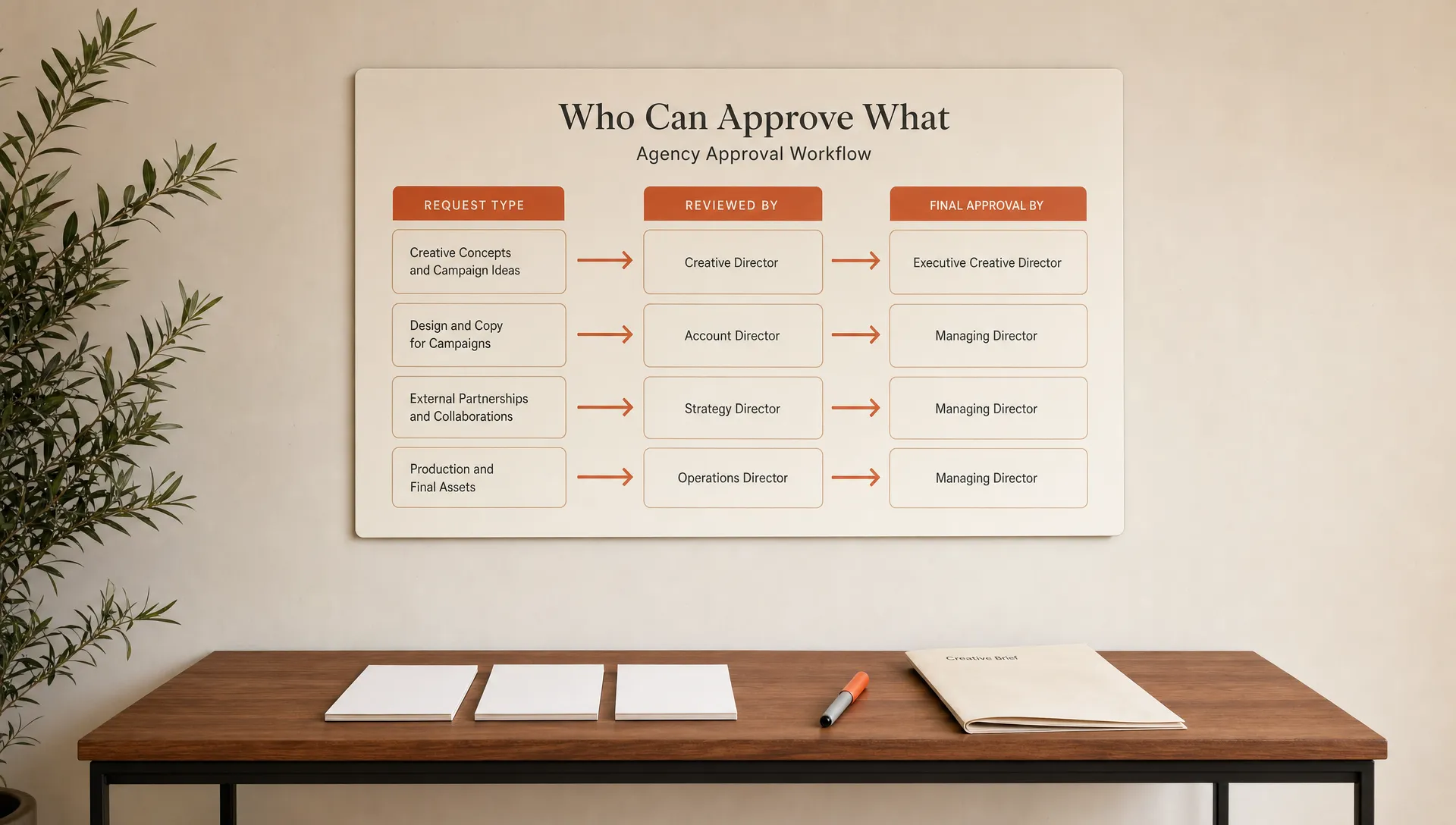
Delivery drift rarely announces itself as a broken process. It shows up as a client brief rewritten twice, a strategist filling in context that should have been captured last week or a report that takes three people to explain. If you run a B2B agency, that drift eats margin before it looks like a staffing problem.
A handoff map gives you a simple way to see where the work changes hands, what context moves with it and who is responsible for the next decision. The goal is not more documentation. The goal is fewer hours burned because someone had to reconstruct what the last person already knew.
Delivery drift starts where ownership changes
Most agency delivery issues do not begin inside the task itself. They begin when ownership moves from one person or function to another.
The sales note becomes an onboarding brief. The onboarding brief becomes a strategy doc. The strategy doc becomes a production ticket. The production ticket becomes a QA pass. The QA pass becomes a client-facing update. Each step looks small, but every transfer can drop context, soften decisions or reopen work that should already be closed.
Delivery drift is the accumulation of those small changes. The client bought one thing, delivery interprets another thing and account management ends up explaining a third thing. Nobody is trying to create chaos. The system just allows too much interpretation between handoffs.
This is one of the first cracks that appears when volume grows. The same pattern shows up in what breaks first when you are scaling a B2B agency: visibility fades, decision rights get blurry and margin leaks before the team can name the cause.
A handoff map makes the leak visible.
A handoff map shows the custody chain
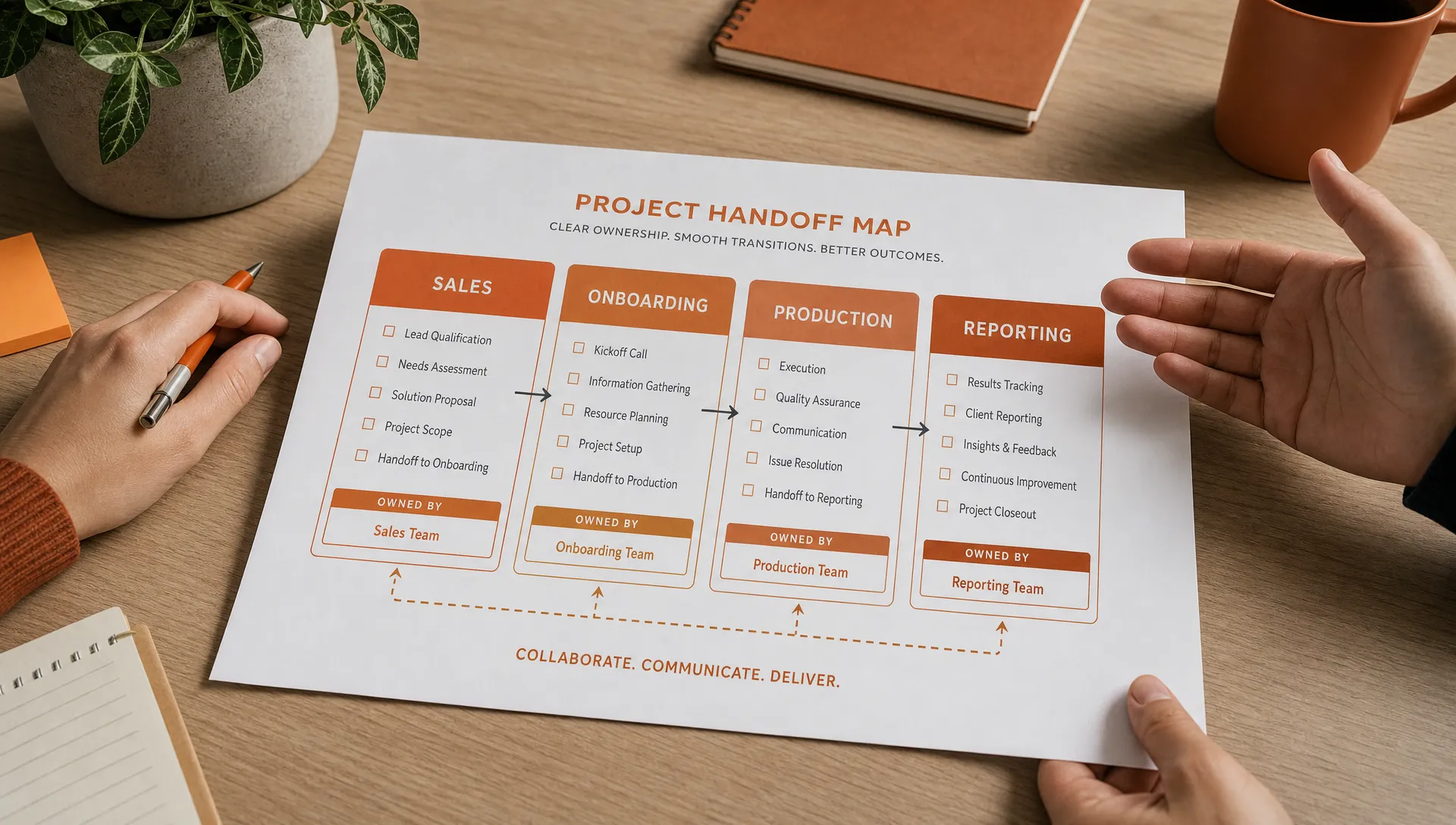
A handoff map is a working view of how client context, assets, decisions and next actions move through your agency. It is not an org chart, and it is not a full SOP library.
The map answers one question at each transfer: what must be true before the next person can do their work without guessing?
At minimum, each handoff should capture:
- The current owner of the work
- The next owner of the work
- The trigger that starts the handoff
- The artifact that moves across the line
- The decisions already made
- The questions still open
- The acceptance criteria for a clean handoff
That last item matters more than most teams think. A task can be technically assigned and still be unusable. A production ticket with a campaign name but no audience context is not a clean handoff. A report with exported metrics but no narrative angle is not a clean handoff. A creative brief that says make it more premium without defining the client’s actual positioning is not a clean handoff.
The map gives your team a shared standard for done enough to pass forward.
Six handoffs carry most of the margin risk
Every agency has its own model, but most delivery drift shows up in six places. If you map only these six, you will usually see the real problem faster than if you try to document every task in the business.
| Handoff | Common drift | Minimum artifact |
|---|---|---|
| Sales to onboarding | Promises, constraints or client expectations stay in the sales notes | Closed deal summary with scope, success criteria, risks and promised timelines |
| Onboarding to strategy | Intake answers get collected but not translated into usable direction | Onboarding brief with client context, assets, missing inputs and strategic assumptions |
| Strategy to production | Approved direction becomes vague tickets or scattered Slack messages | Production brief with deliverables, references, constraints and acceptance criteria |
| Production to QA | Reviewers judge work from memory instead of the approved brief | QA checklist tied to the original brief and client-specific standards |
| QA to client communication | Account lead rewrites the story late because delivery did not frame the work | Client update note with decisions, rationale, tradeoffs and next asks |
| Reporting to next cycle | Insights do not become actions, so the same issues appear next month | Reporting recap with metric movement, interpretation, decisions and next tasks |
You do not need to turn all of this into a heavy process. In fact, a heavy process usually dies after two busy weeks. The useful version is lightweight enough that a project manager, strategist or account lead can update it while work is already moving.
The point is to stop asking people to carry the operating system in their heads.
The handoff brief is the smallest useful control
The handoff brief is the unit that keeps the map from becoming theory. It can live in your project management tool, a CRM note, a document template or a structured form. The format matters less than the consistency.
A good handoff brief is short. It should take the receiving person less than five minutes to understand what is happening, what has already been decided and what still needs judgment.
| Field | What it prevents | Example |
|---|---|---|
| Committed outcome | Scope creep and false assumptions | Launch three landing page variants for the approved offer, not a full site refresh |
| Known context | Repeated discovery and weak first drafts | Client sells to regional operators, buyer cares about implementation risk and speed |
| Decisions made | Reopening settled work | Messaging angle approved by founder on August 22 |
| Open decisions | Silent waiting and late escalation | Need client approval on compliance language before copy moves to design |
| Acceptance criteria | Vague QA and personal preference reviews | Draft must include approved claims, required CTA, brand tone and legal disclaimer |
Context also includes constraints outside your usual marketing checklist. If you serve clients where data control, hosting choices or governance shape what can be done, those assumptions belong in the handoff brief. The same discipline is visible in technical transformation work like Anwit SAS's approach to digital sovereignty and data governance, where execution depends on making ownership and constraints explicit before work starts.
The useful test is simple: could someone who was not in the meeting pick up the work tomorrow and avoid asking the same questions again? If not, the handoff is still relying on memory.
AI belongs in the gaps where context gets lost
Many agencies tried a few AI tools and ended up with another tab, another prompt doc and another place for work to drift. The tool was not the issue. The workflow around it was too loose.
AI is useful in a handoff system when it reads existing context, turns it into the next required artifact or flags a mismatch before a person wastes time. That is very different from asking it to make delivery judgment on its own.
Use AI to:
- Turn sales call notes and CRM fields into an onboarding prep brief
- Compare an intake form against your required inputs and flag missing context
- Draft a production brief from an approved strategy document
- Summarize client comments by decision type, such as preference, scope change or approval
- Scan a report draft for metric changes that need a written explanation
- Create a next-cycle task list from the final reporting recap
The source of truth should still be the approved brief, client record, scope document or reporting file. AI output should sit downstream from that source, not replace it.
This is especially useful in reporting because reporting already contains structured data, repeated formats and predictable review steps. For reporting teams, speeding up reporting and QA usually starts with shared metric definitions, naming rules and a clear reporting brief before any automation is added.
The same rule applies across delivery. If the workflow is undefined, AI just creates faster ambiguity. If the handoff is clear, it can remove formatting work, comparison work and first-draft work that your senior people should not be doing.
Decision rights keep approvals from becoming gossip
A handoff map is incomplete if it only tracks tasks. It also needs to track decision rights.
Agencies lose a surprising amount of time because the team does not know who can say yes. A client gives feedback in a call. The account lead interprets it as a small preference. The strategist sees a positioning change. The designer treats it as a revision request. By the time the work reaches QA, three people have made different assumptions.
Your handoff map should name who owns each class of decision. For example, the account lead may own client communication and next-step framing. The channel lead may own tactical choices within the approved plan. The strategist may own message hierarchy. The founder or delivery lead may own scope changes and client expectations that affect margin.
That does not mean every decision needs a meeting. It means your team knows where to route a decision when the work changes shape.
This is also where client approvals need structure. A client saying looks good in a Slack thread is not the same as approving a budget shift, a strategic direction or a launch-ready asset. The handoff map should define which approvals are informal, which approvals are recorded and which approvals stop work until confirmed.
Without that distinction, approvals become gossip. Everyone heard something. Nobody owns what it means.
Drift signals tell you where the map is weak
You do not need a full operations review to find delivery drift. Look for the places where the same confusion repeats.
| Drift signal | What it usually means |
|---|---|
| The same client question gets asked twice internally | Context is not moving from account management into delivery |
| Production waits for background before starting | The brief is missing decisions, examples or constraints |
| Reports are rewritten late by a senior person | Reporting lacks a narrative standard or metric interpretation step |
| Client feedback reopens strategy during production | Approval stages are mixed together |
| A founder reviews routine work too often | QA standards are unclear or decision rights are too centralized |
| The CRM and project board disagree | Sales, onboarding and delivery are using different source records |
These signals are more useful than general complaints about communication. Communication is too broad to fix. A weak handoff is specific.
If production keeps waiting on client context, fix the onboarding to production handoff. If reporting keeps turning into a late-night rewrite, fix the reporting to next-cycle handoff and the QA step before it. If founders keep getting pulled into small decisions, fix decision rights and acceptance criteria.
The map turns a vague people problem into a specific operating problem.
Build the first version from one live account
Do not start by mapping the whole agency. Pick one active client where delivery feels heavier than it should. A retainer with recent rework is better than a clean account because the friction is easier to see.
Then walk the last thirty days. Open the CRM, project board, Slack threads, client emails, call notes and reporting docs. You are not looking for blame. You are looking for transfers where the next person had to guess.
A simple first pass looks like this:
- Pick one active client with recent rework, delay or senior escalation.
- Mark every point where ownership changed between sales, onboarding, strategy, production, QA, reporting and account management.
- Write down the artifact that actually moved at each point, even if it was just a Slack message.
- Note what the receiving person had to ask, infer or redo.
- Add one required field that would have prevented that confusion.
- Assign one person to maintain that handoff standard for the next cycle.
The first version will be imperfect. That is fine. A rough handoff map used on one account is more valuable than a beautiful process doc nobody touches.
After one cycle, review what changed. Did production start with fewer questions? Did QA catch issues earlier? Did account management spend less time rewriting the story for the client? Did senior review move from rescue work to actual judgment?
Those are the signals that the map is doing its job.
Frequently asked questions
What is a B2B agency handoff map? A B2B agency handoff map is a practical view of how client work moves between roles, such as sales, onboarding, strategy, production, QA, reporting and account management. It defines who owns the work, what artifact gets passed, which decisions are closed and what must be true before the next person starts.
How is a handoff map different from an SOP? An SOP explains how to perform a task. A handoff map explains how ownership changes between tasks. Most agencies need both, but the handoff map usually exposes margin leaks faster because it shows where context and decisions disappear.
Where should AI be used in agency handoffs? AI fits best where information needs to be summarized, checked, reformatted or compared against a standard. Good examples include turning call notes into onboarding briefs, flagging missing intake fields, drafting production briefs from approved strategy docs and scanning reports for changes that need explanation.
Who should own the handoff map? The owner should be the person responsible for delivery quality and capacity, often the founder, ops lead or head of delivery. They do not need to update every field personally, but they should own the standard and make sure each function keeps its part current.
When should an agency build this? Build it before you hire for coordination. If the same information is being re-explained, retyped or rediscovered across accounts, adding another junior person may increase throughput for a while, but the drift will remain.
What to do next this week
Pick one client that feels heavier than the retainer should feel. Map the six handoffs on a single page. For each handoff, write the owner, artifact, decisions made, open questions and acceptance criteria. Then run the next cycle with that map visible.
Do not turn this into a company-wide process project yet. Use one account to prove where the drift is. If the map reduces guessing, rework or late escalation, apply it to the next account type.
Archer Scaling AI installs and runs AI ops systems for marketing agencies, which is the layer that can carry these handoffs once the map is clear. If you want to talk through where handoffs are slipping in your agency, book a free 30-minute intro call. It is a conversation about your operations, not a sales call or an audit.