Running an Agency Without Drowning in Admin
Running an agency should not mean chasing admin. Learn how to cut ops drag, protect margin, and automate the right workflows.
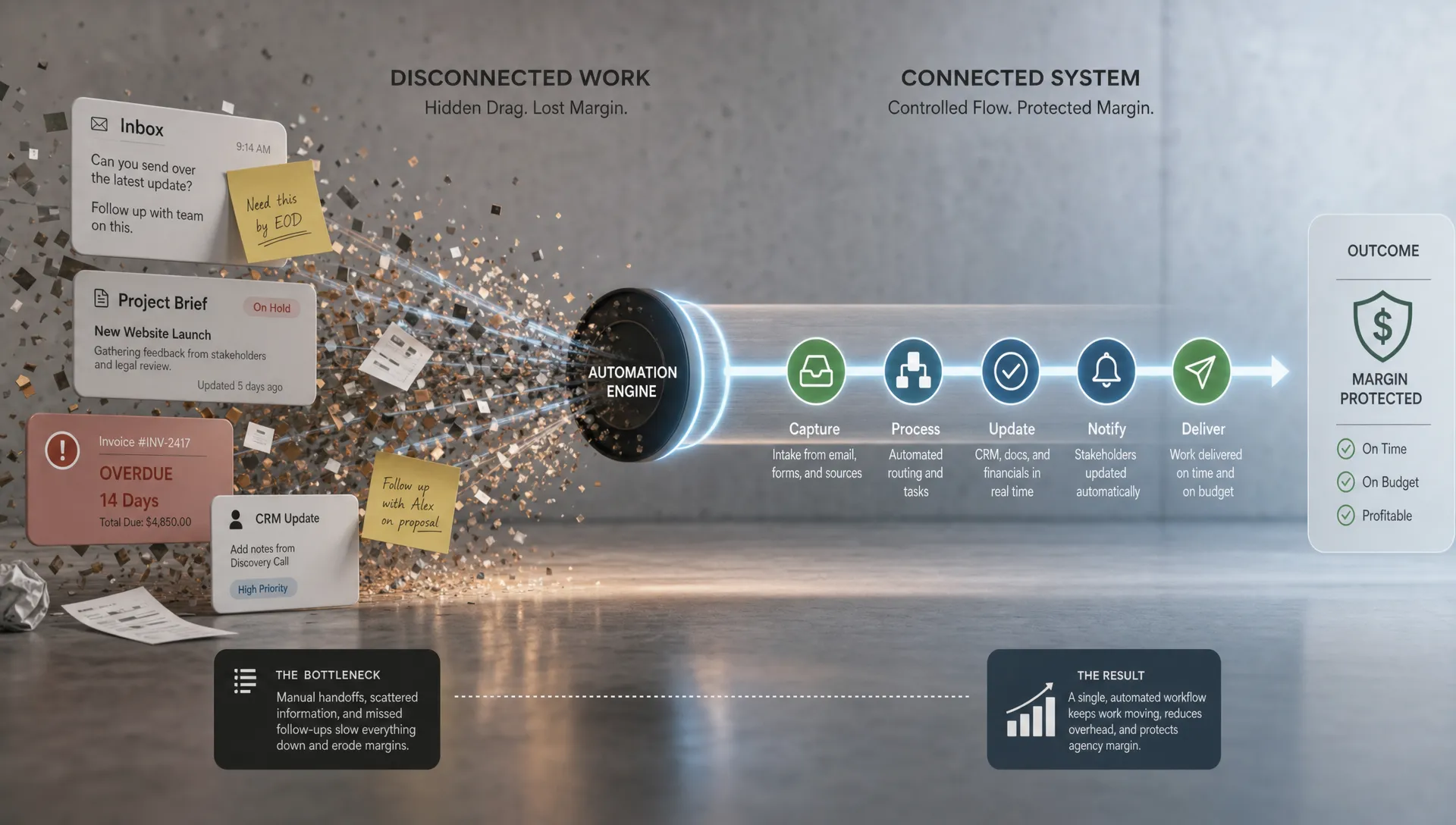
Admin rarely feels like the thing that will break an agency. It starts as a few client follow-ups, a little reporting cleanup, a missing brief, a late invoice note, a Slack reminder, a CRM update someone forgot to make. None of it looks strategic, but all of it feels urgent.
Then the agency grows.
More clients means more requests. More team members means more handoffs. More retainers means more reporting cycles. Suddenly the founder, account lead, or ops manager is spending the week chasing status instead of improving delivery. Running an agency becomes less about strategy and more about keeping the machine from jamming.
The fix is not simply hiring an admin assistant, buying another project management tool, or asking the team to be more disciplined. Those can help, but only after the operating system is clear. The real goal is to separate useful coordination from margin-killing busywork, then automate or standardize the repeatable parts.
Why admin takes over as agencies grow
Agency admin expands because client work is full of moving parts. A single campaign may touch sales notes, onboarding forms, research, strategy, copy, design, approval, QA, launch, reporting, optimization, and renewal. Every stage creates a handoff. Every handoff creates a chance for missing context.
When the agency is small, people compensate with memory. The founder remembers what the client said on the sales call. The strategist remembers the offer angle. The account manager remembers the reporting preference. That works until it does not.
Once the team is handling several accounts at once, memory becomes a hidden liability. The same question gets answered repeatedly. People wait for approvals because no one knows who owns the next step. Client history lives across inboxes, Slack threads, call notes, spreadsheets, and half-updated CRM records.
That is when admin becomes more than inconvenience. It becomes a margin problem.
Common signs include:
- Client meetings require too much prep because information is scattered.
- Account managers spend more time asking for updates than improving relationships.
- Reports take longer to assemble than to interpret.
- Delivery teams start work with incomplete briefs.
- The founder is pulled into routine decisions that should already have rules.
- New hires need weeks of tribal knowledge before they can operate independently.
The frustrating part is that the team may be working hard. The issue is not laziness. It is operational drag.
Not all admin is bad admin
The mistake many agency owners make is treating all admin as waste. Some administrative work protects margin, client trust, and delivery quality. The problem is repetitive coordination that adds no judgment, no quality control, and no client value.
The useful question is not, "How do we get rid of admin?" It is, "Which admin decisions need human judgment, and which ones should be systemized?"
| Agency workflow | Admin that protects margin | Admin that should be reduced |
|---|---|---|
| Client onboarding | Confirming goals, stakeholders, access, and success metrics | Chasing missing assets manually across multiple channels |
| Campaign production | Checking brief quality, approvals, and launch readiness | Copying task details from one tool to another |
| Reporting | Explaining insights and next actions | Manually rebuilding the same report format every month |
| CRM management | Maintaining clean lifecycle stages and ownership | Searching old notes to understand client status |
| Lead follow-up | Prioritizing high-fit opportunities | Remembering who needs a reply and when |
| Hiring and SOPs | Defining role expectations and quality standards | Rewriting the same training instructions repeatedly |
A healthy agency does not eliminate structure. It builds structure that reduces thinking about logistics, so the team can think more about strategy.
The real source of admin overload is unclear ownership
Most admin bloat comes from ambiguity. When ownership is unclear, every task requires extra communication.
Who owns the brief after the sales call? Who confirms access? Who updates the client if the creative team is blocked? Who decides whether a campaign is ready for launch? Who reviews the report before it goes to the client?
If those answers change from account to account, admin grows naturally. The team cannot trust the workflow, so they create side channels. Slack becomes the operating system. Meetings become the backup plan. The founder becomes the escalation path.
The antidote is a simple ownership map. Every recurring workflow needs three things: a trigger, an owner, and an output. The trigger tells the system when work begins. The owner is responsible for moving it forward. The output defines what "done" looks like.
For example, a new client should not create a vague scramble. It should trigger a defined onboarding sequence: internal handoff, access collection, kickoff prep, success metric confirmation, first deliverable planning, and client-facing timeline. If that part of your agency is currently messy, a more scalable approach to marketing agency client onboarding is usually one of the fastest ways to reduce admin pressure.
Build an operating layer, not a longer task list
Many agencies respond to admin overload by adding more task lists. That often makes the problem worse. A task list records work, but it does not necessarily route work, validate inputs, enforce quality, or reduce decisions.
What you need is an operating layer. In practical terms, that means a set of connected workflows that move information through the agency without relying on memory.
Intake should capture complete context
Every recurring workflow starts with intake. Client requests, sales handoffs, content briefs, reporting needs, creative changes, and internal tickets should enter the agency in a structured way.
If a strategist receives a vague request like "we need a new nurture sequence," they have to spend time reconstructing context. Who is the audience? What offer is being promoted? What is the deadline? What assets exist? What is the approval path?
Good intake prevents that. It asks for the minimum information required to begin work properly. It does not need to be bloated. It needs to be consistent.
Routing should happen by rules, not memory
Once work enters the system, it should move to the right person or queue automatically whenever possible. Routing rules can be based on client, service line, priority, deadline, or lifecycle stage.
The point is not to remove human oversight. The point is to stop using senior people as traffic controllers for routine work.
Status should be visible without meetings
If the team needs a meeting to know what is happening, the system is not doing its job. A good operating layer makes status visible by default: waiting on client, in production, in QA, ready for approval, launched, reporting pending.
This reduces the most expensive kind of admin, which is status hunting. Status hunting feels small, but it consumes attention all day.
QA should be built into the workflow
Quality assurance should not depend on someone remembering to check the work. Every major deliverable should have defined review criteria, especially when AI is used in research, copy, reporting, or production support.
QA is not bureaucracy. It is margin protection. Rework is one of the fastest ways agencies lose money on retainers.
Reporting should be standardized before it is automated
Reporting is a common admin sink because agencies try to personalize everything manually. Some client-specific interpretation is valuable. Rebuilding the same charts, metric pulls, screenshots, and explanations from scratch is not.
Before automating reports, standardize metric definitions, reporting cadence, data sources, and review steps. If reporting is already a bottleneck, this guide on fixing marketing agency reporting bottlenecks breaks down where to start.
Clean data is the admin shortcut most agencies ignore
Agency admin becomes much harder when client, lead, and project data is messy. If a CRM is outdated, duplicated, or full of inconsistent fields, the team cannot trust it. When the team cannot trust it, they work around it.
That creates a predictable loop. People stop updating the CRM because it is messy. The CRM gets messier because people stop updating it. Eventually, the agency runs on private notes and memory again.
Clean data is not glamorous, but it is foundational. Your CRM should answer basic questions quickly: who owns the relationship, what stage the account is in, what was promised, what is blocked, what needs follow-up, and what history matters.
If your agency has years of scattered records, duplicate contacts, or inconsistent account fields, a practical starting point is learning how structured CRM data import and customer data migration works before you redesign the rest of the workflow.
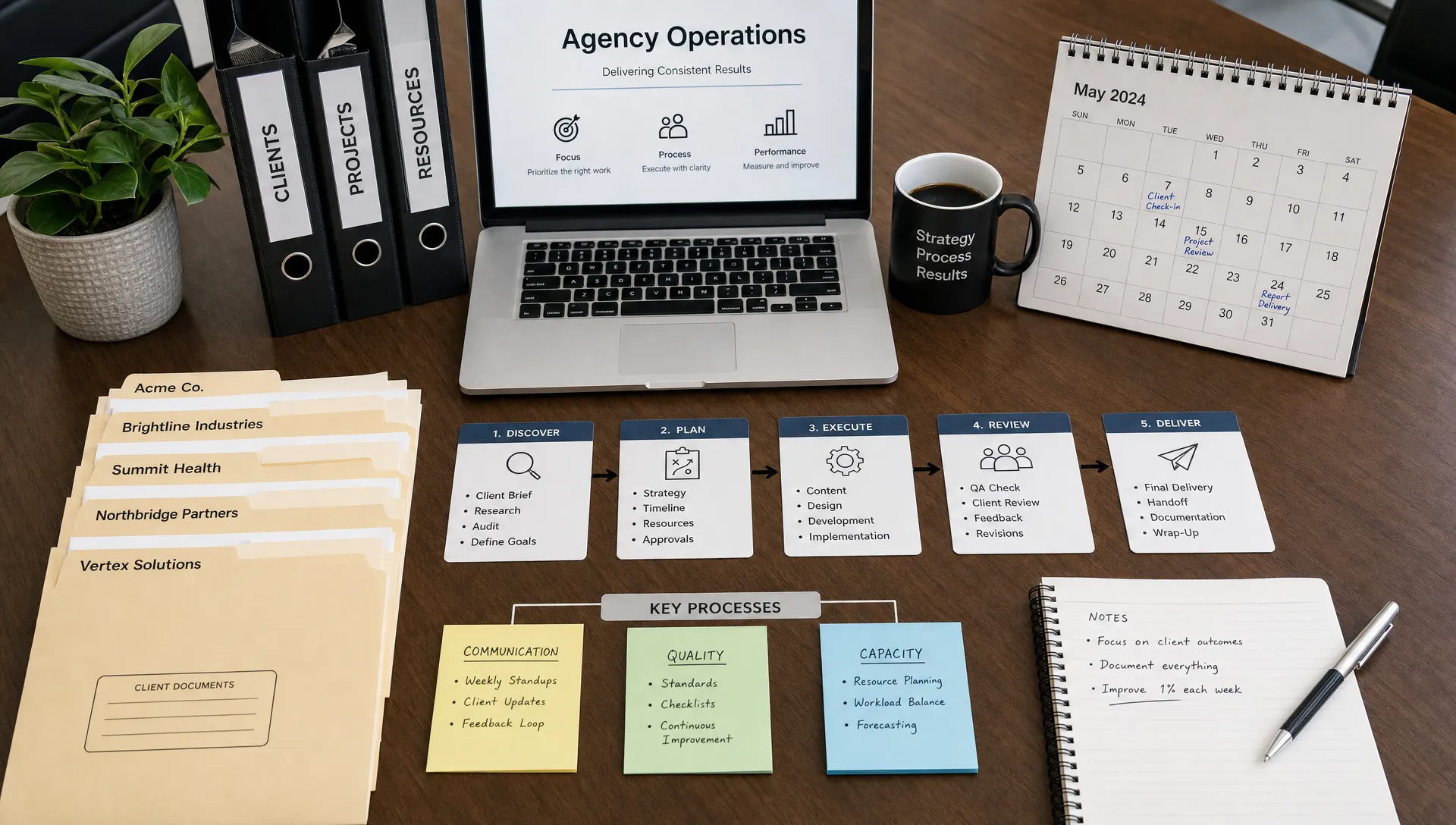
Where AI actually helps with agency admin
AI is useful when the work is repetitive, rule-based, language-heavy, or dependent on pulling information from multiple places. It is less useful when the agency has not defined the workflow yet.
A common mistake is jumping straight to AI content generation while the real margin leak sits in onboarding, reporting, CRM updates, routing, or client follow-up. Better automation starts with the work that repeats every week and drains senior attention.
Good AI ops candidates include:
- Summarizing sales calls into structured handoff notes.
- Turning onboarding forms into internal kickoff briefs.
- Drafting first-pass client status updates from project data.
- Preparing report narratives from approved metrics.
- Routing new leads based on fit, source, and urgency.
- Converting completed work into SOP updates.
The key phrase is "first-pass." AI should reduce blank-page work and repetitive assembly. It should not replace accountability. Anything client-facing still needs standards, review, and ownership.
If you are unsure where AI belongs, start with workflows that already have clear inputs and outputs. That is also why the best first automation is rarely the flashiest one. For a deeper breakdown, see this practical guide on what a marketing agency should automate first.
A 30-day plan to reduce admin drag
You do not need to rebuild the whole agency at once. In fact, trying to fix every workflow at the same time usually creates more chaos. Start with one admin-heavy path from trigger to output.
| Timeframe | Focus | Outcome |
|---|---|---|
| Days 1 to 5 | Map recurring admin work | Identify the top three workflows consuming senior time |
| Days 6 to 10 | Choose one workflow | Pick the workflow with high frequency, clear pain, and measurable impact |
| Days 11 to 15 | Standardize inputs and ownership | Define trigger, owner, required information, and completion criteria |
| Days 16 to 22 | Remove redundant handoffs | Consolidate tools, templates, reminders, and approval steps where possible |
| Days 23 to 30 | Automate the safest repeatable steps | Add routing, summaries, reminders, drafts, or reporting assistance with QA |
The best workflow to start with is often not the most broken one. It is the one that is painful enough to matter but stable enough to systemize.
For many B2B marketing agencies, that means onboarding, reporting, lead follow-up, or content operations. These workflows repeat constantly, touch multiple people, and create visible client experience problems when they break.
What to measure after you reduce admin
If admin reduction is only measured by how people feel, it will be hard to prove the value. Track a few operational metrics before and after the change.
Useful measures include turnaround time, number of handoffs, number of clarification requests, rework rate, missed follow-ups, report preparation time, and founder escalations. You do not need a complex dashboard to start. Even a simple baseline will show whether the new system is working.
Pay close attention to the gap between "work time" and "wait time." Agencies often focus on how long a task takes to complete once someone starts. But margin often leaks while the task is waiting for context, approval, assets, or a decision.
Reducing wait time is one of the fastest ways to make an agency feel calmer without lowering standards.
When not to automate admin
Automation is powerful, but it can also make bad workflows faster. Do not automate a process if the team disagrees on what good looks like, if the inputs are unreliable, or if the client experience depends on nuanced judgment.
You should also avoid automating exceptions too early. If a workflow has ten variations because every client has a different process, step back and ask whether that complexity is truly necessary. Often, the agency has allowed custom delivery habits to accumulate because no one wanted to enforce a standard.
The right sequence is simple: clarify, standardize, then automate.
Clarity removes ambiguity. Standardization makes the workflow repeatable. Automation removes the repetitive manual steps. Skip the first two, and the automation will likely create more cleanup work later.
The founder should not be the operating system
Many agencies grow around the founder's ability to remember, decide, and rescue. That works in the early stage because the founder has context across sales, delivery, client relationships, and finances.
But if the founder remains the operating system, the agency cannot scale cleanly. Every new client increases dependency. Every new hire needs more founder time. Every quality issue becomes an escalation.
The goal is not to remove the founder from strategic decisions. The goal is to stop routing routine admin through the highest-leverage person in the business.
A strong operating layer gives the founder better visibility with fewer interruptions. It lets account managers manage accounts, delivery teams deliver, and leadership focus on margin, positioning, retention, and growth.
Frequently Asked Questions
What is the biggest admin drain when running an agency? The biggest drain is usually not one task. It is repeated coordination across unclear handoffs. Chasing updates, reconstructing context, and clarifying ownership often consume more time than the actual work.
Should an agency hire an admin assistant before automating workflows? Sometimes, but hiring before systemizing can just transfer chaos to another person. First map the workflow, remove unnecessary steps, and define ownership. Then decide whether the remaining work needs a person, automation, or both.
Which agency admin tasks are safest to automate first? Start with low-risk, repeatable tasks such as intake summaries, routing, reminders, internal status updates, report preparation, CRM hygiene prompts, and SOP drafting. Keep human review for judgment-heavy or client-facing outputs.
How do I know if admin is hurting agency margin? Look for slow handoffs, repeated rework, founder escalations, late reports, unclear briefs, and too many meetings about status. If senior people are spending hours every week moving information around, admin is likely reducing margin.
Can AI replace an agency operations manager? No. AI can reduce repetitive work and improve workflow speed, but someone still needs to own standards, exceptions, QA, and process design. AI works best as part of an operating layer, not as a substitute for accountable leadership.
Get out of the admin loop
Running an agency should not mean spending your best hours chasing notes, reports, access, and follow-ups. The agency needs a delivery system that protects margin without adding unnecessary headcount.
Archer Scaling AI installs and runs AI-powered operations systems for B2B marketing agencies, including workflows for onboarding, reporting, CRM, lead follow-up, content ops, SOPs, and repetitive delivery admin. The work starts with a paid Margin Teardown that identifies the highest-leverage automation moves and shows what the system could look like before you commit.
If admin is eating the margin your team works hard to create, start by seeing where the drag is really coming from. You can explore the AI ops approach at Archer Scaling AI.