Marketing Firm Hiring Plans Need a Handoff Review First
Before marketing firm hiring, review handoffs to find margin leaks, reduce rework and decide what needs a person versus a system.

If your team is booked solid, hiring feels like the adult answer. More retainers came in, more work has to go out and somebody has to carry the load.
Before a marketing firm hiring plan turns into a job post, review the handoffs. In agencies doing real volume, the pressure often comes from work changing owners with too little context, too many assumptions and no clear definition of done.
A busy team can hide a broken handoff
Most agency owners do not decide to hire because everything is calm and measured. They decide to hire when Slack is noisy, reports are late, kickoff calls feel rushed and senior people are answering the same questions from three different team members.
That looks like a capacity problem. Sometimes it is. But a handoff problem can create the same symptoms.
A strategist forgets to pass along the client’s real buying trigger. A media buyer gets the budget but not the client’s risk tolerance. A copywriter gets a content brief with channel, audience and deadline, but no notes from the sales conversation. A reporting lead knows which charts go in the deck, but not which questions the client has been asking for two weeks.
The result is extra work that does not show up as a clean line item. People ask for clarification. Senior staff re-explain context. Drafts get redone. Client meetings become status repair instead of decision-making.
A handoff review should sit in front of every serious marketing firm hiring decision because it shows whether you need another person or a cleaner operating system around the people you already have.
A handoff review checks the cost of changing owners
A handoff is any moment where responsibility moves from one person, team or tool to another. Sales to delivery. Strategy to production. Creative to approval. Account management to reporting. Founder to operator. Contractor to internal team.
The review is not a blame session. It is a short inspection of the work path.
You are looking for four things: what information moves, what gets lost, who has to chase it and what rework follows. If the same missing context appears over and over, a new hire may just become the next person chasing it.
This is the same discipline good buyers use when they inspect vendor cost before signing. A useful example from a different industry is Spinlab’s guide to questions that expose hidden operating costs before the deal is signed. The category is different, but the lesson applies to agencies: the expensive part is often buried in the handoff, integration, reporting and operating work that comes after the obvious transaction.
Your hiring plan deserves that same level of scrutiny. The salary or contractor fee is not the full cost. The real cost includes onboarding time, review time, management load and the process debt they inherit.
Start with the ownership changes that already annoy the team
Do not map the entire agency on day one. Pick the three handoffs your team already complains about.
For many agencies, one of them is client onboarding. The sale closes, the client fills out a form, a kickoff is scheduled and delivery starts before the team has the client’s actual constraints in a usable shape. If this is where the pain is, the deeper issue may be intake design, pre-call research and brief quality. A cleaner onboarding path can protect margin before you add another coordinator, and the mechanics are covered in more depth in this guide to marketing agency client onboarding that actually scales.
Another common handoff is strategy to production. The strategist understands the client, but the person creating ads, emails, landing pages, press materials or SEO briefs gets a thinned-out version of the thinking. The work comes back technically complete but slightly off. That gap turns senior review into re-strategy.
Reporting is another place to inspect. Many teams treat reporting as a monthly artifact, but the handoff from data to account lead is where hours disappear. Someone has to decide what matters, what changed, what needs a client decision and what can be ignored. If that judgment is not captured, every report becomes a rebuild from memory.
Separate true workload from rework before you add headcount
A strong handoff review gives you a cleaner hiring conversation. Instead of saying, “We need another account manager,” you can say, “We need fewer account manager hours spent reconstructing context after kickoff.” Those are different fixes.
Use this table as a first pass when you are deciding whether the pressure points to hiring or systemizing.
| If the pain sounds like | Check this handoff first | Hiring helps when | A system helps when |
|---|---|---|---|
| Kickoffs feel rushed | Sales to delivery | The team needs more client-facing judgment | Intake, research and internal briefs are inconsistent |
| Drafts keep missing the mark | Strategy to production | More expert taste or channel skill is missing | The brief does not carry enough context |
| Reports take too long | Data to account lead | Interpretation requires senior experience every time | The same metric checks and notes repeat each cycle |
| Follow-up gets dropped | Client call to task owner | Relationship management load has grown | Tasks, owners and due dates are not captured reliably |
| Founder keeps getting pulled back in | Any senior-to-junior handoff | Decisions truly require founder judgment | Standards and examples live in the founder’s head |
This is where marketing firm hiring plans often disappoint. The new person arrives, looks capable and still slows down the senior team for weeks because the agency never made the work easier to receive.
Hiring adds capacity. It also adds another handoff. If the existing handoffs are already messy, the new role can make the agency feel busier without making delivery feel lighter.
Hiring helps when judgment is the constraint
There are plenty of times when hiring is the right move. A handoff review is not an argument against people. Agencies grow through people.
Hiring makes sense when the missing piece is judgment, taste, relationship handling, leadership or channel experience. If your creative director is rejecting work because the person making it does not yet have the eye, a template will not fix that. If clients need more senior counsel, a workflow cannot pretend to be a seasoned account lead. If the team is missing real platform expertise, you need someone who has done the work.
The review simply keeps you honest about the job you are hiring for. Are you hiring a person to make decisions, or are you hiring a person to chase missing inputs?
A better marketing firm hiring conversation starts with that distinction. For a deeper look at the tradeoff, this breakdown of marketing agency hiring vs automation is useful when you are deciding what belongs with a person and what belongs in the operating layer.
Systems help when context keeps getting recreated
The easiest work to systemize is not usually the glamorous work. It is the repeatable internal work that helps good people move faster without guessing.
An AI system can turn a sales call transcript, intake form and website scan into a first-pass internal brief. It can pull recurring reporting notes into a draft narrative so the account lead starts with something to edit instead of a blank page. It can check whether a production request includes audience, offer, channel, due date, examples and approval owner before the work enters the queue.
None of that replaces strategic judgment. It removes the avoidable context hunt around it.
When these systems are useful, they tend to do three things. They gather scattered inputs, shape those inputs into the agency’s working format and create a review point for a human before anything reaches the client. That last part matters. In agency delivery, speed without review just creates faster rework.
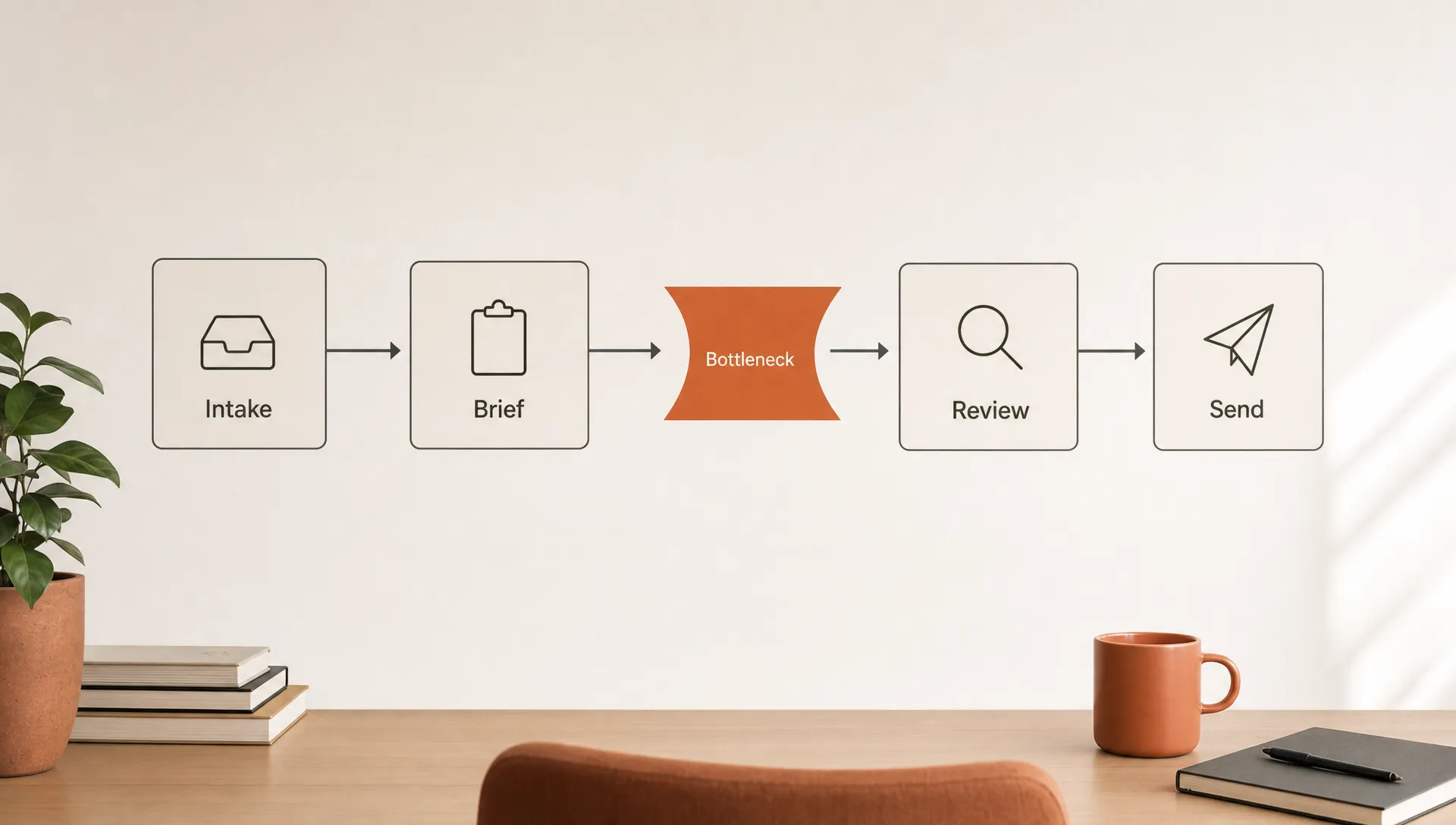
This is especially helpful for owner-led agencies where standards live in someone’s head. If the founder is the person who knows what “good” looks like, the system should capture examples, rules and review notes so the next handoff carries more of that judgment forward.
Review the handoff before writing the role
Before you open a req, take one active client and follow a recent piece of work from request to delivery. Do not do this from memory. Pull the actual artifacts.
Look at the sales notes, kickoff form, internal brief, production request, draft, review comments, client email, reporting notes and final task history. You will see where the team had enough information and where someone had to fill gaps with assumptions.
Pay special attention to silent rework. This is the work nobody labels as rework because it feels normal: rewriting a vague brief, cleaning a messy task, asking the same clarifying question, rebuilding report commentary, checking whether a client approved something, chasing an asset that should have been collected two weeks ago.
Once you see the pattern, define the next role more carefully. Maybe you need a delivery coordinator. Maybe you need a senior account lead. Maybe you need a production manager. Or maybe you need a cleaner intake path, better internal briefs and a reporting workflow that flags what needs attention before a human writes the client narrative.
The point is to make the next hire land into a cleaner system than the team has today.
The handoff review can be done in a week
You do not need a long transformation project to learn something useful. Choose one service line, one client and one recurring deliverable. A paid media agency might inspect the path from client request to campaign launch. A content shop might inspect the path from strategy to first draft. A PR firm might inspect the path from client update to pitch list. A creative studio might inspect the path from concept to client approval.
For each handoff, write down the owner sending the work, the owner receiving it, the artifact they pass and the decision the receiver is expected to make. If the receiver cannot make the decision without chasing someone, you found a handoff gap.
Then decide whether the gap needs a person, a standard, a system or a rule. Most agencies need a mix. The mistake is jumping straight to headcount before you know which part of the machine is actually grinding.
This also makes hiring easier when you do decide to hire. A clear handoff review gives the new person sharper expectations, cleaner inputs and fewer unwritten rules to decode. That is better for the agency and better for the person joining it.
Frequently asked questions
Should we pause all marketing firm hiring until handoffs are fixed? No. If the team is missing senior judgment or the workload is clearly beyond current capacity, hiring may be necessary. The handoff review simply helps you avoid hiring someone into confusion that could have been cleaned up first.
How long should a handoff review take? A useful first pass can happen in a week if you narrow the scope. Pick one client, one recurring deliverable and one painful ownership change. You are looking for repeated context loss, not a perfect process map.
Who should run the review? The owner, ops lead or head of delivery should own it because the findings affect margin, roles and delivery standards. Team members should contribute the real artifacts and explain where they get stuck.
Where does AI fit into this? AI fits best where information is scattered but the decision pattern is repeatable. Examples include drafting internal briefs from intake material, checking production requests for missing inputs and preparing first-pass reporting notes for human review.
What if the team says the process is fine and they still need help? Ask them to show the last three times the work moved from one owner to another. If the artifacts are clean and the handoffs are clear, the case for hiring is stronger. If the artifacts are thin, fix that before adding more people to the path.
What to do next this week
This week, pick the next hire you are considering and trace the work that person would inherit. Follow one real client deliverable from intake to final send. Mark every point where someone had to ask for context, recreate a brief, wait for an approval or pull the founder back in.
If the work needs judgment, write the role around judgment. If the work needs cleaner inputs, fix the handoff before you hire. If the same admin step repeats across clients, put a system around it so your team is not paying the same coordination tax every week.
Archer Scaling AI installs and runs AI ops systems for marketing agencies, especially around the internal work that eats delivery margin before anyone sees it on a client invoice. If you want to talk through where your handoffs are creating hiring pressure, book a free 30-minute intro call. It is a conversation about your operations, not a sales call.