Marketing Agency What Is It and How Does It Work?
Learn what a marketing agency is, how it works, common services, pricing models, roles, and how agencies deliver results for clients.
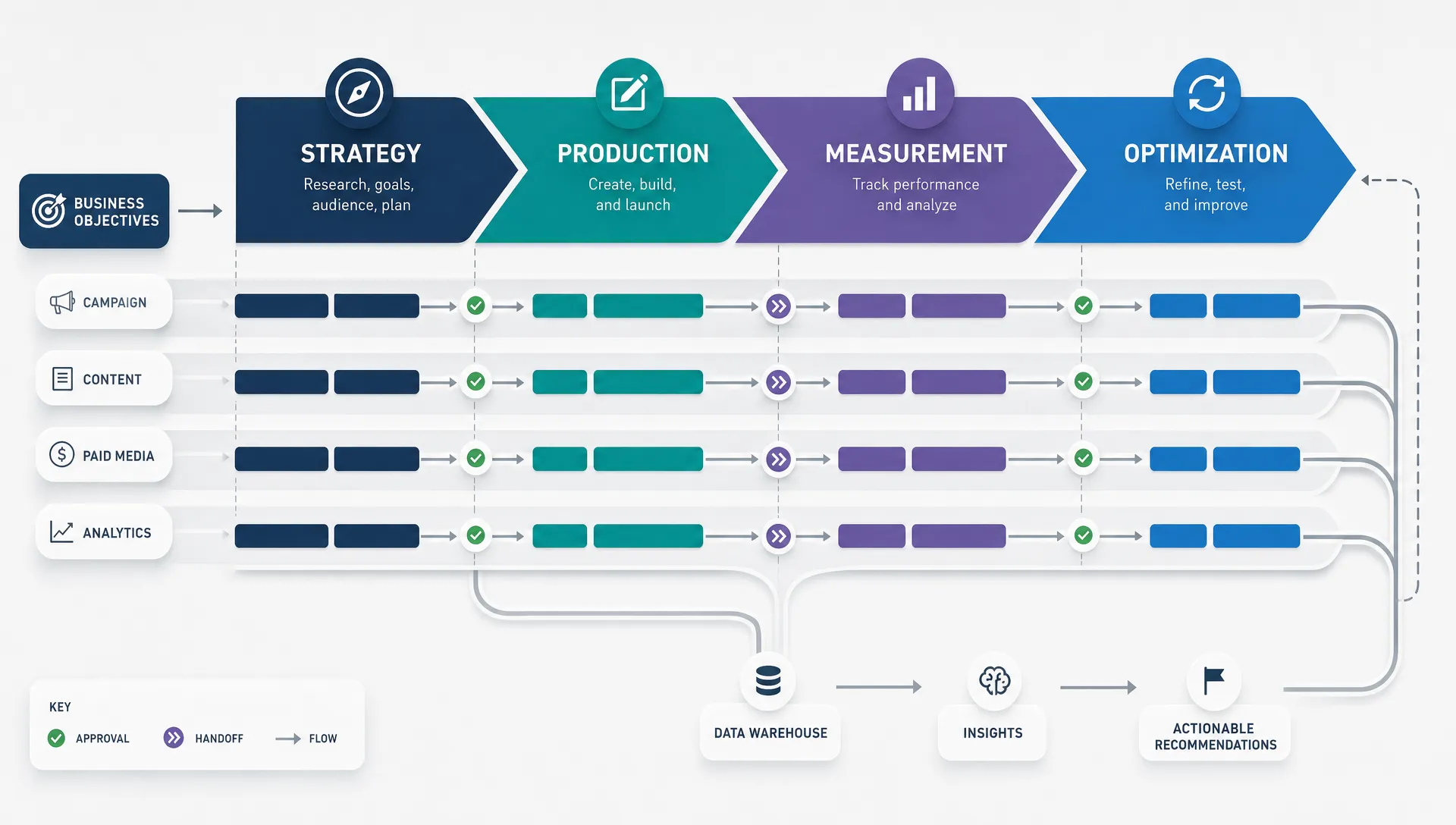
A marketing agency is a company that helps other companies win attention, generate demand, convert customers, and improve the performance of their marketing channels. In plain English, it is an outside team hired to plan, create, launch, measure, and improve marketing work that a business either cannot do internally or does not want to manage alone.
That sounds simple, but the way agencies actually work can feel confusing from the outside. Some agencies build brands. Some run paid ads. Some write content. Some specialize in B2B lead generation, lifecycle email, SEO, social media, events, analytics, or sales enablement. The best agencies connect the work to a business outcome, not just a list of deliverables.
If you are asking, “marketing agency, what is it and how does it work?”, this guide breaks it down without jargon.
What is a marketing agency?
A marketing agency is an external partner that provides marketing strategy, execution, or both. Businesses hire agencies when they need expertise, speed, systems, creative production, campaign management, or an outside perspective.
At a basic level, an agency helps answer questions like:
- Who are we trying to reach?
- What message will make them care?
- Which channels should we use?
- What assets do we need to create?
- How do we track whether the work is paying off?
- What should we change based on performance?
A marketing agency can act as a full marketing department, support an existing internal team, or handle one specialized function. For example, a software company may keep strategy in-house but hire an agency to run paid LinkedIn campaigns. A professional services firm may hire an agency for a full rebrand and new website. A B2B startup may use an agency to build its content engine while the founders focus on sales.
The core idea is always the same: the agency provides marketing capability the client does not currently have enough of.
What does a marketing agency actually do?
Marketing agencies turn business goals into marketing activity. That activity can include research, positioning, messaging, content, design, advertising, website optimization, email campaigns, reporting, and sales support.
A typical agency may help with:
- Market and customer research
- Brand strategy and messaging
- Website design and conversion optimization
- Search engine optimization and content marketing
- Paid search, paid social, and media buying
- Email marketing and marketing automation
- Social media strategy and management
- Case studies, white papers, and sales collateral
- Analytics, dashboards, and performance reporting
Not every agency does all of these. In fact, many strong agencies are specialized. A specialist agency may be more valuable than a generalist if the client has a specific problem, such as reducing paid acquisition costs, creating product-led content, or improving pipeline quality from campaigns.
If you want a deeper breakdown of the people behind the work, Archer Scaling AI has a separate guide on marketing agency roles and what they do.
How does a marketing agency work?
Most agencies follow a repeatable operating model, even if the exact process varies by service. The client brings a goal, the agency diagnoses the situation, then the agency builds and executes a plan.
Here is the usual flow.
| Stage | What happens | Why it matters |
|---|---|---|
| Discovery | The agency learns about the business, customers, offer, competition, current marketing, and goals. | This prevents the agency from guessing or creating generic campaigns. |
| Strategy | The agency recommends positioning, channels, campaign themes, budget allocation, and success metrics. | This connects marketing activity to business outcomes. |
| Planning | The team turns strategy into timelines, deliverables, owners, approvals, and launch dates. | This keeps the work moving and reduces confusion. |
| Production | Writers, designers, strategists, developers, media buyers, or specialists create the assets. | This is where the visible marketing work gets made. |
| Launch | Campaigns, content, ads, emails, landing pages, or other assets go live. | Execution turns the plan into market activity. |
| Measurement | The agency tracks performance against agreed metrics. | Reporting shows what is working and what needs to change. |
| Optimization | The agency improves targeting, creative, messaging, budget, or conversion paths. | Good marketing compounds through iteration. |
The important thing to understand is that marketing agencies do not simply “make things.” They run a workflow. A strong agency has a system for moving from insight to execution to learning.
That system matters because marketing work involves many handoffs. A strategist may define the angle. A copywriter may write the landing page. A designer may create the visuals. A media buyer may launch ads. An account manager may coordinate approvals. An analyst may report results. Without good operations, even talented teams lose time in revisions, unclear feedback, missing data, and slow approvals.
Common types of marketing agencies
Marketing agency is a broad category. The right type depends on the client’s business model, growth stage, internal team, and goals.
Full-service marketing agency
A full-service agency offers a wide range of services, often including strategy, creative, media, content, web, and reporting. This can be useful for companies that want one partner to coordinate multiple channels.
The upside is simplicity. The downside is that not every full-service agency is equally strong in every discipline.
Digital marketing agency
A digital marketing agency focuses on online channels such as search, social, paid ads, email, websites, landing pages, and analytics. This is one of the most common agency models because so much customer acquisition now happens online.
Creative or branding agency
A creative agency helps with brand identity, messaging, visual design, campaigns, and storytelling. These agencies are often hired during launches, rebrands, category repositioning, or major campaign pushes.
Performance marketing agency
A performance marketing agency focuses heavily on measurable outcomes, often through paid search, paid social, conversion rate optimization, and demand generation. These agencies are usually judged by metrics such as cost per lead, pipeline generated, return on ad spend, or customer acquisition cost.
B2B marketing agency
A B2B marketing agency helps companies sell to other businesses. B2B marketing usually involves longer sales cycles, multiple decision-makers, more education, and closer alignment with sales teams. Content, webinars, account-based marketing, case studies, email nurture, and CRM workflows are often important.
Niche specialist agency
Some agencies focus on one industry or one problem. For example, an agency may specialize in SaaS SEO, law firm lead generation, healthcare marketing, event promotion, or e-commerce email. A niche agency can move faster because it already understands the market.
For instance, an event marketing team promoting conferences or live experiences might pair campaign strategy with a modern ticketing tool like TixFlow's event ticketing platform to reduce checkout friction, manage sales phases, and simplify guest list operations.
How agencies make money
Marketing agencies usually charge for expertise, execution time, systems, or performance. The pricing model should match the nature of the work.
| Pricing model | How it works | Best fit |
|---|---|---|
| Monthly retainer | The client pays a recurring fee for ongoing services. | Continuous work such as content, ads, SEO, or reporting. |
| Project fee | The client pays a fixed amount for a defined scope. | Websites, brand projects, audits, or campaign builds. |
| Hourly billing | The agency charges based on time spent. | Consulting, flexible support, or undefined work. |
| Performance-based | Payment is tied partly to results. | Campaigns where attribution and incentives are clear. |
| Hybrid | A base fee plus project, hourly, or performance components. | Complex engagements with both ongoing and variable work. |
Retainers are common because marketing usually needs consistency. A single blog post, ad, or email rarely changes a business by itself. The value comes from sustained execution and improvement.
However, a retainer only works when expectations are clear. Clients should know what is included, how priorities are set, what results are realistic, and how communication will happen.

What clients should expect from an agency
A good agency should bring structure, not just enthusiasm. Before signing, clients should understand the agency’s process, communication rhythm, reporting approach, and definition of success.
Healthy agency relationships usually include:
- A clear scope of work
- Named points of contact
- A kickoff or onboarding process
- A shared timeline and approval process
- Access to required accounts and data
- Regular reporting or performance reviews
- A plan for testing and improvement
The client also has responsibilities. Agencies need timely feedback, subject matter expertise, product knowledge, access to systems, and honest conversations about priorities. Marketing fails when the agency is treated like a vendor that should magically produce outcomes without context.
This is especially true in B2B. If the sales team says leads are poor quality, the agency needs to know why. If a campaign drives traffic but not pipeline, the agency needs CRM visibility. If the client’s positioning is unclear, the agency needs access to customer insights and leadership input.
What happens during agency onboarding?
Onboarding is the first operational test of an agency relationship. It is where the agency gathers context, confirms the scope, gets access, documents goals, and sets the working rhythm.
A strong onboarding process usually covers business goals, target customers, current marketing assets, brand guidelines, account access, analytics setup, sales process, approval stakeholders, and success metrics.
Poor onboarding creates problems later. Missing logins delay launches. Unclear decision-makers slow approvals. Vague goals lead to vague reporting. If an agency says it can start immediately but has no onboarding checklist, that is often a warning sign.
For agency operators, onboarding is also one of the first places where margin gets won or lost. Repeated manual follow-ups, scattered intake forms, and unclear handoffs eat delivery time. Archer Scaling AI covers this in more detail in its guide to marketing agency client onboarding that actually scales.
How agencies measure success
Marketing success depends on the goal. A brand campaign, an SEO program, and a paid acquisition campaign should not be measured the same way.
Common agency metrics include traffic, impressions, engagement, conversion rate, cost per lead, qualified leads, sales opportunities, pipeline, revenue influenced, return on ad spend, email performance, search rankings, and customer acquisition cost.
The best agencies separate activity metrics from business metrics. Activity metrics show whether the work happened. Business metrics show whether the work mattered.
For example, publishing eight articles is an activity metric. Increasing qualified organic demo requests is closer to a business metric. Sending weekly emails is an activity metric. Improving trial activation or booked calls from nurture is closer to a business metric.
Clients should be cautious when an agency only reports vanity metrics. Impressions and clicks can matter, but they need context. The real question is whether those numbers support the commercial goal.
What makes a marketing agency good?
A good marketing agency combines strategy, execution, communication, and operational discipline. Many agencies are strong in one area but weak in another. The best client experience usually comes from the combination.
Look for these signs:
- They ask about business goals before recommending tactics.
- They can explain their process in plain language.
- They define what success will and will not look like.
- They have a realistic view of timelines and constraints.
- They report on insights, not just numbers.
- They document decisions and next steps.
- They are willing to challenge assumptions when needed.
A weak agency may overpromise, hide behind jargon, avoid measurement, rely on generic templates, or treat every client the same. Another warning sign is constant chaos. Creative work can be fluid, but delivery should not feel random.
How marketing agencies use systems and automation
Modern agencies are not just creative teams. They are operations businesses. Every client adds more research, meetings, assets, approvals, reports, and follow-ups. If those workflows are handled manually every time, the agency’s profit margin suffers and the client experience becomes inconsistent.
That is why more agencies are building systems for repeatable work such as onboarding, research, reporting, CRM hygiene, content operations, and lead follow-up. Automation does not replace strategy or taste. It removes repetitive work that slows strategists, account managers, and creatives down.
For example, an agency might automate intake reminders, meeting summaries, report assembly, campaign QA checks, or first-pass research. The human team still makes decisions, but the operational load is lighter.
This matters for clients too. Agencies with better internal systems can often respond faster, reduce errors, and spend more time on work that requires judgment. If you run an agency and want to understand this operational layer, Archer Scaling AI explains how agency marketing systems protect delivery margin.
Agency vs freelancer vs in-house team
A marketing agency is not always the right choice. Sometimes a freelancer or in-house hire is better.
A freelancer is often best for a specific skill, such as copywriting, design, SEO consulting, or paid ads management. Freelancers can be flexible and cost-effective, but one person may not cover strategy, execution, project management, and analytics at the same depth.
An in-house hire is best when the company needs deep internal context, constant cross-functional collaboration, and long-term ownership. The tradeoff is recruiting time, salary, benefits, management, and the risk of hiring one person when the business actually needs several skills.
An agency is best when the company needs a coordinated team, faster ramp-up, specialized expertise, or a complete operating process. The tradeoff is that the agency needs strong onboarding and access to internal knowledge to do its best work.
Frequently Asked Questions
What is a marketing agency in simple terms? A marketing agency is an outside team that helps a business plan, create, run, and improve marketing campaigns so the business can attract and convert more customers.
How does a marketing agency work with clients? Most agencies start with discovery, then build a strategy, plan deliverables, produce assets, launch campaigns, report on results, and optimize based on performance.
What is the difference between a marketing agency and an advertising agency? An advertising agency usually focuses on paid promotion and campaign creative. A marketing agency may cover a broader range of work, including strategy, content, SEO, email, websites, analytics, and customer research.
How much does a marketing agency cost? Costs vary widely based on scope, expertise, industry, and pricing model. Some agencies charge project fees, while others use monthly retainers, hourly billing, performance-based pricing, or hybrid models.
Is hiring a marketing agency worth it? It can be worth it when the agency solves a clear business problem, brings expertise you do not have internally, and measures success against meaningful goals. It is less likely to work if the scope is vague or expectations are unrealistic.
The bottom line
A marketing agency is a growth partner that turns goals into strategy, campaigns, assets, measurement, and improvement. The best agencies do more than produce deliverables. They create a reliable operating rhythm that helps marketing work move from idea to execution to results.
If you are a client, choose an agency based on fit, clarity, process, and evidence of thinking. If you run an agency, remember that your service quality depends not only on talent, but also on the systems behind delivery.
For B2B marketing agencies, Archer Scaling AI installs and runs AI-powered operations systems that reduce repetitive delivery work across workflows like onboarding, reporting, CRM, and content ops. If your agency is growing but margin is getting squeezed, start with the paid Margin Teardown to identify the roadmap and first automation moves before committing to a larger build.