Marketing Agency Operations That Protect Delivery Margin
Build marketing agency operations that protect delivery margin by reducing rework, standardizing delivery and automating repeatable workflows.
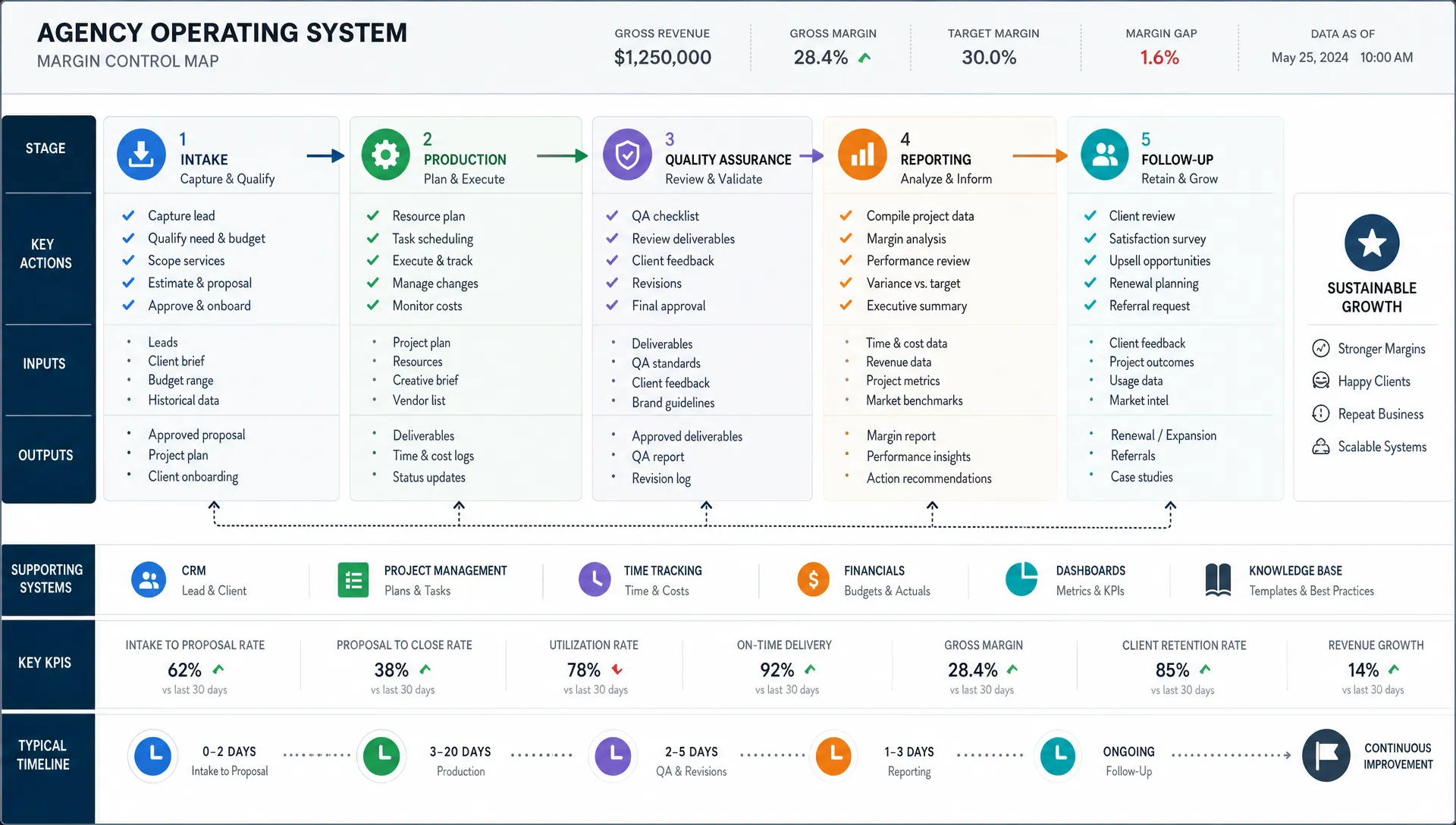
Delivery margin is rarely destroyed by one dramatic mistake. In a B2B marketing agency, it usually leaks through small operational gaps: a missing access request, a vague brief, a late stakeholder comment, a manual report rebuild or a senior strategist spending two hours finding information that should have been ready before the meeting.
That is why marketing agency operations deserve more attention than they usually get. Creative quality, strategy and client relationships still matter, but they only stay profitable when the delivery machine underneath them is controlled. The agencies that protect margin do not simply work harder. They make the cost of delivery visible, repeatable and easier to manage before the team is overloaded.
Good operations are not bureaucracy. They are the set of rules, workflows and automations that help the right person do the right work at the right time, with the right context. When that system is weak, every client feels custom, every report feels urgent and every campaign depends on someone remembering what happened in Slack two weeks ago.
Delivery margin is an operating problem, not just a pricing problem
Raising retainers can help, but price alone will not fix delivery drag. If the agency sells a higher retainer while the team still rebuilds the same briefs, searches for client assets and manually formats performance updates, the extra revenue gets absorbed by hidden labor.
Delivery margin depends on how well the agency converts a client promise into controlled work. The core question is simple: how much paid client value can the team deliver without unnecessary rework, duplicated effort or senior people doing low-leverage tasks?
| Margin leak | What it looks like inside the agency | Operational control that protects margin |
|---|---|---|
| Weak intake | Work starts with missing access, vague goals or unclear approvals | Standardized onboarding and required inputs before kickoff |
| Repeated research | Teams redo ICP, competitor and offer research for every deliverable | Reusable research workflows and structured knowledge capture |
| Manual reporting | Analysts spend hours pulling screenshots and rebuilding slides | Standard metric definitions, automated data assembly and QA checks |
| Late approvals | Client feedback arrives after production is already complete | Approval rules, stakeholder mapping and deadline visibility |
| Scope drift | Small requests are absorbed without pricing or tradeoffs | Change request triage and documented decision paths |
| Context loss | Account managers, strategists and creatives work from different assumptions | Shared briefs, handoff templates and source-of-truth documentation |
This is the reason ops work often creates more margin than another productivity hack. It reduces the number of times the team has to think through the same operational question from scratch.
Map every client promise to a margin event
The first step is not automation. It is mapping where margin is won or lost across the client lifecycle.
A margin event is any moment where the agency either protects delivery efficiency or creates extra unbilled work. Common examples include sales handoff, kickoff, access collection, strategy approval, asset production, campaign launch, reporting, renewal planning and change requests.
Each event should have a clear owner, required inputs, expected timeline and escalation rule. Without that structure, the agency relies on personal memory. That can work with five clients and a small team, but it breaks when volume increases, account complexity grows or a key operator takes a week off.
For each recurring client promise, ask:
- What information must exist before work begins?
- Who approves the work and by when?
- What part of the work is strategic, and what part is repeatable?
- Where do errors usually appear?
- Which tasks are being done by people who are too senior for the work?
- What should happen when the client asks for something outside the original scope?
The answers become the foundation of the operating system. Once the agency sees the margin events clearly, it can decide what to standardize, automate, delegate or stop doing.
Control inputs before delivery starts
Most delivery problems are intake problems that show up later. A campaign brief that lacks offer clarity becomes a creative revision problem. A reporting request without source-of-truth rules becomes an analytics dispute. A kickoff without decision-maker alignment becomes an account management fire drill.
Input control protects margin by preventing incomplete work from entering the delivery system. A strong intake process gathers the information the team needs before expert time is spent. For a B2B agency, that often includes ICP details, offer positioning, campaign goals, compliance rules, brand assets, CRM access, analytics access, approval stakeholders and examples of what good looks like.
Good intake also helps the client make better decisions before work starts. You can see the same principle in other complex service categories. A practical UK to Poland relocation guide reduces uncertainty by helping people understand requirements, concerns and next steps before they commit. Agency onboarding should create a similar sense of clarity: the client knows what is needed, why it matters and what happens if something is missing.
The operational mistake is treating intake as a form. It should be a workflow. Forms collect answers, but workflows chase missing inputs, route information to the right people, create tasks, flag blockers and convert raw details into usable briefs.
If your agency is deciding where to begin, client onboarding and handoffs are often better first targets than flashy content generation. This guide on what marketing work agencies should automate first explains why delivery operations usually create cleaner gains than starting with the most visible creative task.
Protect senior time with a production operating system
Senior people should be used for judgment, not repetitive assembly. Yet in many agencies, the most expensive team members become the glue holding broken workflows together. They summarize client calls, hunt for missing background, rewrite vague briefs, check task statuses and answer questions that should have been resolved by the system.
A production operating system separates expert judgment from repeatable preparation. Strategists still decide positioning, campaign direction and tradeoffs. Account leads still manage relationships. Creative leads still protect quality. But the surrounding steps become structured enough that senior people are not carrying operational load by default.
That usually means building reusable workflows for research, brief creation, asset routing, QA, reporting and follow-up. AI can help with these steps when the process is defined. It can summarize calls, extract client requirements, draft structured briefs from intake data, compare a deliverable against a checklist, prepare report commentary from approved metric definitions and route follow-up tasks based on client responses.
The key is to avoid using AI as a substitute for a missing process. If the agency has not defined the inputs, decision rules and quality standards, automation will only move the confusion faster.
Put QA gates where mistakes are created
Many agencies place quality assurance at the end of production, right before the client sees the work. That protects reputation, but it does not always protect margin. By the time the final QA review catches a strategic mismatch, the team has already spent the hours.
Margin-focused QA happens earlier. It asks whether the work is ready to enter each stage, not just whether the final output looks polished.
| Workflow stage | QA control | Margin impact |
|---|---|---|
| Before kickoff | Confirm decision-makers, access, goals and scope | Prevents false starts and repeated kickoff questions |
| Before strategy | Confirm audience, offer, constraints and success metrics | Reduces strategic rework and misaligned recommendations |
| Before production | Confirm approved brief, asset requirements and deadline | Prevents creative teams from producing against unstable inputs |
| Before client review | Check accuracy, brand fit, scope and next-step clarity | Reduces avoidable revisions and account management cleanup |
| Before reporting | Verify source data, metric definitions and commentary logic | Prevents reporting disputes and manual correction cycles |
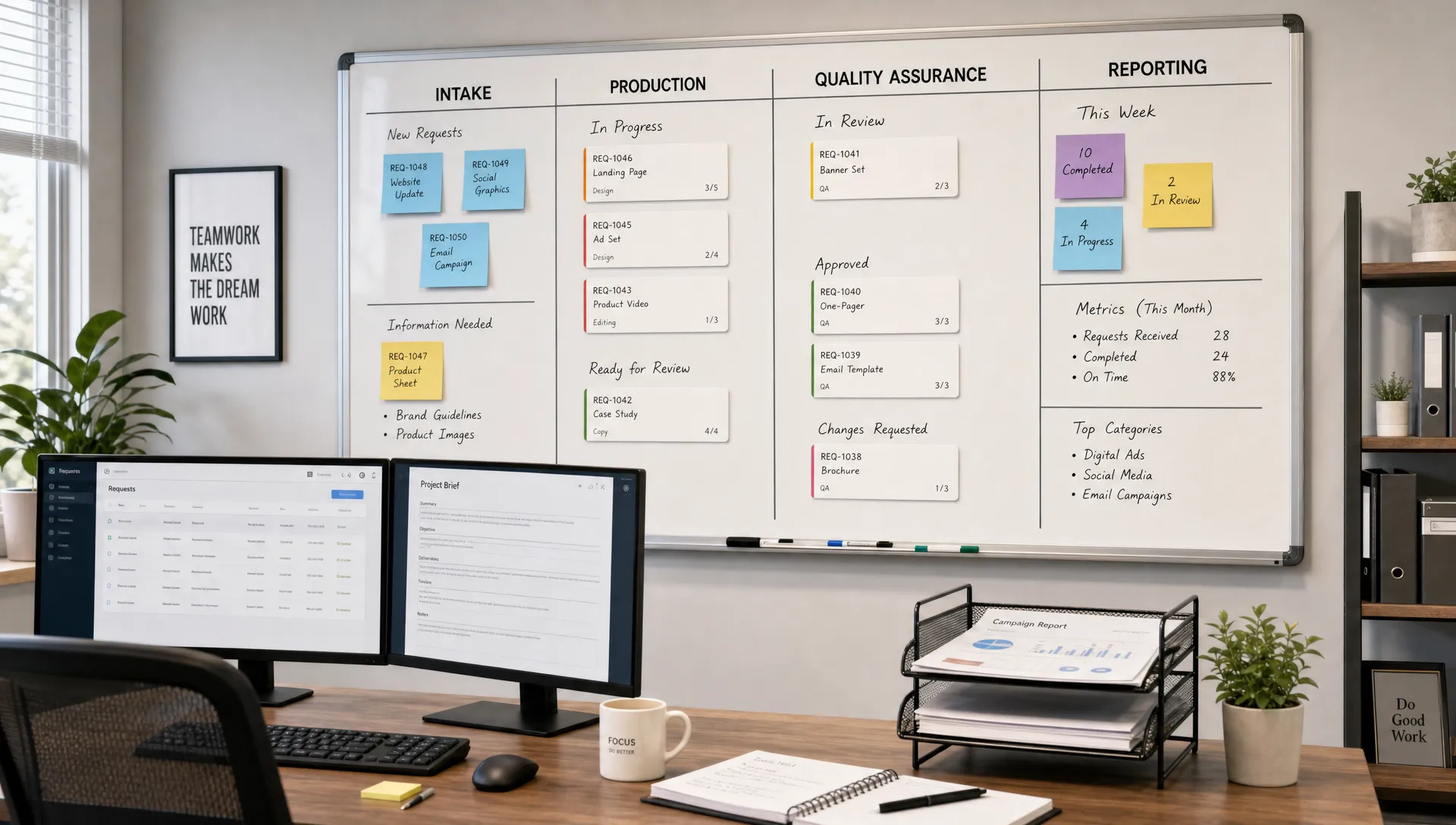
A useful standard is the definition of ready and definition of done. Ready means the work can move into the next stage without the next person chasing missing context. Done means the output meets the quality bar and can move forward without hidden follow-up.
Turn reporting into a repeatable service line
Reporting is one of the easiest places for agencies to lose margin because it feels client-critical and urgent. Teams often tolerate manual report work because the output is visible and clients expect it. But if the reporting process depends on repeated data pulls, custom formatting, inconsistent metric definitions and last-minute commentary, every reporting cycle becomes a hidden tax on the team.
A margin-protective reporting system separates data assembly from analysis. Data collection, formatting, recurring metric checks and first-pass summaries should be as repeatable as possible. Human judgment should be reserved for interpreting what changed, what matters and what the client should do next.
This requires a few operating decisions: which metrics are standard across accounts, where the source of truth lives, when reporting data is locked, who reviews anomalies and how client-facing commentary is approved. Once those rules are clear, automation can reduce the repetitive work without weakening the insight.
If reporting is already a delivery bottleneck, start by fixing the structure before adding more dashboards. This breakdown of marketing agency reporting bottlenecks covers the operational controls that usually matter most.
Make change requests visible before they become unpaid work
Scope creep is not always caused by difficult clients. Often, it happens because the agency has no clean operating path for small requests. The account manager wants to be helpful, the team wants to move fast and nobody wants to turn a quick ask into a commercial conversation.
The problem is that enough quick asks become a margin problem. A new landing page section, an extra reporting cut, another round of edits or a one-off competitor review may be reasonable, but it still consumes delivery capacity.
A change request workflow protects the relationship and the margin at the same time. It gives the team language and structure for deciding whether a request is included, traded off, priced separately or saved for later.
A simple status system can work well:
- Included in current scope
- Included if another task is deprioritized
- Paid add-on
- Backlog for the next planning cycle
This is not about saying no more often. It is about making the cost of yes visible. When clients understand the tradeoff, account teams can stay collaborative without turning every exception into unpaid labor.
Where AI ops actually protects margin
AI is most useful in agency operations when it reduces repetitive coordination, not when it tries to replace the agency's strategic edge. The margin gain comes from compressing admin-heavy workflows that already have patterns.
Good AI ops candidates include call summaries, intake parsing, CRM updates, lead routing, research synthesis, reporting preparation, SOP drafting, content brief assembly, task creation and follow-up reminders. These tasks are valuable, but they do not always require senior human attention from start to finish.
The agency should keep human control over strategy, final recommendations, client-sensitive messaging, commercial decisions and any judgment call where context matters. A reliable AI ops layer should make the team sharper, not less accountable.
The practical test is simple: if a task is frequent, rules-based, time-consuming and easy to review, it is probably a good automation candidate. If it is ambiguous, politically sensitive or core to the agency's strategic value, keep a human in the lead.
Run a weekly margin cadence
Operations only protect margin when they are managed. A workflow may look good in a diagram, but the agency needs a weekly cadence to see whether it is actually reducing friction.
The cadence does not need to be complicated. Review a small set of operational signals, identify the accounts or workflows creating drag and assign fixes before the next cycle repeats the same problem.
| Signal to review | Why it matters | What to look for weekly |
|---|---|---|
| Missing intake items | Incomplete inputs create downstream rework | Clients or service lines with repeated blockers |
| Revision rate | Excess revisions usually mean unclear briefs or approvals | Work types with more feedback loops than expected |
| Handoff delays | Waiting time creates delivery drag and missed deadlines | Tasks stuck between account, strategy, creative and analytics |
| Report assembly time | Manual reporting quietly consumes skilled labor | Accounts requiring custom effort every cycle |
| Unpriced requests | Extra work reduces margin even when the client is happy | Requests absorbed without tradeoff or pricing decisions |
| Senior time on admin | Expensive roles should not carry routine operations | Repeated tasks that should become templates or automations |
This cadence turns operations into a management system rather than a one-time cleanup project. It also creates a feedback loop for automation. The agency can see which recurring issues are worth systemizing next.
A practical 90-day path
A full operating system does not need to be built all at once. The better path is to protect the highest-leverage margin points first, then expand once the team trusts the process.
| Timeline | Focus | Outcome |
|---|---|---|
| Days 1 to 30 | Map margin events, identify delivery leaks and standardize intake | The agency knows where margin is leaking and what must be controlled first |
| Days 31 to 60 | Build repeatable workflows for onboarding, research, reporting or follow-up | The team reduces manual effort in the most common delivery bottlenecks |
| Days 61 to 90 | Add automation, QA rules, documentation and weekly margin reviews | The system becomes easier to run, improve and transfer without lock-in |
The sequence matters. If you automate before mapping the real margin events, you may save time in the wrong place. If you document before simplifying, you preserve complexity. If you build dashboards before defining decisions, you create visibility without control.
Start with the work that is frequent, painful and close to margin. Then make it repeatable enough that automation can support it safely.
What to avoid when improving agency operations
The most common mistake is turning operations into tool collection. A new project management tool, AI assistant or dashboard will not fix unclear ownership, weak inputs or undefined quality standards. Tools amplify the operating model that already exists.
Another mistake is over-standardizing the parts of agency work that clients actually value. Strategy, positioning, creative judgment and relationship management should not feel robotic. The goal is to standardize the scaffolding around those services so the high-value work gets more attention, not less.
Finally, avoid treating documentation as the finish line. Documentation is useful only when it reflects how the team really works and helps the next person complete the task with less friction. A simple, used SOP is worth more than a polished playbook that nobody opens.
Frequently Asked Questions
What are marketing agency operations? Marketing agency operations are the workflows, systems, roles, handoffs and quality controls that turn client commitments into delivered work. They cover areas such as onboarding, research, production, approvals, reporting, follow-up and internal documentation.
How do agency operations protect delivery margin? They reduce the unbilled labor caused by rework, missing inputs, manual reporting, unclear ownership and scope drift. Strong operations make delivery more predictable, which helps the agency serve clients without constantly adding hours or headcount.
What should a marketing agency automate first? Start with repeatable operational work close to delivery margin, such as onboarding reminders, intake parsing, research collection, reporting preparation, CRM updates and follow-up routing. Avoid automating strategic judgment until the surrounding workflow is clear.
Does AI replace agency staff in operations? AI should reduce repetitive coordination and admin work, not replace accountable human judgment. The best use of AI in agency operations is to prepare, route, summarize and check work so the team can spend more time on strategy, quality and client decisions.
How do you know if operations are improving margin? Track signals such as revision rate, missing intake items, handoff delays, reporting assembly time, unpriced client requests and senior time spent on admin. If those numbers improve while client outcomes stay strong, operations are likely protecting margin.
Build an ops layer that keeps delivery profitable
If your agency is growing but delivery feels heavier every month, the problem may not be talent. It may be the operating layer between the promise you sell and the work your team has to deliver.
Archer Scaling AI installs and runs AI-powered operations systems for B2B marketing agencies, covering workflows such as onboarding, reporting, CRM, content ops, lead follow-up, SOPs and repeatable delivery processes. The work starts with a paid Margin Teardown, including a roadmap and three automation moves, or it is on me.
The aim is simple: protect delivery margin without defaulting to another hire, and make the system visible before you commit.