Landing Page Agencies Need a Repeatable QA Checklist
Landing page agencies can protect margin with a repeatable QA checklist for handoffs, copy, forms, tracking and client approvals.
Your team can build a good page. The margin leak is not usually a weak headline or a bad button color, it is the last pass where a senior person catches broken links, wrong offer copy, missing tracking and client comments that should have been resolved two handoffs ago.
For landing page agencies, QA cannot live inside one sharp producer's head. It has to be a repeatable checklist that any project manager, designer, copywriter or builder can run the same way before the page leaves the shop.
A QA checklist protects margin before it protects polish
A landing page project looks contained from the outside. One page, one offer, one form, maybe a thank-you page and a few traffic variants. Inside the agency, that small scope still pulls in strategy, copy, design, development, tracking, CRM, compliance and account management.
That is why page QA is really delivery control. The checklist is not there to make everyone slow down and admire the work. It is there to catch the small misses that create rework after the client has already seen the page.
The best landing page agencies treat QA like a production gate, not a heroic final read. If the same five checks happen at the end of every project, those checks belong earlier in the workflow. If the same person is always the only one who knows whether the page is ready, that knowledge belongs in the system.
A good checklist does three things for the agency:
- It reduces senior review time because obvious misses get caught before escalation.
- It protects client trust because the first version they see feels controlled.
- It creates a training path for new delivery hires without turning every launch into a shadowing exercise.
The aim is not zero mistakes forever. The aim is fewer avoidable mistakes and a clear way to learn from the ones that still get through.
Most page defects come from handoffs, not design taste
When a page comes back with client notes, the visible issue might be a typo, a wrong testimonial or a form that does not route correctly. The source is often earlier: a fuzzy brief, missing source material, unclear offer language or no agreed owner for tracking.
Most landing page agencies do not have a quality problem because their team lacks taste. They have a handoff problem because page work crosses too many roles in a short window.
If your client intake already feels noisy, fix that before adding more QA meetings. A page checklist cannot rescue a project that started with missing access, unclear approvals or no source of truth for offer details. This is the same reason client onboarding has to scale as a workflow, not as a longer kickoff call.
| Defect the client sees | Where it usually starts | What it costs internally |
|---|---|---|
| Wrong offer or audience angle | Sales-to-delivery handoff | Rewrites and strategy debate after production starts |
| Missing proof, logo or testimonial context | Asset intake | Account manager follow-up and design rework |
| Broken form or wrong notification | Build and CRM handoff | Urgent fixes near launch |
| Tracking does not match the campaign plan | Measurement setup | Reporting confusion after traffic starts |
| Old client comments still visible | Review management | Trust loss and another review round |
| Mobile layout feels unfinished | Build QA | Senior review time spent on basic checks |
That table is useful because it moves the conversation away from blame. If the same defect repeats, the checklist needs a clearer gate or the handoff before it needs better wording.
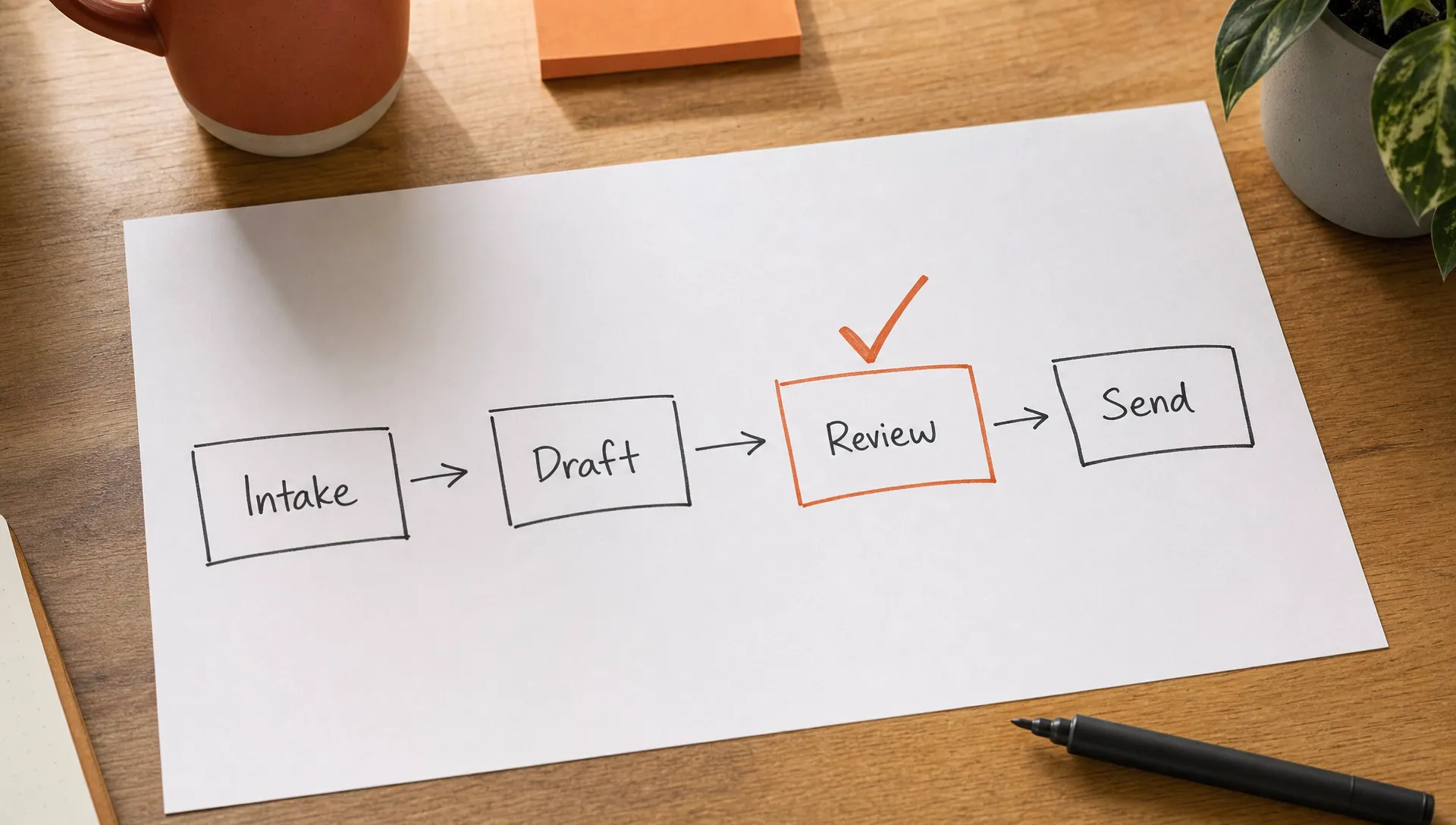
The checklist should follow the page from intake to send
A QA checklist works best when it follows the life of the page. If it only appears after the page is built, it becomes a cleanup list. Cleanup is expensive because the team has already made decisions on top of weak inputs.
Think in gates. A gate is a simple condition that must be true before the page moves forward. Copy should not start until the offer, audience and proof points are clear. Build should not start until copy and design states are approved enough to stop churn. Client send should not happen until the page, form, tracking and comments have been reviewed against the same standard.
| Workflow stage | QA question | Owner to assign |
|---|---|---|
| Intake | Do we have the offer, audience, source assets, access and approval path? | Account or project lead |
| Copy | Does the draft match the brief, voice, claim limits and required sections? | Copy lead or strategist |
| Design | Does the layout support the message on desktop and mobile? | Design lead |
| Build | Does the page match the approved design closely enough to send? | Builder or developer |
| Tracking | Do form events, links and campaign parameters match the plan? | Ops, media or analytics owner |
| Internal review | Are unresolved comments closed before the client sees it? | Project lead |
| Client send | Is the review request specific about what feedback is needed? | Account lead |
A checklist with owners beats a longer checklist with no accountability. If everyone owns tracking, nobody owns tracking.
Write acceptance criteria, not reminders
The weakest checklist items sound reasonable until someone tries to use them under deadline. Check copy. Check mobile. Check tracking. Those are reminders, not criteria.
A reviewer needs to know what finished means. That does not require legal-style language. It does require concrete pass or fail conditions.
| Weak checklist item | Better acceptance criterion |
|---|---|
| Check copy | Headline, offer, proof points and call to action match the approved brief |
| Check mobile | No overlapping elements, cropped text or unusable form fields on common phone widths |
| Check links | All navigation, button, policy and outbound links open to the intended destination |
| Check form | Test submission reaches the expected inbox, CRM field or notification path |
| Check tracking | Pageview, form submit and key click events match the campaign naming plan |
| Check comments | No unresolved internal comments are visible in the client review link |
This is where repetition helps. Landing page agencies do not need a different QA philosophy for every client. They need a core standard that flexes by offer type, regulated language, brand voice and technical setup.
Acceptance criteria also make automation safer. A tool can compare a page against a known checklist much better than it can interpret a vague note that says make sure everything looks good.
Use AI where comparison is tedious and human review where judgment matters
AI is useful in page QA when the task is comparison, extraction or consistency checking. It can compare the draft against the brief, flag missing required sections, spot inconsistent product names, summarize unresolved comments and check whether meta text or page copy drifts from the approved angle.
That does not mean it should approve the page. A human still needs to judge whether the page makes the offer believable, whether the claims are safe, whether the design hierarchy makes sense and whether the client relationship context changes what should be sent.
Landing page agencies can use AI to reduce the time spent finding low-level misses, then keep senior attention on the calls that actually need taste and experience. If your team is deciding where review must stay human, this breakdown of where AI-based marketing needs human review is a useful companion.
The practical test is simple. If the check involves matching the page to a rule, source file or known pattern, a machine can probably help. If the check involves risk, persuasion, client politics or final judgment, keep a human in the loop.
Build the checklist into the workflow instead of another doc
A checklist buried in a shared drive will be ignored the first week a client pushes for speed. Put the checklist where work changes hands.
For some teams, that means checklist fields inside the project management card. For others, it means required questions in the page request form, a QA section inside the build ticket or a pre-send template the account lead cannot skip. The tool matters less than the forcing function.
The best implementation is boring. When copy moves to design, the designer can see the approved brief and knows which claims are final. When design moves to build, the builder can see the desktop and mobile notes. When build moves to internal review, the reviewer can see what has already passed and what still needs judgment.
Do not turn the first version into a compliance manual. Start with the checks that repeatedly burn hours. Broken links, form routing, missing mobile review, stale comments, wrong offer language and unclear feedback requests are usually enough to justify the system.
A practical QA checklist landing page teams can start using
For landing page agencies that sell speed, the checklist has to be short enough to run every time. A useful starter version covers five areas.
Brief and source material: Confirm the approved offer, audience, page goal, traffic source, required proof, brand voice notes, claim limits, access and approval owner. If the page references outside resources, partner mentions or niche publishers such as Haley Marie Blog, the reviewer should verify that the link destination, anchor and surrounding context still fit the page.
Copy and message: Confirm the headline matches the offer, the first screen explains why the visitor is there, proof appears near the claim it supports and the call to action is consistent across the page.
Design and build: Confirm the built page matches the approved layout closely enough for client review, mobile states are usable, images load correctly, text is not cropped and the page does not contain placeholder copy or hidden comments.
Forms, links and tracking: Confirm every button, form field, thank-you state, email notification, CRM path and tracking event has been tested from the live or staging environment the client will review.
Client review package: Confirm the client receives the right link, the right context and a clear request for the type of feedback needed. If the team needs copy approval, do not ask for general thoughts on layout. If the layout is locked, say so before the review starts.
This starter checklist should become more specific over time. A paid media shop may need stronger tracking checks. A creative studio may need more visual QA. A content-heavy agency may need deeper claim sourcing and editorial review. The shared principle stays the same: quality lives in the handoff, not only in the final proofread.
Decide who owns each check before volume rises
As landing page agencies add more volume, unclear ownership becomes more expensive than the mistake itself. A broken link is easy to fix. A debate over who should have checked it slows the next project too.
Assign owners by proximity to the work. The person closest to the page build should test links and layout. The person closest to measurement should test events and CRM routing. The person closest to the client should control the review package. Senior strategy should not be dragged into checking whether a privacy link opens.
This also helps with utilization. Your most experienced people should spend less time hunting for basic defects and more time reviewing the few items that affect conversion logic, client trust and scope. If a junior team member can run a pass-fail checklist before escalation, senior review becomes shorter and sharper.
A simple ownership rule prevents most confusion: no page moves to the next stage without a named person marking the current stage complete. Not a department. Not a channel. A person.
Review the QA system every month, not every fire
A checklist should change when reality changes. New page types, new client industries, new form tools, new compliance concerns and new traffic channels all create new failure points.
Do not wait for a messy launch to update the process. Keep a small error log with the defect, where it was caught, where it started and what checklist item would have caught it earlier. Review that log monthly with whoever owns delivery.
The goal is not to add a new rule for every one-off problem. That creates checklist bloat and people stop reading it. Add a rule when the miss is likely to repeat, when it costs meaningful time or when it creates client-facing risk.
Over time, this turns QA from a last-minute scramble into a learning loop. The agency gets better because the system remembers what the team used to carry in their heads.
Frequently asked questions
Do landing page agencies really need a formal QA checklist? Yes, if more than one person touches the work or if the agency is handling more than a few pages at a time. The checklist protects margin by catching repeatable defects before senior review or client review.
Who should own landing page QA inside an agency? Ownership should be split by stage, but one project lead should own the final send. Builders can own page behavior, measurement owners can own tracking and account leads can own the client review package.
Can AI review a landing page before launch? It can help compare the page against the brief, required sections and naming rules. It should not be the final approver for claims, persuasion, brand fit, client context or risk.
How long should a landing page QA checklist be? Long enough to catch the recurring misses, short enough that the team will run it under deadline. Start with the defects that burn the most rework, then expand only when a pattern repeats.
What to do next this week
Pick one recent page project that created rework. Do not start by rewriting your whole delivery process. Open the brief, the task thread, the design file, the build notes and the client feedback. Find the first moment where the miss became likely.
Then add one gate before that moment. If the form broke, add a named form test before internal review. If the offer was wrong, add offer approval before copy starts. If client feedback wandered, add a tighter review request template before the page is sent.
Repeat that for three projects and you will have the first version of a checklist your team may actually use.
If you want another operator in the room, Archer Scaling AI installs and runs AI ops systems for marketing agencies. You can book a free 30-minute intro call to talk through your operations, not sit through a sales call.