Where AI-Based Marketing Needs Human Review
Learn where AI based marketing needs human review across onboarding, research, copy, reporting and follow-up so agency margin stays protected.

Most agency owners are past the novelty phase. You have tried the writing tools, the meeting summaries, the research assistants and maybe a few AI based marketing automations that worked for a week before the team quietly went back to Slack and spreadsheets.
The hard part of AI based marketing is not getting a model to produce something. The hard part is knowing where a human still needs to review the work before it changes a client relationship, creates rework or burns margin.
Where AI based marketing needs human review most
For an agency, review should not mean “a senior person reads everything.” That just moves the bottleneck from production to approval.
Human review belongs at the points where a bad output can create real cost. A wrong internal tag is annoying. A wrong claim in client copy can create legal risk. A weak report narrative can make a healthy account feel shaky. A sloppy onboarding summary can send the whole team into the first month with the wrong assumptions.
The review question is simple: if this output is wrong, who pays for it?
If the answer is “a coordinator fixes it in two minutes,” sample it. If the answer is “the client loses trust, the strategist has to redo the plan or the owner gets pulled into a save call,” put a human checkpoint in front of it.
A practical review system usually has four lanes:
- Auto-pass with sampling for low-risk internal cleanup, formatting and routing.
- Light review for drafts, summaries and task creation.
- Specialist review for channel-specific work, claims, strategy and QA.
- Owner or delivery lead review for sensitive accounts, scope changes, pricing language and client-facing recommendations.
That distinction is where the margin is. You want the machine doing the repetitive work, but you do not want junior judgment hidden inside a polished paragraph.
Onboarding needs review before assumptions become the brief
Client onboarding is one of the best places to use automation because the work is repetitive and document-heavy. Intake forms, sales notes, call transcripts, existing assets, competitor pages and analytics exports can all be turned into a kickoff packet before a strategist opens a blank doc.
But onboarding is also where bad assumptions harden fast.
A model can summarize the client’s offer. A human has to check whether the offer is actually the one the agency will be marketing. A model can pull competitor notes. A human has to notice that the “competitor” is a marketplace, a partner or a company in a different region. A model can draft a first-call agenda. A human has to decide which questions matter most for the first 30 days.
The review point should sit before the kickoff brief gets handed to the delivery team. The reviewer is not proofreading. They are checking for strategic accuracy, missing constraints and anything that would cause the team to start work in the wrong direction.
If your agency is building out this part of the system, start with the workflows that gather and structure information before the first strategy call. A good next read is this breakdown of research marketing workflows you can automate now, especially if your current intake process depends on someone manually reading every attachment.
Research needs review when the answer becomes a point of view
Research is a tempting place to trust the output too quickly. The tool can scan pages, summarize reviews, group objections and extract themes from sales calls. That feels useful because it removes the first layer of grunt work.
The risk is that research summaries often sound more certain than they are.
AI based marketing systems are good at pattern compression. They can show you what appears often, what language repeats and which topics cluster together. They do not know, without direction, which pattern should shape the strategy for this client, this budget, this retainer and this delivery team.
Human review matters most when research turns into a point of view. That includes audience positioning, message angles, content priorities, paid media hypotheses, PR angles, local market assumptions and campaign recommendations.
A strategist or senior channel lead should check the research against real client context:
- Is this from the right audience or just the loudest audience?
- Is the data current enough for the decision being made?
- Does the source reflect buyers, users, candidates, partners or random commenters?
- Does the conclusion fit the client’s actual capacity to deliver?
- Are we building a plan from evidence or from a clean-looking summary?
For technical niches, this review step gets even more important. If your agency works in industrial, manufacturing or specialized B2B categories, generic phrasing can look fine and still miss the buyer’s language. Comparing drafts against specialist examples, such as an industrial inbound marketing and PPC provider, can help your team see where the model is smoothing over the details that matter.
Copy and creative need review for claims, voice and taste
Drafting is where most teams first tried these tools. Blog outlines, ad variations, landing page sections, email drafts, social captions and creative briefs can all move faster when the first pass is not starting from nothing.
In AI based marketing, the review problem is that a polished draft can hide three issues: unsupported claims, off-brand voice and bad taste.
Claims are the most obvious. If copy says a product is the “fastest,” “most accurate,” “guaranteed” or “proven,” someone has to check whether the client can back that up. In the U.S., the FTC’s advertising and marketing guidance is clear that advertising claims need support. Agencies do not need every writer to become a lawyer, but they do need a review step for claims before client work goes live.
Voice is harder. A model can mimic a sample, but it often averages the brand into safe, clean language. That may pass a grammar check and still feel wrong to the client. Human review should compare the draft against approved examples, banned phrases, market maturity and the client’s appetite for directness.
Taste is the part your best editors and creative leads already catch. Is the hook trying too hard? Is the fear angle cheap? Is the campaign making a sensitive moment feel transactional? That judgment should stay human.
Reporting needs review before it explains cause
Reporting is one of the clearest places to save delivery time. Pull the numbers, compare them to prior periods, flag large movements, draft the client summary, prepare the agenda and create follow-up tasks.
In AI based marketing reporting, the human review line is causation.
A system can say traffic dropped, cost increased, rankings moved, email engagement changed or a campaign outperformed the prior month. A human has to decide what that means. Seasonality, tracking changes, budget shifts, creative fatigue, website changes, delayed approvals and client-side sales process issues can all make the same metric tell different stories.
Bad reporting review creates two types of margin damage. First, the team spends time explaining the same unclear narrative across calls and emails. Second, the account can drift into scope creep because every unexplained metric becomes a new request.
The best review point is before the report reaches the client. A channel lead or account owner should check three things: the numbers are pulled from the right places, the explanation matches the account context and the next steps are actually inside the current scope.
Follow-up automation needs review before it touches a relationship
Follow-up is another area where agencies burn small chunks of time all week. Internal reminders, client approval nudges, sales follow-up, partner outreach, lead response and “just checking in” emails can all be drafted or triggered by rules.
The risk is tone and timing.
A follow-up that is technically correct can still feel pushy, cold or out of touch. A client who just escalated a problem should not receive a cheerful automated nudge asking for feedback on a separate task. A lead who asked a pricing question should not get a generic nurture email that ignores the question.
For internal reminders and low-stakes task nudges, automation can usually run with light sampling. For AI based marketing messages that go to prospects, clients, partners or unhappy stakeholders, a human should review the message or at least approve the rule that sends it.
Production QA needs a named human owner
Automated QA can catch a lot of boring mistakes. Broken links, missing UTMs, wrong image dimensions, empty meta descriptions, mismatched campaign names, duplicated sections, off-brief word counts and missing approval steps should not depend on someone remembering a checklist.
Still, QA needs an owner. The point of AI based marketing automation is to prepare the review, not to make accountability vague.
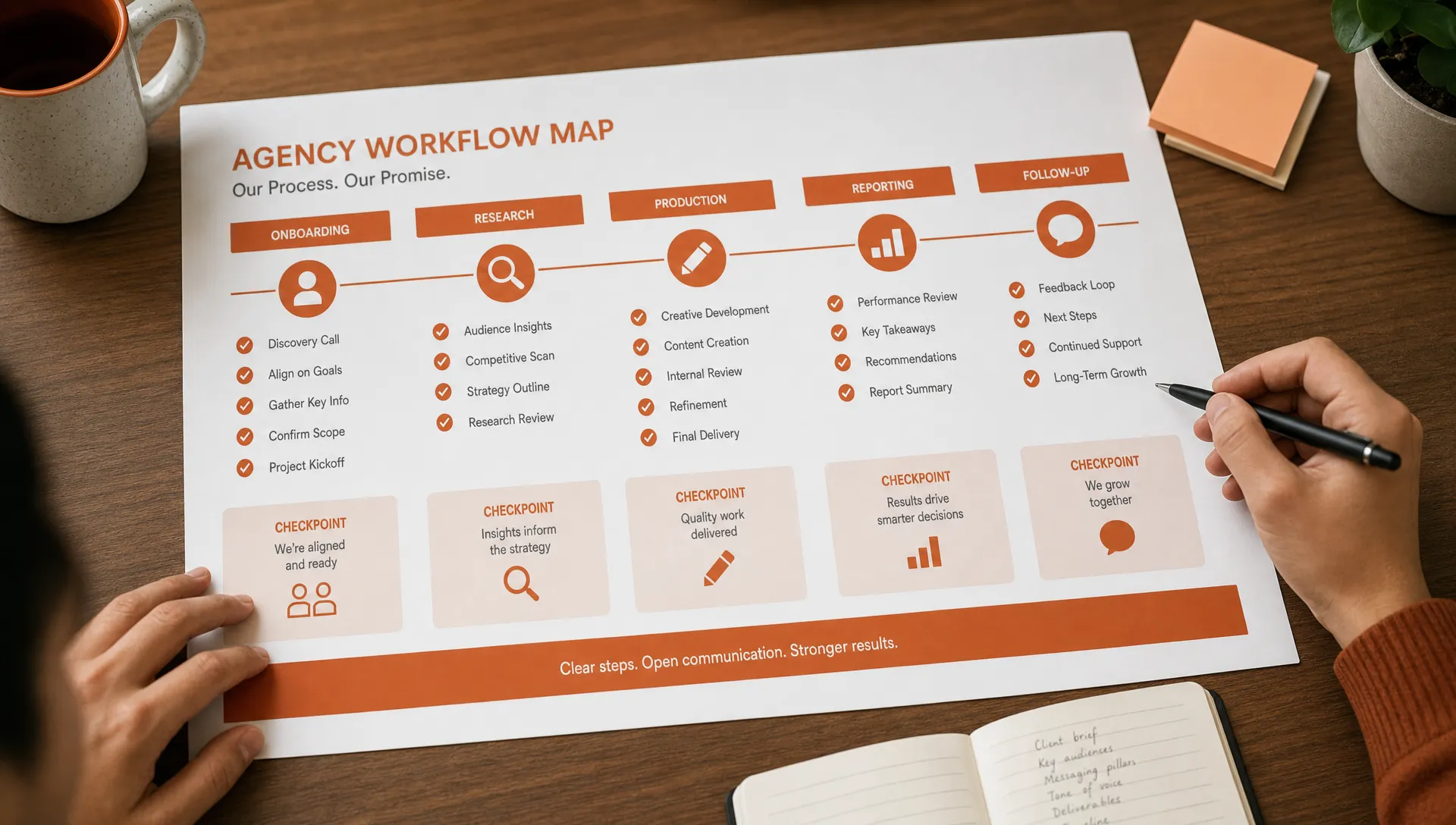
| Workflow area | What the system can prepare | What human review catches | Likely review owner |
|---|---|---|---|
| Onboarding | Intake summary, research packet, kickoff agenda | Wrong assumptions, missing constraints, bad first questions | Strategist or account lead |
| Research | Theme clusters, competitor notes, source summaries | Weak evidence, wrong audience, stale context | Strategist or channel lead |
| Copy and creative | Drafts, variations, briefs, repurposed assets | Claims, voice, taste, market fit | Editor, creative lead or specialist |
| Reporting | Metric pulls, anomaly flags, first-draft narrative | Cause, context, scope and client sensitivity | Channel lead or account owner |
| CRM and follow-up | Draft messages, task creation, record cleanup | Timing, tone, promises and relationship risk | Sales owner or account lead |
| SOPs and hiring | Process drafts, role task lists, training notes | Reality of the workflow, edge cases, accountability | Ops lead or delivery lead |
This table is not a policy by itself. It is a starting point for deciding who owns judgment at each step. If every review routes to the founder, the system will fail. If no one owns review, quality will drift.
A review tier beats a review bottleneck
Agencies often swing between two bad defaults. Either they let outputs move too freely because the draft looks good, or they require senior review on everything and erase the time savings.
A tiered review system avoids both. It gives the team a rule they can follow without asking in Slack every time.
For low-risk internal work, use auto-pass with spot checks. This fits formatting, tagging, task creation and summaries that never reach the client without another step.
For medium-risk work, use light review. A coordinator or specialist checks whether the output is complete, accurate enough and ready for the next stage.
For high-risk work, use specialist review. This fits client-facing recommendations, campaign strategy, claims, reporting narratives, creative concepts and anything that affects spend or scope.
For sensitive work, use owner review. This should be rare. It covers difficult accounts, major positioning shifts, pricing language, escalations and decisions where the wrong message can cost the relationship.
If you want this to protect margin, write the review tier into the AI based marketing workflow itself. Do not rely on memory. Put the checkpoint in the task template, approval board, CRM stage or reporting process.
This is the difference between scattered tool use and an operating system for delivery. If your agency is trying to tighten the broader structure around onboarding, production and reporting, the ideas in agency marketing systems that protect your margin will fit well with this review model.
Use one real delivery task to set the rule
Do not design the whole review policy in a meeting. Pick one recurring delivery task and build the rule around that.
Monthly reporting is a good candidate because the inputs, outputs and client risk are obvious. A kickoff research packet works too. So does content refresh QA, creative brief generation, client approval follow-up or CRM cleanup.
Run one real task through the process. Track where the tool helped, where the reviewer had to intervene and which mistakes would have reached the client without review. Then decide which parts should auto-pass, which need light review and which need a senior checkpoint.
If you are still comparing tools, avoid judging them from a vendor demo or a blank prompt. Test them against the work your team actually does. This guide on how to test AI software for marketing against a real delivery task gives you a cleaner way to evaluate fit before you build process around the wrong tool.
The goal is not to remove humans from delivery. The goal is to stop using human attention on the parts that do not need judgment, then protect the parts that do.
Frequently asked questions
Where is human review most important in AI based marketing? Human review matters most where the output becomes strategy, changes spend, reaches a client, makes a claim or affects a relationship. Onboarding assumptions, research conclusions, reporting narratives, creative claims and sensitive follow-up should all have clear review owners.
Can an agency let AI-generated work go directly to clients? Sometimes, but only for narrow, low-risk items with clear rules and sampling. Client-facing strategy, reports, copy, recommendations and sensitive messages should have a human checkpoint before they leave the agency.
Who should review AI-generated marketing work inside an agency? The reviewer should match the risk. Coordinators can review completeness and formatting. Specialists should review channel accuracy, claims and quality. Account owners or delivery leads should review sensitive client context, scope and relationship risk.
How do we keep review from eating the time we saved? Use review tiers. Not every output needs senior approval. Put low-risk work on sampling, medium-risk work on light review and high-risk work on specialist review. The rule should live inside the workflow so the team does not have to debate it every time.
What should we automate first if the team is already busy? Start with a recurring workflow that burns time but has clear inputs and review points, such as reporting prep, kickoff research, CRM cleanup, approval follow-up or production QA. Avoid starting with a vague “use AI more” initiative.
What to do next this week
Choose one workflow that happens every week and already annoys the team. Map the steps from input to client-ready output. Mark the points where a mistake would be harmless, where it would create rework and where it would damage trust or scope.
Then write a one-page review rule for that workflow. Name the review owner, define what they are checking and decide what can pass with sampling. Keep it small enough that the team will actually use it next week.
If you want outside help, Archer Scaling AI installs and runs AI ops systems for marketing agencies. If you want to talk through where human review belongs in your own delivery flow, schedule a free 30-minute intro call. The call is a conversation about your operations rather than a sales call.