How to test SaaS software development companies’ cost estimates
Test SaaS software development companies’ cost estimates against scope, codebase risks, operating costs and ownership before you commit.

You have two development estimates, different totals and no clear way to tell what either company has priced. Comparing SaaS software development companies gets harder when your existing product carries unknowns or your next release is still a sketch. Before committing runway, separate what is known, what is assumed and what becomes your problem later.
Start with the decision the estimate must support
An estimate should help you choose a next commitment: finish a usable first version, repair an inherited product or add a capability customers need. Those are different jobs. A proposal that quietly combines them can become difficult to challenge because every missing feature seems connected to something else.
Write down the result you need and the boundary around it. For example: existing users can export records they are permitted to access, without changing the rest of the product. That gives you something more concrete than “improve reporting.”
Then name what the commitment must protect. That might be existing customer access, a launch dependency or enough remaining runway to keep selling while development continues. A founder preparing for diligence may also need evidence of ownership and a documented release process.
Keep the wishlist separate. Otherwise, you cannot tell whether a higher estimate reflects necessary work, a broader interpretation of the roadmap or assumptions nobody discussed. A lower estimate may simply leave those assumptions with you.
Give SaaS software development companies the same scope
Send each provider the same short scope document. Its purpose is to expose different interpretations before they turn into different commercial commitments.
For an illustrative export feature, the comparison could look like this:
| Scope question | What the estimate should specify |
|---|---|
| Who can export? | Which users qualify and how access is checked |
| What gets exported? | Included records, fields and file format |
| What counts as success? | Observable behavior you can accept |
| What happens on failure? | User messaging, retries and recovery behavior |
| What existing behavior must remain? | Relevant checks against breaking current workflows |
| What is excluded? | Explicit boundaries, such as scheduled exports |
These details change the work. An export that downloads immediately is different from one that must handle a long-running job, notify the user and remove stored files afterward. Neither interpretation should hide inside “export functionality.”
Ask each provider to mark departures from your scope rather than silently rewriting it. A useful response might say that the immediate download is included, while background processing depends on what the codebase already supports.
Your comparison now has a baseline. You can judge whether an added item is necessary for acceptance, a sensible precaution or a separate roadmap decision. You also have a record of what the original estimate actually covered.
Require evidence behind the codebase assumptions
Before treating SaaS software development companies’ estimates as comparable, establish what each provider has actually inspected. A product demo shows behavior. It does not establish how releases happen, whether important checks exist or which dependencies the next change will touch.
For an existing product, ask for written findings tied to relevant parts of the codebase and its environment. Useful evidence includes the current release path, the affected data relationships and whether the provider could run the relevant checks.
Keep the request proportional. You do not need a complete review of the company to estimate one bounded change. You do need enough inspection to distinguish implementation work from repairs required before implementation can begin.
If access was limited, the estimate should say so. “We have not verified the production configuration” is useful information. A confident total that assumes the configuration is correct leaves you carrying an unnamed risk.
For a first version with no codebase, the evidence comes from the product scope, external dependencies and unresolved decisions. A detailed feature list still cannot settle an integration whose access requirements nobody has confirmed.
Ask one direct question: Which finding would change this estimate most? The answer should point to something inspectable, not a general statement that software is unpredictable.
Turn uncertainty into a bounded decision
Ask SaaS software development companies to separate verified work, assumptions, unknowns and exclusions. Those categories should not all disappear into a single contingency amount.
An assumption is something the estimate treats as true. An unknown needs investigation. An exclusion is work you are explicitly not buying. Confusing them makes it hard to understand what happens when the product behaves differently from expectations.
For the export example, an assumption might be that existing access checks can be reused. An unknown might be whether the current data structure supports the requested export without additional work. Scheduled delivery could be an exclusion.
Each important unknown needs a resolution step and a decision point. Ask what will be examined, what evidence you will receive and which possible findings would change the scope. You should be able to stop or reconsider after that evidence arrives.
A range can be useful when its endpoints have explanations. One end might assume the existing export mechanism is reusable; the other might include replacing it. A wide range with no explanation gives you little basis for a decision.
Avoid assigning invented probabilities to risks just to produce a precise-looking forecast. For an unresolved dependency, a clearly described alternative is more useful than a percentage nobody can defend. You can still decide whether the exposure fits your runway.
Check what can change the commercial commitment
When SaaS software development companies describe an estimate as fixed, ask exactly what is fixed: the scope, the total commitment, the delivery window or only an initial stage.
The proposal and contract should explain what happens when an assumption proves false. Does the provider absorb that work, narrow the deliverable or ask you to approve a revised commitment? Understand that mechanism before choosing between totals.
Request a written change process. A proposed change should identify the new finding, explain its effect and state what happens if you decline it. Approval should happen before additional work proceeds.
Also separate changes you request from work needed to meet the original acceptance criteria. If exporting another file format was excluded, adding it changes scope. If the agreed export exposes another user's records, correcting that behavior belongs in the discussion of whether the original deliverable is acceptable.
Check what happens when you pause, reject a deliverable or end the engagement. You need to know which obligations remain and what completed or incomplete work you receive.
Do not rely on a reassuring explanation in a sales conversation. If a rule materially affects your exposure, it belongs in the written agreement. Resolve conflicting language before signing rather than assuming the friendlier interpretation will apply later.
Test the claimed savings from agentic engineering
If SaaS software development companies credit coding agents with a lower estimate, ask which work becomes cheaper and what remains necessary. Generated code alone does not establish that a change is ready for users.
Agentic engineering can put coding, test, security and documentation agents to work under one accountable engineer. The engineer decides how to implement the approved scope, reviews the work and owns the technical release decision. The founder still approves product tradeoffs and accepts the deliverable.
The estimate should reflect that mechanism. Ask where agent output is checked, how failures return for correction and who handles a change that passes automated checks but misses the agreed behavior.
Ask where agent usage is charged, too. Development-time model usage is different from the ongoing cost of an AI capability inside your product. Combining them can hide a recurring expense behind an initial development total.
You do not need a transcript of every agent action. You need a named technical owner, evidence of relevant checks and a clear acceptance boundary. Those are inspectable commitments.
Treat claims about speed as something to test through accepted work. Faster code generation may help, but review, external dependencies and unresolved product decisions can still determine when the deliverable ships. A credible estimate explains which constraint the agents actually reduce.
Include the cost of running what ships
A development estimate can be accurate while the resulting feature is expensive to operate. Check the recurring costs before deciding whether the implementation fits your company.
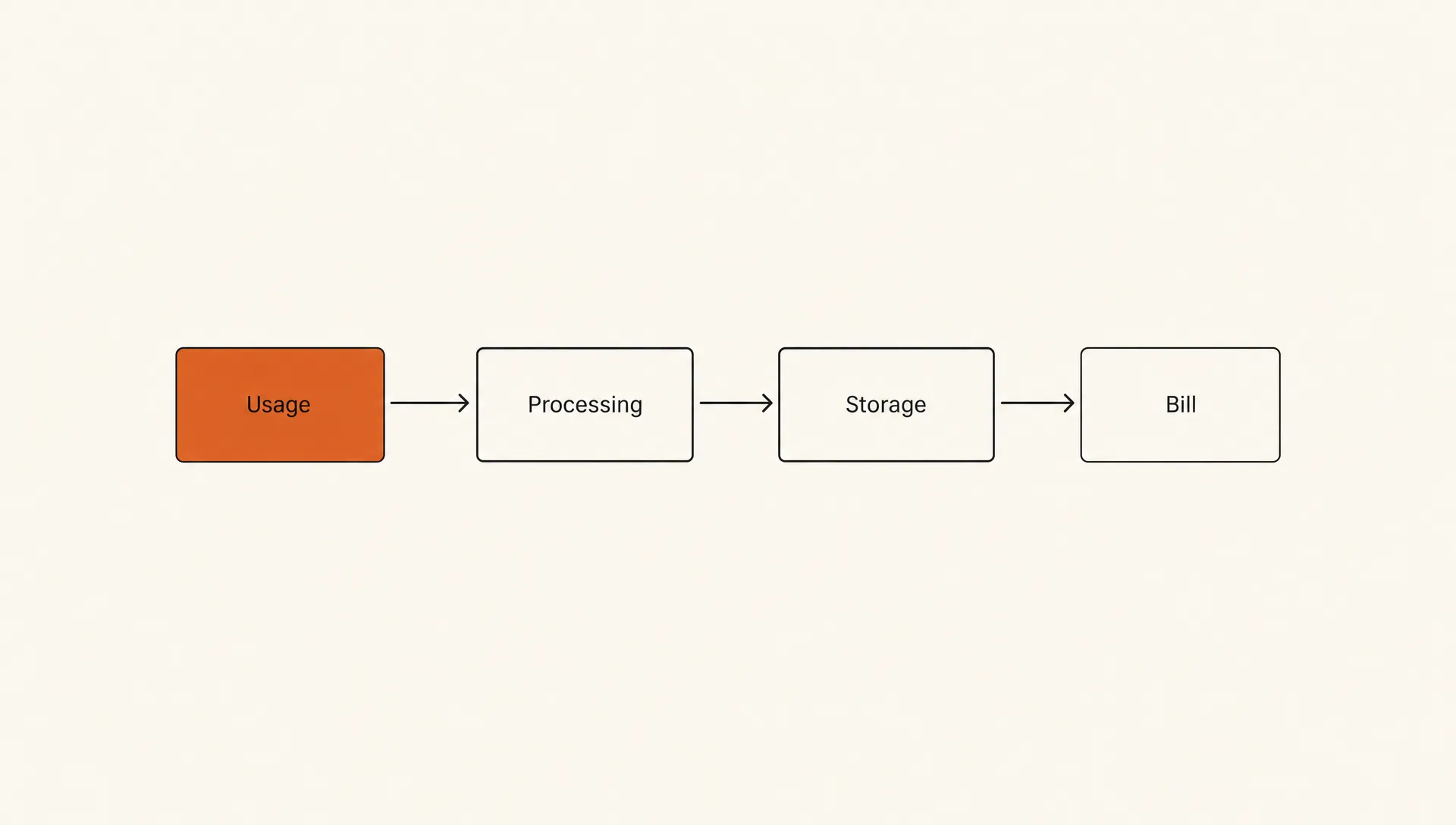
The operating assumptions from SaaS software development companies should connect costs to actual product activity: records processed, files stored, messages sent or model requests made. Ask what happens as that activity changes, rather than accepting “hosting included” as a complete explanation.
For the export example, the recurring work might involve processing requests, storing generated files and removing them afterward. Whether those costs matter depends on how the feature is implemented and used. The provider should identify the drivers without inventing usage you do not yet have.
Require usage and cost telemetry from the first release. You should be able to see what was used, what it cost and which customer action caused the expense where attribution is practical. That gives you evidence for product limits and pricing decisions.
Separate infrastructure and third-party charges from maintenance responsibilities. Someone still needs to handle dependency changes, failed releases and production problems. Your estimate comparison should identify who owns those tasks and which are outside the proposed commitment.
The broader question of what development services should include after launch matters here because an apparently complete build can leave ongoing work unassigned.
Use your current activity as the starting point, then describe a plausible higher-use scenario. Keep forecasts clearly labeled until telemetry replaces them.
Count ownership and exit work before choosing
The ownership terms from SaaS software development companies belong in the cost comparison because they affect what you must do when the relationship ends.
Confirm where the code, data, deployment configuration and service accounts will live. Company-controlled accounts from the beginning reduce the transfer work you may otherwise face later. Ownership language should also address work supplied by subcontractors and dependencies with separate license terms.
Ask what another engineer would need to run the product after departure. That includes documented configuration, access to required services, a working release process and an explanation of unresolved problems.
A repository alone does not establish that the product can be operated independently. If essential knowledge remains with the provider, the estimate has left part of the handoff unpriced or undefined.
Treat replacement work as a scenario, not an automatic surcharge. You are checking whether the exit path exists and what it requires, rather than pretending every engagement will end badly.
A focused review of the development company's exit terms can help you separate contractual ownership from practical control. If a provider's estimate depends on keeping its own accounts or private operating tools, ask how you would leave before accepting the apparent saving.
Connect the forecast to accepted deliverables
To compare SaaS software development companies over time, tie the estimate to work you can accept. A roadmap item marked “in progress” does not tell you how much usable product your commitment has bought.
Ask for the next deliverable, its written definition of done and the evidence you will use to accept it. A useful deliverable might include the export behavior, relevant checks, release notes and usage telemetry. The boundary depends on the scope, but it must be explicit.
A weekly acceptance rhythm can expose mistaken assumptions earlier. It should not force an arbitrary production release every week or turn unfinished fragments into claimed progress. The deliverable needs to be meaningful and independently inspectable.
After acceptance, ask for an updated forecast of the remaining work. It should explain which assumptions were confirmed, which changed and what that means for the next commitment. The original estimate remains useful as a record, not as a number everyone must defend regardless of new evidence.
Watch your own management load as well. Repeatedly translating requirements between people, chasing status and reconstructing decisions consumes attention you need for product, sales and funding decisions.
Record those interruptions without inventing a monetary value for them. A cheaper proposal can still demand more founder management, and that tradeoff should be visible before you extend the engagement.
Compare the exposure, not just the headline total
Compare SaaS software development companies using one worksheet with the same decision window and scope. Keep the original proposal beside it so you can trace every adjustment.
Separate the development commitment, expected operating costs and responsibilities you must fund elsewhere. Show unresolved risks alongside those figures rather than burying them inside a blended total. Check that maintenance or infrastructure charges have not been counted twice.
Use a base case and a clearly described adverse case. The base case follows verified facts and stated assumptions. The adverse case shows what happens if a significant unresolved assumption fails. Neither should pretend to predict every possible problem.
Then ask each provider to correct your interpretation. A useful correction explains the missing scope, evidence or contractual term. “Trust us, it is covered” does not resolve the comparison.
You can now make a smaller counterproposal: resolve the largest unknown, narrow the release or remove an optional dependency. That is more informative than asking for a discount on work you still do not understand.
Choose based on the commitment you can inspect and afford to carry. The lowest total may be appropriate when its boundaries are clear. A higher total may be justified by included work you genuinely need. Neither conclusion follows from the headline number alone.
Common questions about development estimates
Can SaaS software development companies give a fixed estimate? They can offer a fixed commercial commitment for defined work. Ask which assumptions, exclusions and change provisions apply. Unresolved codebase questions still need an agreed treatment, even when the headline total is fixed.
Should I pay to resolve unknowns before committing to development? A bounded investigation can be useful when its findings materially change the decision. Agree on the questions, access, written output and stopping point first. Avoid an open-ended discovery stage with no decision attached to it.
Should using coding agents always reduce the estimate? No universal discount follows from agent use. Ask which tasks agents handle, who reviews their output and whether the proposed approach reduces the constraint affecting your delivery. Evaluate accepted work and actual usage costs rather than the label.
What if I cannot judge the technical assumptions myself? Ask for plain-language findings tied to evidence and consequences. For a consequential commitment, an independent engineer can review the assumptions. You should still own the scope and acceptance decision without having to personally verify every implementation detail.
This week, write one estimate comparison sheet
Choose the next product result your company needs. Write its acceptance boundary, exclusions and the facts you already know. Put unresolved assumptions beside the evidence needed to settle them.
Then add operating responsibilities, account ownership and the next point where you can accept, pause or revise the work. Keep that sheet when you speak with SaaS software development companies so each conversation answers the same questions.
You can do this before hiring anyone. Its value is that your next commitment becomes easier to explain and challenge.
Archer Scaling AI helps early-stage SaaS become AI-native. It builds and runs the systems that develop, market and sell the SaaS so the founder's time goes to the decisions.
For a conversation about your company, your codebase and the commitment you are considering, book a free intro call.