How to check a SaaS application development company’s exit terms
Check a saas application development company’s exit terms before signing. Verify code ownership, account access, data exports and handoff costs.

You are choosing a saas application development company, and the proposal explains what gets shipped. It says less about what happens when you leave. Whether you are handing over an existing v1 or commissioning one, the exit terms determine what your company can keep running without the supplier.
Define an exit you could actually complete
Start with a concrete test: another engineer should be able to take over the product using accounts, code, data and instructions your company controls. Your customers should not need to move accounts simply because you changed who develops the software.
That test separates three things founders often treat as one. Legal ownership gives you rights to the work. Account control lets you reach it. A reproducible handoff lets someone operate it. A contract can give you the first while leaving the other two unresolved.
Ask the supplier to walk through an ordinary departure before discussing a difficult one. You give notice, the current deliverable finishes, another engineer takes over and access changes. Identify every point where someone would still need the outgoing supplier's permission.
For a non-engineer founder, this does not mean learning to inspect every file. It means knowing which evidence an independent engineer should verify. A technical founder can run more of the checks personally, but should still document them so the company does not depend on one person's memory.
Read the documents that govern termination together
A saas application development company may put its exit obligations across the main agreement, a statement of work, a data-processing agreement and terms incorporated through a link. Read them together. A helpful promise in a proposal may conflict with the document that takes precedence.
Locate the notice period, renewal mechanism and permitted notice method. Check whether notice must reach a particular address or person. Separate ending the engagement without a breach from termination following a breach, including any opportunity to correct it.
Then read what survives termination. Confidentiality, intellectual property rights, licenses and data-handling obligations may need to continue after delivery stops. Check whether suspension, a billing dispute or an alleged breach can interrupt production access before the disagreement is resolved.
The most useful question is specific: what must each party provide, stop doing or retain when the relationship ends? If the answer depends on a later agreement, the exit is still partly unpriced and undefined.
Have a lawyer familiar with your company's jurisdiction review the language. Bring the operational handoff plan to that review. Counsel can assess enforceability and conflicting terms more effectively when you can explain which accounts and dependencies keep the product running. Also ask what happens if the supplier closes, becomes unreachable or cannot complete the transition; an exit plan should cover those situations too.
Check a saas application development company’s ownership clauses
Ask what your company owns, when ownership transfers and which work the supplier excludes. The answer should cover source code, database changes, tests, documentation, designs and configuration created for your product, rather than relying on a broad promise that you own the application.
For US companies, the US Copyright Office's work-made-for-hire guidance explains the limited circumstances in which work qualifies. Paying an independent contractor does not, by itself, settle copyright ownership. Have counsel check the assignment language and whether the supplier has secured the necessary rights from its contributors.
Ownership from the first commit is a useful term to request. If the agreement instead makes assignment conditional on payment or acceptance, understand exactly what that condition covers and what rights you have while a deliverable is disputed. Repository access alone does not answer that question.
Separate custom work from pre-existing components. A supplier may retain a reusable library, and third-party packages retain their own license terms. Your company needs the rights required to keep using, modifying and deploying the product after departure.
Request a written schedule of exclusions and dependencies. For each supplier-owned component, establish whether the license survives termination, whether a successor can maintain it and whether an external service is required. A vague reference to proprietary technology leaves too much of the product's future operation unresolved.
Put critical accounts under company control
A saas application development company should be able to explain which accounts belong to your company and which access its team receives. Check actual administrator access during onboarding. An invitation to view a repository is different from control of the organization that contains it.
Use a short account register to expose dependencies:
| Asset | Evidence to check | Exit dependency to resolve |
|---|---|---|
| Code repository | Company-controlled organization and administrator access | Supplier-only repositories or private packages |
| Hosting and database | Company account, billing control and recovery access | Production running inside a shared supplier account |
| Domain and DNS | Company registrant details and administrator access | Supplier controlling domain changes |
| Product services | Company-owned billing, administration and export access | Supplier-owned email, storage or model-service accounts |
Company ownership does not mean giving every contributor unrestricted access. Grant access for the work they perform and keep recovery methods under company control. Where supported, maintain a second company-controlled administrator so one lost login does not block the handoff.
If the supplier proposes shared infrastructure, ask how your product can be separated. Get the migration scope, dependencies and responsibility in writing before customer data accumulates there.
For an existing v1, verify the current position rather than assuming the previous contractor arranged it correctly. Record the legal account holder, billing owner and recovery route separately. Those can belong to different people even when the founder can log in.
Verify that an export can become a working product
Ask a saas application development company to describe how your data leaves, not merely whether an export button exists. A spreadsheet of customer records may omit relationships, uploaded files, permissions or configuration needed to reconstruct the product.
Define the export package around what a successor must restore. That may include a database snapshot, file storage, schema information and a description of how records connect. The package should identify which application version matches the data and which external services remain necessary.
Some assets cannot simply be copied. Payment tokens, authentication credentials and third-party integration permissions may require provider-specific procedures or customer action. Establish those limits before signing rather than discovering them while customers are trying to log in.
Test restoration in an isolated environment with appropriate protection for personal data. A successful download proves that files were transferred. It does not prove that another engineer can restore the application or that the exported records are complete.
The exit terms should also cover data retained by the supplier: where it sits, why it remains, who can access it and when deletion occurs. Backups may follow a different deletion schedule from active systems. Have counsel check those provisions against your customer commitments and applicable requirements; do not accept an undefined promise to delete everything immediately if the supplier cannot explain how its backups work.
Separate cancellation terms from transition costs
Before signing with a saas application development company, distinguish the right to cancel from the work required to leave. Ending the engagement may stop future delivery while leaving migration, documentation or account separation as additional work.
Identify the remaining commitments at each possible exit point. These can include an unfinished deliverable, notice-period obligations, external subscriptions and transition assistance. Ask whether any prepaid third-party commitments belong to your company and whether you can cancel them independently.
Transition assistance needs a defined scope. Specify the artifacts to be delivered, the questions the outgoing supplier must answer and the conditions under which that obligation ends. An open-ended promise to cooperate gives neither party a reliable boundary.
Also check whether access, exports or repository transfer depend on settling every disputed invoice. That is a legal negotiation, but the operational consequence is straightforward: a commercial disagreement could affect your ability to serve customers. Identify that possibility explicitly for counsel.
For your own runway planning, separate unavoidable contractual commitments from replacement work. A successor may need to replace a supplier-owned component even when no cancellation charge applies. Conversely, a well-documented product in company accounts may still carry notice-period obligations. Record both categories so the decision to leave is based on the whole transition, including the founder attention required to supervise it, rather than the cancellation clause alone.
Make the handoff package part of normal delivery
A saas application development company should not need to reconstruct the product's operating knowledge during its final week. Ask which handoff artifacts stay current as work ships, who maintains them and how you can verify their condition.
The useful package includes the current code, deployment instructions, configuration requirements, database changes, recovery instructions and known defects. It should also explain which release is live, what remains unfinished and where the next engineer should look when something fails.
Keep acceptance separate from aspiration. If a deliverable is described as complete, its written definition of done should say what was tested and what the founder accepted. An ambitious roadmap is not evidence that the current release works, and an unresolved task should not disappear into a handoff document marked complete.
Weekly accepted deliverables make that boundary easier to inspect. At departure, the successor can distinguish shipped work, work in progress and unstarted plans without reverse-engineering status from chat history.
Our guide to what development services should include after launch covers ongoing operating responsibilities. For exit terms, concentrate on the evidence a new owner receives and the condition it must be in.
Agree how acceptance of the handoff will be recorded. Name the person checking it, the deficiencies that require correction and the process for resolving disagreement. Avoid wording that treats delivery of a folder as automatic acceptance of everything inside it.
Rehearse the handoff before you need it
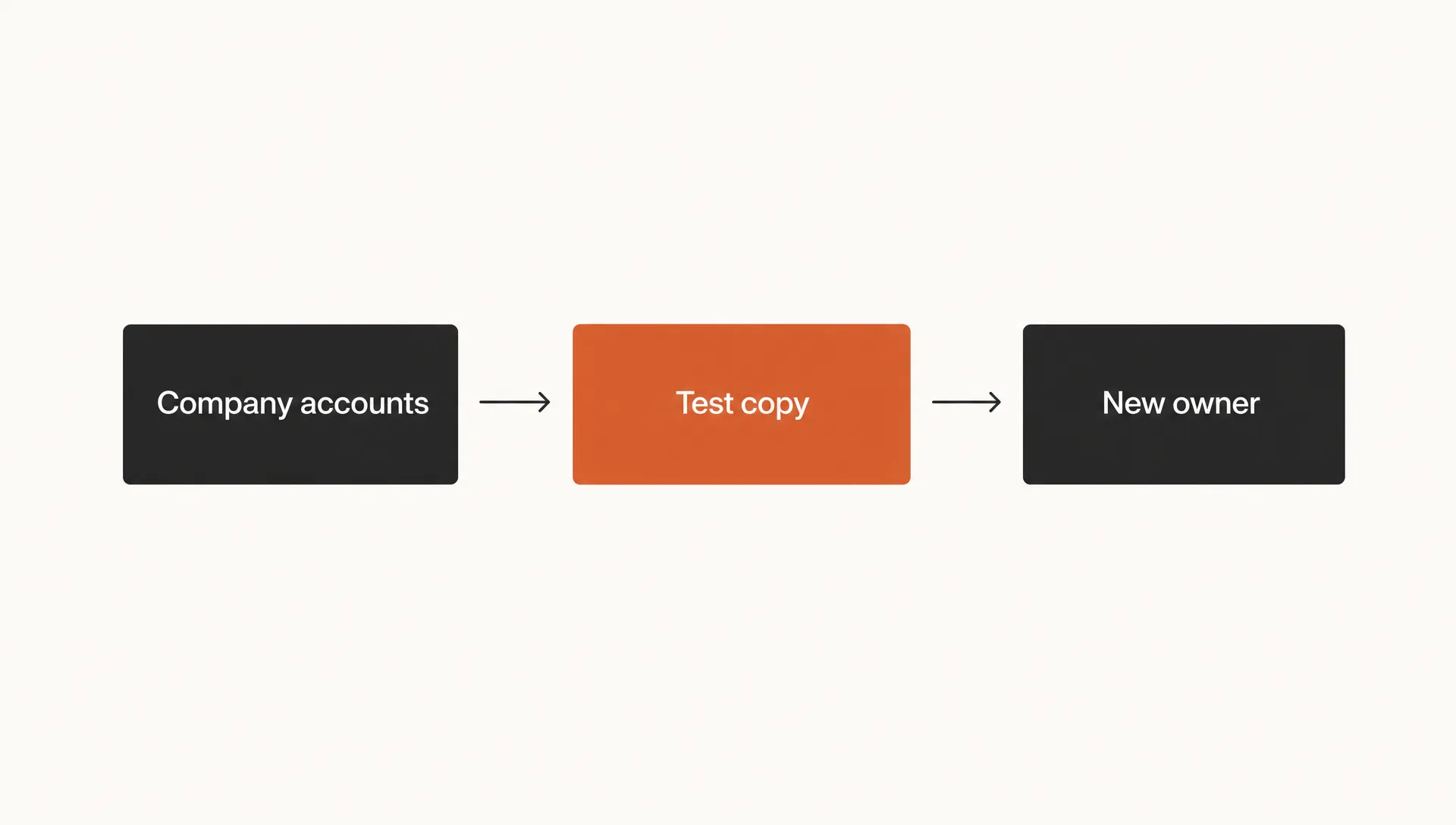
Arrange a bounded rehearsal using company-controlled access. An independent engineer takes the documented package and brings up a test copy without relying on undocumented instructions from the supplier. Use an isolated environment so the exercise cannot alter customer records or production traffic.
The engineer should confirm that the code is available, dependencies can be obtained, configuration requirements are explained and the matching data can be restored. Then they should test the product's essential user journey and describe any remaining external dependencies.
Record every point where the exercise stops. A missing service account, unavailable package or unexplained database step is an actionable finding. Ask the supplier to correct the documentation or remove the dependency, then repeat the blocked part.
You do not need a second implementation or a broad product review. The question is narrower: can a qualified successor operate what already exists using the assets and rights your company holds?
Agree the rehearsal's access and confidentiality requirements beforehand. If a supplier objects to unrestricted access for a competing provider, a scoped independent check may address that concern. If it refuses any meaningful verification, record the unresolved dependency before committing further.
For a non-engineer founder, request a plain-language result: what worked, what failed and what still requires the supplier. A technical report without that summary can leave the ownership decision just as unclear.
Include agent workflows in the transfer
If a saas application development company uses agents to develop your product, the exit package needs to explain the work those agents perform. Receiving generated code does not necessarily give the next engineer the instructions, permissions or checks used to produce it.
Agentic engineering can place coding, test, security and documentation agents under one accountable engineer. For a handoff, identify which workflows are specific to your company, where they run and which parts belong to the supplier's general method. Request transfer rights or a documented replacement path for anything your product's operation requires.
Check model-service accounts, repository permissions, task instructions and approval gates. Credentials should move through company-controlled access mechanisms, not through copied secrets in a handoff document. The successor also needs to know which actions require human approval and who reviews changes before release.
Usage and cost telemetry matter here. If a workflow continues running after the engagement ends, your company needs to see its activity and consumption. Otherwise an automated task can remain active without anyone clearly responsible for its behavior or expense.
Where the same engagement covers the systems that develop, market and sell the SaaS, apply the check to each system in scope. An outbound workflow or lifecycle sequence needs an owner, a stop control and transferable records too. Keep that inventory tied to the work actually commissioned rather than assuming every supplier runs those systems.
Assign responsibility during the changeover
Agree with the saas application development company on who handles production while the handoff happens. Without an explicit boundary, the outgoing supplier may assume responsibility has ended while the incoming engineer assumes it has not begun.
Name the release owner, the incident contact and the person authorized to change credentials during the transition. Establish whether deployment pauses while the successor verifies access. If a serious defect appears, the agreement should explain which existing obligations apply and how additional work is approved.
Use a written changeover record. It should identify the production release, unresolved incidents, outstanding work and the point at which operating responsibility transfers. This gives the founder a concrete acceptance decision instead of a vague final meeting.
Remove supplier access in a controlled sequence after replacement access is verified. Review repository membership, cloud roles, service accounts, deployment credentials and automated jobs. Rotating a shared credential without updating the application can cause an outage, so assign the change and its verification to a named engineer.
Include retained copies and confidential information in offboarding. Request confirmation against the agreed retention terms rather than assuming revoked access deletes material already downloaded. Preserve the records your company needs for its own obligations.
The aim is continuity with a clear owner at each stage. Avoid a transition plan that depends on both suppliers informally remaining available until someone decides the handoff feels finished.
Turn missing evidence into a signing decision
Evaluate a saas application development company by the gaps it will close before you become dependent on it. A reassuring conversation is useful, but the decision should rest on contract language, account access and a demonstrated handoff path.
Classify each gap by consequence. Missing documentation may be repairable within a defined deliverable. A supplier-owned production account may require migration. A component you cannot license or replace can change whether the engagement makes sense at all.
Give each unresolved item a named owner and an acceptance condition. For example, company administrator access is verified when you can manage membership and recovery yourself. A restoration instruction is verified when someone other than its author can use it successfully.
Avoid negotiating every theoretical risk equally. Prioritize anything that could prevent you from serving existing customers, reaching the code or appointing a replacement engineer. Then address the remaining administrative and documentation gaps in a written order.
Apply the same standard if you choose an independent contractor or hire your first engineer. Employment and engagement structures differ, but company-owned accounts and current operating instructions still matter. The founder should not have to rebuild the company's memory whenever one person leaves.
If a supplier cannot agree to a workable exit, include that dependency in your decision now. Do not assume a future renewal negotiation will be easier after more of the product depends on it.
Frequently asked questions
What should a saas application development company provide when we leave? The agreed package should cover code, data, operating instructions, account access, unfinished work and any required transition assistance. It should also identify retained supplier components and third-party services. Specify the condition of those artifacts and how a successor will verify them, rather than asking only for a file transfer.
Does access to the repository prove we own the code? No. Repository access is a practical permission; ownership and license rights depend on the relevant agreements and law. Check contributor assignments, supplier exclusions and third-party licenses with counsel. Also confirm that your company controls the repository organization, because access granted by the supplier can otherwise remain dependent on it.
Can we leave before all planned work is finished? That depends on the termination provisions and existing commitments. Separate completed and accepted work from unfinished work, then check what must be delivered at termination. Clarify whether another engineer has the rights and information needed to finish it. Do not assume an incomplete milestone automatically removes obligations on either side.
Should the founder run the exit rehearsal? The founder should set the acceptance question and review the result. A qualified engineer should perform the technical verification. A technical founder may do that work, but using another engineer can reveal knowledge the documentation assumes rather than explains.
Check your most important dependency this week
This week, take your current agreement and identify who controls the code, production account and customer data. If you are still choosing a saas application development company, request the same evidence before signing. Mark anything you cannot verify from your own access.
Choose one blocked dependency and write down the correction, its owner and the evidence that will show it is resolved. You can do this with your current contractor, a prospective supplier or the engineer already working with you. Keep the record with the company's operating documents.
Archer Scaling AI helps early-stage SaaS become AI-native. It builds and runs the systems that develop, market and sell the SaaS so the founder's time goes to the decisions.
For a conversation about your company, its current product and who owns the technical work, book a free call.