How to Keep Clients Agency Side Without More Chaos
Learn how to keep clients agency side with better onboarding, reporting, scope control, and AI ops that reduce chaos without more hires.
Keeping clients on the agency side rarely fails because the team forgot how to market. It fails because the client experience becomes harder to trust as delivery gets busier.
A few extra accounts get added. Senior people stay in Slack later. Reports go out, but the analysis is thin. Client calls become status recaps instead of decision meetings. Everyone is working, but the client starts to feel friction everywhere.
That is the retention problem most B2B marketing agencies face: not bad service, but unmanaged complexity.
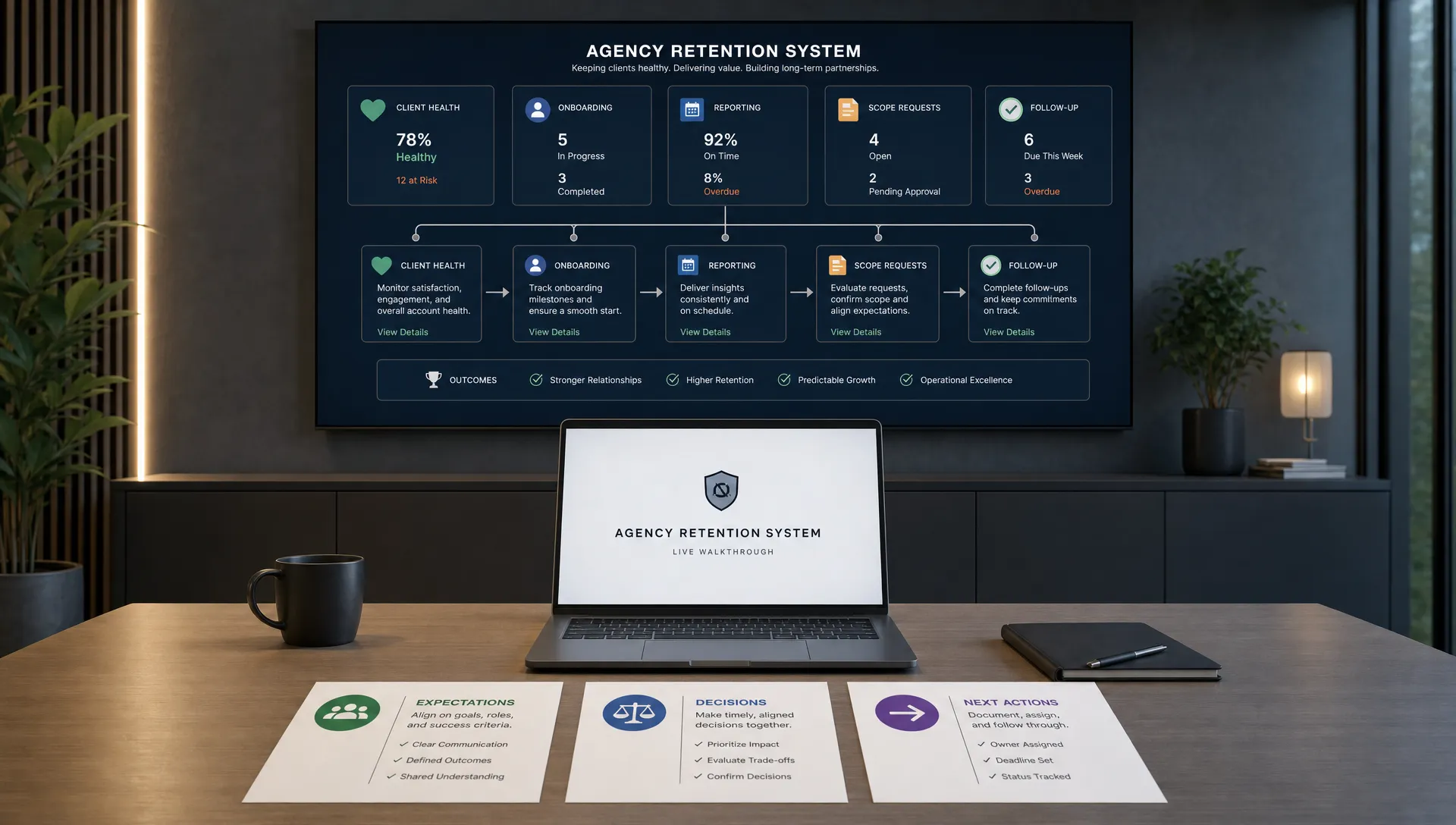
The answer is not simply hiring another account manager or asking the team to “communicate better.” Those may help temporarily, but they often add more coordination overhead. To keep clients without more chaos, agencies need a retention operating system: clear expectations, repeatable delivery, visible progress, controlled scope, and enough automation to remove low-value manual work.
Why client retention becomes chaotic as agencies grow
Client retention is often treated like an account management problem. In reality, it is usually an operations problem wearing an account management disguise.
Clients leave when they lose confidence. That loss of confidence can come from poor results, but it can also come from inconsistent updates, slow follow-up, unclear ownership, messy approvals, repeated rework, or reports that do not explain what changed and what happens next.
Harvard Business Review has noted that acquiring a new customer can be far more expensive than retaining an existing one. For agencies, the hidden cost is even sharper: churn does not just remove revenue, it disrupts staffing plans, weakens morale, and forces leadership back into sales mode before delivery has stabilized.
The mistake is assuming retention means more meetings, more custom attention, and more “white glove” service. That can work for a small book of business. At scale, it burns the team out and trains clients to expect every request to become an exception.
A healthier approach is to make the agency easier to work with, without making every client experience bespoke.
The retention equation: clarity plus momentum plus trust
Clients stay when three things are true.
First, they understand what is happening. Second, they believe the work is moving toward outcomes that matter. Third, they trust that the agency can handle issues without turning every problem into a fire drill.
That means your retention system should not be built around vague satisfaction. It should be built around operational signals you can manage.
| Retention signal | What the client notices | What the agency should systemize |
|---|---|---|
| Clear expectations | “I know what is included and what happens next.” | Onboarding, scope, timelines, roles, and escalation paths |
| Visible progress | “The agency is moving the work forward.” | Status updates, workflow stages, milestones, and approvals |
| Useful insight | “I understand the decisions we need to make.” | Reporting narratives, metric definitions, and recommendations |
| Low friction | “I do not have to chase them.” | Follow-up reminders, ownership, CRM hygiene, and meeting notes |
| Controlled change | “New requests are handled professionally.” | Intake rules, change requests, prioritization, and tradeoffs |
The goal is not to make delivery rigid. The goal is to make the default way of working strong enough that flexibility does not create chaos.
Start by finding where chaos enters the client experience
Before adding tools or automation, map the points where clients experience confusion. Most agencies find that chaos enters through a few predictable doors.
A new client signs, but the handoff from sales to delivery is incomplete. A campaign brief is approved verbally, but the details are scattered across email and Slack. A report is assembled manually each month, so the team spends more time fixing screenshots than explaining performance. A client asks for “one quick change,” but there is no intake process, so the request jumps the queue.
These issues feel small in isolation. Across 10, 20, or 50 clients, they become margin leaks and trust leaks.
A simple diagnostic can help. Review your last three difficult client relationships and ask:
- Where did the first signs of frustration appear?
- Which promises were unclear, undocumented, or interpreted differently by each side?
- Which tasks required senior intervention more than once?
- Which updates were delayed because someone had to manually assemble information?
- Which requests should have gone through a defined intake or change process?
This is where retention becomes practical. You are not trying to “improve client happiness” in the abstract. You are identifying the operational defects that make good clients harder to keep.
Build a stronger onboarding reset
Client retention starts before the first deliverable. Onboarding is where the agency teaches the client how the relationship will work.
Weak onboarding creates future escalation. If the client does not understand timelines, communication channels, approval responsibilities, reporting cadence, and what counts as out of scope, every later discussion becomes harder.
Strong onboarding should answer five questions clearly:
- What are we trying to achieve in the first 30, 60, and 90 days?
- Who owns decisions, approvals, assets, and feedback?
- What does the agency need from the client to keep work moving?
- How will performance be reported and interpreted?
- How are new requests, urgent items, and scope changes handled?
The important part is not just having an onboarding call. It is turning onboarding into a reusable system. That means a structured handoff from sales, a client-ready kickoff agenda, an internal delivery brief, a shared timeline, and a follow-up summary that confirms decisions in writing.
If your onboarding depends on the memory and style of whichever account lead is assigned, it will create uneven client experiences. Automation can help here, but only after the process is clear. For example, a standardized onboarding workflow can trigger internal tasks, collect missing assets, create client folders, and prepare kickoff notes without requiring a senior operator to rebuild the setup each time.
Make reporting a retention tool, not a monthly artifact
Many agencies lose trust through reporting even when performance is acceptable. The problem is that reports often show activity without helping the client make decisions.
A client does not need 30 slides of metrics if the key question is whether to shift budget, revise messaging, change targeting, or improve sales follow-up. They need a clear explanation of what happened, why it happened, what the agency recommends, and what decision is required.
This is where reporting becomes central to retention. Reports should reduce anxiety, not create more interpretation work for the client.
If your team struggles here, it is worth reviewing common agency reporting mistakes that hurt client trust, especially inconsistent metric definitions, hiding bad news, and reporting activity without context.
A retention-focused report should include:
- A short executive summary written in plain English
- The client goal the report is tied to
- The few metrics that actually indicate progress
- What changed since the last reporting period
- What the agency recommends next
- Any decisions, risks, or client actions needed
This does not mean every report must be custom from scratch. In fact, the opposite is usually true. The structure should be standardized, while the analysis should be specific.

Control scope without sounding defensive
Clients often create chaos because the agency has not given them a clean way to request change.
When there is no intake process, every request competes through urgency, personality, or Slack volume. The client thinks they are being responsive. The team feels interrupted. Leadership sees margins shrinking, but no single request looks large enough to challenge.
Scope control does not have to feel rigid or adversarial. It can be framed as prioritization.
Instead of saying, “That is out of scope,” the account lead can say, “We can take that on. Here are the options: swap it with the current priority, add it to next month’s sprint, or price it as an additional request.”
That small shift protects the relationship and the margin at the same time.
Agencies should define request types before they become contentious. For example, small edits, strategic pivots, net-new deliverables, urgent fixes, and experimental work should not all follow the same path. Each should have a clear intake route and expected turnaround.
Creative and content-heavy teams especially benefit from stage-based reviews and structured feedback. If rework is a recurring source of client tension, the operating principles in cutting rework with better agency ops apply directly to retention.
Create a client health score that triggers action early
Most agencies notice churn risk too late. By the time the client is openly unhappy, the relationship may already be emotionally expensive to repair.
A client health score does not need to be complicated. It should combine delivery, communication, performance, and relationship indicators into a simple review rhythm.
| Health factor | Green signal | Warning signal |
|---|---|---|
| Communication | Client responds and attends key meetings | Missed calls, delayed approvals, shorter replies |
| Delivery | Work is on time and moving through stages | Repeated delays or unclear ownership |
| Results | Progress is visible against agreed goals | Metrics are flat with no clear explanation |
| Scope | Requests follow agreed process | Frequent urgent requests or side-channel asks |
| Sentiment | Client shares feedback constructively | Passive frustration, surprise objections, or silence |
The score matters less than the habit. Review client health weekly or biweekly with delivery and account leads. Assign actions before the situation becomes a renewal problem.
For example, a yellow account might need a proactive strategy call, a clearer roadmap, a reset on approvals, or a senior review of performance. A red account might need an executive intervention and a written recovery plan.
The key is to make retention visible inside operations. If account health only lives in someone’s head, leadership cannot manage it.
Automate the repetitive work around retention
AI and automation should not replace the human parts of client retention. They should remove the repetitive work that prevents humans from doing those parts well.
In many agencies, senior people spend too much time gathering information, formatting updates, checking task status, chasing inputs, and preparing reports. Those tasks are necessary, but they are not where strategic value is created.
Useful automation opportunities include:
- Client onboarding task creation from signed deal data
- CRM follow-up reminders after meetings or missed replies
- Draft meeting summaries from call notes and transcripts
- Report assembly from approved data sources and templates
- Internal alerts when approvals, assets, or deadlines are stuck
- Content and creative workflow routing based on stage and owner
The best first automations are usually not flashy. They are the ones that reduce handoff errors, protect response times, and make client-facing teams more prepared. That is why many agencies should automate delivery operations before they chase AI content volume. If you are deciding where to begin, this guide on what a marketing agency should automate first gives a practical prioritization lens.
There is also a broader cost angle. If your agency or clients rely heavily on Salesforce, CRM efficiency is not only about workflow hygiene. Licensing, SKU fit, renewal timing, and unused seats can quietly affect operating budgets. Specialist Salesforce procurement teams such as SaaSed help organizations review usage, contracts, and renewal leverage before commercial discussions begin.
Keep the client cadence simple
A retention system does not need more meetings. It needs the right cadence.
Too many agencies use meetings as a substitute for operational clarity. That creates more talk, not more trust. A better cadence separates status, strategy, and escalation.
A simple model works well for many B2B marketing agencies:
| Cadence | Purpose | Output |
|---|---|---|
| Weekly status update | Keep work visible and blockers clear | Priorities, completed work, blockers, next actions |
| Monthly performance review | Interpret results and recommend decisions | Insights, actions, risks, and tradeoffs |
| Quarterly strategy reset | Reconnect work to business goals | Roadmap, priorities, budget allocation, scope alignment |
| Exception escalation | Resolve urgent or high-risk issues | Owner, decision, timeline, written next steps |
This structure helps clients know where each conversation belongs. It also keeps account managers from turning every meeting into a blend of status, therapy, strategy, and negotiation.
The written follow-up matters as much as the meeting itself. Every important client conversation should produce a concise recap with decisions, owners, and due dates. If it was not captured, it will be re-litigated later.
Protect the team so they can protect the relationship
Client retention often breaks when the internal team is already overloaded.
A burned-out team becomes slower, more reactive, and more defensive. Quality drops, follow-up weakens, and client communication becomes inconsistent. Leadership may see this as an account problem, but it is often a capacity and systems problem.
To keep clients without chaos, protect the team’s ability to deliver. That means fewer unclear requests, fewer manual reporting scrambles, fewer last-minute handoffs, and fewer undocumented exceptions.
Agency leaders should pay attention to invisible labor. If senior people are constantly fixing briefs, rebuilding reports, clarifying ownership, or rescuing timelines, the agency is relying on heroics instead of systems. Heroics may save a client this month, but they make the next month more fragile.
A practical rule: whenever the same client issue happens twice, turn it into a process decision. Update the intake form, change the kickoff checklist, add a QA step, improve the reporting template, or automate the reminder. Do not simply tell the team to be more careful.
What not to do when trying to keep clients
Retention pressure can push agency leaders into decisions that feel helpful but create more instability.
Do not promise custom service levels for every nervous client. Customization should be strategic, not emotional. If every account gets a different workflow, delivery becomes impossible to manage.
Do not add more internal meetings without removing friction from the workflow. Internal meetings can expose problems, but they do not solve unclear ownership, weak documentation, or manual bottlenecks by themselves.
Do not automate a broken process. Automation will make unclear steps happen faster, but it will not make them better. Standardize the workflow first, then automate the repeatable parts.
Do not hide bad news in reports. Clients can usually sense when something is being softened. Trust grows when issues are explained clearly, paired with options, and followed by action.
Most importantly, do not make retention solely the account manager’s burden. Account leads are important, but retention is created by the whole operating system.
A practical 30-day retention cleanup plan
If client delivery already feels chaotic, do not try to rebuild the whole agency at once. Start with the highest-friction points.
In the first week, identify the five clients that consume the most unplanned internal time. Look for patterns across reporting, approvals, unclear scope, missed handoffs, and recurring escalations.
In the second week, tighten onboarding and handoffs. Make sure every active client has a clear owner, goal, cadence, scope summary, and next milestone. Fill gaps where expectations are undocumented.
In the third week, standardize one recurring client touchpoint. Reporting is usually the best candidate because it directly affects trust. Create a simple narrative template, define the core metrics, and separate data assembly from analysis.
In the fourth week, choose one automation that removes visible friction. That might be approval reminders, report preparation, follow-up tasks, or onboarding asset collection. Keep it narrow enough to implement properly.
This is not a full operations transformation, but it changes the retention conversation. Clients feel more clarity. Teams feel less reactive. Leadership gets a better view of where margin is leaking.
Frequently Asked Questions
How do agencies keep clients longer without over-servicing them? Agencies keep clients longer by creating clarity, consistency, and proactive communication. Over-servicing happens when every client issue becomes a custom exception. A better approach is to standardize onboarding, reporting, scope control, and follow-up so clients feel supported without draining delivery capacity.
What is the biggest cause of client churn for agencies? Poor results can cause churn, but many agency relationships break down because of operational friction. Missed expectations, unclear ownership, weak reporting, slow responses, and unmanaged scope can erode trust even when the agency is doing good work.
Should agencies use AI to improve client retention? Yes, but AI should support retention by reducing repetitive operational work. It can help with onboarding workflows, reporting preparation, meeting summaries, task routing, and follow-up reminders. Human judgment should still own strategy, relationship management, and sensitive client conversations.
How often should an agency review client health? Most growing agencies should review client health weekly or biweekly. The review should look at delivery status, communication, performance, scope pressure, and client sentiment. The goal is to act while an account is at risk, not after the client has decided to leave.
What should be automated first to reduce client chaos? Start with the workflow that creates the most repeated friction. For many agencies, that means onboarding, reporting assembly, CRM follow-up, or approval reminders. The best first automation is usually the one that prevents missed handoffs and frees senior people from manual coordination.
Keep the clients you worked hard to win
Client retention does not improve because the agency asks the team to care more. It improves when the agency installs a better operating layer around the work.
If your B2B marketing agency is growing but delivery feels heavier with every new account, Archer Scaling AI can help identify where margin and client trust are leaking. The process starts with a paid Margin Teardown that gives you a roadmap and three automation moves, with a risk-reversed promise: a useful roadmap and three moves, or it is on me.
You can see the actual system running live before you commit. Start at Archer Scaling AI and make retention easier to deliver, not harder to survive.