How to Build Agency Systems Before You Add Headcount
Build agency systems before hiring with a practical workflow plan for onboarding, reporting, CRM and AI automation that protects margin.

Hiring is often the first solution agency leaders reach for when delivery feels tight. A strategist is overloaded, reports are late, project managers are chasing updates and the founder is still reviewing work that should have been delegated months ago.
Adding people can help, but only after the agency has a system for how work moves. Without that, every new hire inherits the same unclear handoffs, messy inputs and invisible quality standards. The agency gets more capacity on paper, then loses margin through rework, meetings and management drag.
To build agency systems before you add headcount, you need to treat operations as a delivery asset, not internal housekeeping. The goal is not to document every tiny task. The goal is to create repeatable workflows that protect client experience, preserve senior attention and make the next hire more productive from week one.
What an agency system actually is
An agency system is a repeatable way to turn a specific input into a specific output with clear ownership, standards and escalation rules.
A checklist alone is not a system. A Notion page nobody uses is not a system. A Slack habit that depends on one project manager remembering every detail is not a system either.
A useful system answers six questions:
- What triggers the workflow?
- What inputs are required before work starts?
- Who owns the outcome?
- What quality standard defines “done”?
- What gets automated, templatized or routed by AI?
- What happens when the workflow breaks or an exception appears?
This matters because headcount only scales what already exists. If the operating model is clean, a new person extends capacity. If the operating model is messy, a new person adds more coordination work.
For many B2B agencies, the real constraint is not talent. It is the lack of a reliable operating layer between strategy and execution.
Why hiring before systems creates margin drag
When agencies are small, smart people compensate for broken workflows. The founder remembers client context. The account lead knows where files live. The strategist fixes unclear briefs in their head. The project manager chases missing assets manually.
That works until volume rises. Then every workaround becomes a recurring cost.
| What you see | What it looks like internally | The system gap underneath |
|---|---|---|
| Late reports | Teams scramble at the end of the month | No automated reporting workflow or insight template |
| Slow onboarding | Delivery waits for access, assets and context | No sales-to-delivery handoff system |
| Founder bottlenecks | Senior review is needed on routine work | No quality standard or approval logic |
| Overloaded account managers | Client questions require manual digging | No source of truth for status, decisions and next steps |
| Low utilization | Staff are busy but output is inconsistent | Too much admin and rework inside delivery |
The danger is that these problems can look like a staffing issue. “We need another account manager” may be true, but if that person spends half their week finding information, asking for updates and rebuilding reports, the agency has bought more labor without fixing the margin leak.
If you are trying to distinguish between a real capacity issue and operational debt, this deeper breakdown of when an agency needs systems before more staff gives useful signals to look for before opening another role.
Start with workflows that touch revenue and margin
Do not begin by systemizing everything. That creates an internal ops project so large that nobody has time to finish it.
Start where weak systems create the most financial drag. In a B2B marketing agency, that usually means workflows tied to client acquisition, client delivery, reporting and retention.
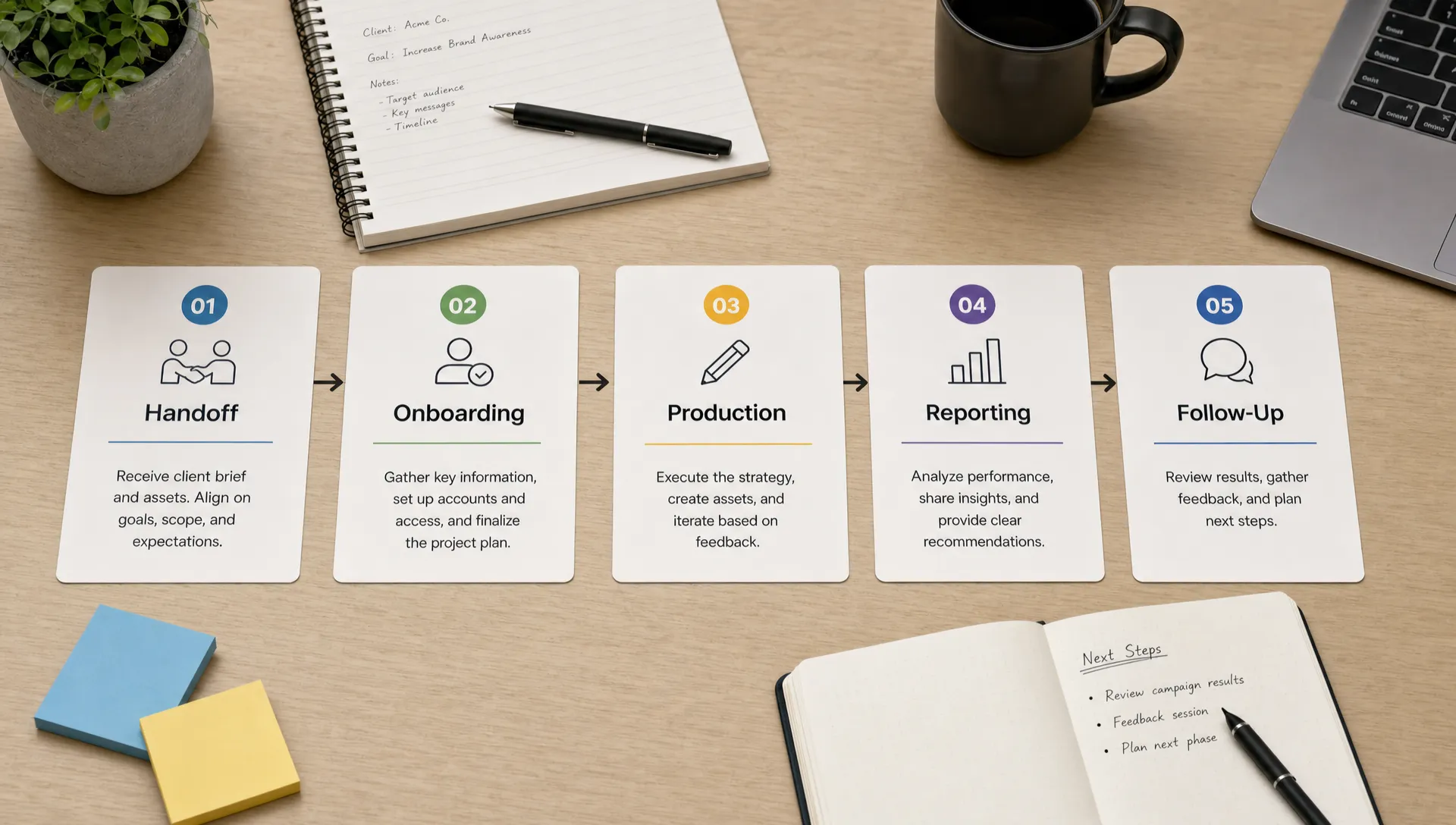
A practical first pass is to map five workflows:
- Sales-to-delivery handoff
- Client onboarding
- Campaign or content production
- Reporting and insight delivery
- Lead routing, follow-up and CRM hygiene
For each workflow, look for the same failure patterns: missing inputs, unclear ownership, repeated questions, manual copy-paste work, late approvals, inconsistent QA and senior people doing low-value coordination.
This is where agency leaders often underestimate the size of the problem. A workflow may feel “mostly fine” because clients are not complaining loudly. But internally, the team may be burning hours every week to make the work appear smooth. That hidden labor is margin erosion.
Build the handoff system first
If you only fix one system before hiring, fix the handoff from sales to delivery.
This is where scope, expectations, positioning, access requirements and client context either transfer cleanly or disappear into Slack archaeology. A poor handoff forces delivery teams to rediscover what sales already learned. It also creates early client doubt because the client has to repeat information they already gave during the buying process.
A strong handoff system includes:
- A required intake format for deal context, goals, stakeholders, promised outcomes and known risks
- A scope confirmation step before delivery begins
- A clear owner for collecting access, assets and approvals
- A kickoff brief that the delivery team can actually use
- A client-facing timeline that matches internal capacity
This system should be built before you add more account managers or strategists because it shapes every project that follows. If handoff quality is inconsistent, more staff will simply create more variations of the same problem.
Client onboarding deserves the same level of discipline. A scalable onboarding process reduces rework, shortens time to value and prevents early churn signals from appearing in the first 30 days. If onboarding is your current bottleneck, the article on marketing agency client onboarding that actually scales covers that workflow in more depth.
Turn production into a pipeline, not a pile of tasks
Agency delivery often breaks down because production work is managed as individual tasks rather than a pipeline. A content brief, ad concept, landing page draft, report or campaign build may each have tasks assigned, but the flow between stages is unclear.
A production system defines how work moves from intake to draft, review, revision, approval and delivery. It also clarifies what AI can support without lowering quality.
For example, AI can help with first-pass research, brief structuring, transcript cleanup, content repurposing and reporting summaries. It should not silently replace strategic judgment, client nuance or final quality control. The system should state where AI enters the workflow, what human review is required and what output standard must be met before the work reaches a client.
The more standardized the pipeline becomes, the easier it is to identify the actual staffing need. You may discover that you do not need another full-time strategist. You may need a cleaner intake process, reusable research templates and an approval system that keeps senior review focused on judgment rather than formatting.
Create reporting that does not depend on heroics
Reporting is one of the most common places agencies lose margin because it combines data gathering, interpretation, formatting and client communication. If every report is rebuilt manually, the team spends too much time assembling the artifact and too little time explaining what it means.
A scalable reporting system separates three jobs:
| Reporting layer | Purpose | What to systemize |
|---|---|---|
| Data collection | Pull the correct inputs from source systems | Connections, naming rules and refresh cadence |
| Analysis | Identify what changed and why it matters | Insight prompts, variance checks and benchmarks |
| Client delivery | Communicate decisions and next actions | Narrative template, owner and delivery schedule |
The best reporting system is not just faster. It makes the agency look more strategic because clients receive clearer interpretation with fewer gaps. That improves retention and reduces reactive client service work.
If reports are late, inconsistent or overly manual, hiring another account person may only mask the issue. Fix the reporting operating system first, then decide whether a new role is still needed.
Decide what to automate, delegate or outsource
Not every operational problem should become an internal automation project. The right decision depends on frequency, margin impact, risk and whether the task is core to your agency’s advantage.
Use this simple decision filter:
| Work type | Best move | Example |
|---|---|---|
| Repetitive, rules-based and frequent | Automate or templatize | Client intake routing, report assembly, CRM updates |
| Judgment-heavy and tied to client strategy | Support with AI, keep human ownership | Positioning, offer strategy, campaign analysis |
| Rare, technical and outside your core delivery | Outsource to a specialist | Custom software, niche integrations, app development |
| Recurring but unclear | Standardize before automating | Creative review, onboarding, account updates |
This distinction protects the agency from building the wrong thing. If you need a client-facing custom mobile product, for instance, that is not the same as systemizing your internal agency operations. In that case, it may make more sense to work with a specialist mobile app developer for a fast MVP rather than pull your delivery team away from margin-critical workflows.
Inside the agency, automation should be aimed at repeatable internal drag: research compilation, reporting prep, lead routing, follow-up reminders, SOP generation, onboarding steps and QA prompts. Those are the workflows where AI ops can reduce manual effort without turning your agency into a software shop.
Install ownership before you install tools
Tools do not solve ownership problems. A CRM, project management platform or AI automation layer can make a strong workflow faster, but it can also make a messy workflow harder to diagnose.
Before selecting or rebuilding tools, assign ownership at the workflow level. Every system needs one accountable owner who is responsible for the outcome, not just the task list.
For example, “client onboarding” should not be owned vaguely by the account team. One person should own whether onboarding is complete, whether inputs are collected, whether kickoff happens on time and whether delivery has what it needs. Other people may contribute, but the outcome cannot float between roles.
The same principle applies to reporting, CRM hygiene, campaign launch and creative QA. The clearer the owner, the easier it becomes to automate supporting steps.
Document the minimum viable SOP
Agency SOPs often fail because they are written like manuals instead of operating tools. A 30-page process document may look impressive, but it rarely helps a busy team move faster.
A minimum viable SOP should include the trigger, inputs, steps, owner, quality bar, tool links and exception rules. Keep it short enough that a new hire can use it during real work.
The goal is not perfect documentation. The goal is enough structure to make performance repeatable.
A good SOP should make these questions easy to answer:
- When does this workflow start?
- What must be true before work begins?
- Who approves the output?
- What does “good” look like?
- What should the team do if information is missing?
- Which parts are automated, AI-assisted or manual?
Documentation also protects the agency if a person leaves. When knowledge lives only in someone’s head, every resignation becomes an operational fire drill. When workflows are documented and supported by automation, transitions are less disruptive.
Use AI ops where the workflow is already clear
AI is most useful when the agency has a clear process and a painful repetitive step. It is much less useful when nobody agrees on the workflow.
If your reporting process is undefined, AI will not magically create a strategic reporting culture. If your onboarding process is inconsistent, automation may simply move bad data faster. If your CRM fields are ignored, AI follow-up workflows will create noise.
The sequence matters:
- Clarify the workflow.
- Standardize the inputs.
- Define the output standard.
- Automate the repetitive steps.
- Monitor exceptions and improve the system.
For B2B agencies, the strongest early AI ops opportunities tend to sit in research, reporting, CRM, onboarding and content operations. These workflows are frequent enough to justify automation and structured enough to improve without forcing a full business redesign.
That is also why margin-focused systems matter more than random AI experiments. A clever automation that saves 10 minutes once is not as valuable as a boring workflow improvement that saves hours every month across every client.
For a broader view of where operational systems protect profitability, this guide to agency marketing systems that protect your margin is a useful companion.
Know when you are actually ready to hire
The point of building systems is not to avoid hiring forever. It is to make hiring work.
Once core workflows are clear, the next role becomes easier to define. You can hire against a real operating model instead of a vague feeling of overload. The job description gets sharper, onboarding gets faster and performance expectations become measurable.
You are closer to headcount readiness when these statements are true:
- New client onboarding follows the same path every time.
- Delivery teams receive complete briefs before work starts.
- Reporting is prepared through a repeatable workflow.
- CRM updates and follow-up are not dependent on memory.
- Senior review is focused on judgment, not cleanup.
- SOPs are short, current and used during live delivery.
- AI and automation support the workflow instead of replacing ownership.
If several of those statements are false, adding headcount may still be necessary, but it should not be the first move. Build the operating base first, then hire into it.
Frequently Asked Questions
What agency systems should I build before hiring? Start with sales-to-delivery handoff, client onboarding, production workflow, reporting and CRM follow-up. These systems touch revenue, retention and delivery margin, so fixing them usually creates more leverage than documenting low-impact tasks.
How do I know if I need systems or more staff? If senior people are doing routine admin, client work depends on memory, reports require manual rebuilding or new clients create repeated confusion, you likely have a systems problem. If workflows are clear and utilization is still too high, headcount may be the right next step.
Can AI replace hiring inside an agency? AI can reduce the need for some repetitive work, but it should not replace ownership, strategy or client judgment. The strongest use cases are AI-assisted research, reporting prep, onboarding support, CRM routing and content operations.
How detailed should agency SOPs be? SOPs should be detailed enough for repeatable execution but short enough to use during real work. Include the trigger, inputs, owner, steps, quality standard and exception path. Avoid long documents that nobody opens after onboarding.
Should I automate a broken workflow? No. Standardize the workflow first. Automation makes a good process faster, but it can make a broken process fail at higher speed.
Build the system before you fund the next role
Before you add headcount, find out where delivery margin is already leaking.
Archer Scaling AI installs and runs AI-powered operations systems for B2B marketing agencies, including onboarding, reporting, CRM, content ops and follow-up workflows. The work starts with a paid Margin Teardown: a roadmap and three automation moves, or it is on Archer Scaling AI.
If you want to see what should be systemized before you hire, start with Archer Scaling AI and review the actual system before you commit.