How tech co founders should handle roadmap disagreements
How tech co founders can resolve roadmap disagreements with clear decision rights, evidence and weekly deliverables. Keep your SaaS shipping.

You need the next release to move the company forward, but the person responsible for the code wants to fix what is underneath it first. When tech co founders disagree over the roadmap, both may be protecting something real: customer trust, runway or the ability to keep shipping. The useful next step is a decision process that makes those trade-offs visible.
Name the decision beneath the disagreement
“Customers need this feature” and “the codebase needs work” are too broad to compare. Neither tells you what happens if the work waits.
Start with the specific choice in front of you. For example: should the next release include a customer export, or should it replace the background process that would generate that export? This is a hypothetical decision, but it exposes the questions a real roadmap discussion needs to answer.
The founder arguing for the export should explain who needs it, what they cannot do today and whether a promise has already been made. The technical owner should explain what could fail, what evidence supports that concern and whether a smaller change would address it.
For tech co founders, the first useful agreement is a shared description of the decision. Write down what you are choosing between, what each option delays and when a decision is needed. Otherwise, one person can be arguing about this week's release while the other is arguing about the next year of maintenance.
Choose the constraint before comparing the work
A roadmap needs a current priority. Without one, every proposed feature, repair and experiment can claim to be urgent.
Choose the constraint that matters for the next meaningful company milestone. A bootstrapped founder might need to reduce manual support work. A founder preparing for diligence might need clear ownership of the code and evidence that the release process works. A founder testing demand might need a usable workflow in customers' hands.
The evidence should match the constraint:
| Current constraint | Evidence worth bringing | Decision it helps you make |
|---|---|---|
| A customer cannot complete a core task | A reproduced failure and its consequences | Whether a repair takes priority |
| A proposed feature may change buying behavior | Customer conversations, a commitment or observed use | Whether to test the feature now |
| Releases keep breaking existing behavior | Failed checks, incident notes and reproduction steps | Which reliability work belongs in the release |
| Product usage may cost more than expected | Usage records and cost telemetry | Whether to change the workflow before expanding it |
Select one primary constraint for the decision. Keep the others visible as boundaries. Revenue urgency does not remove a data-loss risk, and a cleaner architecture does not automatically justify delaying a customer test.
Give tech co founders clear decision rights
Shared ownership of the company does not require both founders to approve every implementation choice. It does require agreement about who decides when their responsibilities overlap.
A practical starting point is for the commercial owner to propose customer priorities and explain the commitments behind them. The technical owner proposes implementation, estimates uncertainty and identifies release risks. Together, they settle scope and acceptance criteria.
Then name the final decision owner for unresolved priority calls. That might be the CEO under your operating agreement, but the title alone is not a substitute for an explicit agreement.
Release safety needs a separate rule. Agree on the conditions that require a pause, such as a known path to exposing customer data or corrupting records. A pause should identify the concrete risk, the evidence and the smallest action needed to resolve it. “I don't like this architecture” needs a different discussion.
If you are still choosing a partner, settle these boundaries among the agreements to make before splitting equity. Ask counsel to reflect governance and deadlock arrangements in the appropriate documents rather than relying on a roadmap note.
Put the disagreement into a short decision note
A decision note gives tech co founders something specific to challenge. It also preserves the reasoning when the same discussion returns a month later.
Keep it short enough to read before the meeting. Include the decision, the options, the evidence, the cost of waiting and the person who will make the call. Separate facts from assumptions. “The last release failed this check” is evidence; “this will become impossible to maintain” needs an explanation.
The most useful line is often: “What would change our minds?” A founder might reconsider a feature if the customer accepts a manual workaround. A technical owner might reconsider a rewrite if a small repair passes a representative test.
Record the decision and its review trigger afterward. That trigger could be a failed release check, a customer rejecting the workaround or measured usage crossing a limit you have agreed to investigate.
Avoid making the note a permanent argument archive. Its purpose is to let someone act. A decision that says “investigate further” still needs a named question, an owner and a stopping point. Otherwise, research becomes another way to defer the disagreement without admitting it.
Test the disputed assumption before approving the whole project
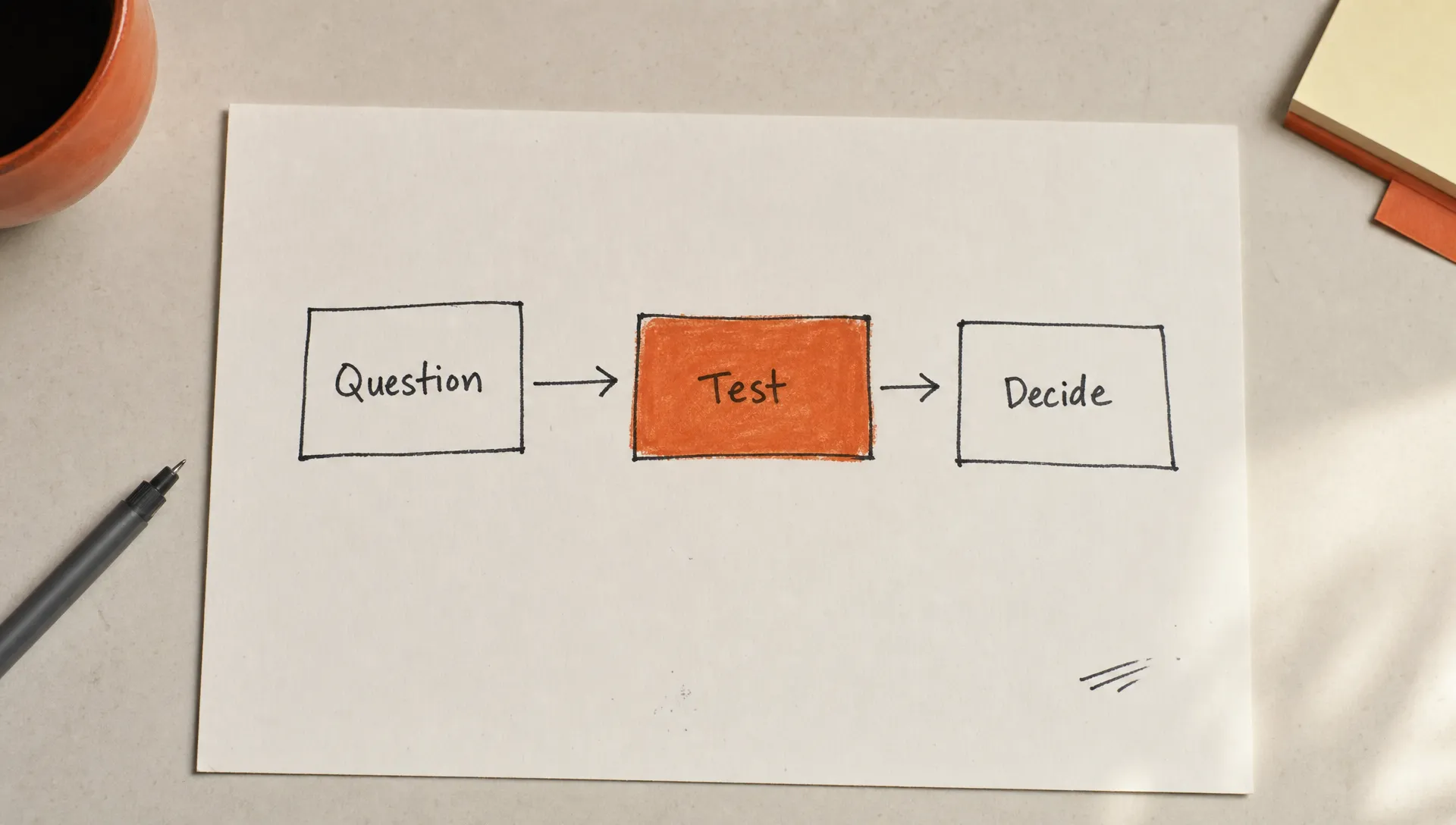
When tech co founders cannot agree on the size of a problem, a bounded test can provide better evidence than another estimate. Choose the smallest piece of work that could change the decision.
Return to the hypothetical export. The commercial founder wants customers to retrieve their records. The technical owner believes the existing background process will fail under that work.
Instead of approving either a full export feature or a broad replacement, agree on a narrow deliverable: generate an export for one supported record type in a controlled environment, check access permissions and measure completion behavior. Use synthetic or appropriately protected test data.
Write the definition of done before implementation starts. It should say what the export contains, which access checks must pass, what evidence will be recorded and who accepts the result. List what remains outside scope, including any customer release.
That can become one accepted deliverable for the week. If it passes, you have evidence for a smaller release. If it fails, you have a specific failure to address rather than a general claim that the stack needs replacing.
Some work cannot safely be reduced to a customer-facing experiment. A known exposure of private data needs containment. Use the bounded test to answer uncertainty, not to postpone handling a demonstrated risk.
Use agents to carry out an agreed decision
Agentic engineering changes how much implementation work one accountable engineer can direct. It does not settle a disagreement about what the company should do next.
For tech co founders, faster implementation is useful only when the work has a clear boundary. Coding agents can produce a proposed change, test agents can exercise specified behavior, security agents can check for classes of issues and documentation agents can update the handoff material. Their output still needs review.
The engineer remains responsible for deciding whether the change is ready to ship. The founder responsible for the business accepts whether it meets the agreed need. Those are distinct checks, even when one person holds both roles.
Agents do the work. You make the decisions.
Keep the code, environments and resulting evidence in company-owned accounts. Record usage and cost telemetry where the workflow creates variable costs, so a successful demo does not hide an expensive production behavior.
An agent-generated backlog should not quietly become the roadmap. The same applies to automated changes in marketing or sales: customer promises, spending limits and consequential actions belong among the decisions the founder keeps. Faster execution makes those boundaries more important.
Set the deadlock rule before the next argument
A useful deadlock rule tells tech co founders how a decision will happen without requiring either person to pretend they agree.
Start by restating the shared goal and the unresolved assumption. If evidence can settle that assumption, commission the bounded test. If the evidence is sufficient but you prefer different trade-offs, the agreed decision owner makes the call and records the reason.
Set a review trigger rather than reopening the argument whenever someone feels uneasy. New evidence deserves attention. Repeating an unchanged preference should not automatically restart the decision.
For a disputed technical claim neither founder can evaluate confidently, an independent engineer can review a defined question. Give them the relevant code and evidence, then ask for a written finding. “Review this failure risk” is more useful than asking them to choose which founder is right.
Repeated deadlocks may reveal a larger mismatch: different appetites for risk, conflicting expectations about the company or commitments made without consultation. A roadmap meeting cannot resolve all of that. Address the working relationship directly, and use qualified legal advice if the issue concerns governance, equity or separation.
Frequently asked questions
Who should have the final say on the roadmap? Tech co founders should name a decision owner in advance and keep that arrangement consistent with their company documents. Product priority, implementation choices and release safety can have different owners. A vague expectation of consensus leaves urgent decisions exposed to deadlock.
Should technical debt take priority over features? Sometimes. Tie the work to a specific consequence, such as recurring release failures, a security exposure or a change that cannot be made safely. Define the smallest intervention that addresses it rather than approving an open-ended cleanup.
Do you need a technical co-founder to use agentic engineering? No. A founder can work with an accountable engineer without creating a co-founder relationship. The important questions are who reviews the work, who owns the accounts and code, how releases are accepted and what happens when that engineer leaves.
Resolve one roadmap disagreement this week
Choose one disputed item in your own company. Write the decision, the evidence on each side and the consequence of waiting. Name the decision owner, then define a bounded deliverable with written acceptance criteria. Put its review on the calendar before adding more work to the roadmap.
If nobody owns the technical side yet, name that gap explicitly. A contractor queue or a coding agent does not by itself provide someone accountable for release decisions.
At Archer Scaling AI, I help early-stage SaaS become AI-native. I build and run the systems that develop, market and sell the SaaS so the founder's time goes to the decisions. The AI-native assessment comes first, with discovery across the company and codebase before a plan; the development retainer follows with one accepted deliverable each week.
For a conversation about your company, its technical ownership and the roadmap decisions in front of you, book a free intro call.