Which decisions should an AI-native SaaS founder keep?
Which decisions should an AI native SaaS founder keep? Set clear rules for product promises, data access, spending and weekly shipping.

You have agents drafting code and emails, but product direction, sales and the bank balance still come back to you. As an AI native SaaS founder, the job is to decide what those agents may do without turning every task into another approval request.
Keep the decisions that change your company's commitments
Keep authority over the customer promise, the next deliverable, data permissions, spending limits and actions that would be difficult to reverse. Delegate the work needed to prepare those decisions, along with execution inside boundaries you have already approved.
For an early-stage SaaS, a useful definition of becoming AI-native is that agents perform recurring work inside systems with a named human accountable for the result. Adding a summarization feature to your product changes a feature. Changing how development, marketing and sales work reach you changes how you run the company.
That distinction matters because faster output can create more review work. Someone still has to decide whether the output serves the company.
| Decision | What the founder keeps | What can be delegated |
|---|---|---|
| Product direction | Customer promise and priority | Research, proposals and implementation |
| Weekly shipping | Scope and acceptance | Coding, testing and release preparation |
| Customer data | Permitted uses and access boundaries | Processing within those boundaries |
| Spending | Budget and exceptions | Usage tracking and cost reports |
| Customer commitments | Offers, claims and material exceptions | Approved messages and routine follow-up |
| Ownership | Company control and exit requirements | Account administration and documentation |
A decision belongs with you when it changes what the company owes, risks, spends or owns. The person running the work should bring you the evidence and a recommendation.
An AI native SaaS founder owns the customer promise
You decide whose problem the product serves and what you are willing to promise them. An agent can summarize interviews, compare requests and draft a roadmap. Those outputs cannot settle which customer you want to serve or which trade-off you can live with.
Suppose customers request both a new integration and a more reliable import. The integration might help a sales conversation. The import might protect the experience you already sold. That choice depends on your commitments and current priorities, not just the ease of generating code.
Turn the choice into one named weekly deliverable with a written definition of done. For example: “A customer can retry a failed import without creating duplicate records, and support can see why it failed.”
The engineer owns how to implement and verify that behavior. You accept whether it meets the agreed customer need. A working demonstration, relevant test results and a short account of known limitations give you something concrete to judge.
For a non-engineer founder, acceptance should not require reading the codebase. For a technical founder, it should not require personally repeating every engineering check. Both need evidence tied to the promise.
Keep changes to that promise with you. If the proposed deliverable grows halfway through the week, approve the scope change explicitly rather than discovering it at the demonstration.
Approve data use and consequential actions yourself
An AI native SaaS needs an explicit boundary around what agents may read, send, change and delete. Access should follow an approved purpose, rather than whatever a connected tool happens to allow.
Customer information collected to run the product does not automatically become material for prospecting, model training or unrestricted debugging. Before introducing a new use, establish what permission you have, which providers receive the data and how long they retain it. Get qualified advice where legal obligations are unclear.
You keep authority over that use. The engineer should translate it into permissions, retention settings and checks that prevent work from crossing the boundary. Our guide to customer data access questions covers the evidence to request before granting access.
The same principle applies to actions with consequences outside your product. For a SaaS serving property-support teams, the work described by a UK service helping homeowners facing repossession illustrates a sensitive boundary. An agent might prepare intake information; a human should remain responsible for advice and commitments that could affect someone's home.
In your own company, identify the equivalent boundary. It might be deleting customer records, changing an agreement or sending a claim about what your product can do. Require approval before the action, not a notification afterward.
Set a spending boundary before agents run
The budget decision stays with the AI native SaaS founder. Agents can report consumption and suggest cheaper ways to complete work, but they should not expand their own spending authority.
Measure the cost of a completed workflow, including failed attempts and retries. A low cost per model request tells you little if a customer task requires repeated calls, external services and manual repair.
Useful telemetry connects usage to an outcome you recognize: a completed import, an accepted deliverable or an approved campaign. It should also show failures, provider charges and work that still required human intervention. Customer-facing pricing needs those facts, especially when usage varies widely between customers.
Before a workflow runs unattended, decide what happens at its spending boundary. It could pause, finish the current task without starting another or ask for permission. The correct behavior depends on the cost of stopping midway.
Also keep the decision about whether automation is worth maintaining. An agent that prepares occasional material you must rewrite may cost more attention than it saves. A rule-based workflow may be sufficient for a predictable task. Some work should remain human-led.
Review the evidence against the job you wanted done. More generated output is not evidence that the company is better off.
Keep ownership and exit rights in the company
An AI native SaaS founder should retain control of the repositories, hosting, domains, data and service accounts that keep the company operating. The person running the systems can administer them without becoming their sole owner.
Company ownership needs a practical test: could someone else take responsibility if the current engineer or contractor left?
That requires more than a repository transfer. The next person needs to know what runs, how it is deployed, where credentials are managed and how to restore service. They also need access that does not depend on a departing person's private account.
Keep decisions about new dependencies with you when they materially affect portability, cost or customer data. Ask the engineer for the trade-off in plain terms: what the dependency does, what replacing it would involve and what happens if it becomes unavailable.
Convenience can justify a dependency. The decision should still be deliberate, with an export or recovery path where one is needed.
If another provider is doing the work, examine the exit terms and transfer requirements before the relationship becomes difficult to unwind. Ownership is easier to establish at the start than to negotiate during a failed handoff.
Put technical decisions with one accountable engineer
Keeping company decisions does not require reviewing every implementation choice. An AI native SaaS founder needs someone accountable for the technical work, including the parts agents produce.
Agentic engineering gives coding, test, security and documentation agents defined jobs. One engineer sets their scope, reviews the evidence and decides whether the technical work is ready to ship. The founder sets the priority and accepts the deliverable.
That engineer should own ordinary implementation decisions within the agreed boundaries. Choosing an internal code structure should not need founder approval. Introducing a provider that receives customer data should. Releasing a routine fix may fit an approved release policy; removing a customer-facing capability changes the promise and comes back to you.
The technical owner also needs authority to stop an unsafe release. Weekly shipping creates a useful cadence, but a failed security check should not become a business decision you are asked to wave through without explanation.
Agents do the work. You make the decisions. The accountable engineer makes that arrangement usable by bringing you a verified result, the remaining risks and a clear recommendation.
For a non-engineer founder, “the tests passed” needs a translation into what was checked and what remains uncertain. A technical founder can inspect more deeply when needed without becoming the default reviewer for every generated change.
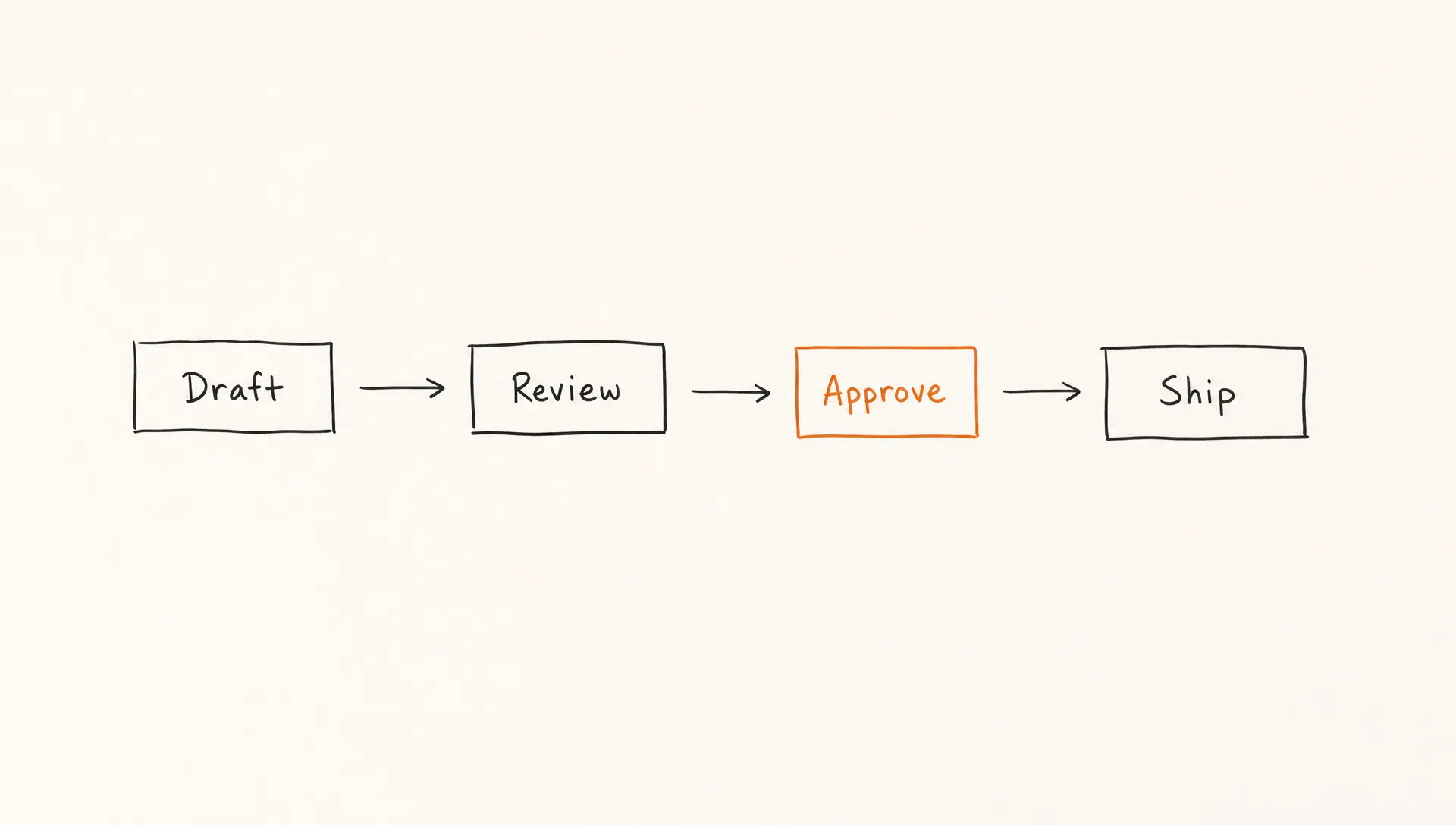
Approve exceptions instead of reviewing every repetition
Your approval boundary needs to distinguish a new decision from another instance of a decision already made.
For example, you might approve a campaign's audience, claims, message and sending limit. Agents can then prepare and send messages within that approved scope. A new offer, an unsupported claim or a recipient outside the agreed audience should stop the workflow for review.
The same pattern applies to development. An approved release policy can permit routine changes after specified checks. A migration that could permanently alter customer data needs a separate decision and recovery plan.
For an AI native SaaS founder, this is how oversight avoids becoming a queue of repetitive approvals. You establish the permitted action and the conditions that require the work to stop.
Every stopped task should arrive with a short decision record: what happened, which boundary was reached, what options exist and what the operator recommends. “Please review” is not enough context.
Keep a record of your answer and its scope. Approving one exception should not silently create permanent permission for every future case. Otherwise, a sensible one-off decision can become an operating rule you never intended.
Revisit the boundary when the company changes
A permission that was sensible for an internal prototype may be wrong once paying customers depend on it. A workflow that handled one approved message may need different controls before it sends an entire campaign.
Review decision boundaries when you introduce a new data source, change a provider, increase unattended activity or make a new customer commitment. Incidents and repeated exceptions are also reasons to revisit the rules.
The useful question is whether responsibility still matches the consequences. If an agent can now affect more customers, spend more or change more data, its previous permission may be too broad.
An AI native SaaS founder should also watch for decisions that repeatedly return without getting easier. Repeated questions about expected product behavior can mean the scope is unclear. Repeated technical escalations can mean nobody has enough ownership to resolve them.
That pattern informs your first engineering hire. Persistent work that needs continuous product context and technical judgment may justify hiring. A collection of repetitive tasks may instead need better systems and a named operator. Base the choice on the ownership gap you can observe, rather than the volume of generated work.
Frequently asked questions
Can agents decide what goes on the roadmap? They can organize evidence, identify patterns and propose priorities. The founder keeps the choice because it determines which customers the company serves and what it commits to delivering.
Does an AI native SaaS founder need to approve every release? The founder should accept the agreed deliverable and approve material changes to scope or risk. Routine releases can follow a previously approved policy, with an accountable engineer checking technical readiness and stopping work when the conditions are not met.
Who decides whether a workflow should use a model at all? The engineer should explain the options, expected costs and failure modes. The founder decides whether the proposed behavior and economics fit the company. A predictable task may need ordinary software rules, while a sensitive judgment may need a human.
What should happen when an agent exceeds its permission? The workflow should stop the affected action, preserve a useful record and notify the named owner. Someone should establish what happened and whether recovery is needed before allowing it to continue.
Write your decision boundaries this week
Choose one workflow already taking your attention: a weekly release, customer onboarding or outbound follow-up. Write down what it may read, change, send and spend. Then name the conditions that require it to stop and the person who handles that stop.
For an AI native SaaS founder, this page of decisions is useful even before another tool or hire enters the company. Compare it with what actually happens during the week. Each unexpected approval request reveals an unclear rule, missing evidence or an ownership gap.
Archer Scaling AI helps early-stage SaaS become AI-native. It builds and runs the systems that develop, market and sell the SaaS so the founder's time goes to the decisions.
If you want to discuss where those boundaries belong in your company, book a free intro call.