How Content Agencies Build Faster Content Pipelines
Learn how content agencies build faster content pipelines with tighter briefs, AI ops, review gates, automation, and margin-safe workflows.
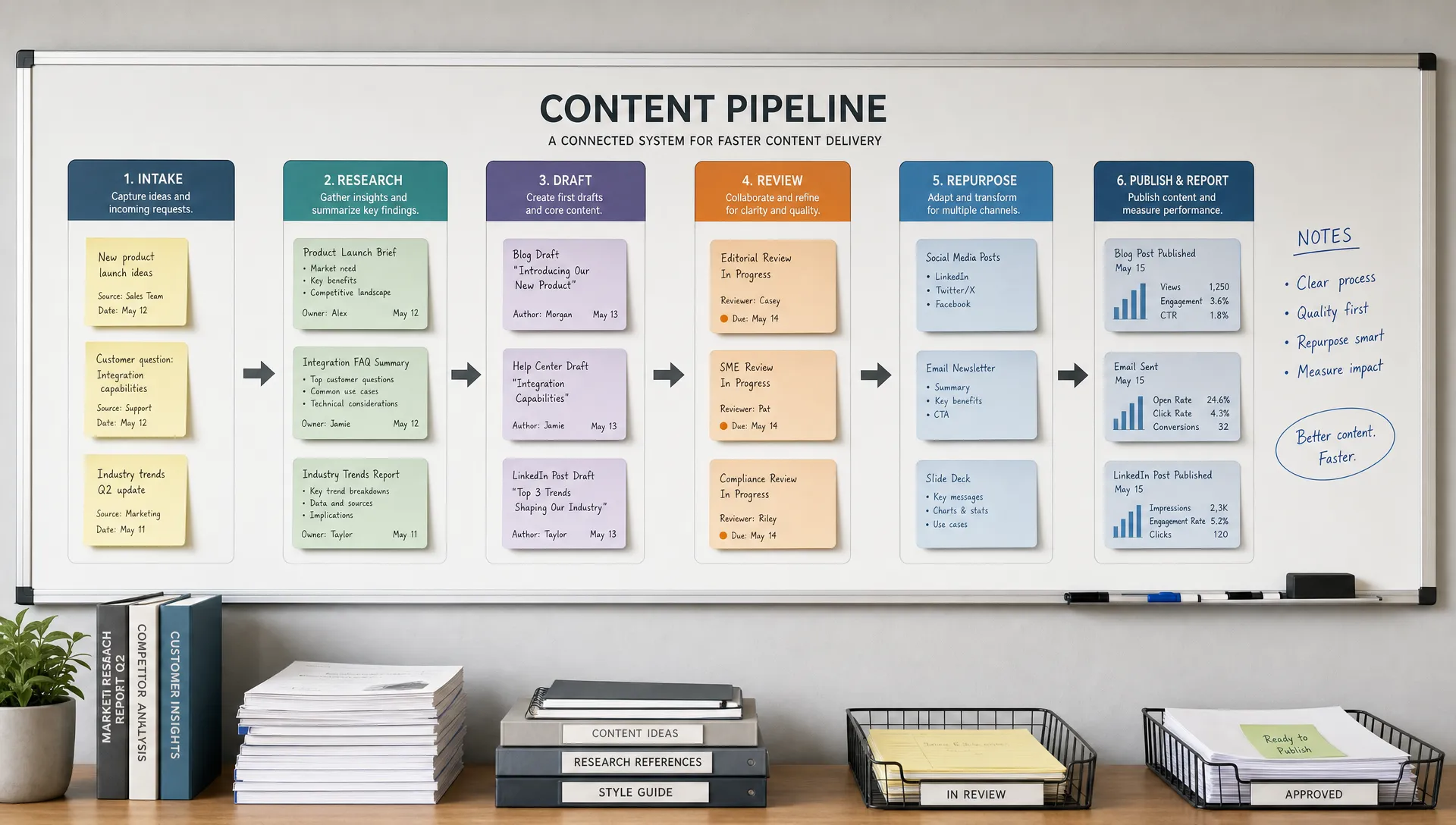
Faster content delivery rarely comes from telling writers, strategists, or designers to work harder. Most content agencies already have talented people doing their best inside a workflow that leaks time at every handoff.
A faster content pipeline is built by removing ambiguity, reducing rework, automating repeatable steps, and making every stage easier to inspect. The goal is not to turn your agency into a content farm. It is to protect quality while increasing throughput, so the team can ship more work without quietly destroying margin.
For B2B content agencies, this matters because delivery speed is now part of the value proposition. Clients expect tighter turnaround, more channel coverage, more repurposing, and more visibility into progress. If your pipeline depends on heroic project managers, scattered docs, and manual status chasing, growth will eventually create delivery drag.
Here is how high-performing content agencies build faster content pipelines without adding chaos.
Start by treating content speed as an operations problem
When a content program runs slowly, the obvious assumption is that production is the bottleneck. Maybe writers need to draft faster. Maybe designers need fewer rounds. Maybe editors need to clear their queue more often.
Sometimes that is true, but more often the real bottleneck appears before production begins.
A strategist is waiting for client inputs. A writer is working from a vague brief. A subject matter expert is slow to respond. A project manager is manually updating three tools. A client reviewer is giving feedback after the asset is already too polished. None of these issues look dramatic in isolation, but together they create a pipeline where everyone is busy and nothing moves cleanly.
The best content agencies stop asking, “How do we make the team faster?” and start asking, “Where does work stop, loop, or lose context?”
That shift matters because speed is not simply output per person. It is the time between a client need being identified and a usable asset going live. If half of that time is waiting, clarifying, checking, chasing, or rebuilding, the pipeline has an operations issue.
Map the pipeline before you automate it
Before adding AI tools or new project management software, map the actual path a content asset takes from idea to published piece. Do not map the ideal process from your SOP. Map what really happens.
For many content agencies, a basic pipeline looks like this:
| Pipeline stage | Common delay | Faster pipeline fix |
|---|---|---|
| Intake | Missing context, unclear goals, late access to assets | Standardized client intake with required fields and source collection |
| Research | Manual source gathering, repeated ICP discovery | Reusable research templates and AI-assisted synthesis |
| Briefing | Vague angles, inconsistent structure | Standard brief format with audience, promise, proof, objections, and CTA |
| Production | Writer starts before strategy is clear | Draft only after the brief passes a quality gate |
| Review | Too many stakeholders, conflicting comments | Staged review gates with defined decision owners |
| Repurposing | Treated as extra work after publication | Repurposing plan built into the original brief |
| Reporting | Manual screenshots and narrative writing | Automated data pull, commentary prompts, and QA checks |
This exercise usually reveals that the production stage is not the only place to optimize. The pipeline may be slow because the agency is asking high-skill people to repeatedly rebuild the same context from scratch.
If you are unsure where automation belongs, start with the operational workflows that create delays before chasing flashy AI content generation. Archer Scaling AI has a practical breakdown of what a marketing agency should automate first if you want a broader prioritization framework.
Build a stronger intake layer
A fast content pipeline starts with a clean intake process. This is where many agencies lose days, even before anyone opens a draft.
Weak intake sounds like this:
“Can you write a blog post on this topic?”
Strong intake captures the business case behind the content. It clarifies who the asset is for, what the reader should believe or do next, what sources can be used, what claims must be avoided, and how success will be measured.
For content agencies, a good intake system should capture:
- Target audience and buying stage
- Primary search intent or campaign objective
- Core offer, product, or service context
- Required internal sources, subject matter experts, or sales notes
- Differentiators, proof points, and approved claims
- Competitors or narratives to avoid
- Distribution channels and repurposing needs
- Reviewers, approvers, and final decision owner
The key is to make intake structured enough that missing inputs are visible immediately. A project manager should not discover two days into drafting that the client has not provided a product demo, customer quote, keyword target, or approval chain.
AI can help here, but not by replacing strategy. It helps by turning messy intake responses into structured briefs, flagging missing information, and routing follow-up questions before the work enters production.
Separate research from writing
One of the biggest reasons content pipelines slow down is that research and writing are blended into one task. A writer receives a topic, then has to understand the audience, gather sources, infer the angle, validate claims, and draft the piece all at once.
That is cognitively expensive. It also creates inconsistency across writers, especially when multiple people are producing for the same client.
Faster content agencies separate research into its own repeatable workflow. Before writing begins, the team gathers and organizes the raw material needed to make the asset useful. This can include customer language, sales call themes, competitor positioning, SERP patterns, internal documentation, campaign data, and subject matter expert notes.
AI is especially useful in this layer because research workflows often involve summarizing, clustering, extracting, and comparing information. The output should not be “write the article.” The output should be a structured research packet that makes human judgment easier.
For example, an AI-assisted research workflow might turn five customer calls, three competitor pages, and a client positioning doc into:
- Recurring pain points in the customer’s own words
- Common objections and buying triggers
- Gaps in competitor content
- Suggested angles by funnel stage
- Claims that need proof before publication
This is where content agencies can create real leverage. A strategist still decides the angle, but they are no longer starting from a blank page every time. For deeper examples, see these research marketing workflows you can automate now.
Standardize the brief, not the thinking
A content brief should not flatten every asset into the same formula. It should create enough consistency that every contributor understands the job to be done.
The fastest agencies use briefs as a control point. The brief is where strategy, audience insight, search intent, source material, and conversion path come together before production begins. If the brief is weak, the rest of the pipeline pays for it.
A practical content brief should answer five questions:
| Brief question | Why it speeds up production |
|---|---|
| Who is this for? | Prevents generic content and reduces editing time |
| What problem are they trying to solve? | Anchors the piece in real reader intent |
| What should they believe after reading? | Clarifies the narrative and argument |
| What proof supports the claims? | Reduces fact-checking delays and client pushback |
| What is the next action? | Aligns the asset with distribution and conversion goals |
Standardizing this brief format does not mean every article, landing page, email, or case study sounds the same. It means every contributor gets the same quality of inputs.
This is especially important when an agency uses freelancers or fractional specialists. A strong brief turns external talent into a scalable extension of the delivery system instead of a recurring management burden.
Create reusable content modules
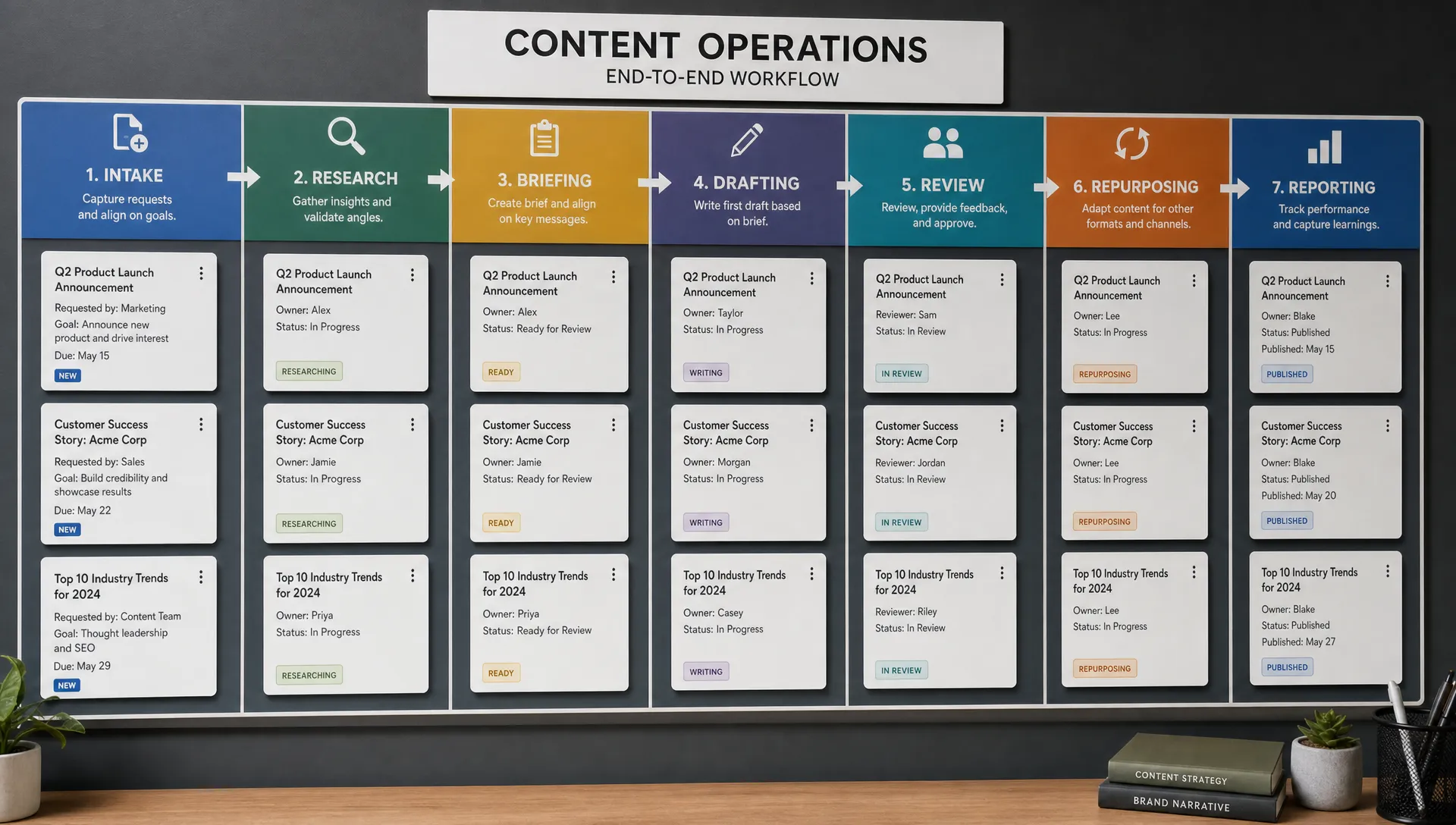
Many content agencies still produce assets one at a time. A blog post is a blog post. A LinkedIn post is a LinkedIn post. An email is an email. That approach creates unnecessary production effort because the team repeatedly rebuilds ideas for each channel.
A faster pipeline treats content as modular.
Instead of creating one asset, the agency builds a source asset and plans derivative outputs from the start. A webinar can become a long-form article, sales enablement summary, email sequence, short LinkedIn posts, newsletter section, and ad angle bank. A customer interview can become a case study, objection-handling copy, landing page proof block, and nurture email.
The important part is that repurposing is not added at the end. It is included in the brief, so writers and editors know which ideas need to be preserved for other formats.
This approach improves speed because the hardest part of content is often not the writing itself. It is deciding what matters. Once the core insight, angle, and proof are clear, the agency can produce multiple assets from the same strategic foundation.
For B2B content agencies, modular production also protects margins. The team gets more client-visible output from the same research and strategy investment.
Install review gates that reduce rework
Review is where many content pipelines go to die.
A client gives strategic feedback after the final draft. A subject matter expert rewrites copy because they were not included during briefing. A designer lays out an asset before the messaging is approved. Internal reviewers comment on style when they should be checking accuracy.
Fast agencies do not eliminate review. They structure it.
The cleanest review systems define what is being reviewed at each stage. For example, the outline stage is for angle, structure, and completeness. The draft stage is for clarity, evidence, and voice. The final stage is for accuracy, formatting, links, and publish readiness.
This prevents late-stage strategic changes that trigger expensive rewrites. It also gives clients a clearer role. Instead of asking, “What do you think?” the agency asks for specific decisions at specific moments.
If rework is one of the biggest sources of drag in your agency, the issue may be your operating system, not your creative talent. Archer Scaling AI has written more on how agencies can cut rework with better ops, including intake, feedback, and review structure.
Use AI for acceleration, QA, and handoffs
AI can absolutely speed up content pipelines, but only when it is placed inside a clear workflow. Dropping a generative AI tool into a messy process often makes the mess faster, not better.
The strongest use cases are usually not “write the whole thing.” They are the repeatable, high-friction tasks that surround content production.
AI can help content agencies:
- Turn intake responses into first-pass briefs
- Summarize client documentation and call transcripts
- Cluster customer language by pain point or objection
- Generate outline options from an approved angle
- Check drafts against brief requirements
- Flag unsupported claims or missing proof
- Repurpose approved content into channel-specific formats
- Draft reporting commentary from performance data
The human role remains critical. Strategists decide positioning. Editors protect quality. Subject matter experts validate accuracy. Client leads manage business context.
AI works best as the operations layer that makes those roles faster and more consistent. It should reduce blank-page work, manual transfer, and quality misses, not remove human accountability.
Connect production to distribution earlier
A content pipeline does not end when the draft is approved. For many agencies, the handoff from content production to distribution is another slow zone.
The content team finishes an asset, then someone else figures out how to publish it, promote it, turn it into email copy, brief paid social, or adapt it for sales. That delay weakens momentum and limits the asset’s value.
Faster agencies define distribution requirements before production begins. If an article will support an account-based campaign, the brief should include the target segment, CTA, email angle, sales follow-up use case, and repurposing plan. If the campaign includes offline or omnichannel touchpoints, tools like an all-in-one direct mail platform for agencies and brands can help connect data, design, postal workflows, automation, and reporting under one operational roof.
The principle is simple: distribution is not a separate project. It is part of the content pipeline.
When production and distribution are connected, the agency can create assets that are easier to activate. That means fewer last-minute rewrites, fewer channel mismatches, and more client-visible impact from each piece of content.
Make reporting part of the workflow, not an afterthought
Reporting is often treated as the final administrative burden after the “real” content work is done. But if reporting is manual, inconsistent, or disconnected from the pipeline, it creates two problems.
First, it consumes delivery margin every month. Second, it prevents the team from learning quickly.
A faster pipeline captures performance context as work moves through the system. Each asset should have a defined goal, channel, CTA, publish date, and reporting tag. That makes it easier to analyze what happened later without reconstructing the story from scattered tools.
For content agencies, the most useful reporting often answers practical questions:
| Reporting question | Operational value |
|---|---|
| Which topics moved pipeline or engagement? | Improves future editorial planning |
| Which formats were easiest to repurpose? | Guides production investment |
| Which review stages caused delays? | Reveals workflow bottlenecks |
| Which assets needed the most rework? | Improves briefing and QA |
| Which clients consumed the most delivery time? | Protects pricing and margin decisions |
This is where content operations and agency profitability connect. A content pipeline should not only produce assets. It should generate the data needed to improve the next cycle.
Track pipeline metrics that actually matter
If you want a faster content pipeline, measure the system, not just output volume.
Publishing more pieces per month can be useful, but it does not tell you whether the agency is becoming more efficient. A team can increase output while quietly burning more hours, adding more freelancers, or accepting more rework.
Better pipeline metrics include:
- Intake completion rate before kickoff
- Average time from intake to approved brief
- Average time from brief approval to first draft
- Number of review rounds per asset
- Percentage of assets requiring strategic rewrite
- On-time publication rate
- Repurposed assets created per source asset
- Delivery hours per asset type
- Margin by client or content package
These metrics help agency leaders find the real constraints. If briefing takes too long, improve intake and research. If drafts require too many rounds, improve briefs and review gates. If reporting takes too many hours, automate data collection and commentary preparation.
The point is not to create a dashboard for its own sake. The point is to make hidden operational drag visible enough to fix.
Build the faster pipeline in phases
Trying to rebuild the entire content operation at once creates its own bottleneck. The better approach is to improve the pipeline in phases, starting with the stages that waste the most high-skill time.
A practical sequence looks like this:
- Document the current workflow: Map every stage from intake to reporting, including tools, owners, delays, and rework loops.
- Standardize intake and briefing: Create required fields, approval checkpoints, and a repeatable brief structure.
- Automate research support: Use AI to summarize, cluster, and organize source material before strategy decisions are made.
- Add QA and review gates: Define what gets reviewed at each stage and who has final decision rights.
- Systemize repurposing and reporting: Build derivative outputs and performance tracking into the workflow from the beginning.
This order matters. If you automate production before fixing intake, you create faster drafts with the same strategic gaps. If you automate reporting before standardizing goals and tags, you create prettier reports with weak insight.
The agencies that scale well do not bolt automation onto chaos. They build a cleaner operating system, then use AI to make it run faster.
The real advantage is margin-safe throughput
Fast content pipelines are not just about speed. They are about creating a delivery model that can handle growth without forcing the agency to hire every time a new client signs.
That means fewer manual handoffs. Better briefs. Cleaner reviews. Reusable research. Modular assets. Automated QA. Reporting that does not require a monthly scramble.
For content agencies, this is where operational maturity becomes a competitive advantage. Clients experience faster delivery and clearer communication. Teams experience less chaos and fewer late-stage rewrites. Agency owners protect margin because the system carries more of the repeatable work.
AI is part of the answer, but the real unlock is process design. A fast pipeline is not one tool. It is a connected system where each stage prepares the next one.
Frequently Asked Questions
How can content agencies speed up production without lowering quality? Content agencies can speed up production by improving intake, separating research from writing, standardizing briefs, using review gates, and automating repetitive handoffs. Quality improves when contributors get clearer inputs and fewer late-stage surprises.
Should agencies use AI to write content faster? AI can help, but it works best inside a structured workflow. Use it for research synthesis, brief creation, outline options, QA checks, repurposing, and reporting support. Human strategists and editors should still own positioning, judgment, and final quality.
What is the biggest bottleneck in a content pipeline? The biggest bottleneck is often not writing. It is unclear intake, weak briefs, slow approvals, scattered source material, and unstructured feedback. Fixing those issues usually improves speed more than asking writers to draft faster.
How do you measure content pipeline efficiency? Useful metrics include time from intake to brief, time from brief to draft, review rounds per asset, rework rate, on-time publication rate, repurposed outputs per source asset, and delivery hours per asset type.
What should a content agency automate first? Start with workflows that remove repetitive operational labor, such as intake cleanup, research summaries, brief generation, QA checks, repurposing, and reporting preparation. Avoid automating final creative judgment before the workflow is stable.
Build a faster content pipeline without adding another hire
If your agency’s content work is growing but your margins are tightening, the answer may not be another writer, project manager, or strategist. It may be a better AI ops layer.
Archer Scaling AI helps B2B marketing agencies install and run automation systems across research, reporting, onboarding, CRM, content ops, and repeatable delivery workflows. The process starts with a paid Margin Teardown: a roadmap and three automation moves, or it is on me.
If you want to see the actual system running live before you commit, start with the Margin Teardown and identify where your content pipeline is leaking time, margin, and momentum.