How a B2B Telemarketing Agency Can Route Leads Faster
Learn how a B2B telemarketing agency can route leads faster with cleaner intake, SLA tiers, AI handoffs and escalation rules.
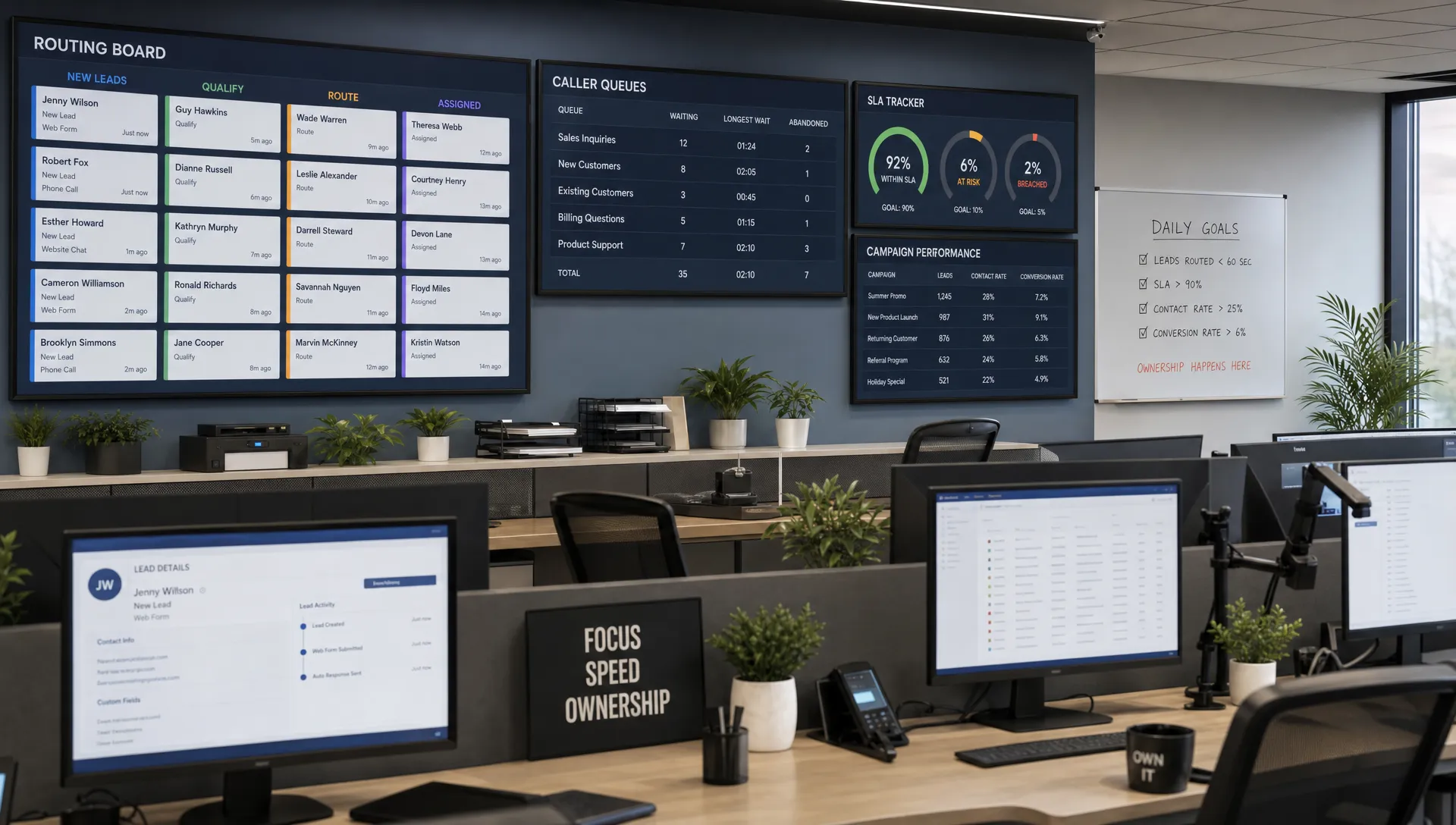
For a B2B telemarketing agency, lead routing speed directly affects booked meetings, client trust and delivery margin. When a hand-raiser waits in a shared inbox, gets assigned to the wrong caller or reaches a sales rep without context, the agency pays twice: first in missed revenue opportunity, then in extra coordination work to explain what happened.
Faster routing is not only about assigning leads sooner. It means every qualified lead reaches the right person with the right context, the right priority and a clear next action before intent fades.
That requires more than a CRM notification. It requires a lead routing operating system.
Why lead routing is an agency margin problem
Telemarketing agencies often sit between several moving parts: client campaigns, landing pages, paid media, events, outbound lists, CRM fields, calling teams and the client sales organization. A lead can enter through a form, a call-back request, a webinar list, a partner file or a rep's manual note. If those sources do not feed a single routing process, speed becomes dependent on whoever checks the spreadsheet or inbox first.
The operational cost shows up quickly. Senior account managers chase status updates. Callers waste time clarifying ownership. Clients ask why a lead was not called sooner. Managers create manual workarounds that work for one campaign, then break on the next.
A B2B telemarketing agency can route leads faster by treating routing as a repeatable delivery workflow, not a one-off sales admin task. The best systems answer five questions automatically:
- Where did the lead come from?
- Is the lead valid, consented and actionable?
- Which account, segment, territory or campaign does it belong to?
- Who should act on it now?
- What happens if that person does not act within the SLA?
That last question matters. Routing without escalation is just assignment with nicer labels.
Start by mapping every lead source
Before changing tools, map the real path leads take today. Many agencies skip this because the CRM looks like the source of truth. In practice, the lead often touches three or four systems before the CRM record is useful.
A simple map should include every source that creates a callback, meeting request or sales conversation. For a B2B telemarketing agency, that may include paid search forms, LinkedIn lead forms, event badge scans, cold outbound replies, inbound phone calls, referrals, client-uploaded account lists and CRM reactivation campaigns.
The mapping exercise should identify three details for each source: the moment the lead is created, the first place it lands and the current owner of the next action. If the first place is a spreadsheet, inbox or Slack channel, routing speed will depend on manual monitoring unless you create an automated capture step.
This is also the point where agencies should separate routing problems from follow-up problems. If the right rep receives the lead in two minutes but waits six hours to call, routing is not the bottleneck. If the rep never receives the lead or receives it without campaign context, routing is the issue. Both issues hurt conversion, but they require different fixes. Archer has a related breakdown on how sales teams can stop losing warm leads when handoffs and follow-up ownership are unclear.
Build a routing rulebook before automating
Automation makes a clean rulebook faster. It makes a messy rulebook messier.
Your routing rulebook should define which fields determine ownership, priority and timing. Do not start with every possible CRM field. Start with the minimum data needed to route the lead correctly.
For most B2B telemarketing workflows, the core routing fields are:
- Lead source
- Campaign or client account
- Company domain
- Persona or job function
- Account status, such as net new, open opportunity or customer
- Region and time zone
- Product or service interest
- Consent status and permitted channel
- Urgency signal, such as demo request or pricing inquiry
- Assigned caller pool or client sales owner
Once the fields are clear, define how they interact. For example, a demo request from a target account may override standard round-robin assignment. A lead from an existing opportunity may route to the opportunity owner. A lower-fit content download may enter a nurture queue rather than the immediate call queue.
A practical routing rulebook often looks like this:
| Routing tier | Example trigger | Target action | Escalation rule |
|---|---|---|---|
| Hot | Demo request, pricing inquiry or direct callback request | Assign to named owner or priority caller queue | Escalate if not accepted quickly |
| Warm | Webinar attendance, high-fit content form or engaged target account | Assign to campaign caller pool | Requeue if no first attempt inside SLA |
| Existing account | Lead matches open opportunity or customer account | Route to account owner or client sales contact | Notify manager if ownership is unclear |
| Low fit or incomplete | Missing company data, invalid domain or outside target segment | Send to validation queue | Close or enrich before assignment |
The exact SLA depends on the campaign, staffing model and client agreement. The key is to make timing explicit. If a lead is important enough to promise speed, the system needs an SLA timer and a fallback route.
Add AI where routing creates decision fatigue
Lead routing slows down when humans have to interpret messy context. A form says finance, the company looks like manufacturing, the CRM has a duplicate account and the campaign notes say to prioritize companies over 500 employees. A coordinator can solve that puzzle, but not at scale without creating delay.
AI can help by turning unstructured or inconsistent inputs into routing-ready context. For example, it can summarize form responses, normalize company names, detect likely duplicate accounts, classify intent from a free-text message and draft a handoff note for the caller.
The best use of AI in routing is not to replace the rulebook. It is to prepare the lead record so the rulebook can work. That distinction prevents black-box assignment decisions that managers cannot explain to clients.
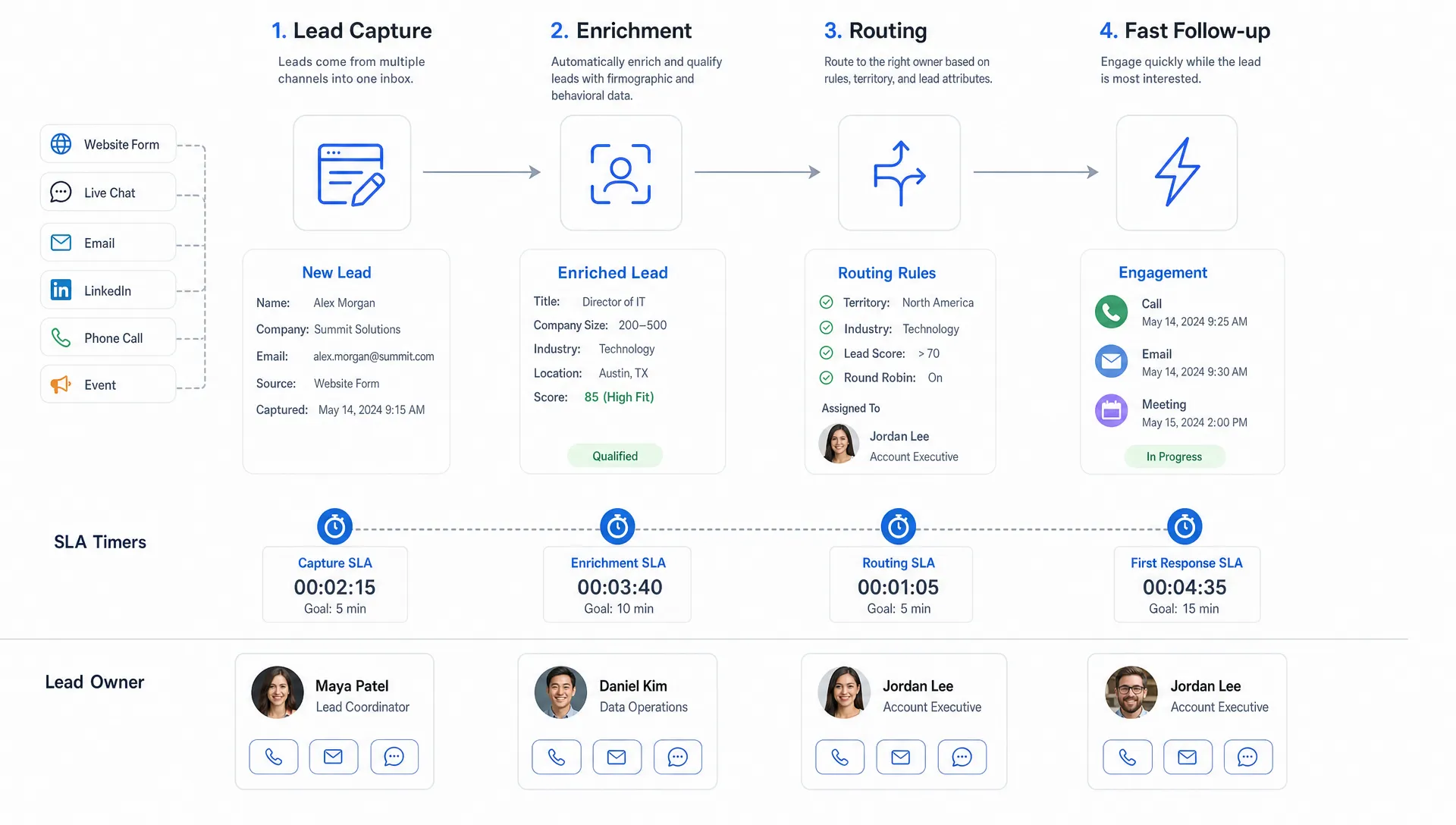
A strong AI-assisted routing workflow might work like this: the system captures the lead, enriches missing fields where permitted, checks for account matches, classifies the inquiry, applies the routing rules, posts a concise handoff summary and starts the SLA timer. The caller does not receive a vague notification. They receive a clear reason for ownership and the next best action.
Use queues without creating ownership confusion
Many agencies use round-robin queues because they feel fair. Fair is useful, but speed matters more. If the round-robin assigns a lead to someone in a meeting, on PTO or outside the right skill set, the lead stalls.
A faster system uses smart queues with eligibility rules. A rep should receive a lead only if they are available, trained for that campaign, allowed to call that region and inside the relevant working window. If they do not accept or act within the SLA, the system should reassign or escalate.
This is where many CRM setups break. They assign ownership but do not confirm action. A faster lead routing process tracks acceptance, first attempt and outcome. For telemarketing teams, a first attempt is not just opening the CRM record. It is a call, voicemail, email, LinkedIn touch or approved campaign action logged against the lead.
A clean queue design usually includes three layers:
- Primary owner for the first attempt
- Backup pool for missed SLA or unavailable reps
- Manager escalation for repeated stalls, duplicates or unclear ownership
The manager escalation should be reserved for exceptions, not routine assignment. If managers become the normal routing layer, the system is still manual.
Make the handoff useful, not just fast
Routing a lead in 60 seconds can still fail if the recipient has to search through campaign folders to understand what to say. Speed and context need to travel together.
A useful handoff note should include why the lead is being routed, what triggered the action, what the prospect already knows and what the caller should do next. For example, a callback request from a CFO after viewing a pricing page needs a different opening than a content syndication lead who downloaded an industry report.
This is where telemarketing agencies can reduce both response time and call prep time. Standardized handoff templates can pull in the campaign name, offer, source, target persona, account notes and previous engagement. AI can draft the summary, but the fields and decision logic should be controlled by the agency.
If the agency also handles client reporting, handoff quality has a second benefit. It creates cleaner downstream data. That makes it easier to explain which lead sources produce conversations, which queues are overloaded and where client-side response breaks. Better data discipline is one of the same operating principles covered in Archer's guide to improving delivery efficiency for B2B marketing firms.
Train the team on the route, not just the tool
A routing system only works if callers, account managers and client stakeholders understand the operating rules. Otherwise, reps create side channels, managers override queues and clients ask for special handling that never gets documented.
Training should focus on the behavior the system requires. Callers need to know when to accept, reject or requeue a lead. Account managers need to know which exceptions deserve manual intervention. Client sales teams need to know what information they will receive and what SLA they are accountable for after handoff.
Short, role-specific enablement usually works better than a long CRM training session. Agencies that need structured training material can look at upskilling paths for technology and business teams as a model for building practical learning routes around CRM hygiene, automation adoption and team operating standards.
The goal is not to make every rep an automation specialist. The goal is to make the routing behavior predictable enough that automation can support it.
Measure lead routing speed and quality together
Speed alone can create bad incentives. If reps race to accept leads but do not follow up well, the dashboard looks better while outcomes get worse. Track routing speed alongside quality measures.
A B2B telemarketing agency should review routing performance at least weekly during the first few months of a new system. The most useful metrics are simple enough for managers to act on:
| Metric | What it tells you | Common operational fix |
|---|---|---|
| Time to assign | How long leads wait before an owner is selected | Automate capture, reduce manual validation or improve source mapping |
| Time to first attempt | How long leads wait before real outreach happens | Add SLA timers, backup queues or availability rules |
| Acceptance rate | Whether reps are taking routed leads as expected | Fix queue eligibility, rep capacity or campaign training |
| Reassignment rate | How often leads bounce between owners | Clarify territory rules, duplicate logic or client ownership |
| First-attempt outcome | Whether fast routing creates conversations | Improve handoff context, call scripts or lead qualification |
The review should separate system delays from human delays. If leads are assigned slowly, fix capture and routing logic. If leads are assigned quickly but untouched, fix SLA management, capacity or rep behavior. If leads are called quickly but conversations are poor, fix targeting and handoff context.
This prevents the common mistake of adding more automation to a process that actually needs clearer ownership.
A practical 30-day rollout
A full routing overhaul does not need to take months. Start with one campaign, one client or one lead source that has visible leakage and enough volume to test the system.
In the first week, map the current lead path and agree on the fields that matter. In the second week, define routing tiers, SLAs and fallback rules. In the third week, build the automation around capture, enrichment, assignment and alerts. In the fourth week, run the process live with daily checks on exceptions.
Keep the rollout narrow enough that you can inspect every failure. When a lead stalls, ask whether the problem came from the source data, the rulebook, the queue, the notification, the rep's behavior or the client handoff. Each failure should improve the operating system.
Once the first route works, clone the pattern. Do not clone the exact rules blindly. Clone the structure: clean intake, minimum required fields, clear priority logic, named queues, SLA timers, fallback paths and performance review.
That is how a B2B telemarketing agency can improve speed without creating a fragile web of one-off automations.
Frequently Asked Questions
What is lead routing for a B2B telemarketing agency? Lead routing is the process of assigning each incoming or campaign-generated lead to the right caller, sales owner or validation queue based on source, account status, region, persona, intent and SLA priority.
Why do telemarketing leads get routed slowly? Leads usually slow down because they enter through too many channels, lack required fields, depend on manual review or have unclear ownership rules. Slow routing is often an operations design problem rather than a rep motivation problem.
Can AI route leads automatically? AI can help classify intent, enrich context, identify possible duplicates and prepare handoff notes. The safest approach is to let AI support a clear rulebook instead of letting it make unexplained ownership decisions.
What is a good SLA for lead routing? The right SLA depends on lead value, staffing, client agreements and working hours. High-intent leads such as demo requests and callback forms should usually receive the fastest routing tier, with a clear fallback if the first owner does not act.
How can an agency know if routing has improved? Track time to assign, time to first attempt, acceptance rate, reassignment rate and first-attempt outcome. Improvement means leads move faster and create better conversations, not just faster notifications.
Turn faster routing into a repeatable agency system
Lead routing gets faster when the agency removes ambiguity. The route is clear, the fields are clean, the queue is eligible, the handoff has context and the fallback happens automatically.
If routing is one of several delivery margin leaks inside your agency, Archer Scaling AI can help you inspect the workflow, identify the highest-leverage automation moves and build the AI ops layer around them. Start with the paid Margin Teardown, then decide whether to move into build and managed automation with clear documentation and no lock-in. You can see how the system fits an agency model at Archer Scaling AI.