How a B2B Public Relations Agency Can Use AI Ops
Learn how a B2B public relations agency can use AI ops to streamline research, pitching, reporting, and onboarding without risking quality.

AI ops is not about asking a chatbot to “write a press release.” For a B2B public relations agency, the real leverage is building repeatable operating systems where AI helps move information from intake to research, messaging, pitching, reporting, and follow-up with less manual drag.
That distinction matters because PR work is judgment-heavy. The agency still needs experienced humans to understand the market, protect reputation, shape narratives, build media relationships, and advise clients under pressure. AI ops simply reduces the time lost to repetitive collection, formatting, summarizing, routing, and QA.
Done well, it can help a B2B PR team protect delivery margin without making the work feel generic. Done poorly, it creates faster noise, weaker pitches, and more review headaches.
What AI ops means for a B2B public relations agency
AI ops is the operational layer that connects tools, data, workflows, and human review. It turns AI from an ad hoc writing assistant into a controlled system that supports specific agency processes.
For a B2B public relations agency, that might include:
- Turning a client intake form into a structured PR brief
- Summarizing analyst reports, earnings calls, podcasts, and competitor announcements
- Drafting first-pass media angles from approved messaging
- Matching journalists to topics based on beat relevance
- Creating reporting summaries from coverage, CRM notes, and campaign activity
- Flagging missing inputs before a pitch, byline, or award submission moves to review
The important word is “system.” A prompt saved in someone’s notes app is not AI ops. A repeatable workflow with inputs, outputs, review points, data sources, and documentation is.
If your agency is already exploring broader automation, the same principle applies across delivery. Archer Scaling AI has covered this at the agency level in its guide to AI in marketing workflows agencies can automate, but PR agencies need a slightly different lens because accuracy, nuance, and reputation risk are higher.
Why PR agencies need AI ops now
B2B PR delivery has become more complex. Clients expect media relations, executive visibility, thought leadership, analyst relations, awards, podcasts, newsletters, and social amplification to work together. At the same time, newsroom capacity is thinner, journalists are harder to reach, and generic outreach is easier to ignore.
That creates a margin problem. Many agencies respond by hiring more coordinators, asking account managers to absorb more admin, or accepting slower turnaround. None of those options are ideal.
AI ops gives agencies another route: remove avoidable manual work while keeping strategic work in human hands.
The strongest opportunities are usually not in the glamorous parts of PR. They are in the repetitive handoffs that quietly eat hours every week: cleaning notes, checking client inputs, compiling research, formatting reports, updating status documents, and rebuilding the same briefing structure for every account.
Where AI ops fits across the PR delivery lifecycle
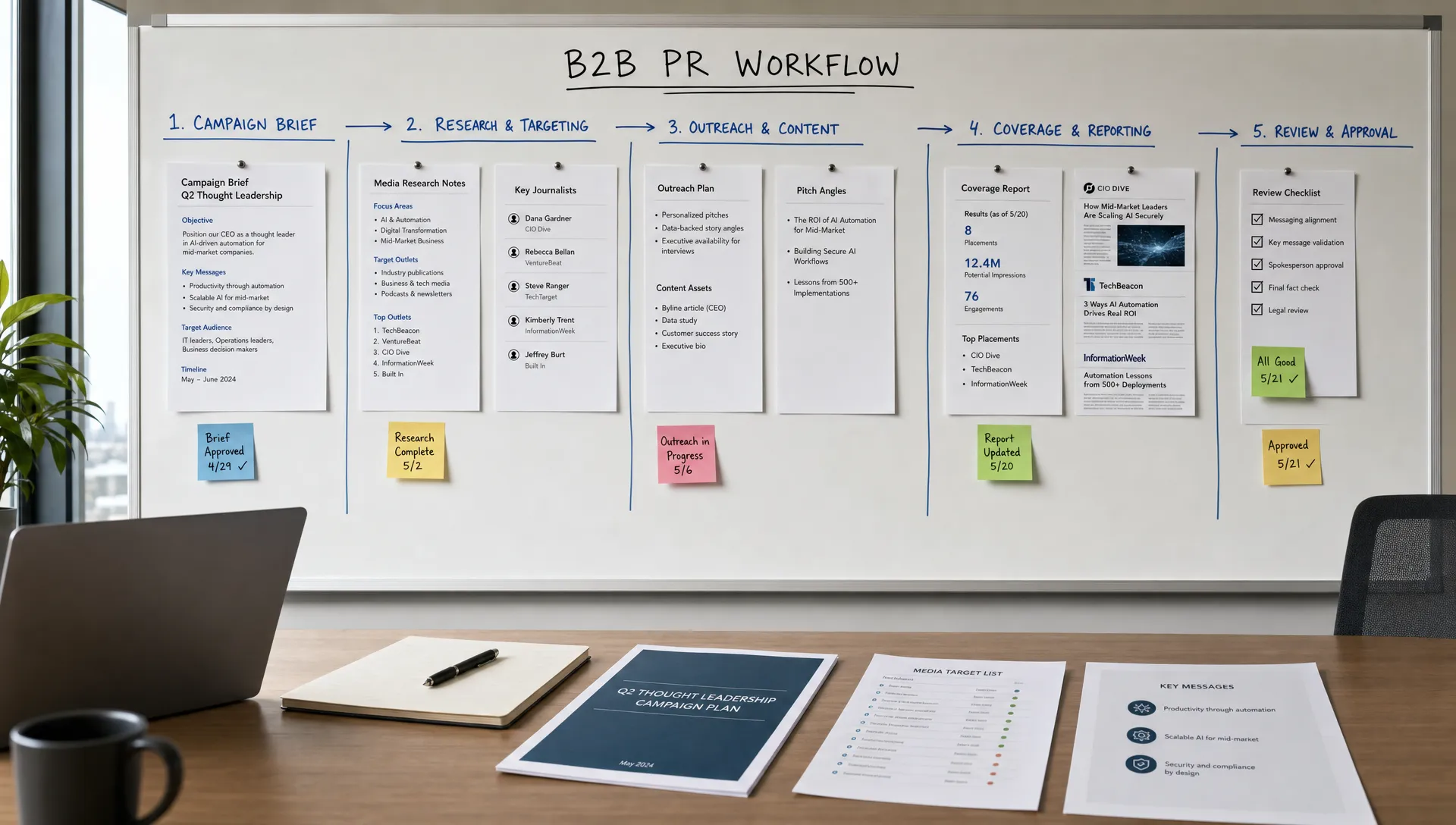
A practical AI ops setup follows the way a PR account already runs. It should not force the team into an abstract automation model. Start by mapping the lifecycle, then identify the points where work is repetitive, rules-based, or dependent on scattered information.
| PR workflow | AI ops use case | Human review required |
|---|---|---|
| Client onboarding | Convert intake answers, sales notes, and kickoff transcripts into a PR brief | Account lead confirms positioning, constraints, and goals |
| Messaging | Summarize product, market, and ICP inputs into draft message pillars | Strategist approves narrative and claims |
| Media research | Cluster journalists by beat, outlet, audience, and past coverage themes | PR specialist validates fit and relationship context |
| Pitch development | Generate angle options from approved messaging and current news hooks | Senior PR lead selects and edits |
| Executive visibility | Turn SME interviews into byline outlines, LinkedIn post drafts, and speaker bios | Executive and agency approve voice and substance |
| Reporting | Summarize coverage, activity, next steps, and client-facing insights | Account manager checks interpretation and recommendations |
This is where many agencies make the first mistake. They try to automate the most visible output first, like the press release or pitch email. A better first move is to automate the upstream inputs that make those outputs better.
Start with intake and account context
Most PR inefficiency begins with incomplete context. A client answers a few questions in a kickoff call, the sales team has more context in the CRM, the founder gave useful messaging in a proposal call, and the account team has to reconstruct it all manually.
AI ops can make onboarding cleaner by taking approved inputs and producing a structured account brief. That brief can include the client’s ICP, product category, competitors, proof points, spokespersons, sensitive topics, approved language, claims that need substantiation, and campaign goals.
This does not replace the strategist. It gives the strategist a better starting point. Instead of spending the first few hours copying notes into a document, they can review, correct, and sharpen the account direction.
For B2B PR, this is especially useful because clients often operate in technical categories where small language errors can create credibility problems. The AI system should be trained to preserve source language, cite the source note it used internally, and flag uncertainty rather than filling gaps.
A simple rule helps: if the input is weak, AI should create questions, not confident copy.
Use AI for research synthesis, not lazy media lists
Media research is one of the most obvious AI use cases for PR agencies, but it is also one of the easiest to misuse. The goal is not to scrape together a huge list of names. The goal is to help a PR professional find a smaller number of more relevant opportunities.
AI ops can support research by summarizing recent coverage, grouping journalists by themes, identifying recurring angles, and comparing a client’s point of view against what a publication already covers. It can also help detect whether a journalist writes about a business problem, a technology category, funding news, workplace trends, regulation, or executive leadership.
The human still decides whether the contact is appropriate. Relationship history, timing, editorial tone, and common sense matter.
This same approach can be used for analyst relations, podcast outreach, award submissions, and speaking opportunities. AI helps reduce the research burden, but the agency’s judgment turns research into a credible recommendation.
Build a safer pitch development workflow
AI-generated pitches are risky when they start from a blank page. They tend to sound polished but vague, which is exactly what busy journalists dislike.
A better PR AI ops workflow starts with constraints. The system should use approved message pillars, verified proof points, client-specific examples, and current context. It should also know what not to say.
For example, a pitch workflow might require these inputs before drafting anything:
- The target audience and outlet category
- The journalist’s recent relevant coverage
- The approved client point of view
- The evidence or example supporting the angle
- The desired action, such as briefing, interview, contributed article, or data commentary
- Any legal, regulatory, or client language restrictions
Once those inputs exist, AI can generate angle variations, subject line options, and first-pass pitch structures. Then a PR professional edits for relevance, tone, brevity, and relationship context.
This keeps AI in the right role. It accelerates options, but it does not decide what is newsworthy.
Turn SME interviews into more usable assets
B2B PR agencies often sit on a goldmine of raw material: interviews with founders, product leaders, analysts, customers, and technical experts. The problem is that turning those conversations into usable assets takes time.
AI ops can help convert transcripts into structured outputs such as message notes, quote banks, byline outlines, LinkedIn thought leadership drafts, podcast prep notes, and FAQ documents for account teams.
The key is to separate extraction from creation. First, extract what the expert actually said. Then identify themes, claims, supporting examples, and follow-up questions. Only after that should the system help draft external-facing content.
This is similar to how AI-powered feedback systems work in other knowledge-heavy contexts. For instance, AI-powered career intelligence platforms such as Versadox analyze a person’s existing materials, identify gaps, and suggest improvements rather than pretending the raw input does not matter. PR agencies can apply the same principle to expert interviews: improve and structure the source material before generating polished outputs.
Improve reporting without turning it into vanity metrics
PR reporting is another high-friction workflow. Account teams gather coverage links, screenshots, domain metrics, social engagement, campaign activity, journalist feedback, and client notes. Then they turn it all into a narrative the client can understand.
AI ops can make reporting faster by pulling recurring inputs into a standard structure and creating first-pass summaries. But the system should not reduce PR value to a pile of metrics.
A strong reporting workflow should separate three layers:
| Reporting layer | What AI can help with | What humans must add |
|---|---|---|
| Activity | Summarize pitches sent, follow-ups, briefings, interviews, and content submitted | Explain whether activity matched the plan |
| Outcomes | Organize coverage, mentions, backlinks, share of voice notes, and qualitative wins | Interpret quality and business relevance |
| Recommendations | Draft next-step options based on campaign history | Decide strategy, priority, and client guidance |
This matters because clients do not just want to know what happened. They want to know what it means and what the agency recommends next.
If reporting is a major drag across your team, it may help to study how other agency types standardize reporting before automation. Archer Scaling AI’s article on how B2B ad agencies speed up reporting and QA is focused on advertising, but the operating principle applies to PR too: define the reporting structure before asking AI to fill it.
Add guardrails for reputation-sensitive work
PR teams cannot afford careless automation. A wrong claim, invented journalist reference, inaccurate quote, or off-brand statement can damage trust quickly.
AI ops for PR needs guardrails from the beginning. These do not have to be complicated, but they do need to be explicit.
Useful guardrails include approved source libraries, claim verification steps, human approval before external sending, sensitive topic flags, spokesperson voice guidelines, and a clear escalation path for crisis or legal-risk content.
The system should also document what it produced and what source material it used. This makes review easier and prevents the team from treating AI output as magically authoritative.
For a B2B public relations agency, the safest automation rule is simple: AI can prepare, summarize, format, route, and draft. Humans approve, advise, and send.
What to automate first
The best first AI ops project is usually the one that is frequent, painful, and low-risk. Avoid starting with anything that could create public reputational damage if it fails.
Good first projects for a B2B PR agency include client intake summaries, weekly internal account updates, coverage report drafts, media research synthesis, transcript summarization, and byline outline generation from approved SME interviews.
Poor first projects include fully automated journalist outreach, crisis response statements, unsupervised press release creation, and anything involving legal, financial, medical, or regulatory claims without strict review.
A useful prioritization test is to ask three questions: does this task happen every week, does it consume senior time unnecessarily, and can a human review the output before it reaches the client or the public? If the answer is yes, it is a strong candidate.
How to implement AI ops without overwhelming the team
The biggest adoption mistake is trying to roll out AI everywhere at once. PR teams already operate under deadlines. A messy automation initiative can feel like one more thing to manage.
Start with one workflow and make it boringly reliable. Document the current process, define the inputs, design the AI-assisted output, add the review step, and measure whether it saves time or improves consistency.
For example, an agency might start with weekly reporting. The system collects activity notes, coverage links, CRM updates, and approved campaign goals. It drafts an internal summary and a client-ready outline. The account manager reviews, edits, and adds recommendations. Over a month, the agency can compare time spent, revision volume, and client satisfaction against the old process.
Once that works, expand to the next workflow. This gradual approach is often more profitable than chasing an impressive all-in-one AI transformation.
If your agency is still building the operational foundation, it may be worth reviewing the broader principles behind agency marketing systems that protect margin. AI creates leverage only when the underlying process is clear enough to repeat.
The metrics that matter
AI ops should be measured like an operational investment, not a novelty. The goal is not “more AI usage.” The goal is better delivery economics and better client experience.
For a B2B PR agency, useful metrics include turnaround time for briefs and reports, senior review hours per deliverable, percentage of work returned for missing context, time from interview to usable asset, reporting prep time, client revision volume, and account team capacity.
You can also track qualitative improvements, such as more consistent messaging across accounts or better handoffs between strategy, media relations, and content teams.
Be careful with vanity productivity claims. Saving 10 minutes on a task that happens once a quarter is not meaningful. Saving 45 minutes every week across 15 accounts is.
Frequently Asked Questions
Can a B2B public relations agency use AI without damaging pitch quality? Yes, if AI is used to support research, structure, and first-pass drafting rather than unsupervised outreach. The strongest pitch quality still comes from human judgment, relevance, and relationship context.
What is the safest PR workflow to automate first? Reporting support, intake summaries, transcript summaries, and internal account updates are usually safer starting points because they can be reviewed before reaching journalists or clients.
Should AI write press releases for clients? AI can help create a first-pass structure from approved messaging and verified facts, but a PR professional should always review claims, quotes, tone, and news value before anything is shared externally.
How does AI ops improve agency margin? AI ops reduces repetitive manual work, shortens handoffs, improves consistency, and lowers the amount of senior time spent on formatting, summarizing, and rebuilding the same assets from scratch.
Does AI ops replace PR account teams? No. In a serious B2B PR environment, AI should support account teams by preparing information and reducing admin. Strategy, counsel, media judgment, and client trust remain human-led.
Build the AI ops layer before adding more headcount
A B2B public relations agency does not need more random AI tools. It needs an operating layer that makes the agency’s existing expertise easier to deliver, repeat, and scale.
The best systems start with the work your team already does every week: onboarding, research, message development, pitch prep, SME interviews, reporting, and follow-up. When those workflows become clearer, AI can reduce the operational load without weakening quality.
Archer Scaling AI helps B2B marketing agencies install and run AI-powered operations systems for workflows like onboarding, reporting, CRM, content operations, and lead follow-up. The process starts with a paid Margin Teardown that identifies the highest-leverage automation moves, with a risk-reversed roadmap if the opportunities are not there.
If your PR agency is feeling the squeeze between client expectations and delivery capacity, start by looking at the workflow leaks. The right AI ops layer can protect margin, improve consistency, and give senior people more time for the work clients actually pay you for.