How a B2B Brand Strategy Agency Can Reduce Rework
Learn how a B2B brand strategy agency can reduce rework with cleaner intake, decision gates, structured feedback, and AI ops.
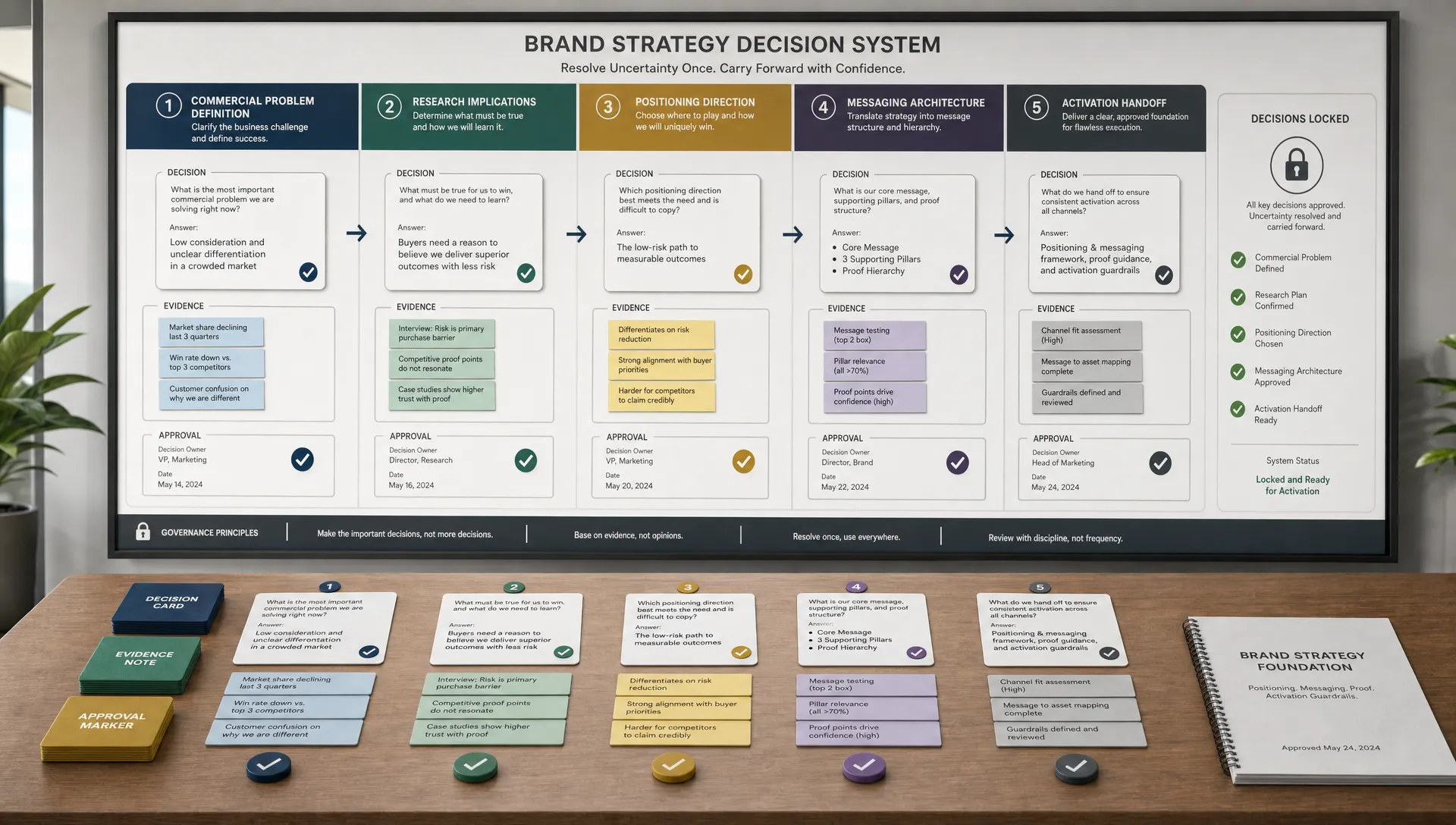
Rework is rarely caused by a strategist “not thinking hard enough.” In a B2B brand strategy agency, rework usually appears when the team is forced to solve the same uncertainty multiple times: unclear commercial priorities, late stakeholder input, vague feedback, undocumented decisions, or deliverables that move from person to person without a shared operating system.
That matters because brand strategy work is already complex. You are translating market realities, buyer psychology, sales constraints, competitive positioning, executive preference, and creative judgment into a direction the client can actually use. If the operating layer is weak, every phase becomes more subjective than it needs to be.
The goal is not to remove creativity. The goal is to remove preventable loops so senior people spend more time making strategic calls and less time cleaning up avoidable confusion.
Why rework happens in B2B brand strategy
Most rework in brand strategy starts upstream. By the time a client says, “This does not feel right,” the real problem often happened days or weeks earlier. The agency may have accepted a fuzzy business problem, skipped stakeholder alignment, combined too many decisions into one approval, or failed to translate sales realities into the strategy.
For B2B clients, this is especially common because the buyer journey is longer, the buying committee is larger, and brand decisions are tied to revenue conversations. A positioning idea that sounds strong in a workshop may fall apart when Sales has to use it in an enterprise demo. If your agency serves clients that need their brand to support pipeline, the strategy process has to account for sales alignment from the start. Archer’s guide to branding for B2B companies that need sales alignment explores that connection in more depth.
The most common rework triggers are operational, not artistic:
- The client briefs the agency on symptoms instead of the commercial problem.
- Stakeholders join late and challenge decisions they never saw being made.
- Research is gathered, but not converted into decision-ready implications.
- Strategy, messaging, naming, and visual preference are reviewed in the same conversation.
- Feedback arrives as taste, not as evidence or business concern.
- Project knowledge lives in calls, Slack threads, and individual memory.
Reducing rework means designing a process where uncertainty gets resolved once, documented clearly, and carried forward into every deliverable.
Start by mapping where rework actually occurs
Before adding templates, automations, or AI tools, map the real rework pattern across the last five to ten brand strategy projects. Do not ask only, “Where did the client request revisions?” Ask, “Where did the team have to redo thinking, rewriting, synthesis, formatting, or coordination that should have been settled earlier?”
A simple rework map can reveal the operational leakage quickly.
| Rework symptom | Likely upstream cause | Operational fix |
|---|---|---|
| Positioning gets rewritten after the first presentation | The business problem was not defined tightly enough | Add a strategy charter before research starts |
| Messaging is repeatedly softened by executives | Risk tolerance and category ambition were not aligned | Add an executive alignment gate before messaging development |
| Creative team rejects strategic inputs as unusable | Strategy outputs are too abstract for execution | Create a handoff format with claims, proof points, audience, and usage notes |
| Client feedback contradicts prior approvals | Decisions are not documented in an accessible source of truth | Maintain a decision log with dates, owners, and implications |
| Senior team keeps rescuing deliverables at the end | QA criteria are unclear or applied too late | Add stage-based review gates before client-facing work |
This exercise is useful because it separates necessary iteration from waste. A good strategy process should include debate, refinement, and pressure testing. But it should not require the agency to rediscover context, restate decisions, or rebuild work because the system failed to capture the logic behind it.
Build a stronger intake system, not just a better questionnaire
Many agencies have intake forms. Fewer have intake systems.
A questionnaire collects information. A system turns that information into scope, decision rights, risks, dependencies, and working assumptions. For a B2B brand strategy agency, the intake process should prevent the team from starting strategy work until the agency understands what business decision the brand strategy must support.
Useful intake should clarify four areas.
First, define the commercial problem. Is the client trying to move upmarket, unify a post-acquisition portfolio, reposition after category change, support a new sales motion, increase trust in a technical product, or differentiate in a crowded category? Each of these requires a different strategic path.
Second, identify the buying context. Who is involved in the buying committee? What objections slow deals? What language do prospects already use? Which proof points carry weight? A B2B brand cannot be built only around internal ambition. It has to survive external buying behavior.
Third, document internal constraints. Some clients have legal restrictions, investor expectations, founder preferences, product roadmap uncertainty, or sales team habits that will affect the work. These constraints should not surprise the team during final review.
Fourth, define decision rights. A brand project can involve founders, marketing leaders, sales leaders, product leaders, and board members. If the agency does not know who approves what, every review meeting becomes a negotiation.
The output should be a one-page strategy charter. It does not need to be fancy. It needs to be clear enough that every strategist, copywriter, designer, account lead, and client stakeholder can answer the same questions about the work.
Separate strategy approval from expression approval
One of the fastest ways to reduce rework is to stop asking clients to approve too many things at once.
When a client reviews a strategy deck that includes research synthesis, positioning options, messaging direction, naming language, visual examples, and rollout implications, feedback becomes messy. A stakeholder may dislike a visual cue and use that discomfort to question the strategy. Another may agree with the positioning but object to the tone. Someone else may raise a sales concern that should have been discussed two weeks earlier.
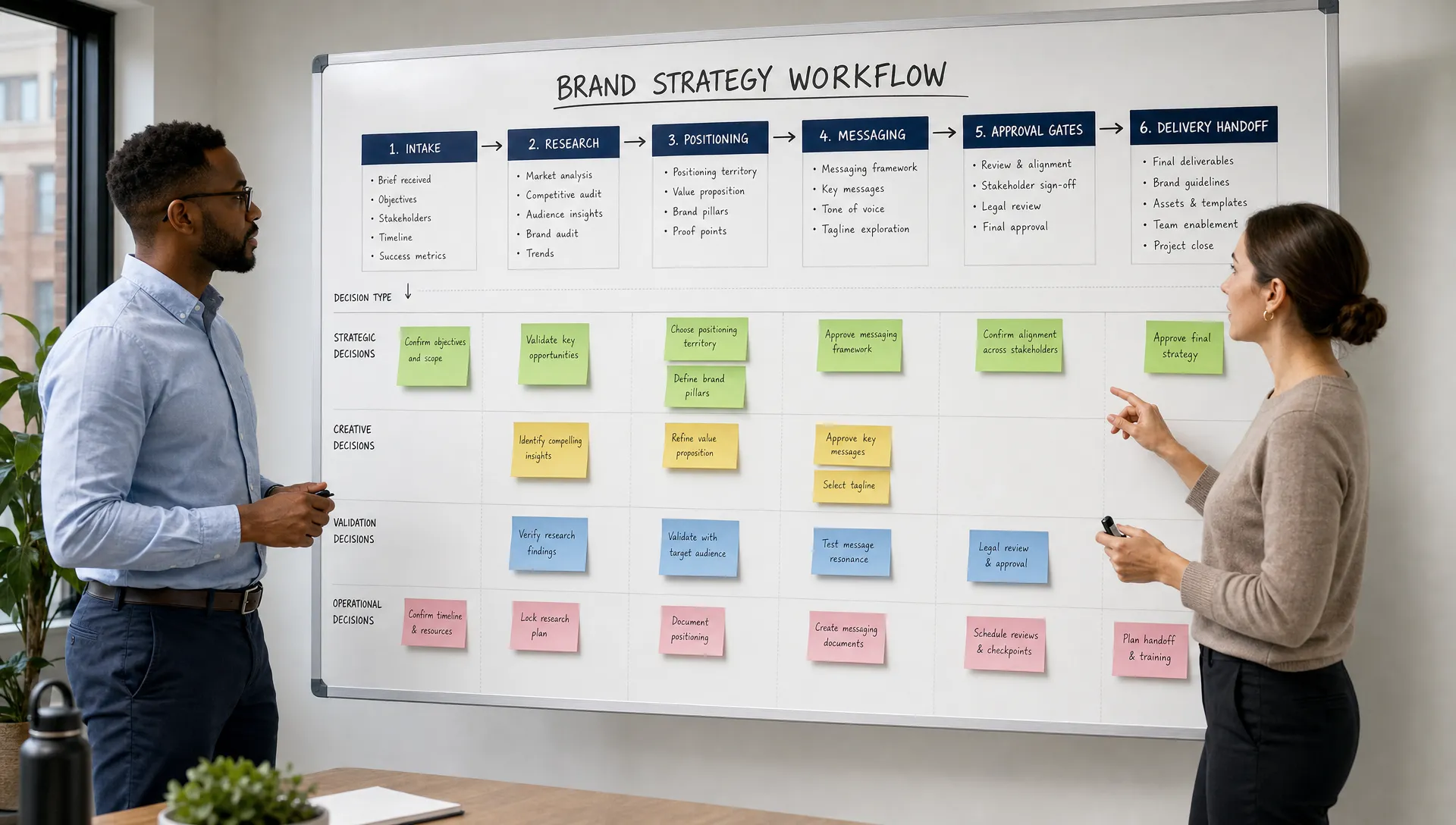
A cleaner process separates approval gates by decision type.
| Approval gate | Decision being made | What should not be debated here |
|---|---|---|
| Problem definition | What commercial challenge the brand strategy must solve | Taglines, creative ideas, visual style |
| Research implications | What the agency believes based on evidence | Final positioning language |
| Positioning direction | Which market position the client will commit to | Full copy system or design execution |
| Messaging architecture | How the strategy becomes usable language | Visual identity preferences |
| Activation handoff | How teams will use the strategy in market | Reopening approved positioning unless new evidence appears |
This structure does not make the process rigid. It makes it fair. Clients know what kind of feedback is useful at each stage, and the agency can protect approved decisions without sounding defensive.
If your agency’s biggest issue is endless commentary on decks and concepts, the deeper operating fixes in Archer’s article on how B2B branding agencies reduce revision loops pair well with this gate-based approach.
Turn feedback into evidence, not preference
Feedback is not the enemy. Unstructured feedback is.
Brand strategy is subjective enough that stakeholders need a way to respond without defaulting to personal taste. Instead of asking, “What do you think?” ask questions that force feedback to connect to the agreed strategy.
For example, after presenting a positioning direction, ask:
- Does this direction reflect the commercial problem we agreed to solve?
- Where would this help or hurt current sales conversations?
- Which buyer segment would find this most compelling, and why?
- What claim feels unsupported by evidence?
- What would make this difficult for your team to adopt?
These questions change the nature of the conversation. They make disagreement more useful because the team can distinguish between a strategic objection, a proof gap, a tone issue, and a stakeholder preference.
It also helps to require feedback in a consistent format. A simple structure such as “concern, reason, evidence, recommended change” prevents vague comments from turning into open-ended rewrites. If a stakeholder cannot explain why something fails against the agreed criteria, the agency can acknowledge the reaction without rebuilding the strategy around it.
Use AI ops to remove repetitive drag from the strategy process
AI should not replace the strategic judgment of a strong brand team. But it can reduce the operational drag that causes senior people to spend expensive hours on low-leverage work.
For a B2B brand strategy agency, the best AI use cases are usually the workflows around the thinking, not the thinking itself. That includes preparing inputs, summarizing evidence, checking consistency, routing tasks, and packaging decisions.
Practical AI ops opportunities include:
- Normalizing client intake answers into a consistent internal brief.
- Summarizing stakeholder interviews into themes, objections, and open questions.
- Converting sales call notes into recurring buyer pain points and proof gaps.
- Creating first-pass competitor comparison tables for strategist review.
- Checking messaging drafts against approved positioning, claims, and tone rules.
- Turning meeting notes into decision logs, task owners, and next-step summaries.
- Preparing internal handoff notes for copy, design, web, and campaign teams.
The important phrase is “for strategist review.” AI can accelerate synthesis, but the agency still owns interpretation. The system should make it easier for senior people to see patterns, spot contradictions, and make decisions, not bury them in more machine-generated material.
A good AI ops layer also reduces rework by preserving context. When a strategist makes a positioning call, that decision should be available later to the writer drafting the messaging system, the designer interpreting the identity, and the account lead preparing the next client review. Without that connective tissue, every handoff becomes a new opportunity for drift.
Protect margin by reducing internal handoff loss
Client-facing rework is visible. Internal rework is easier to miss.
In many agencies, the most expensive rework happens between roles. Strategy hands off to copy. Copy hands off to design. Design hands off to account management. Account management turns everything back into client language. Each handoff can dilute the original logic unless the agency has a standard way to transfer context.
A useful handoff should include the approved decision, the rationale, the evidence behind it, the implications for the next role, and the risks to avoid. For example, a positioning handoff to copy should not just say, “The client wants to own operational confidence.” It should explain the buyer context, the claims that support the idea, the phrases to avoid, the proof points that matter, and the objections Sales needs to overcome.
This is where operations directly affects margin. If your senior strategist has to re-explain the same decision three times, the agency pays for that decision repeatedly. If the copy team produces language that misses the strategic nuance, the agency pays again. If the account lead cannot defend the work because the rationale is buried in a call recording, the agency pays a third time.
Reducing handoff loss is one of the highest-leverage moves because it improves delivery quality without requiring more headcount.
Fix capacity problems without creating more chaos
Sometimes rework is not only a process issue. It is also a capacity issue. When the right person is unavailable, work gets passed to someone without enough context, senior review happens too late, or a project manager fills gaps manually because the system is not clear.
Before hiring, agencies should clarify whether they need more people or less operational leakage. If a strategist is overloaded because they are doing repetitive formatting, meeting recap, research cleanup, and feedback chasing, hiring another strategist may not solve the root problem. If the agency truly does need additional talent, the role should be defined around the workflow gaps already identified.
That same principle applies to recruiting operations. Agencies and HR teams that want to reduce manual screening, outreach, and interview coordination can explore AI-supported platforms such as CandiDesk’s AI-first recruitment platform, especially when hiring processes are becoming another source of operational drag.
The larger point is simple: do not add people into a broken workflow and expect the workflow to fix itself. Define the operating system first, then staff against it.
Create a reusable strategy asset library
A lot of brand strategy rework comes from starting from scratch too often.
This does not mean every client should receive the same strategy. It means the agency should standardize the components that do not need to be reinvented each time. A reusable asset library gives teams a stronger baseline and reduces quality variation across projects.
For a B2B brand strategy agency, the library might include standard interview guides, positioning option formats, messaging architecture templates, category research structures, sales alignment prompts, stakeholder feedback forms, and QA checklists. The value is not the template itself. The value is that every project starts from the agency’s best current thinking.
A good asset library should be maintained like a product. When a project reveals a better question, a sharper positioning format, or a more effective feedback prompt, update the system. Over time, the agency’s process gets smarter instead of relying on individual memory.
This also makes onboarding easier. New hires and contractors can learn how the agency thinks by using the same structures senior people use. That reduces review burden and makes quality less dependent on who happens to be available that week.
Use a 30-day plan to reduce rework quickly
Reducing rework does not require a year-long operations transformation. A focused 30-day sprint can remove the worst friction if the agency starts with the highest-leverage workflows.
| Timeframe | Focus | Output |
|---|---|---|
| Days 1 to 5 | Audit recent projects for rework patterns | Rework map by phase, role, and cause |
| Days 6 to 10 | Standardize intake and decision rights | Strategy charter and stakeholder approval map |
| Days 11 to 15 | Build approval gates | Stage criteria for problem, research, positioning, messaging, and activation |
| Days 16 to 20 | Structure feedback | Feedback prompts, decision log, and response format |
| Days 21 to 25 | Improve handoffs | Role-specific handoff templates and QA checklist |
| Days 26 to 30 | Add selective automation | AI-supported summaries, routing, QA checks, or reporting workflows |
The key is sequence. Do not automate a vague process. Standardize the decision flow first, then use automation to make the process faster and more reliable.
Track rework like a margin metric
If rework is not measured, it becomes a vague feeling. One team member thinks revisions are normal. Another feels the project is out of control. A partner notices margin erosion only after the project closes.
Track a few simple metrics instead.
| Metric | What it reveals |
|---|---|
| Revision cycles per deliverable | Whether clients are responding within the intended decision framework |
| Hours spent after internal approval | How much work is being reopened late |
| Stakeholder feedback turnaround time | Whether approvals are slowing delivery |
| Percentage of comments tied to approved criteria | Whether feedback quality is improving |
| Senior rescue hours | How often senior people must repair preventable issues |
| Time from intake to approved positioning | Whether the strategy process is becoming more efficient |
These metrics do not need to create bureaucracy. They give agency leaders a clearer view of where margin leaks. If one project type consistently requires twice as many senior rescue hours, the issue may be scope, intake, staffing, client fit, or a missing automation layer.
Frequently Asked Questions
How can a B2B brand strategy agency reduce rework fastest? Start by improving intake, decision rights, and approval gates. Most rework happens because the agency begins execution before the commercial problem, stakeholders, and criteria are clear.
Should AI write brand strategy deliverables? AI can support research organization, synthesis, consistency checks, meeting summaries, and handoffs, but strategic judgment should remain with experienced humans. The strongest use of AI is usually operational acceleration, not replacing the strategist.
What is the difference between revision and rework? A revision improves work within the agreed direction. Rework reopens decisions that should already be settled, often because the process failed to capture alignment, evidence, or approval clearly.
How do approval gates help brand strategy projects? Approval gates separate decisions by phase, so clients review the right thing at the right time. This prevents visual preference, copy tone, sales concerns, and positioning decisions from becoming tangled in one conversation.
Reduce rework before it drains delivery margin
For a B2B brand strategy agency, rework is not just a project management nuisance. It is a margin problem, a client experience problem, and a team energy problem.
The fix is not to make the work less strategic. It is to build an operating layer that protects the strategy: stronger intake, clearer decision gates, structured feedback, reusable assets, better handoffs, and selective AI automation around repetitive workflows.
Archer Scaling AI helps B2B marketing agencies install and run that kind of AI ops layer, starting with a paid, risk-free Margin Teardown that identifies the roadmap and the first automation moves. If you want to see where rework is eating into delivery margin, explore how Archer Scaling AI can help you build the system before adding another hire.