B2B Selling Systems That Keep Warm Leads Moving
Build B2B selling systems that keep warm leads moving with clear triggers, routing, follow-up loops and automation that protects agency margin.
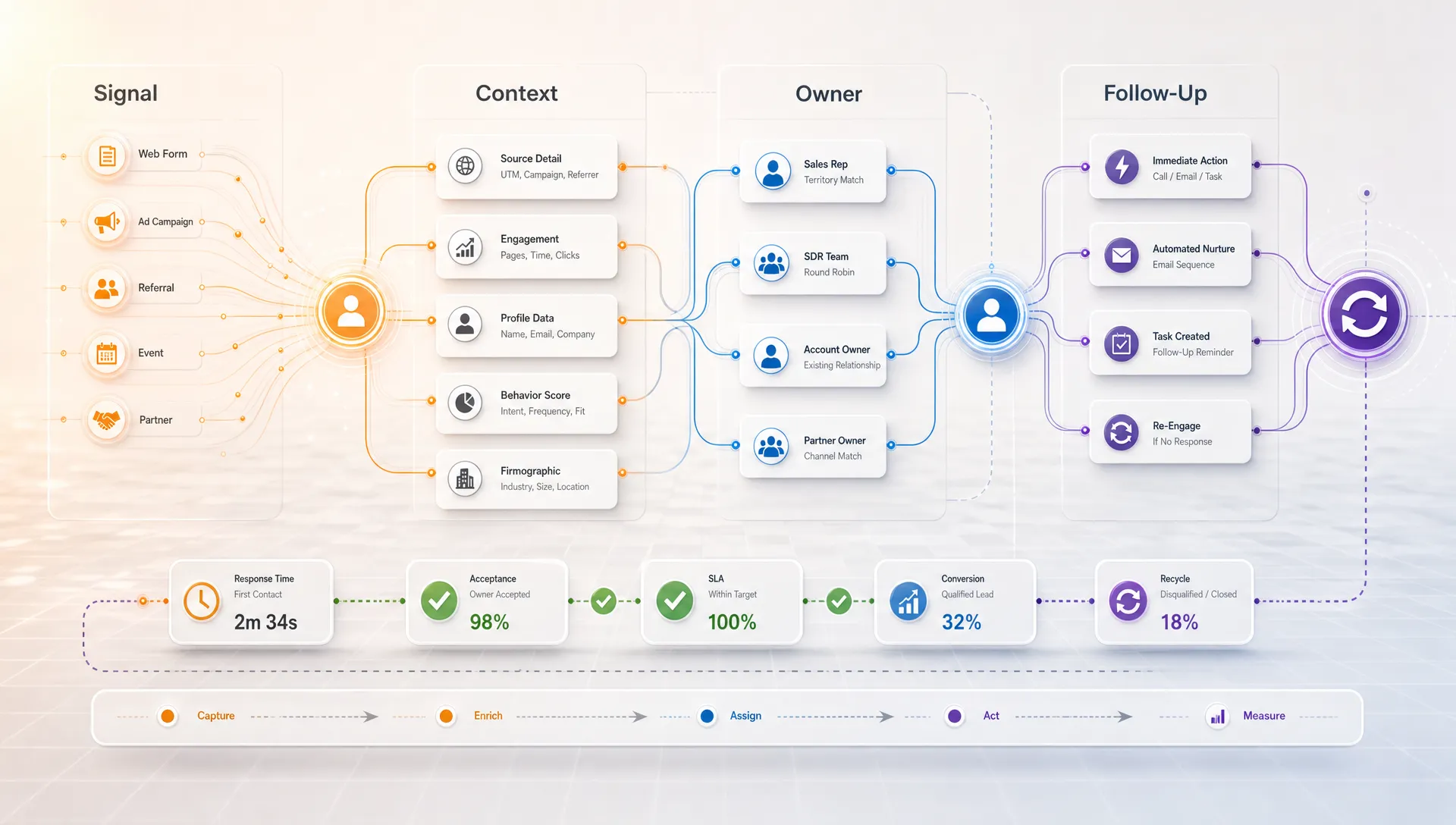
Warm leads are too expensive to let them sit in a CRM stage named “follow up.” By the time someone has downloaded the right asset, replied to a nurture email, asked for pricing, requested a proposal or been referred by a partner, your agency has already paid for the demand in media, content, events, partnerships or founder time.
The problem is rarely that Sales does not care. Warm leads stall because the system around the seller is too loose. A rep sees the lead, opens three tabs, checks notes, asks who owns the account, drafts a custom reply, gets pulled into a client call and comes back two days later to a colder conversation.
Good B2B selling systems remove that drag. They do not replace judgment. They make sure every warm lead has context, ownership, a next step and a timer before it disappears into tool sprawl.
What a B2B selling system really controls
A B2B selling system is not just a CRM pipeline. It is the operating layer that turns buying signals into consistent commercial motion.
At minimum, the system needs to control five things:
- Signal capture: Where the buying signal came from and what it means.
- Lead context: Company fit, role, account history, campaign source and known pain.
- Ownership: The person or team responsible for the next move.
- Next action: The specific outreach, offer, resource, meeting path or nurture track.
- Timing: The service level agreement (SLA) for response, follow-up and escalation.
Without those controls, “warm” becomes a feeling instead of an operational category. One person treats a webinar attendee as urgent. Another ignores a pricing page return visit because no form was submitted. Someone else assumes a referral is already handled because it came through a partner channel.
A real system gives the team shared definitions. It also makes the next move obvious enough that a busy seller can act quickly without rebuilding the entire context from scratch.
Why warm leads stall inside agencies
Agencies are especially vulnerable to warm lead leakage because their selling motion often runs beside client delivery. The same team that needs to respond to a prospect may also be preparing reports, joining client calls, reviewing creative, chasing approvals and troubleshooting campaign issues.
A performance agency serving a defined niche, for example a sports, fitness and wellness growth agency, might see buying intent through ecommerce audits, paid social conversations, SEO requests, CRO diagnostics and founder referrals. The channels differ, but the operational risk is the same: if every signal enters a different workflow, warm leads become scattered work rather than a managed sales lane.
The most common stall points are predictable. A lead enters the CRM with missing context. The wrong owner is assigned. A rep does not know whether to push for a call or send a diagnostic. A proposal goes out with no scheduled follow-up. A “not now” response is treated as closed lost instead of being recycled into a timed nurture path.
If your team is already losing opportunities at the earliest handoff, start by tightening the basics of how you stop losing warm leads at the capture and handoff stage. Once capture is reliable, the bigger win is building the full movement system around it.
Stop sorting warm leads only by source
Many teams route leads based on source: webinar, paid search, referral, LinkedIn, outbound reply or website form. Source matters, but it is not enough. A referral from a poor-fit company should not outrank a target-account visitor who has returned to the pricing page three times and replied to a nurture email.
A stronger B2B selling system sorts by buying temperature, fit and required action.
| Warm lead type | Signal pattern | Best next move | System failure to avoid |
|---|---|---|---|
| Active hand raiser | Demo request, pricing request, direct reply or consultation form | Fast qualification and meeting booking | Treating it like a generic inbound lead |
| Warm evaluator | Multiple high-intent visits, content engagement and repeat account activity | Personalized value-led outreach | Waiting for another form submission |
| Internal champion | Mid-level buyer shares pain or asks for resources | Enablement content and stakeholder mapping | Pushing too hard before consensus exists |
| Partner or founder referral | Introduction from a trusted source | Context-rich reply and clear meeting path | Losing momentum through slow scheduling |
| Reopened account | Past opportunity re-engages or returns to the site | Reference old context and ask what changed | Restarting from zero |
This shift prevents over-reliance on lead source as a proxy for urgency. It also helps the team choose the right commercial move instead of sending the same follow-up sequence to everyone.
The warm lead movement loop
The strongest systems operate as a loop, not a linear sequence. A warm lead might move from evaluation to sales call to nurture to reactivation over several months. The system should keep context alive the whole time.
Capture the signal with usable context
A form fill is not enough. The seller needs to know what triggered the handoff, what the prospect likely cares about and what has already happened.
For agencies, useful context often includes campaign source, industry, company size, role, recent pages viewed, content consumed, previous sales activity and any existing relationship. The goal is not to build a massive research dossier. The goal is to give the owner enough context to make the first response feel relevant.
This is where AI-assisted enrichment can help, provided the rules are clear. AI can summarize notes, classify the likely intent, pull account context and draft a starting point for outreach. A human still decides the commercial angle.
Qualify with fit and intent
Warm does not always mean qualified. A lead can show strong intent and still be a poor fit. Another lead might be quiet but highly strategic because the account matches your ideal client profile.
A simple qualification layer should answer three questions: Is this account worth pursuing, is there a current buying signal and what is the best next conversion step? That conversion step may be a call, an audit, a referral ask, a case study, a stakeholder intro or a future nurture track.
The point is to avoid binary thinking. Not every warm lead should go straight to a sales call, but every warm lead should go somewhere on purpose.
Route based on ownership and response requirements
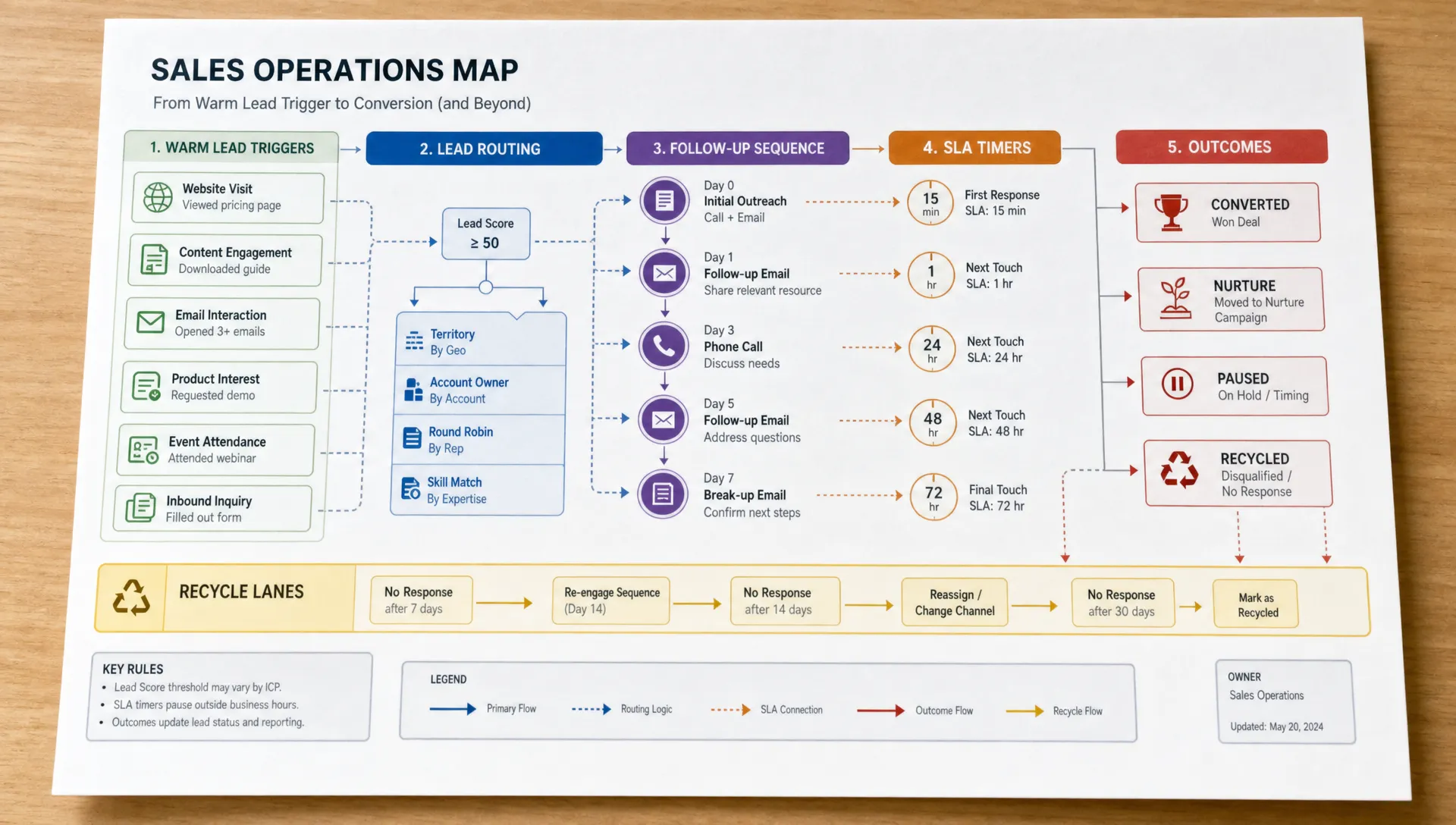
Routing should not depend on who happens to see the notification first. Define the owner by segment, deal size, existing relationship, geography, service line or account status. Then add SLAs for the first action and follow-up windows.
This matters even more when your agency handles multiple sales motions at once: inbound consultations, outbound replies, referral intros, partner leads and reactivation campaigns. A clear routing model prevents the common “I thought you had it” failure.
If your sales motion includes call-based outreach or appointment setting, the principles behind faster lead distribution are similar to the systems used when a B2B telemarketing agency needs to route leads faster: source mapping, rules, priority tiers, SLAs and escalation when a lead sits too long.
Give sales a next-step kit
A warm lead system should not drop a name into the CRM and hope the seller improvises well. It should provide a next-step kit that matches the lead type.
That kit might include a short discovery email, a diagnostic call agenda, a relevant case study, a proposal follow-up template, a “not ready yet” nurture path and a reactivation message for old opportunities. The seller can personalize, but they should not start from a blank page every time.
Where AI belongs in B2B selling systems
AI is most useful where warm leads slow down because people are doing administrative work between decisions. It should reduce the time between signal and action.
For example, AI can summarize a prospect’s journey before the first response, draft follow-up options based on meeting notes, flag leads that have gone stale, classify replies by intent and prepare CRM updates after calls. It can also help build research briefs for target accounts so a seller does not spend 20 minutes gathering basic context before writing a two-paragraph email.
The line to protect is strategic ownership. AI should not decide your positioning, promise outcomes you cannot deliver or invent personalization. It should package the facts, enforce the workflow and make the next human action easier.
This distinction matters for margin. If every warm lead requires manual research, manual routing, manual CRM cleanup and manual follow-up drafting, the sales system becomes another hidden delivery cost. Automation should reclaim that time without making the buyer feel like they are inside a generic sequence.
Metrics that show whether leads are actually moving
Pipeline value alone does not tell you whether the system is working. You need movement metrics. These show whether warm leads are advancing, stalling, recycling or being abandoned.
| Metric | What it tells you | What to review |
|---|---|---|
| Speed to first action | How quickly the team acts after a warm signal | Delays by source, owner or lead type |
| Next-step coverage | Whether every warm lead has a defined action | Leads with no task, meeting, nurture or owner |
| Stale warm leads | How many leads have exceeded the SLA | Bottlenecks in routing or seller capacity |
| Follow-up completion | Whether promised follow-ups actually happen | Missed tasks after calls, proposals and replies |
| Recycle rate | Whether “not now” leads return to nurture | Lost opportunities that should have future timing |
| Meeting-to-opportunity conversion | Whether warm meetings become real pipeline | Lead quality, qualification and sales messaging |
| Sales admin time | How much time sellers spend on non-selling work | Manual research, CRM updates and reporting cleanup |
These metrics should be reviewed weekly, not once per quarter when the pipeline already looks thin. A short weekly review can show where warm leads are getting stuck and whether the issue is lead quality, process design, capacity or sales execution.
A practical build sequence for agencies
Do not start by buying another sales tool. Start by mapping the current path from signal to action. Most agencies already have enough software. What they lack is a connected operating system.
| Build step | Output | Why it matters |
|---|---|---|
| Audit warm lead sources | A list of all places buying signals appear | Prevents leads from hiding in inboxes, forms and Slack |
| Define lead temperature | Clear rules for cold, warm, hot and recycled leads | Gives Sales and Marketing the same language |
| Create routing rules | Owner assignment by segment, service line or account type | Removes confusion when a new lead appears |
| Set SLAs | Time limits for first response, follow-up and escalation | Keeps urgency visible |
| Build next-step assets | Templates, call agendas, nurture paths and handoff notes | Reduces blank-page selling |
| Automate admin | Enrichment, task creation, summaries and stale lead alerts | Frees the team to sell instead of chase data |
| Review movement weekly | A short pipeline operations check | Improves the system before revenue is lost |
The best first automation is usually not the flashiest one. It is often a simple trigger that creates the right task, assigns the right owner, adds the right context and starts the clock. Once that works, you can layer in AI summaries, follow-up drafting, nurture logic and reporting.
Make the system useful for clients too
For B2B marketing agencies, warm lead movement is not only an internal sales problem. It also affects client outcomes. If your agency generates demand for clients but their sales team cannot respond, route, follow up or recycle leads consistently, campaign performance will look worse than it really is.
This is where agencies can create leverage. Instead of handing over leads and hoping the client follows up, you can define the handoff rules, provide lead context, recommend follow-up paths and report on movement after conversion. That makes marketing more accountable to revenue without turning your team into the client’s sales department.
The key is to stay inside the right scope. You can systemize the handoff, automate context, improve reporting and flag stuck leads. The client still owns sales conversations, qualification judgment and closing. Clear boundaries protect your margin and improve the client experience.
Common mistakes to avoid
The first mistake is treating CRM cleanup as the system. Clean fields help, but they do not guarantee movement. A beautiful CRM can still leak revenue if nobody owns the next step.
The second mistake is over-automating the buyer-facing experience before the internal rules are stable. If routing logic is unclear, automation will simply move the wrong leads faster. Fix definitions, ownership and SLAs before scaling workflows.
The third mistake is measuring only lead volume. More warm leads do not help if they create more admin, slower response times and more unresolved follow-up. A better question is: what percentage of warm leads received the right next action within the right window?
The fourth mistake is letting nurture become a graveyard. A recycled lead should have a reason, a message path and a date for re-entry. “Check back later” is not a system unless later is defined.
Frequently Asked Questions
What is a B2B selling system? A B2B selling system is the set of rules, workflows, assets and automations that move prospects from buying signal to next action. It includes capture, qualification, routing, follow-up, nurture and measurement.
How do you keep warm leads from going cold? Give every warm lead an owner, a next step and a deadline. Then use automation to create tasks, enrich context, trigger reminders and escalate stale leads before momentum is lost.
Should all warm leads go to Sales immediately? No. Some should go straight to a meeting path, but others need nurture, education, stakeholder mapping or later reactivation. The system should match the next move to fit and intent.
Where should AI be used in the sales process? AI is best used for enrichment, summaries, task creation, reply classification, follow-up drafting and stale lead alerts. It should support sales judgment rather than replace it.
What should agencies systemize first? Start with the handoff between signal capture and first action. Once routing, ownership and SLAs are reliable, add AI-assisted research, follow-up workflows and reporting.
Keep warm leads moving without adding headcount
Warm lead leakage is an operations problem before it is a sales talent problem. If your agency is paying to create demand, your selling system needs to protect that demand with clear routing, fast follow-up, useful context and disciplined recycling.
Archer Scaling AI installs and runs AI ops systems for B2B marketing agencies that need better delivery margin without another hire. The starting point is the paid Margin Teardown: a roadmap and three automation moves, or it is on me. If warm leads are getting stuck between marketing, sales and delivery, that is usually one of the first places to look.