B2B Copywriting Briefs That Prevent Weak First Drafts
Build B2B copywriting briefs that prevent weak first drafts, reduce revision loops and protect agency delivery margin without extra headcount.

Your writer is not the only reason the first draft is weak. In agencies, weak B2B copywriting drafts often come from missing decisions that get pushed downstream to the person with the blinking cursor.
Then the account lead rewrites, the strategist comments in three directions, the founder jumps in late and the draft becomes a margin leak. A better brief is not admin. It is a delivery control.
A weak draft is usually a brief failure
When a draft misses, the easy move is to blame the writer, the freelancer or the tool that produced the first pass. Sometimes that is fair. More often, the draft did exactly what the brief allowed it to do.
A vague brief gives the writer room to guess on the reader, the offer, the angle, the proof, the claim boundaries and the next step. In B2B copywriting, those guesses are expensive because the copy usually sits inside a longer buying process. A landing page, nurture email, case study, service page or sales enablement piece has to carry a specific part of the conversation.
If the brief only says “write a thought leadership article for CFOs” or “create a landing page for the new service,” the first draft will come back as a generic category piece. The writer had no usable constraints.
For an agency, this is not just a quality problem. It burns senior review time, delays client approvals and turns fixed-scope copy into invisible over-service. The brief should prevent that before production starts.
The brief must separate strategy decisions from writing tasks
A copy brief should not ask the writer to solve strategy from scratch unless strategy is part of the assignment. Most agency delivery teams get into trouble when they mix these two jobs.
Strategy decisions include who the piece is for, what they already believe, what needs to change, what proof is allowed and what action the asset should move them toward. Writing tasks include structure, phrasing, examples, flow and polish.
If the writer has to decide both, the agency has created a hidden strategy sprint inside a copy task. That may be fine for a senior strategist-writer. It is not fine when the work is scoped as production, assigned to a junior copywriter or routed through an AI-assisted draft process.
The clean handoff is simple: the strategist or account owner decides the direction, then the writer turns that direction into a usable draft. If the direction is not ready, the work is not ready for writing.
Start with the job the asset has to do
Every B2B copywriting brief should open with the job of the asset. Not the format. Not the word count. The job.
A service page might need to explain a complex offer clearly enough that a prospect can decide whether to book a call. A nurture email might need to reopen a stalled conversation. A case study might need to give a buyer internal language they can repeat to their team. A comparison page might need to help the reader understand tradeoffs without sounding defensive.
That job changes the draft. The same source material can become five different assets depending on what the piece is supposed to move forward.
This matters even more in agencies that deliver more than one type of work. A shop like Digidatale, a web, SEO and digital marketing agency in La Réunion, may produce web pages, SEO content, identity work and local visibility campaigns, so the brief has to say which job this piece is doing before a writer touches it.
A useful opening line sounds like this: “This page helps a skeptical operations leader understand why the current manual process is costing delivery time and why this service is the safest next step.” That one sentence gives the writer a path.
Give the writer source material, not a pile of tabs
A folder full of call recordings, old decks, client notes and competitor links is not a brief. It is raw material. Someone still has to turn it into direction.
For B2B copywriting, the writer needs a curated set of inputs. That usually includes the client’s offer notes, a few lines of voice-of-customer language, approved proof points, the strongest objections, the current positioning and any claims that cannot be made. If the client is in a regulated or technical category, the brief should also say what needs legal, compliance or subject matter review.
The key word is curated. Do not make the writer infer which sales call matters, which testimonial is approved or which product claim is current. That is how drafts get filled with soft language, safe filler and claims that later get stripped out.
A good source section answers three questions: what must be used, what can be used if helpful and what should be ignored. That last category saves more time than most teams expect because old messaging tends to creep back into new copy.
Put voice into rules a writer can use
“Make it sound premium” is not a voice rule. Neither is “more punchy,” “more strategic” or “less corporate.” Those comments may make sense to the reviewer, but they give the writer almost nothing to apply on the next paragraph.
Voice rules need to be behavioral. For example, “Use direct claims, then prove them with an example” is usable. “Avoid hype words unless they appear in client quotes” is usable. “Prefer short opening sentences, but allow longer explanatory paragraphs when the idea needs it” is usable.
For agency teams, the best voice sections often come from marked-up examples. Take one strong page, email or case study and annotate why it works. Point out the lead, the proof, the sentence length, the level of technical detail and the way the piece asks for action.
This turns voice from personal taste into a reusable production asset. It also helps when multiple people touch the account, which is where consistency usually breaks.
Add examples of what good looks like
A brief gets stronger when it includes examples of the expected output. That does not mean the writer should copy the example. It means they can see the standard.
For a landing page, include a strong section from a previous page and explain what it does well. For an email, include the preferred opening style and the kind of call to action the client accepts. For a long-form article, include the level of specificity expected in the body, especially if the client dislikes broad category commentary.
Examples also help reduce subjective review. Without a reference point, “stronger” can mean clearer, sharper, shorter, more emotional, more technical or more direct. The brief should narrow that before the draft exists.
One useful practice is to include a “do not imitate” example too. If the client hates inflated SaaS language, generic thought leadership or overworked metaphors, show the writer what to avoid. A negative example can save a full revision round.
Use review criteria before anyone writes
Most agencies review copy after it is written. Better teams define the review criteria inside the brief.
The reviewer should know what they are checking for before the draft lands. Is the main risk strategic accuracy, tone, proof, offer clarity, SEO fit, sales usefulness or compliance? If three reviewers are judging three different things without saying so, the writer gets contradictory comments and the account lead becomes the translator.
Separate review roles where you can. The strategist checks direction. The account owner checks client fit. The subject matter reviewer checks accuracy. The copy lead checks structure and language. One person can wear multiple hats, but the hats should still be named.
The same review discipline applies beyond copy. If brand work is where your team loses time, this piece on how B2B branding agencies reduce revision loops covers the same approval problem in a different delivery lane.
Use AI where it removes prep and checking work
If your team has already tried AI tools and abandoned them, the issue was probably not the model. It was the missing operating slot. A blank chat box does not fix a broken brief.
AI is useful when it has a defined job around the brief. It can turn intake transcripts into summarized objections. It can extract repeated customer phrases from sales notes. It can compare a draft against the brief and flag missing proof, unsupported claims or sections that drift from the agreed reader.
It should not be asked to invent strategy the agency has not chosen. That is where generic copy comes from.
For agency delivery, the better pattern is to use AI before and after the writer’s draft. Before writing, it organizes source material and turns messy intake into a structured brief draft for a human to approve. After writing, it checks whether the draft followed the brief. The human still owns judgment, positioning and final voice.
That same principle applies across repetitive agency work. If a human is copying, sorting or checking the same things every week, the task may belong in a system, which is the operating lens behind what B2B marketing teams should never do by hand.
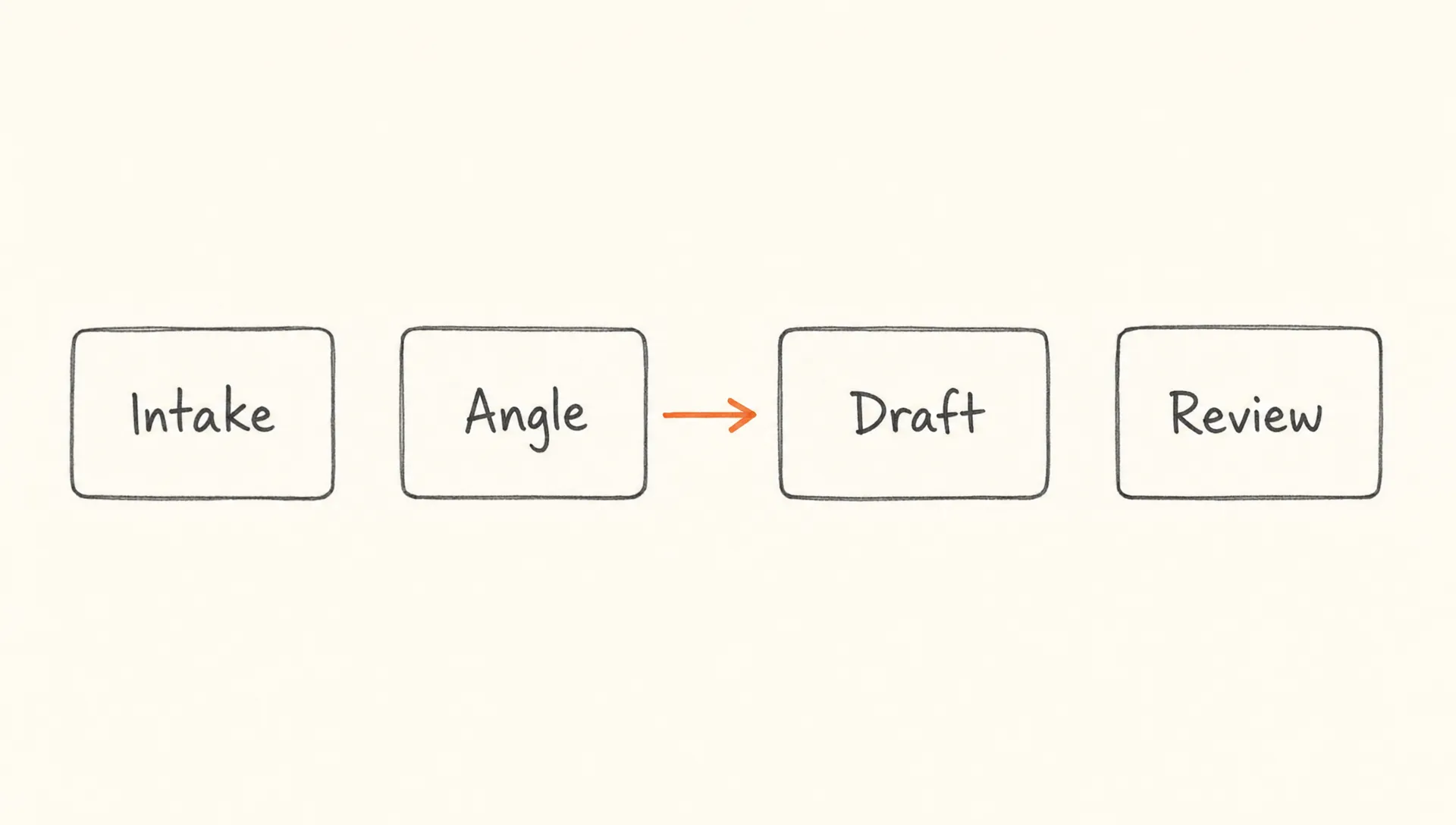
A practical B2B copywriting brief structure
You do not need a long template. You need a template that forces the right decisions before writing starts.
Use the structure below as a working base. Keep it short enough that the team will actually fill it out, but specific enough that a writer can produce a real first draft without guessing.
| Brief field | What it should answer | Margin risk it prevents |
|---|---|---|
| Asset job | What business or delivery purpose does this piece serve? | Drafts that are well written but strategically useless |
| Reader situation | What does the reader already know, believe or misunderstand? | Generic category copy that sounds like every competitor |
| Desired belief shift | What should the reader think differently after reading? | Copy that lists features without changing the conversation |
| Offer or argument | What is the core point the piece must make? | Wandering structure and weak section flow |
| Source material | Which inputs are approved, current and required? | Time lost hunting through calls, decks and notes |
| Proof and claims | What can we prove, and what should we avoid saying? | Risky claims, vague filler and late-stage rewrites |
| Voice rules | What patterns should the writer follow or avoid? | Subjective tone feedback and inconsistent drafts |
| Required sections | What must appear in the asset? | Missing pieces that trigger avoidable revisions |
| Call to action | What next step should the copy support? | Endings that are either too soft or too aggressive |
| Review owners | Who reviews for strategy, accuracy and language? | Conflicting comments and slow approvals |
The most important field is the desired belief shift. If the team cannot fill that in, the asset is not ready. “Educate the market” is too broad. “Help the reader see that their reporting problem is a handoff problem, not a dashboard problem” is useful.
That sentence gives the writer a spine for the draft. It also gives the reviewer something concrete to judge.
Make the brief a delivery checkpoint
A template does not help if everyone treats it as optional. The brief has to become a checkpoint in the delivery process.
That means no first draft starts until the brief is approved by the person who owns direction. Not perfect, not bloated, just approved enough that the writer is not guessing on the major decisions.
For a busy agency, this approval does not need to become another meeting. A five-minute async review can work if the brief is clear. The owner or strategist should be able to scan the reader, asset job, belief shift, proof and review owners, then say yes or fix the missing piece.
The handoff also needs a clean place to live. If the brief is buried in a Slack thread, the writer will miss something and the reviewer will remember a different version. Put the brief where the draft, source material and feedback all connect. The tool matters less than the habit.
Once the first draft is reviewed, update the brief if the feedback reveals a missing rule. Over time, the template becomes an account-specific production asset instead of a blank form the team fills out from scratch.
Weak briefs create hidden hiring pressure
When first drafts keep missing, the agency often assumes it needs a better writer, another account person or a more senior editor. Sometimes it does. But if the brief process is broken, new headcount just absorbs the same confusion at a higher cost.
This is where copy operations affect margin. A weak brief creates extra work in strategy, project management, client service and senior review. None of that extra work looks dramatic on its own. It shows up as late nights, slower delivery, lower utilization and a team that feels busy without moving more client work through the system.
A strong brief does not remove judgment from copywriting. It protects judgment for the places where it matters. Senior people should be shaping strategy and making high-value calls, not rewriting introductions because the writer was never told what the page had to prove.
If your agency is growing and every new retainer adds more internal coordination, better briefs are one of the cheapest places to start systemizing. They sit near the front of production, so they reduce waste across everything that follows.
Frequently asked questions
What should a B2B copywriting brief include? It should include the asset job, reader situation, desired belief shift, core argument, approved source material, proof points, claim limits, voice rules, required sections, call to action and review owners. The goal is to remove strategic guessing before the first draft starts.
Who should write the brief inside an agency? The person who owns direction should own the brief. That might be a strategist, account lead, content lead or founder depending on the account. A writer can help sharpen it, but they should not be forced to invent missing strategy unless that is part of the scoped work.
Can AI create the copy brief for us? It can create a strong first version if it has intake notes, call transcripts, source documents and a clear template. A human still needs to approve the strategy, claims and voice rules before the brief becomes a production input.
How do we know if our briefs are working? Watch the practical signals: fewer clarification messages before drafting, fewer strategic rewrites after the first draft, faster review cycles and less senior time spent fixing basic direction. You do not need a complex dashboard to see whether the first draft is landing closer to the mark.
What to do next this week
Pick one active copy workflow, not the whole agency. Choose the asset type that creates the most rework right now, such as service pages, case studies, landing pages, nurture emails or thought leadership articles.
Then pull the last three briefs and compare them against the structure above. You will probably find the same gaps repeating: no belief shift, unclear proof, vague voice direction or too many reviewers with no defined role.
For the next assignment, force the team to fill in five fields before drafting starts: asset job, reader situation, belief shift, approved proof and review owner. Keep the rest simple. The point is to create a better handoff, not a beautiful document.
After the draft comes back, ask one question in the review: did the brief prevent the problems we usually fix later? If yes, keep the field. If no, rewrite the field until it gives the writer a clearer decision.
Archer Scaling AI installs and runs AI ops systems for marketing agencies, including the internal workflows that turn intake, source material, briefs, drafts and review into a cleaner delivery process. If you want to talk through where copy production is burning hours inside your agency, book a free 30-minute intro call as a conversation about your operations, not a sales call.