What B2B Marketing Teams Should Never Do by Hand
Learn what B2B marketing teams should never do by hand, from onboarding and reporting to CRM follow-up, plus where human judgment still matters.
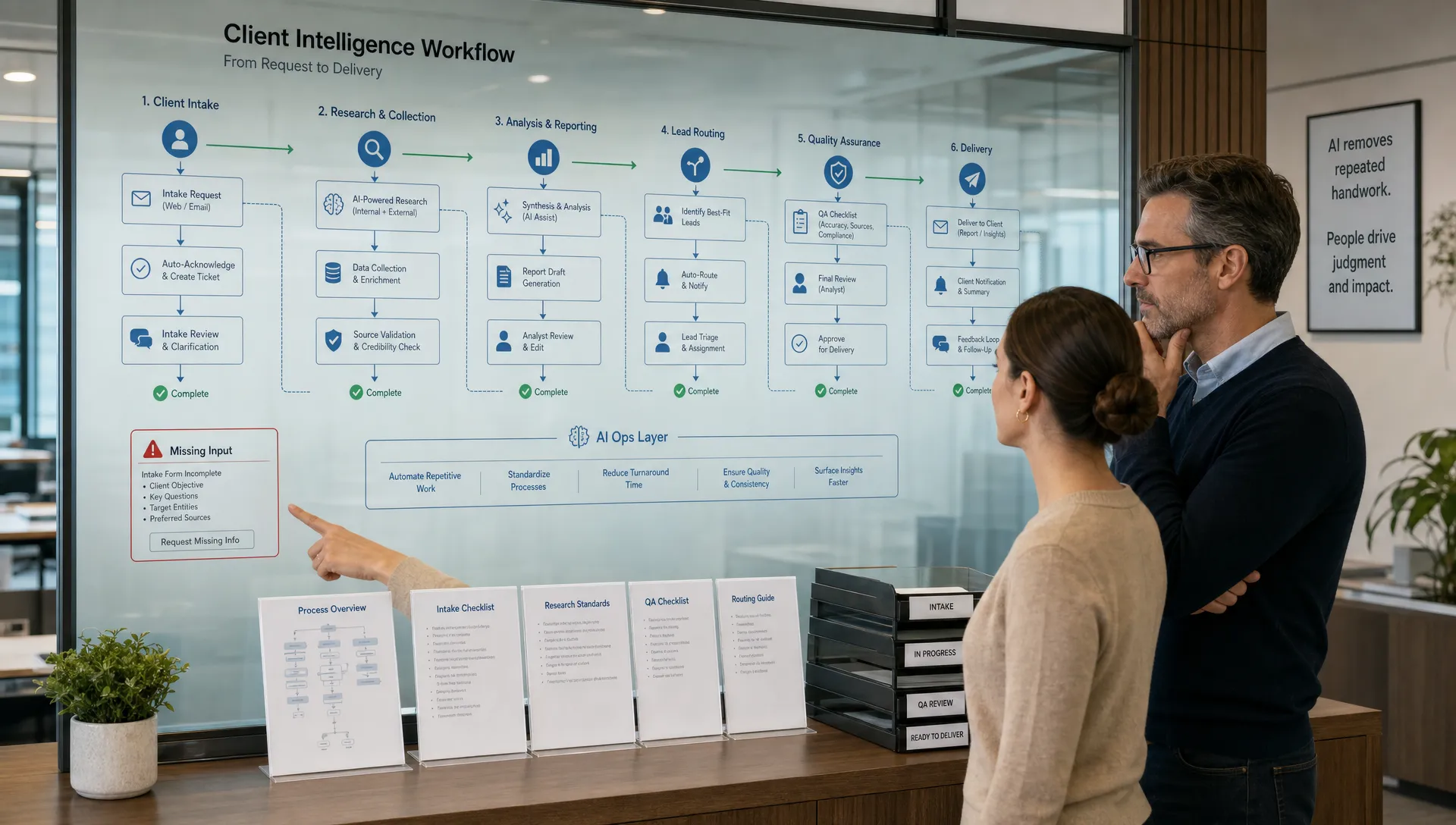
Manual work is not always a problem. In B2B marketing, some of the most valuable work is slow, thoughtful, and deeply human: positioning a complex offer, deciding what a market actually cares about, coaching a client through a hard tradeoff, or spotting the insight no dashboard can surface.
The problem is the other kind of manual work: copying data between tools, rebuilding the same reports, chasing missing intake answers, formatting briefs, routing leads, checking UTM conventions, and reminding people to do work the system should have already triggered.
That work does not make your team more strategic. It quietly eats margin, slows delivery, and trains smart people to become human middleware.
For B2B marketing teams, the question is not, “Can AI do marketing?” A better question is, “Which parts of our operating system should no human be forced to repeat by hand?”
The rule: never do repeatable operational work by hand
A useful automation rule is simple: if the work follows a pattern, depends on structured inputs, moves information between systems, or creates a predictable output, it should not live in someone’s memory or calendar.
That does not mean every workflow should be fully automated. Many should be semi-automated, with AI or software handling the collection, formatting, routing, and first draft while a human reviews the judgment layer.
| Work type | Should it be done by hand? | Better operating model |
|---|---|---|
| Strategic positioning | Often, yes | Human-led, AI-assisted research and synthesis |
| Client intake collection | No | Form-based capture, automated setup, missing-info flags |
| CRM updates and lead routing | No | Rules-based routing, enrichment, alerts, and follow-up triggers |
| Reporting assembly | No | Automated data pulls, templated narratives, human commentary |
| Creative direction | Often, yes | Human-led, supported by structured briefs and asset pipelines |
| QA checklists | No | Automated checks, required approvals, exception alerts |
| Client relationship management | Yes | Human-led, supported by context summaries and next-step prompts |
The highest-performing teams do not remove humans from marketing. They remove unnecessary handwork from the path of the humans doing the marketing.
Client onboarding should never be rebuilt manually
Client onboarding is one of the clearest places where B2B marketing teams lose time for no good reason.
A new client signs. Someone creates a folder. Someone copies a kickoff doc. Someone asks for logins. Someone creates tasks in the project management tool. Someone updates the CRM. Someone forgets which questionnaire version to send. Then the delivery team joins the kickoff without complete context, and the first two weeks become a scavenger hunt.
None of that should be handled from scratch.
A modern onboarding workflow should collect required information once, store it in the right places, create the right internal tasks, notify the right people, and flag missing inputs before they cause delays. The human role is not to assemble the onboarding machine each time. The human role is to interpret the client’s goals, pressure-test the plan, and create confidence.
For agencies, this is especially important because onboarding sets the tone for margin. If every new account requires senior people to manually coordinate the basics, growth creates operational drag instead of leverage.
Good onboarding automation can include intake forms, CRM updates, folder creation, kickoff agenda generation, stakeholder mapping, access-request tracking, and internal handoff summaries. The key is not making onboarding feel robotic. The key is making it reliable, so the client-facing experience feels calmer and more professional.
Research collection should not mean copying tabs into a document
B2B marketing research is essential, but much of the collection process is painfully repetitive.
Teams review competitor pages, customer reviews, sales call notes, LinkedIn posts, analyst summaries, community threads, and client-provided documents. Then someone copies snippets into a doc, rewrites obvious themes, and tries to remember which source supported which claim.
That is not strategy. That is manual extraction.
AI is well-suited to first-pass research operations when the workflow has guardrails. It can cluster voice-of-customer themes, summarize sales call transcripts, tag objections, compare competitor messaging, extract claims from source material, and build a structured research brief for a strategist to review.
The strategist still needs to decide what matters. AI can find that prospects repeatedly mention implementation risk, but a human should decide whether that becomes the central campaign angle, a sales enablement asset, a landing page section, or a client workshop topic.
If your team is still doing repetitive research collection manually, start by separating research operations from research judgment. The operations layer can be systematized. The judgment layer should stay with experienced marketers. For a deeper breakdown of specific examples, see these research marketing workflows you can automate now.
CRM hygiene and lead follow-up should never depend on memory
Warm leads are too valuable to be managed by “I think someone followed up.”
In B2B marketing, a lead can come from a demo request, webinar attendance, content syndication, outbound reply, partner referral, paid search form, event scan, or a hand-raised comment on LinkedIn. Each source carries different context, urgency, and routing logic.
When follow-up depends on a person noticing the lead, assigning the owner, checking the CRM, and writing the first response manually, opportunities leak. Even worse, teams often discover the leak only after pipeline has already gone cold.
Lead routing and follow-up should be system-driven. A good workflow can identify the lead source, match it to the right owner, enrich the account where appropriate, summarize available context, trigger a first-touch task, and escalate if nobody responds within the agreed window.
The human still matters. A sales or marketing lead should personalize the conversation, interpret account fit, and decide the next commercial move. But the system should make sure the lead is never invisible.
This is also where marketing and sales alignment becomes operational rather than aspirational. Service-level agreements are easy to write and hard to enforce manually. Automated routing, reminders, and exception reporting make the agreement real.
Reporting assembly should not consume strategist hours
Reporting is one of the most common traps in B2B marketing operations.
Clients and executives need visibility. They want to know what happened, what changed, what it means, and what the team recommends next. That part is valuable. But the assembly work around reporting is often wasteful: exporting data, taking screenshots, pasting charts, checking date ranges, rebuilding tables, and formatting slides.
No strategist should spend their best hours assembling the same dashboard by hand every month.
Reporting systems should pull recurring data from the right sources, populate consistent templates, surface anomalies, and prepare a draft narrative that a human can edit. The final commentary should come from someone who understands the account, the campaign, the market, and the client’s goals.
This distinction matters. Automated reporting without human interpretation becomes noise. Manual reporting without automation becomes margin erosion. The better model is automated assembly plus human analysis.
For agencies, white-label reporting is also a client experience issue. A clean, consistent reporting process makes the agency feel more organized. It reduces internal scramble before client calls and gives account leads more time to prepare recommendations instead of chasing numbers.
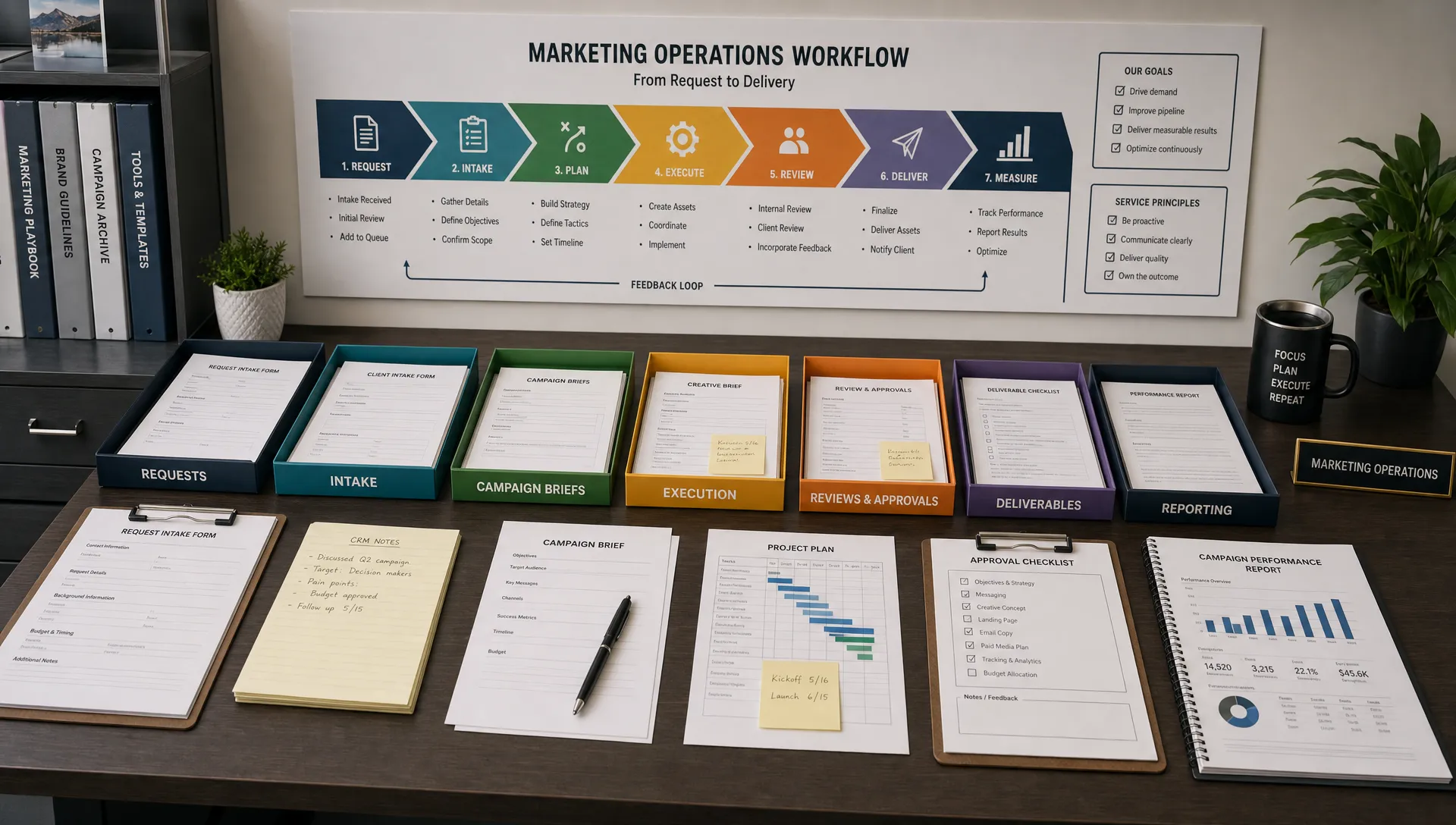
Content operations should not rely on ad hoc handoffs
Content quality depends on strategy, expertise, and taste. Content operations depend on process.
Too many B2B marketing teams blur those two things. They treat every asset as a fresh operational project, even when the workflow is predictable: brief, outline, draft, subject matter expert review, edit, design, compliance check, publish, distribute, repurpose, report.
The creative thinking should be flexible. The operational path should not be improvised every time.
Manual content operations create familiar problems. Briefs arrive incomplete. Reviewers do not know what kind of feedback is needed. Designers receive copy without asset specs. Distribution is remembered after publishing. Repurposing never happens because nobody owns it. Performance data is reviewed too late to inform the next piece.
A better system creates structured briefs, assigns workflow stages, routes approvals, generates derivative asset requests, checks required metadata, and reminds owners when work is stuck. AI can also support first drafts, repurposing, summary generation, and message variation, as long as human editors own the final quality bar.
This is especially important in B2B because content often supports a long buying journey. A single webinar might become a sales follow-up email, a blog post, a LinkedIn carousel, a nurture sequence, a one-page brief, and a set of objection-handling snippets. If repurposing depends on someone remembering to do it, it will be inconsistent.
QA checklists should not live in someone’s head
Manual QA feels responsible until you realize how much of it depends on memory.
Before a campaign goes live, someone needs to check links, forms, tracking, naming conventions, audience rules, suppression lists, budget settings, UTMs, legal requirements, brand rules, and client approvals. In many teams, this happens through a mixture of Slack messages, personal checklists, and last-minute panic.
That is a fragile way to protect quality.
B2B marketing teams should turn recurring QA into structured checklists, automated validations, and required approval gates. The system should catch missing fields, broken links, inconsistent naming, incomplete approvals, and skipped steps. Humans should investigate exceptions and make judgment calls.
This principle is not unique to marketing. Operations-heavy industries learned long ago that checklists and logs should be systematized, not left to memory. For example, drone operators use drone operations management and flight planning software to centralize planning, checklists, risk assessments, and flight logs because administrative consistency directly affects safety and productivity. Marketing may not carry the same physical risk, but the operational lesson still applies: repeatable checks belong in a system.
For B2B teams, QA automation protects both performance and trust. A broken demo-request form or misrouted high-intent lead can cost far more than the time it would have taken to build the right workflow.
Internal status updates should not require meetings
Many teams use meetings to compensate for weak systems.
If people need a recurring call just to find out what changed, what is blocked, who owns the next step, or whether the client sent feedback, the operation is under-instrumented. Status should be visible before the meeting begins.
This does not mean eliminating collaboration. It means reserving meetings for decisions, tradeoffs, creative debate, and client strategy. Basic status should be automated through task updates, workflow triggers, notifications, and summaries.
A useful operating system can answer questions like these without requiring a meeting:
- Which deliverables are blocked?
- Which client inputs are missing?
- Which leads have not been followed up with?
- Which reports are ready for review?
- Which approvals are overdue?
- Which campaigns changed status this week?
When status is automated, managers stop acting as traffic controllers. They can coach, prioritize, and improve the system instead of constantly asking for updates.
What B2B marketing teams should keep human
The goal is not to automate everything. That is how teams create bland content, awkward client experiences, and workflows nobody trusts.
The work that should stay human usually involves ambiguity, empathy, accountability, or taste. Humans should own positioning, messaging decisions, strategic prioritization, client conversations, final creative judgment, ethical calls, and the interpretation of performance in context.
A useful test is this: if the work requires understanding what a client means but did not say, keep a human close to it. If the work requires moving information from one place to another, producing a standard first draft, checking a known rule, or triggering the next step, do not do it by hand.
That is the real promise of AI operations in B2B marketing. It does not replace expertise. It creates more space for expertise by removing the repetitive work surrounding it.
How to decide what to stop doing by hand first
Do not start with the flashiest AI use case. Start where manual work is frequent, painful, and tied to margin or revenue.
The best first automation candidate usually has five traits: it happens often, follows a repeatable pattern, involves multiple tools or handoffs, creates delays when missed, and has a clear success metric.
Client onboarding, reporting, lead routing, research synthesis, and QA are strong candidates because they meet those criteria. They are not glamorous, but they compound. Every hour removed from these workflows gives time back to account leads, strategists, operators, and creatives.
If you need a practical prioritization model, this guide on what a marketing agency should automate first explains why operational workflows usually beat flashy content generation as the starting point.
The mistake is treating automation as a collection of disconnected hacks. A few helpful zaps can save time, but they do not create a durable operating model. B2B marketing teams need workflows, documentation, ownership, quality control, and a system for improving the automations after they go live.
That is why the “AI ops layer” matters. It sits between your strategy, tools, team, and delivery process so automation becomes part of how work moves, not a side project that breaks when one person leaves. If your team is still stitching together tasks manually across too many tools, it may be time to understand why marketing departments need an AI ops layer.
A simple audit for manual work
To find what your team should stop doing by hand, review one recent client, campaign, or reporting cycle from start to finish. Do not start with tools. Start with the work.
Look for moments where people copied information, waited for approvals, retyped data, rebuilt a document, asked for the same input twice, chased status, checked something from memory, or created a deliverable from a template manually.
Then ask three questions:
- Could this step be triggered automatically by an event?
- Could the required information be captured once and reused?
- Could AI or software create a first draft, checklist, summary, or alert for human review?
If the answer is yes, that workflow is a candidate for automation.
The biggest wins are rarely hidden. They are usually the annoying tasks everyone has normalized because “that’s just how we do it.”
Frequently Asked Questions
What should B2B marketing teams automate first? Start with workflows that happen often and create delivery drag, such as client onboarding, reporting assembly, CRM updates, lead routing, research synthesis, and QA checklists. These areas usually produce faster operational gains than experimenting with AI content generation alone.
Should AI write all B2B marketing content? No. AI can help with briefs, outlines, repurposing, summaries, and first drafts, but subject matter expertise, positioning, tone, and final editorial judgment should stay human. The best use of AI is to support the content system, not replace strategic thinking.
Is manual QA safer than automated QA? Not for repeatable checks. Humans are essential for judgment calls, but automated checklists and validations are better for catching known issues consistently, such as missing UTMs, broken links, incomplete approvals, or skipped campaign steps.
How do you automate without making the client experience feel robotic? Automate the invisible operations behind the experience: setup, routing, reminders, summaries, reporting assembly, and QA. Keep human attention on communication, strategy, recommendations, and relationship management.
Stop paying smart people to do middleware work
If your B2B marketing team is growing but delivery still depends on manual coordination, the constraint is probably not talent. It is the operating system around the talent.
Archer Scaling AI installs and runs AI-powered operations systems for B2B marketing agencies, starting with a paid Margin Teardown that identifies the roadmap and three automation moves. If the work is repetitive, margin-sensitive, and slowing delivery, it should not stay trapped in someone’s calendar, inbox, or memory.
To see where manual work is costing your agency margin, start with Archer Scaling AI and get a clearer path from hand-built delivery to a managed AI ops layer.