Agency Scaling Exposes the Handoffs You Never Documented
Agency scaling exposes hidden handoffs. Learn how to document, automate and protect delivery margin before hiring around broken ops.

Agency scaling rarely breaks at the visible parts of delivery. It breaks in the handoffs your best people have been carrying in their heads, the quiet transfers between sales, strategy, production, QA, reporting and follow-up.
At $50K to $500K a month, you can still survive on memory if the team is small and the owner is close to every account. Add more clients, more specialists, more retainers or more service lines and the same informal habits start creating rework. Nobody means to drop context. The operating system just depends on people being available at the exact moment someone else needs an answer.
Agency scaling turns informal memory into a margin problem
The first warning sign is usually not missed deadlines. It is extra coordination. A strategist asks sales to confirm what was promised. A media buyer rebuilds context from old notes. A designer waits for a brief that exists partly in Slack and partly in someone’s head. A client success lead rewrites the same explanation for the third month in a row.
None of those moments look expensive by themselves. Together, they eat the gap between the retainer and the actual labor required to deliver it.
When agency scaling starts to strain delivery, the handoff becomes the unit to inspect. Not the department. Not the tool stack. The handoff. Work moves from one person to another, and that is where context gets lost, assumptions sneak in and scope gets quietly redefined.
A documented handoff does not need to be a giant SOP. It needs to answer a simple question: what does the next person need in order to move without asking for tribal knowledge?
The handoffs that hurt are usually boring
The painful handoffs are rarely dramatic. They are the everyday transfers that happen so often the team stops seeing them.
Sales hands a new account to delivery. Intake hands research to strategy. Strategy hands direction to production. Production hands assets to QA. QA hands comments back to production. Reporting hands decisions back to the account lead. The account lead hands renewal risks back to the owner.
During agency scaling, those ordinary handoffs carry more weight because each one repeats across more accounts. A vague brief that used to waste 20 minutes now wastes an afternoon across the team. A missing approval owner that used to be annoying now delays a client launch. A report that does not say what needs attention now creates another meeting.
The trap is treating this as a people problem too early. Sometimes you do need a stronger operator, account lead or specialist. But if the same confusion appears across multiple capable people, the system is asking individuals to compensate for missing structure.
If you want a deeper way to see the full path from sale to delivery, this agency handoff map gives you a practical frame for spotting where work starts drifting.
Find the undocumented handoff before you automate it
The useful starting point for agency scaling is not a new tool. It is a repeated moment where someone has to stop, interpret, chase, rewrite or rebuild context before doing the actual client work.
Look for the phrase “I just need to check with...” inside your agency. That sentence often points to a missing handoff. It may be a legitimate decision, but it may also mean the next person does not know the promise, the owner, the deadline, the client preference or the definition of done.
Start by choosing one workflow that happens every week. Client onboarding is a common one because it touches sales, account management, strategy, research, access requests and the first deliverable. Reporting is another because it forces the team to collect facts, interpret performance, explain next steps and route decisions.
Do not document everything. Document the handoff where margin is leaking now.
| Handoff | Common failure | What to capture |
|---|---|---|
| Sales to delivery | Promises are unclear | Scope, exclusions, urgency, decision makers and risks |
| Intake to strategy | Research is scattered | Client inputs, access status, market notes and open questions |
| Strategy to production | Direction is too vague | Audience, offer, examples, constraints and approval path |
| Production to QA | Review is subjective | Checklist, client standards, source files and known issues |
| Reporting to account lead | Data does not drive action | What changed, why it matters and what needs a decision |
What documentation actually needs to say
Most agencies overbuild documentation once they finally decide to write things down. They create long SOPs nobody reads, then wonder why the team keeps asking the same questions.
A useful handoff document is shorter and sharper. It tells the next person what changed hands, what good looks like and where judgment is still required. The goal is not to remove thinking from the work. The goal is to remove detective work from the work.
A good handoff has five parts: trigger, owner, inputs, standard and exception path. The trigger says when the handoff happens. The owner says who is accountable for sending it. Inputs define what must be included before the next person starts. The standard defines what “ready” means. The exception path tells the team what to do when something is missing.
In agency scaling, that level of clarity protects senior people from becoming the help desk for every unclear transfer. It also makes junior hires more useful because they are not forced to infer how the agency operates from scattered examples.
If your team keeps saying the workflows are too manual, start with one repeated handoff rather than trying to redesign the whole agency. This piece on where to start with manual workflows matches that approach.
AI helps when the handoff already has a job
AI is useful in agency operations when the handoff has a defined job. It can summarize intake notes, extract missing fields, draft a production brief, compare work against a QA checklist, flag report sections that need commentary or turn a client call transcript into follow-up tasks.
It performs poorly when you ask it to guess the agency’s operating model from messy inputs. If the brief is unclear, the generated draft may look polished but still be wrong. If the reporting standard is vague, the summary may be fluent but not useful. If nobody owns the approval path, automation only moves confusion faster.
That is why agency scaling should pair automation with handoff design. First decide what context must move. Then decide which parts can be drafted, checked, routed or summarized by software. The human still owns judgment, client nuance and final decisions. The system carries the repeatable load.
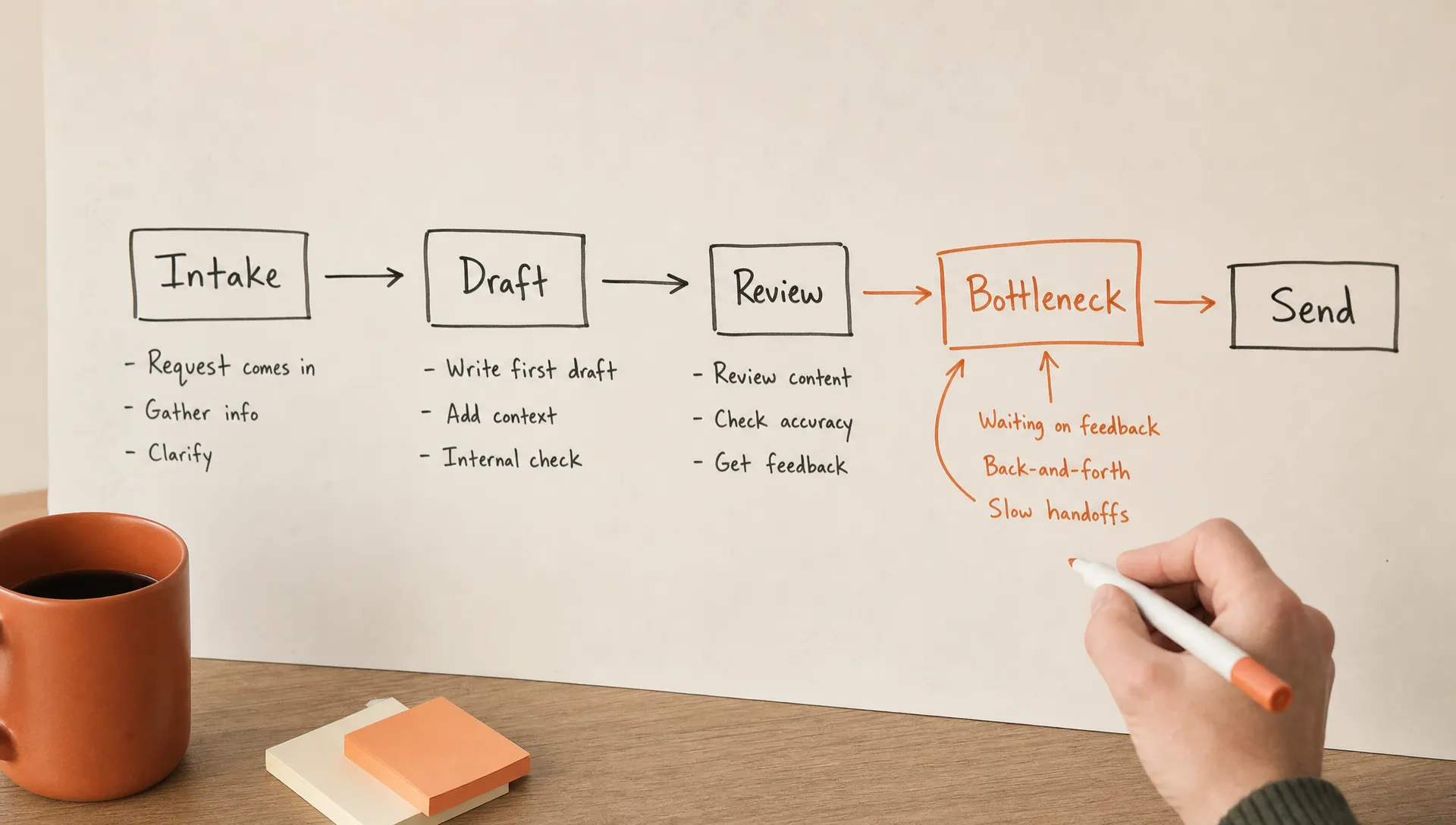
A simple test: can a stranger pick up the work?
Here is a practical test for any handoff: could a competent person who was not in the last meeting pick up the next task and move it forward without interrupting the team?
This does not mean they can make every strategic call. It means they can understand the account, the request, the constraints, the expected output and the open questions. If they cannot, the handoff is not ready.
Take a local or franchise marketing agency as an example. If the client is a manufactured home dealer in San Antonio, the next person needs more than “build campaign assets.” They need to know which home models are being promoted, what financing language has been approved, which locations matter, which audiences are being served and what the client has already promised buyers.
For content, SEO, paid media, creative or PR teams, the same rule applies. A handoff should carry the context that shapes the work, not just the task name. Agency scaling exposes the difference quickly because more people touch the work and fewer people have the full story in their head.
Do not hire around missing handoffs too early
Hiring can hide a handoff problem for a while. A new coordinator can chase missing assets. A new account manager can sit in more meetings. A junior specialist can clean up half-finished briefs. The agency feels relief because the owner is no longer doing all of that work.
But if the workflow stays unclear, the new hire becomes the place where confusion collects. They spend their time asking for updates, translating vague requests and patching holes between teams. That may increase capacity on paper while reducing margin in practice.
Before adding headcount, inspect the handoffs that would land on the new person’s desk. If the role exists mainly to move context between people who do not have a shared process, you may be hiring a human router.
If agency scaling keeps pushing you toward another hire, run a handoff review first. This article on why marketing firm hiring plans need a handoff review goes deeper on that decision point.
The operating cadence keeps handoffs from going stale
A handoff is not finished when it is documented once. Agencies change too often for that. Offers shift, retainers evolve, client expectations change, platforms update, team members move into new roles and service lines get packaged differently.
The cadence can be simple. Once a week, review one workflow where work stalled, rework happened or someone had to chase context. Ask where the handoff failed. Was the input missing? Was the owner unclear? Was the standard outdated? Was the exception path ignored?
This is not a long meeting if you keep it grounded in real work. Pick one account example. Fix one handoff. Update one template, checklist, intake form or routing rule.
Agency scaling gets easier when the operating system changes at the same pace as delivery. The agencies that struggle most are not always the ones with weak talent. They are often the ones asking strong people to work inside stale handoffs.
Frequently asked questions
What is the biggest operations risk in agency scaling? The biggest risk is assuming the way work moved at a smaller size will still work with more clients and more people. The hidden cost is usually context loss between roles, which turns into rework, delays and margin pressure.
Which handoff should an agency document first? Start with the handoff that repeats often and creates the most interruption. For many agencies, that is sales to delivery, onboarding to strategy or reporting to account management.
Can AI fix undocumented agency workflows? AI can help draft, summarize, check and route work, but it needs a clear operating rule to follow. If nobody has defined the owner, input, standard or exception path, the tool will only process messy work faster.
How much documentation is enough? Enough documentation lets the next competent person move forward without chasing basic context. If your SOP is long but people still interrupt each other for the same missing details, it is not doing the job.
What to do this week
Pick one active client account and trace one workflow from start to finish. Do not start with your org chart. Start with the work. Where did the request begin? Who touched it? What did each person need? Where did someone wait, ask, rewrite or guess?
Write down the handoff that caused the most friction. Then define the trigger, owner, inputs, standard and exception path. Keep it short enough that the team will actually use it next week. If a tool can draft, route, summarize or check part of that handoff, add it after the handoff is clear.
Treat agency scaling as a pressure test on your operating system. The point is not to document for the sake of neatness. The point is to stop paying skilled people to rebuild context that should travel with the work.
If you want outside help, Archer Scaling AI installs and runs AI ops systems for marketing agencies. For a conversation about where your operations are getting stuck, you can book a free 30-minute intro call.