A Marketing Monthly Report Should Cut Status-Meeting Time
A marketing monthly report should reduce status calls. Learn the report structure, workflow and AI handoffs that protect agency delivery time.

Your team should not spend report week building a deck that only becomes the script for another long status call. If the next client meeting repeats the same explanations, the report did not carry enough weight.
For an agency owner or delivery lead, a marketing monthly report should remove low-value meeting time. The call can then focus on decisions, risks, approvals and the few places where human judgment actually matters.
A monthly report has one job: reduce uncertainty before the call
A client status meeting gets long when nobody is sure what has changed, what matters or what happens next. That uncertainty shows up as live explanations, metric debates, screen sharing, side questions and follow-up emails.
The report should answer four questions before anyone joins the call:
- What changed since the last report?
- Why did it change?
- What is the agency doing about it?
- What decision or input is needed from the client?
If the report handles those questions clearly, the meeting shifts from “walk me through the numbers” to “let’s agree on the next move.” That is where your senior people should spend time.
This matters because status meetings are rarely just one person’s calendar problem. An account lead prepares the agenda. A specialist joins to explain the channel. A strategist may sit in for context. Then someone updates tasks afterward. A vague report burns hours across the delivery team.
Status meetings expand when the report is built like a scrapbook
Many agency reports are really archives. They collect screenshots, exports, activity notes and charts from every service line. The client sees effort, but not always meaning.
That kind of report creates more questions because it leaves the interpretation to the meeting. A client sees a chart move up or down and asks whether that is good. The account lead answers from memory. The specialist adds caveats. The next step gets discussed live. Ten minutes disappear on one slide.
You can spot this pattern in a few places:
- The same metric is explained differently by different team members.
- The client asks basic status questions that should have been answered in the report.
- The account lead has to translate channel details into business implications during the call.
- The report lists completed work but does not say what changes next.
- The meeting ends with action items that were already knowable before the meeting.
If reporting itself has become a recurring delivery drag, fix the mechanics first. Standard metric definitions, cleaner handoffs and QA gates usually matter more than a nicer deck, which is why I like starting with the actual causes of marketing agency reporting bottlenecks before adding more tools.
Build the report around decisions, not departments
A report organized by department reflects your internal structure. A report organized by decisions reflects the client’s reality.
The client usually does not care whether the insight came from paid media, SEO, creative, PR or lifecycle. They care whether the current plan is working, what needs attention and what they need to approve.
That does not mean you hide channel detail. It means the top of the report should make the situation easy to understand before the client gets into the detail.
| Report section | Question it answers | Meeting time it removes |
|---|---|---|
| Executive summary | Are we on track, off track or watching something? | Live recap of the whole account |
| Exceptions and changes | What moved enough to matter? | Slide-by-slide metric explanation |
| Agency actions | What are we doing next based on the data? | Open-ended “what do you recommend?” discussion |
| Client decisions | What approval, asset, access or input do we need? | Follow-up emails after the meeting |
| Risks and blockers | What could slow delivery or change the plan? | Surprise escalation later in the month |
A good first page often does more to reduce meeting time than twenty polished slides. It gives the client a clear read on the month and tells them exactly where to look if they want detail.
Separate facts, interpretation and action
A useful marketing monthly report has three layers.
The first layer is facts. These are the numbers, dates, deliverables, campaign changes, content shipped, links earned, creative tested, reviews managed, locations updated or placements secured. The exact facts depend on the agency type, but they should be sourced and checked.
The second layer is interpretation. This is where the team explains what the facts mean. A drop in one metric may be fine if it came from a planned budget shift. A spike may be less exciting if it came from a one-time promotion. Interpretation keeps the client from treating every chart movement as a crisis.
The third layer is action. This is the part many reports underbuild. If something changed, what will the agency do next? If nothing material changed, what stays the same? If the client is blocking progress, what decision is needed?
Keep those layers distinct. When a report mixes raw numbers, opinion and next steps into one paragraph, the meeting becomes the place where everyone untangles it.
AI can help here when the inputs are clean. It can compare current performance against prior periods, flag unusual changes, draft variance notes from structured campaign logs and turn specialist notes into a cleaner first draft. It should not invent the reason a metric moved. Your team still needs to approve the interpretation before the client sees it.
The report should tell the client where to look
Clients do not read reports like agency teams build them. Your team may move left to right through every chart. The client scans for risk, progress and anything that requires their attention.
Design the report for scanning. Use plain labels like “watch,” “action needed” and “decision required.” Put the most important sentence above the chart, not below it. If the client only reads the first page and the call agenda, they should still understand the month.
Different agency types need different signals, but the same rule applies: point attention where a decision may change.
| Agency type | The report should clarify | Common meeting it prevents |
|---|---|---|
| Paid media and performance | Budget changes, creative fatigue, conversion shifts and test outcomes | A long channel-by-channel walkthrough |
| Ecommerce and DTC growth | Revenue drivers, promo effects, merchandising notes and retention signals | Debates over isolated campaign numbers |
| Content and SEO | Priority pages, technical blockers, published work and ranking or traffic movement | Re-explaining why SEO work compounds over time |
| Social and creative | Content shipped, approval delays, audience response and next creative angles | Reviewing every post one by one |
| PR and communications | Coverage quality, message pull-through, journalist response and upcoming angles | Treating all mentions as equal |
| Local or franchise marketing | Location variance, listing issues, review themes and market-level blockers | One meeting becoming twenty location updates |
For agencies that now report on how brands appear inside generative search results, it helps to treat that work as a monitored visibility layer instead of a loose “we checked ChatGPT” note. A platform like CapstonAI for AI visibility scans and citation tracking can give teams a cleaner way to show where a brand appears, where it is missing and what content needs to be made easier for answer engines to read.
Pre-read discipline is part of the reporting system
A report cannot cut meeting time if it arrives five minutes before the call. The client needs enough time to read it, and your team needs a meeting format that rewards pre-reading.
The agenda should assume the report has done its job. Start with questions on the report, then move to decisions, risks and next steps. If the client has not read it, resist turning the meeting into a full presentation by default. Summarize the first page, then go straight to the items that need input.
That sounds small, but it changes the behavior on both sides. Clients learn that the report is where status lives. Meetings become where decisions happen.
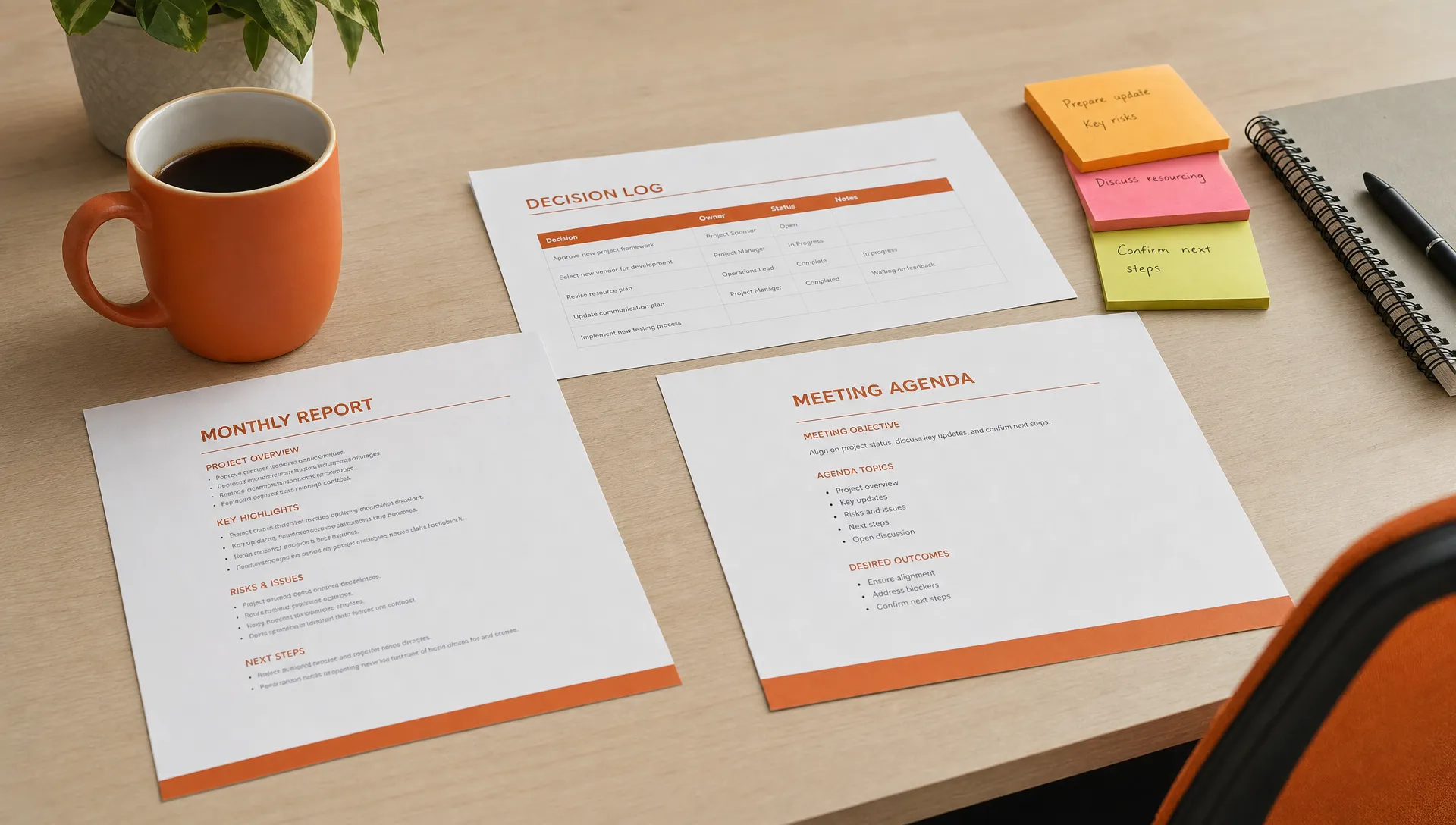
A simple agenda can look like this:
| Time block | Focus | Owner |
|---|---|---|
| First 5 minutes | Questions on the written summary | Account lead |
| Next 10 minutes | Exceptions, risks and material changes | Channel owner or strategist |
| Next 10 minutes | Decisions needed from the client | Account lead |
| Final 5 minutes | Confirm actions, owners and dates | Account lead |
The exact timing can flex, but the principle should hold. Do not use senior delivery time to narrate information that should have been written down.
Automation belongs in the boring parts first
The best place to use AI and automation in reporting is usually the work your team repeats every month with low judgment and high annoyance.
That includes pulling data from source systems, checking naming conventions, comparing current results against prior periods, flagging missing screenshots, summarizing task activity, drafting the first version of recurring commentary and updating an action log after the meeting.
The wrong place to start is the final recommendation. If the system does not understand the client context, scope, constraints, seasonality and recent approvals, it can write something that sounds confident and wastes trust.
A safer reporting workflow looks like this: automation prepares the inputs, AI drafts structured notes from approved context, the specialist reviews meaning, the account lead turns it into client language and the delivery lead checks whether the next steps fit scope and capacity.
If you are deciding where this fits with the rest of your agency operations, the same logic applies beyond reporting: start with repeatable delivery work before chasing flashy tools. This breakdown of what marketing work agencies should automate first covers that order in more detail.
The internal workflow matters as much as the client deck
A report that cuts meeting time usually has a boring internal workflow behind it. Boring is good. Boring means fewer heroics at the end of the month.
The workflow needs clear ownership. One person should own the report package. Specialists should own their channel notes. Someone should own data QA. Someone should own the decision log. If everyone owns the report, the account lead usually ends up chasing everyone.
The handoff should also happen before the deadline. A common failure mode is asking specialists for commentary after the report is already assembled. That creates rushed explanations, vague recommendations and last-minute edits.
A cleaner sequence is data first, variance notes second, narrative third, QA fourth, client-ready summary last. The summary should be written after the team knows what mattered, not before.
You do not need a huge operating manual for this. A short reporting SOP can define the source of truth, naming rules, due dates, required commentary format, QA checklist and escalation path when data is missing. That is enough to remove a lot of monthly friction.
Measure whether the report is actually reducing meeting time
Do not judge the report by how polished it looks. Judge it by what happens after it goes out.
Track a few practical signals for the next two or three reporting cycles. How many minutes of the meeting are spent re-explaining the report? How many corrections happen live? How many follow-up emails ask for information that should have been included? How many decisions are made during the call? How many hours did the team spend preparing the report?
You are looking for a specific pattern: less narration, fewer surprises and more decisions. If the meeting is still mostly status, the report is missing context, clarity or pre-read discipline.
Also watch the hidden cost. A report can reduce client meeting time while increasing internal prep time. That is not a win for delivery margin. The goal is a reporting process that is faster to prepare and clearer to consume.
A simple marketing monthly report template your team can use
If your current report is bloated, do not rebuild everything at once. Start with a front section that changes the meeting.
| Section | What to include | Keep it short by asking |
|---|---|---|
| Monthly summary | The main read on the account in plain English | What would the client need to know if they only read one page? |
| Scorecard | A small set of agreed metrics with status labels | Which numbers actually affect decisions? |
| Meaningful changes | Only the changes that require attention or explain the month | Would we discuss this live if it were not in the report? |
| Work completed | Deliverables tied to outcomes, learning or setup for future work | Why did this work matter? |
| Next month plan | The few moves the team will make next | What changes because of this report? |
| Client decisions | Approvals, assets, access, feedback or tradeoffs needed | What could block progress if ignored? |
This template works because it forces the report to earn its place in the meeting. Anything that does not answer a question, explain a change or drive an action can move to an appendix or disappear.
Frequently asked questions
What should a marketing monthly report include? It should include a plain-English summary, agreed metrics, meaningful changes, work completed, next steps, risks and client decisions needed. The exact metrics depend on the agency service, but the structure should make the next action clear.
How does a monthly report reduce status-meeting time? It reduces meeting time by answering routine status questions before the call. The meeting can then focus on exceptions, decisions, approvals and risks instead of walking through every chart.
How long should a marketing monthly report be? It should be as long as needed to support decisions, but the main read should fit in the first few pages. Put supporting detail in an appendix so the client can inspect it without forcing everyone through it live.
Should AI write the monthly report? AI can draft summaries, flag changes and turn structured notes into cleaner language. A human still needs to verify the data, approve the interpretation and make sure the recommendations fit the client’s scope and context.
Why do clients ignore monthly reports? Clients ignore reports when they are too long, too late, too metric-heavy or unclear about what needs attention. A report gets read when it helps the client make decisions faster.
What to do next this week
Pick two recent client reports and review them with one question in mind: which parts reduced meeting time, and which parts created more of it?
Mark every slide or section as status, context, decision, risk or appendix. If most of the report is status, rewrite the first page so it answers what changed, why it matters, what your team is doing next and what the client needs to decide. Then use the next client call to track how much time goes into explanation versus decisions.
If you want outside help, Archer Scaling AI installs and runs AI ops systems for marketing agencies, including reporting workflows that reduce manual prep and keep the human judgment where it belongs. You can book a free 30-minute intro call to talk through where your reporting process is burning delivery time and what could be cleaned up first.