Who Owns QA for Every B2B Landing Page?
Who should own landing page b2b QA? Give one owner clear gates across intake, copy, build, launch and reporting so rework stops eating margin.

When a client asks for a "landing page b2b" build, the visible deliverable looks small: one page, one form, one offer. Inside the agency, it touches strategy, copy, design, dev, tracking, CRM handoff and reporting. If nobody owns QA end to end, the page becomes a margin leak hiding behind a launch date.
Most agencies do have capable people checking their own work. The problem is that a B2B landing page fails between functions, not inside a single task. The ad promise, page copy, form logic, thank-you path and client follow-up can each look fine in isolation while the launch still breaks in the handoff.
The launch problem is an ownership problem
QA is often treated as a final pass. Someone opens the staging link, clicks around, finds a typo, posts a Slack message and hopes the right person sees it. That is not ownership. That is a last-minute scavenger hunt.
For agency operators, the better question is simple: who has the authority to say the page is not ready?
That person does not need to be the best copywriter, designer, developer or media buyer. They need enough context to compare the page against the brief, ask specialists for proof and stop a launch when the handoff is not clean.
When ownership is vague, small misses turn into expensive rework. The strategist thought the offer had changed. The designer used the latest copy but not the latest compliance edit. The developer connected the form correctly but mapped the wrong hidden field. Nobody was careless. The system made careful work hard.
Why landing page b2b QA needs one accountable owner
A B2B landing page is not judged only by how it looks. It has to carry a specific promise from a specific traffic source into a specific next step, often with sales or account teams waiting on the other side.
That makes QA more than proofreading. The QA owner is checking whether the work still matches the commercial reason the page exists. If the campaign is meant to book calls, the form and calendar path matter. If the page supports a gated asset, the delivery email and CRM record matter. If the client has a long internal review chain, the approved language matters.
For landing page b2b work, the QA owner should be the person closest to delivery risk. In a smaller agency, that may be the founder or head of delivery. In a larger shop, it may be a senior project manager, ops lead or dedicated QA lead. The title matters less than the authority.
The owner needs three rights: the right to request missing context, the right to assign fixes and the right to delay launch when the page does not meet the agreed criteria.
Split the checks by specialty, but centralize the pass or fail call
One owner does not mean one person checks every detail alone. That creates a bottleneck and turns QA into another heroic task. Specialists should still review the parts they understand best.
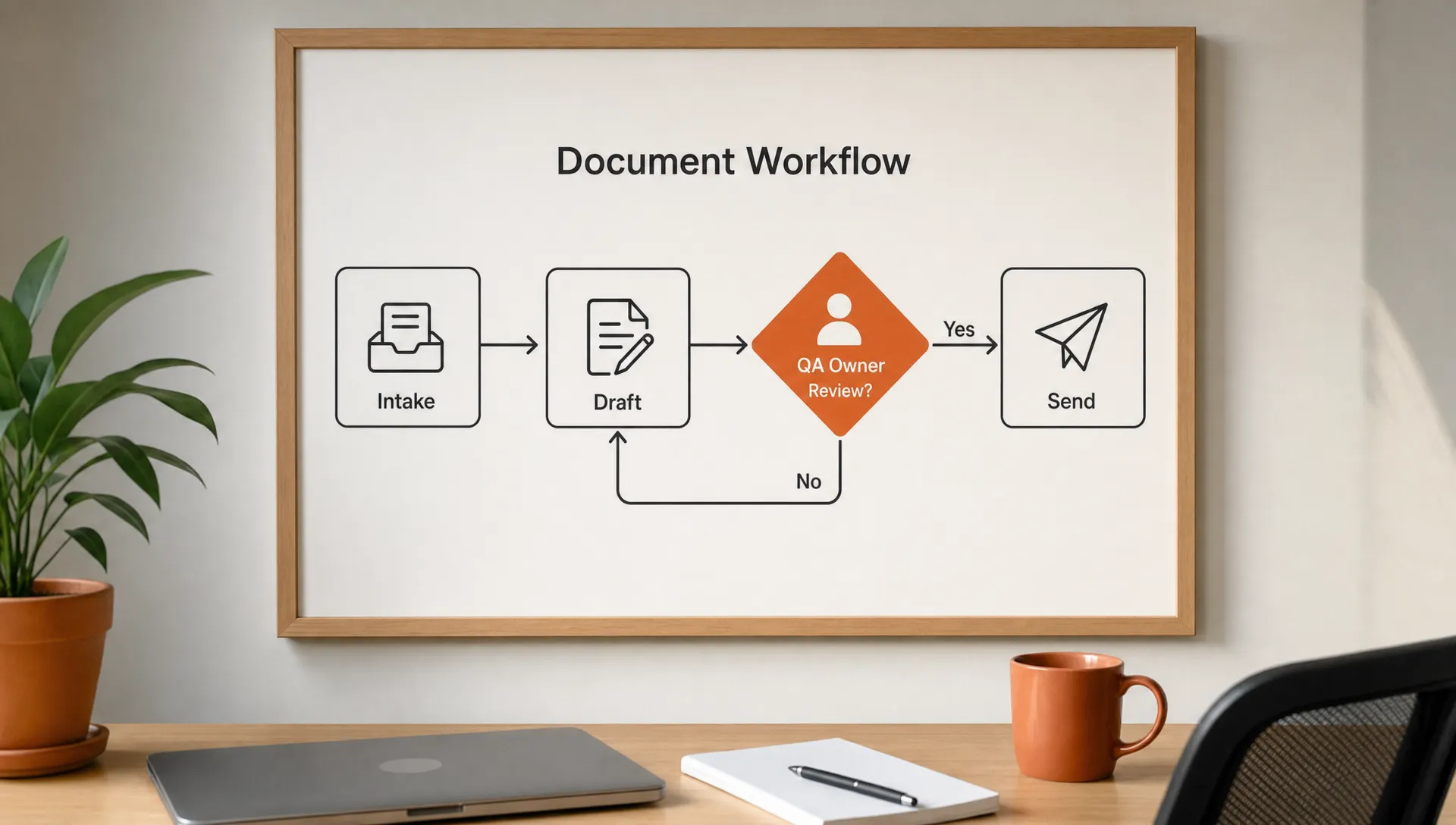
The difference is that their checks feed one pass-or-fail decision. The QA owner gathers the evidence, resolves conflicts and decides whether the page is ready to move from production to launch.
| Workstream | Best reviewer | What they should prove |
|---|---|---|
| Intake and strategy | Strategist or account lead | The offer, audience, traffic source and next step match the brief |
| Copy | Copy lead or editor | Claims, proof points, tone and CTA language are approved |
| Design | Design lead | Visual hierarchy, mobile layout and accessibility basics have been checked |
| Build and tracking | Developer or marketing ops | Forms, thank-you paths, tags, naming and CRM fields work as expected |
| Final acceptance | QA owner | All checks are complete, conflicts are resolved and launch evidence is saved |
For landing page b2b work, central ownership protects specialists from becoming the accidental catch-all for every late change. If your team needs a more tactical layer underneath this ownership model, a repeatable QA checklist for landing page agencies can help define the checks without turning every launch into a meeting.
Move QA earlier than the final review
The costliest QA findings are the ones discovered after design is finished or after the page is built. At that point, fixing a strategic mismatch means rewriting copy, changing layout, rerouting approvals and eating hours that were never scoped.
Earlier gates reduce that waste. This is the same principle behind moving QA earlier in the workflow, but ownership decides whether the gate actually holds.
Gate the intake before production starts
The QA owner should not wait for a staging link. They should confirm that the intake has enough detail to build the page without guessing. That usually means a clear offer, audience, traffic source, CTA, required proof points, client approval path and routing rule.
If those inputs are missing, production has already inherited risk.
Gate copy before design starts
Copy is where many B2B landing page issues become expensive later. The QA owner should confirm that the draft matches the brief, the claims are allowed, the CTA is specific and the page has the right amount of proof for the offer.
This is also where client feedback needs one source of truth. Slack threads, email comments and doc suggestions should not compete with each other during design.
Gate launch before traffic goes live
The launch gate is the final acceptance point, not the first real QA pass. By this stage, the owner should be confirming form behavior, routing, thank-you page logic, tracking, mobile layout and final approvals.
If the first serious review happens here, the process is already asking people to do careful work under pressure.
QA changes when the conversion asset is bigger than a form
Not every campaign sends traffic to a standard page with a headline, form and thank-you screen. Some clients are testing calculators, demos, community assets, interactive pages or owned experiences that behave more like products than landing pages.
A service like CRM-connected brand video-games changes the QA surface. The agency still has to confirm that the promise in the ad, the interactive experience, the data capture and the follow-up path all agree.
A landing page b2b project may sit in front of that kind of asset, or it may be the asset itself. Either way, the QA owner has to think past the visible page. Where does the data go? Who receives the signal? What does the visitor expect next? What does the client team need to see in the CRM or report?
This is where ownership becomes more valuable than a longer checklist. A checklist can remind people what to test. An accountable owner can notice that two correct pieces do not belong together.
What the QA owner should actually check
The QA owner should focus on cross-functional failure points. Specialists can catch local defects. The owner catches contradictions.
| Area | QA question | Evidence to save |
|---|---|---|
| Message match | Does the page match the ad, email or referral promise? | Screenshot or link to the source asset |
| Offer clarity | Is the next step obvious and approved? | Final brief or approval note |
| Claims and proof | Are claims supported and safe to publish? | Approved copy doc or client source |
| Form behavior | Does a test submission land where expected? | Test record, email receipt or CRM entry |
| Tracking and naming | Will reporting connect traffic to the right page and campaign? | Naming sheet or tag check |
| Client feedback | Is final feedback merged into one accepted version? | Approval thread or project note |
The owner should also decide what does not need review. QA gets bloated when every preference becomes a blocker. A button shade may be a design note. A broken routing rule is a launch blocker. The difference should be written down before people are tired.
Where AI helps, and where it makes the mess worse
AI can help with QA when the agency gives it clear inputs and narrow jobs. It can compare a brief against a draft, flag missing proof points, summarize scattered feedback, generate form test cases from a checklist or highlight differences between an approved version and a staging page.
For landing page b2b delivery, that matters because the repetitive comparison work is exactly where busy teams burn time. The machine can read the intake, copy doc and QA checklist faster than a human can. It can also produce a clean list of suspected gaps for the owner to review.
It should not be treated as the final judge. AI does not know whether a client’s legal team approved a claim unless that approval is in the source material. It does not know whether sales wants a shorter form this month unless the intake says so. If the source of truth is messy, automation will spread the mess faster.
The best use is simple: let software do the first pass on comparison and memory, then let the QA owner decide what blocks launch.
A simple ownership model for busy agency teams
If your agency is doing $50K to $500K a month, you probably do not need a separate QA department for landing pages. You need a clear owner, a few hard gates and less guessing at the end.
Use the person who already feels the pain of rework. If the founder is still in delivery, they may own the standard once and delegate the recurring pass. If a head of delivery owns capacity and margin, they are often the natural owner. If a senior PM already coordinates launch handoffs, they can own QA if they have authority to push back.
For landing page b2b retainers, the owner should not change from page to page unless the account changes. Consistency is the point. The same person sees recurring misses, updates the checklist and notices when one client’s approval style keeps creating rework.
The simplest rule is this: the person who owns launch readiness owns QA. Everyone else contributes evidence.
Frequently asked questions
Should the account manager own QA for B2B landing pages? Sometimes, but only if they understand the acceptance criteria and have authority to stop a launch. In many agencies, account managers are close to client feedback but not close enough to build, tracking and routing details.
Should the designer or developer own final QA? They should own their specialty checks, not the final pass. Designers and developers can confirm the page is built correctly, but final QA needs someone comparing the full launch against the brief and client commitments.
Can AI replace the QA owner? No. It can speed up comparison work, catch missing fields and prepare a review list. The QA owner still decides what matters, what blocks launch and what can ship.
What is the first QA gate to add? Add an intake acceptance gate. Most late defects start as missing context, unclear approvals or a vague next step. Fixing that before production starts protects the whole workflow.
How detailed should a landing page b2b QA checklist be? Detailed enough to remove guessing, but not so detailed that nobody uses it. Start with message match, approvals, form behavior, routing, tracking and reporting needs.
What to do next this week
Pick one recent landing page launch that created rework. Do not overhaul your whole process. Trace the misses back to the handoff where they first became visible: intake, copy, design, build, launch or reporting.
Then assign one QA owner for the next launch and give that person written authority to pause the page when required inputs are missing. Ask each specialist for evidence, not opinions. Save the launch record so the same defect does not need to be rediscovered next month.
If landing page b2b QA keeps falling between roles, the fix usually starts with ownership before tools. Tools help after the agency decides who is allowed to say, "this is ready."
Archer Scaling AI installs and runs AI ops systems for marketing agencies. If it would help to talk through your handoffs, QA owner and launch flow, book a free 30-minute intro call. It is a conversation about your operations, not a sales call.