What B2B Advertising Agencies Should Systemize First
Learn what B2B advertising agencies should systemize first to protect margin, improve campaign launches, and scale delivery without chaos.
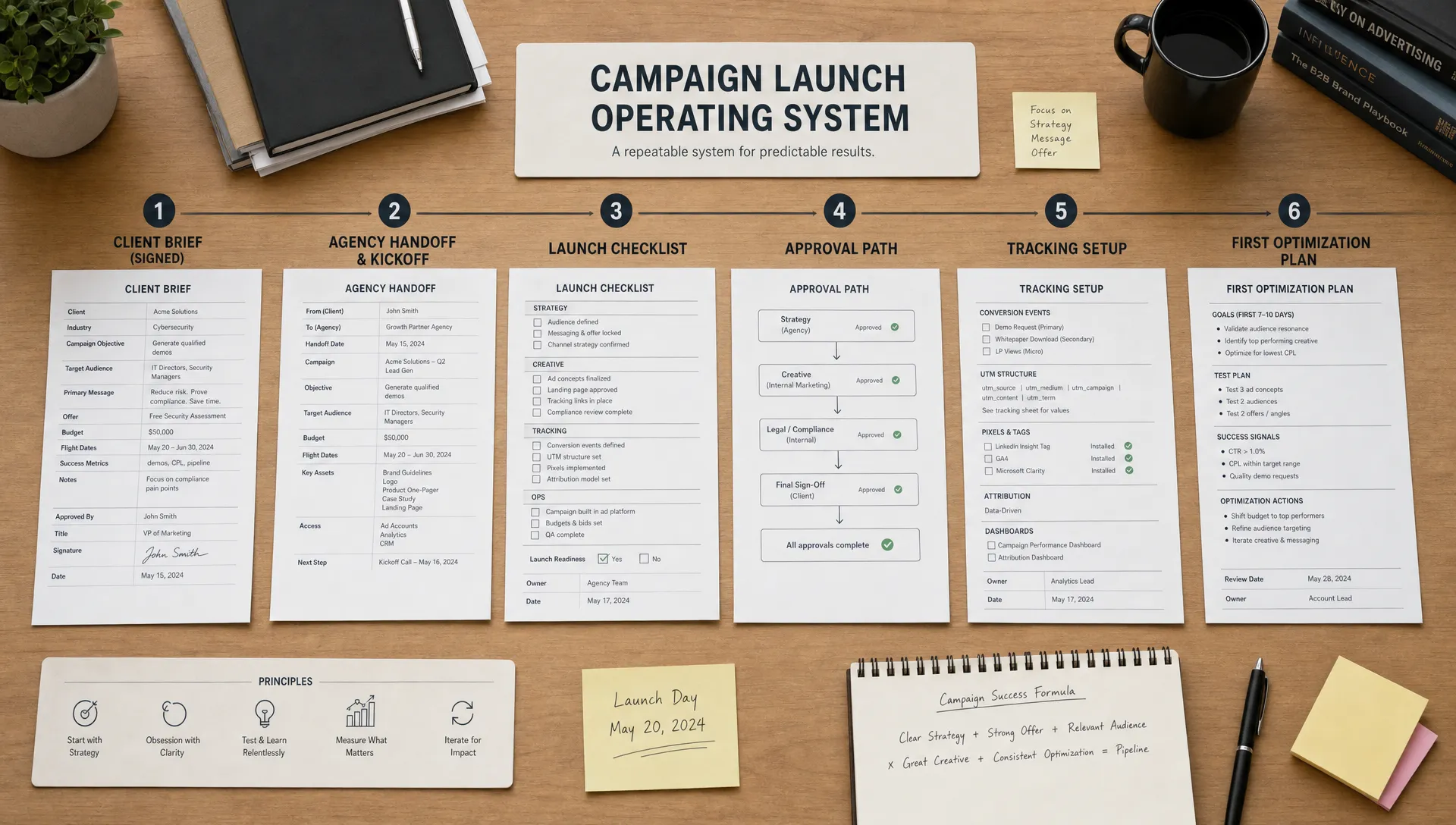
Most B2B advertising agencies do not lose margin because their teams lack talent. They lose margin because too much of delivery depends on memory, Slack archaeology, last-minute client chasing, and senior people translating the same messy inputs over and over again.
That is why the first thing to systemize is not ad copy generation, dashboard design, or a new AI tool stack. The first thing to systemize is the campaign launch operating system, the repeatable path from signed client to live campaign to first optimization decision.
For B2B advertising agencies, this is where the most expensive chaos hides. A vague ICP becomes weak targeting. Missing CRM context becomes bad lead quality feedback. Unclear approvals become creative delays. Incomplete tracking becomes performance debates. By the time reporting looks messy, the margin leak started weeks earlier.
If your agency wants better delivery margin, start where every campaign begins.
Systemization comes before automation
A system is not a folder full of SOPs nobody opens. It is a repeatable way work moves through the agency, including required inputs, owners, decision rules, quality checks, and output formats.
Automation can speed that up, but it cannot fix a workflow the agency has not defined. AI makes good systems faster. It makes bad systems louder.
If a strategist receives incomplete sales notes, AI can summarize the gaps, but it cannot know which gaps matter unless the agency has defined the required handoff. If a media buyer gets a campaign brief with no offer hierarchy, automation can produce variants, but it cannot decide what the client is actually willing to stand behind. If a report has no agreed definition of qualified lead, a polished narrative only makes the confusion look more professional.
The practical rule is simple: systemize the workflow first, then automate the stable pieces.
For a broader view of how operational systems connect to profitability, Archer has covered the larger margin picture in this guide to agency marketing systems that protect your margin. This article narrows the question to sequence: what should B2B advertising agencies systemize first?
Use a priority filter, not a wish list
Most agencies have dozens of processes they could improve. The mistake is trying to systemize all of them at once. That creates internal theater: new templates, new docs, and new meetings, but no measurable reduction in delivery drag.
Instead, pick the first system using four filters.
| Priority filter | What to look for | Why it matters |
|---|---|---|
| Frequency | The workflow happens on almost every client or campaign | Repetition creates the fastest operational return |
| Margin exposure | Mistakes create rework, senior intervention, or client churn risk | The system should protect profit, not just tidy documentation |
| Downstream dependency | Other workflows depend on this one being clean | Fixing the source prevents multiple later problems |
| Decision complexity | The work requires judgment, not just task completion | Systems should capture how good decisions are made |
The campaign launch workflow scores high on all four. It happens repeatedly, consumes senior attention, affects performance, and determines whether every downstream team starts with clarity or confusion.
The first system: your campaign launch operating system
A campaign launch operating system begins the moment a deal is won and ends after the first meaningful optimization cycle. It is bigger than onboarding, but onboarding is part of it. It is also bigger than a launch checklist, although a launch checklist is one of its outputs.
The goal is to make every new engagement answer the same core questions before work accelerates:
- Who exactly are we trying to reach?
- What offer or conversion action are we asking them to take?
- What proof, positioning, and objections shape the message?
- What data, access, and tracking must be ready before launch?
- Who approves what, by when, and against which criteria?
- How will we judge early performance without overreacting to noise?
This matters even for smaller specialist teams. The same discipline applies whether you run a multi-person agency or compare boutique operators like BrandBuilder's Collective, whose managed campaign services show how buyers evaluate expertise, scope, and accountability before work begins.
A strong launch system protects both sides. The client experiences clarity. The agency avoids reinventing the starting line every time.
Why launch beats creative, reporting, and sales scripts
Creative production, reporting, and lead follow-up are all worth systemizing. But in most B2B advertising agencies, they should not come first because they inherit problems from launch.
Launch contains the most preventable waste
The highest-friction work is often not the visible campaign work. It is the coordination around it: chasing access, clarifying ICPs, correcting assumptions from the sales process, finding old brand assets, confirming conversion definitions, and explaining why a client cannot approve ads without approving the underlying message.
When those issues are handled ad hoc, senior people become the glue. They jump into calls, rewrite briefs, reframe strategy, and rescue timelines. The client may never see the operational mess, but the agency feels it in margin.
Launch exposes weak strategy early
B2B advertising performance depends heavily on the quality of the underlying commercial inputs. A campaign aimed at the wrong buying committee will not become efficient because the ads are well formatted. A weak offer will not become compelling because the landing page loads quickly. A lead magnet without sales follow-up will not generate pipeline just because cost per lead looks acceptable.
A launch system forces these questions early, before media spend, creative hours, and reporting cycles amplify the problem.
Launch makes every later system easier
Once launch is standardized, other workflows become easier to improve. Reporting has clean definitions. Creative has a clear thesis. Media buying has an agreed test plan. Sales follow-up has context. Client communication has a shared baseline.
This is why launch is the operational hinge. It turns scattered service delivery into a controlled delivery engine.
What your first system should produce
Do not start by writing a 40-page SOP. Start by defining the artifacts that must exist for every campaign. These artifacts become the operating layer your team actually uses.
| Artifact | Purpose | What it prevents |
|---|---|---|
| Sales-to-delivery handoff | Transfers context from the sale into execution | Re-discovery, missed promises, unclear expectations |
| Campaign thesis brief | States the audience, offer, message, channel role, and test logic | Random creative, unfocused targeting, subjective debates |
| Access and tracking checklist | Confirms ad accounts, analytics, CRM, pixels, UTMs, and conversion events | Launch delays and unreliable reporting |
| Approval path | Defines who approves strategy, copy, creative, landing pages, and budget changes | Revision loops and hidden decision makers |
| Launch QA checklist | Verifies naming, links, audiences, budgets, exclusions, tracking, and creative versions | Avoidable errors after campaigns go live |
| First optimization cadence | Sets when performance will be reviewed and what decisions can be made | Panic changes, vague updates, and premature conclusions |
The best version of this system is lightweight but non-negotiable. It should not slow down strong teams. It should remove ambiguity so strong teams can move faster.

The handoff is the highest-leverage piece
If you only improve one part of launch first, improve the sales-to-delivery handoff.
Many agencies sell with nuance, then deliver from fragments. The founder knows why the client bought. The salesperson remembers the real pain. The strategist hears a summary. The media buyer gets a task. The copywriter gets a brand guide. By the time the work starts, the original commercial context has been diluted.
A proper handoff captures what matters for delivery, not just what matters for billing. It should include the client goal, the business constraint, the buying committee, the promised scope, the key risks, the offer being tested, the primary objection in the market, and any expectations set during sales.
This does not need to be complicated. In fact, the more complicated it is, the less likely it will be used. The handoff should be short enough to complete consistently and structured enough that missing information is obvious.
The handoff also prevents one of the most common agency margin traps: discovery repeated as delivery. If the delivery team has to rediscover what sales already learned, the agency pays twice for the same understanding.
What to systemize second
After campaign launch, the next systems should support recurring delivery and performance accountability. The right order depends on your service model, but most B2B advertising agencies should prioritize reporting, lead handling, and creative production after launch is stable.
Systemize the reporting and insight loop
Reporting is not just sending numbers. It is translating campaign activity into decisions the client understands and trusts.
A reporting system should define the metrics by funnel stage, the source of truth for each metric, the commentary format, the decision rules, and the client-facing cadence. The goal is to reduce the time your team spends rebuilding the same story every month while improving the quality of the insight.
This is especially important in B2B, where buying cycles are longer and platform metrics rarely tell the whole story. If the client judges ads by pipeline, your report cannot stop at clicks and form fills.
Systemize lead routing and follow-up
Paid media can create demand, but poor follow-up can make the campaign look like it failed. If leads sit untouched, get routed to the wrong rep, or receive generic responses with no campaign context, advertising performance is judged unfairly.
Your lead handling system should define what counts as a warm lead, where it routes, how fast follow-up should happen, what context sales receives, and how feedback returns to the agency. Archer covers this issue in more depth in the guide on how B2B teams can stop losing warm leads.
Even if your agency does not own sales execution, you need a system for surfacing the handoff risk. Otherwise, media delivery gets blamed for revenue leakage it did not create.
Systemize the copy and creative pipeline
Creative systems should come after the campaign thesis is clear. Otherwise, the team produces more assets without knowing what they are testing.
A strong creative pipeline defines input requirements, message angles, review criteria, version naming, testing logic, and retirement rules. It should help the team answer a simple question: what are we learning from each creative iteration?
This is where AI can eventually help, but only after the agency has defined what good looks like. Without a message framework and approval criteria, AI-generated volume often creates more review work instead of less.
What not to systemize first
Some workflows feel urgent because they are noisy, but they are not always the best starting point. Be careful with these early systemization traps:
- Rare bespoke strategy work: If it happens only occasionally and depends heavily on senior judgment, capture principles first instead of forcing a rigid SOP.
- A broken offer: Systemizing delivery around an offer that buyers do not want will make failure more efficient, not more profitable.
- Tool sprawl: Buying or connecting more software before defining the workflow usually creates more surfaces for errors.
- AI content volume: More drafts, more ad variants, and more reports do not help if the underlying brief, approval path, and QA process are unclear.
Systemization should reduce operational drag. If a new system creates more meetings, more fields, and more exceptions without reducing rework, it is documentation theater.
A two-week plan to build the first system
You do not need a six-month operations project to systemize campaign launch. You need a focused sprint that turns the best version of your current process into the default version.
- Days 1 to 2: Review the last five campaign launches and identify where time, quality, or client confidence broke down.
- Days 3 to 4: Define the minimum required inputs for a campaign to move from sold to ready for strategy.
- Days 5 to 6: Build the sales-to-delivery handoff and campaign thesis brief, then test them against past clients.
- Days 7 to 8: Create the access, tracking, approval, and QA checklists needed before launch.
- Days 9 to 10: Assign owners, decision rights, and due dates for each step of the launch workflow.
- Days 11 to 14: Run the system on one active client, note every exception, and revise only what improves speed or clarity.
The key is to avoid perfection. The first version should be usable, visible, and enforced. A simple system used every time beats a sophisticated system people bypass under pressure.
Where AI automation belongs
Once the launch system is stable, AI and automation can remove repetitive work from the process. This is where agencies can create real margin lift without reducing service quality.
AI can summarize intake calls, detect missing handoff fields, generate first-draft campaign briefs, turn research into message angles, assemble reporting narratives, flag incomplete tracking, and route follow-up tasks. But each automation should sit inside a defined workflow with clear human ownership.
If you are deciding which operational tasks to automate after systemizing the workflow, this breakdown of what a marketing agency should automate first is the natural next step.
At Archer Scaling AI, this is the distinction that matters most. The goal is not to sprinkle AI across the agency. The goal is to install an AI ops layer around workflows that already map to margin, delivery speed, and client experience.
How to know you chose the right first system
A good first system creates measurable operational relief. Within a few launches, you should see fewer avoidable delays, fewer internal clarifications, fewer client surprises, and less senior rescue work.
Track simple indicators:
- Time from signed agreement to campaign-ready brief
- Number of missing access or tracking items at planned launch date
- Rounds of revision before launch approval
- Hours of senior intervention per new campaign
- Percentage of campaigns launched with CRM and conversion tracking confirmed
- Time from launch to first optimization recommendation
These metrics do not need to be perfect. They need to show whether the system is reducing friction where it matters.
If the numbers improve, you have built a foundation. If they do not, the system may be too heavy, too vague, or aimed at the wrong bottleneck.
Frequently Asked Questions
What should B2B advertising agencies systemize first? B2B advertising agencies should systemize the campaign launch operating system first. This includes the sales-to-delivery handoff, campaign thesis, access and tracking checklist, approval path, launch QA, and first optimization cadence.
Why not systemize creative production first? Creative production depends on clear strategy inputs. If the ICP, offer, message, and test logic are unclear, a creative system will only produce more assets for the team to review and revise.
Is systemizing the same as automating? No. Systemizing defines how work should happen. Automating uses software or AI to execute repeatable parts of that system. Automation works best after the process has clear inputs, owners, outputs, and quality standards.
How detailed should the first system be? It should be detailed enough to prevent common mistakes, but simple enough for the team to use under deadline pressure. Start with required artifacts and decision rules, not a long manual.
When should an agency add AI to the system? Add AI after the workflow is stable. Good early use cases include summarizing intake notes, drafting briefs, checking for missing information, preparing reporting commentary, and routing follow-up tasks.
Find the margin leak before you build more process
If every new campaign still needs senior rescue, the issue is probably not effort. It is an operating system gap.
Archer Scaling AI helps B2B marketing and advertising agencies install and run AI-powered operations systems for workflows like onboarding, reporting, CRM follow-up, research, and content ops. The starting point is a paid Margin Teardown: a roadmap and three automation moves, or it is on me.
If you want to see where your agency should systemize first, start with Archer Scaling AI and look at the actual system before you commit.