What agentic engineering changes about a SaaS release decision
See how agentic engineering changes SaaS release decisions, with clear ownership, acceptance checks, cost telemetry and a practical release note.

Your coding agent has finished the change, and the demo works. With agentic engineering, you still need to decide whether that change belongs in front of customers. If nobody owns the technical side of your SaaS yet, the gap between “the agent finished” and “we should release” lands back on you.
Finished code is only one input to a release decision
Agentic engineering means an accountable engineer directs agents that can inspect the codebase, change code, run tests and prepare documentation. The engineer sets the boundaries, reviews the work and owns the technical recommendation. Agents do the work. You make the decisions.
That arrangement can move more work toward review without requiring you to coordinate a larger team. It also makes the release decision more important: generated code, passing tests and a convincing demo can all exist while a customer-facing risk remains unresolved.
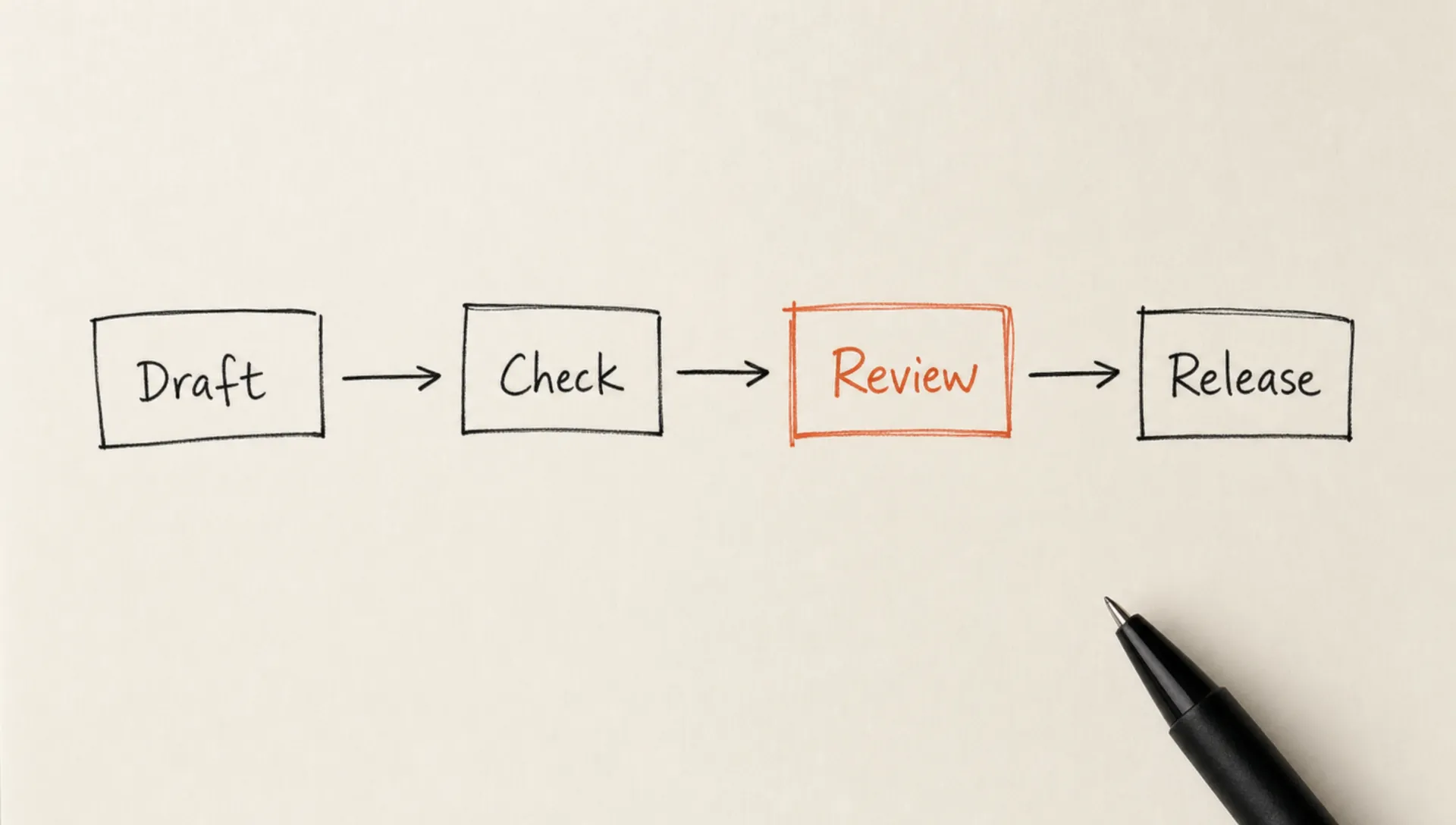
Keep three events separate. Merging puts a change into the shared codebase. Deploying puts it into an environment, which may be production. Releasing exposes the behavior to customers. Your stack may combine these events, but you should know when each happens.
A useful release decision connects the promised behavior to evidence, names what remains uncertain and identifies who will respond if the change fails. A completion message from an agent does not provide that record by itself.
Use agentic engineering with one accountable engineer
The founder should not become the coordinator for a coding agent, a testing agent and a security agent. Someone needs to reconcile their outputs and answer a direct question: “What have you checked, and what do you recommend we release?”
That person owns the technical review. They inspect the relevant code changes, check whether the tests address the actual risks and explain anything that remains unverified. An agent reporting that another agent's work looks correct does not remove this responsibility.
Your responsibility is different. You decide whether the proposed behavior serves the roadmap, whether the remaining business trade-offs are acceptable and who should receive the release. If you are a technical founder, you may also perform the engineering review. Keep the two judgments explicit even when you own both.
For a non-engineer founder, approving a release should not require pretending to understand a code diff. It should require a clear explanation supported by inspectable evidence.
Exploratory prompting can help you discover what a feature should do. Before that experiment reaches customers, someone still has to turn it into a bounded change with acceptance criteria and a release recommendation.
Write acceptance before the agents begin
The useful unit of work in agentic engineering is a change you can accept against a written definition of done. “Improve exports” leaves too much room for an agent to produce something plausible that misses the actual need.
Suppose your next deliverable lets an account owner export records. This is a hypothetical feature, not a client example. Before implementation begins, define which records belong in the export, who may request it and what should happen when the job fails.
Then name the boundaries that must hold. An export must not include another account's records. A user without export permission must not obtain the file. A failed job must produce a clear status rather than leave the customer wondering whether anything happened.
These statements give the engineer something concrete to verify. They also give you something concrete to accept.
For a weekly deliverable, acceptance should describe observable behavior and its limits. “The export works for the agreed account-owner workflow, with these exclusions” is a decision you can make. “The export code is finished” leaves you guessing about what finished means.
Ask for evidence matched to what could go wrong
A passing test suite matters only in relation to what it checks. Tests written from the same incomplete instruction as the implementation can repeat the same misunderstanding.
In agentic engineering, ask the technical owner to connect each material risk to evidence rather than hand you a test count.
| What changes | Evidence to request | What a working demo cannot establish |
|---|---|---|
| Account permissions | Checks for allowed access, denied access and access across account boundaries | That every unauthorized route is blocked |
| An existing customer workflow | Checks covering the changed behavior and the behavior it must preserve | That customers outside the demo path are unaffected |
| Stored data | A migration plan tested on representative data, with recovery limits stated | That existing records will survive the change correctly |
| A paid model or external API call | Usage measurements, failure handling and retry limits | That repeated use has an acceptable cost |
The engineer should also look beyond the agent's chosen path. For the export example, that could mean checking the download route directly rather than only clicking through the interface.
Agent permissions belong in this review too. Access to a repository does not automatically justify access to production records, secrets or deployment controls. Our guide to where security fits in MVP development explains how to set those boundaries around a real customer workflow.
Bring one release note to the decision
You do not need to read every agent conversation. You need a short record that lets you understand the change, inspect the evidence and make a decision without reconstructing the work yourself.
A useful agentic engineering release note should include:
- Change and acceptance: The customer-visible behavior, its exclusions and the written definition of done.
- Technical owner and version: The person recommending release and the exact code version they reviewed.
- Evidence and gaps: Links to relevant checks, the test environment and anything still unverified.
- Exposure and recovery: Who will receive the change, how to stop it and what cannot be reversed easily.
- After-release checks: What will be observed and which conditions require intervention.
Keep the note in the company's own repository or another company-controlled record. It should remain available if the engineer or contractor changes.
The recommendation can be “release,” “release to a limited group” or “hold.” A hold should identify the missing evidence or unresolved risk, not disappear into another round of vague polishing.
This note is also where disagreements become manageable. You can accept the feature's scope while holding customer exposure until a permission check passes. Those are separate decisions, and the record should show both.
Separate deployment from customer exposure where practical
A completed change does not always need to reach every customer immediately. Depending on the product and stack, the engineer may be able to deploy it with access disabled, enable it for an internal account or expose it to a limited group first.
That gives you a narrower release decision. You can evaluate behavior in the real environment without making the same commitment to every account at once.
Ask what remains active when the visible feature is disabled. A background job might still run. A data migration might already have changed stored records. Switching off a button does not necessarily undo either action.
The recovery plan must distinguish stopping new activity from repairing what already happened. Returning to an earlier application version may not restore changed data or reverse an external action.
Before release, name the person who will carry out recovery and confirm they have access to do it. If that answer is unclear, use this guide to recovering a failed SaaS release to identify what needs to be established before customer exposure.
Check cost and behavior after customers start using it
Agentic engineering needs a feedback loop after release. Tests provide evidence about selected conditions; production use tells you what happens under the conditions your customers actually create.
For the export example, useful observations include completed jobs, failed jobs, waiting time and records included. If the feature calls a paid external service, measure usage and cost per completed export, including failed attempts and retries. Otherwise a successful demo can hide an expensive failure path.
Separate the cost of developing the feature from the cost of running it. Coding-agent usage belongs to the development work. Model calls inside your product belong to the product's operating economics. You need both records to judge the change accurately.
Agree on intervention conditions before release. Unexpected cross-account access should stop exposure. Repeated job failures may justify disabling the feature while the owner investigates. Cost behavior outside an agreed budget may require limiting use.
To judge whether this way of working helps your company, track accepted changes alongside rework, production defects and founder intervention. More generated code is not evidence of better delivery. A change that reaches customers sooner but creates repeated repair work deserves a different judgment from one that stays accepted after release.
Frequently asked questions
How does agentic engineering change release approval? Agents can perform implementation and verification work, while an accountable engineer reviews the evidence and recommends whether to release. The founder approves customer exposure and business trade-offs using that recommendation, rather than treating agent completion as approval.
Can I approve a release without reading the code? Yes, but you need a technical owner who does read the relevant changes. Your approval should rest on demonstrated acceptance criteria, disclosed gaps and a clear recovery plan. A demo alone does not cover those responsibilities.
Does every change need the same review? No. Review should follow the consequences of failure. A copy change usually needs less evidence than a permission change, a data migration or a new external action. The technical owner should explain why the proposed checks fit the change.
Should coding agents deploy directly to production? That depends on explicitly granted permissions and release controls. For a company still establishing technical ownership, separating permission to change code from permission to expose it to customers gives the founder a clearer approval gate.
This week, put the next release decision in writing
Choose the next customer-visible change in your company. Write its acceptance criteria, name the technical owner and ask what evidence will support release. Record who receives it first, how you will stop it and what you will check afterward.
If agentic engineering is already part of your workflow, apply this to the next change rather than redesigning the whole process. If nobody can own the technical recommendation, resolve that gap before treating agent completion as permission to release.
At Archer Scaling AI, I help early-stage SaaS become AI-native. I build and run the systems that develop, market and sell the SaaS so the founder's time goes to the decisions.
For a conversation about your company, your codebase and who owns the next release, book a free intro call.