Vibe coding limitations when your SaaS needs a second environment
See where vibe coding limitations surface in a second SaaS environment, from shared secrets to database changes, and what to verify before shipping.

Your v1 runs, and now you need somewhere to test the next change without touching the product your customers use. This is where vibe coding limitations start costing founder time: the app may work in its original setup, but nobody has established what it needs to run somewhere else. Before adding another feature, you need a second environment with separate data, controlled access and a release process someone owns.
A second environment needs its own boundary
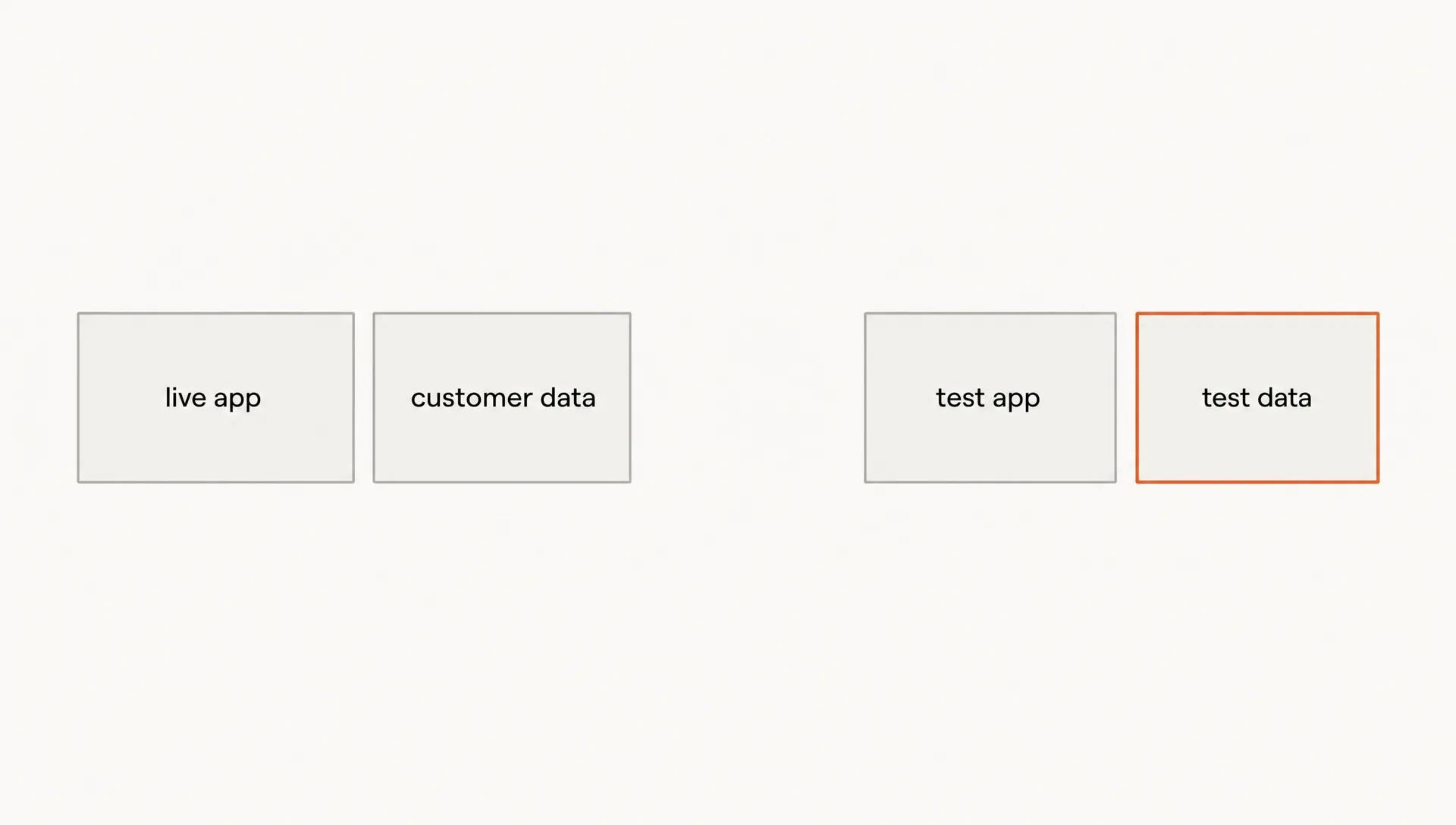
An environment is a running copy of your product together with its configuration, data stores and connected services. Production serves your customers. A staging environment gives you somewhere to check changes before releasing them.
A second URL alone does not establish that separation. Two app deployments can still share the same database, file storage, payment credentials or background workers. A test that looks harmless in the browser can change a real account behind it.
Vibe coding is useful for exploring a workflow, building a prototype and getting something concrete in front of potential users. Coding agents can also help create the second environment. The limitation appears when generated changes accumulate without anyone maintaining an accurate picture of how the product runs.
One of the practical vibe coding limitations is that a successful deployment proves only that the app started under those particular conditions. It does not prove that the next deployment is isolated, reproducible or recoverable.
For a founder, the useful artifact is a short environment map. It should name the app host, database, file storage, login provider, external services and background jobs for each environment. Each connection should show which account owns it and whether it can reach production. You should be able to discuss that map without reading the codebase.
Separate customer data before testing changes
Suppose you duplicate your app and its deployment settings. The new copy starts successfully, but it still points to the production database. Creating a test account now writes into the same place as customer activity.
That setup can be especially misleading for a non-engineer founder: the separate address looks like evidence of separation. A technical founder moving quickly can make the same mistake through a copied connection setting.
The boundary needs to cover more than the main database:
| Area | What to establish in staging | Evidence to request |
|---|---|---|
| Database | Separate data and credentials | A staging write leaves production unchanged |
| File storage | Separate storage or enforced access boundaries | A test upload cannot overwrite a customer file |
| Login | Environment-specific login settings and redirects | Test sign-in returns to the staging app |
| External services | Test accounts, restricted credentials or disabled actions | A test cannot trigger a live customer action |
| Background jobs | Separate queues and worker configuration | Staging workers cannot consume production work |
These vibe coding limitations become consequential when real customer records enter the product. Use synthetic test data first. Copying production data into staging creates another place where access, retention and deletion need to be managed.
If realistic records are necessary, decide which fields are needed and how identifying information will be removed before copying anything. The same principle applies when putting security into an early SaaS release: define the boundary, then check that the product actually enforces it.
Vibe coding limitations show up in configuration
Configuration tells the same code where it is running and which services it may use. It includes database addresses, login redirects, service credentials and settings that turn features on or off.
In a quickly assembled v1, these settings may be scattered across the codebase, a hosting console, a contractor’s account and a conversation with a coding agent. A second environment exposes the missing record.
Ask for a configuration inventory with the purpose, owner and environment of each setting. Record where a secret is stored without copying its value into the document. Also distinguish settings needed when the app is built from settings read when it runs. Changing a hosting setting will not necessarily change a value already bundled into the app.
The security dimension of vibe coding limitations becomes concrete here: a working connection can hide credentials that grant much more access than the task requires.
The OWASP secrets management guidance covers access control, rotation and the lifecycle of credentials. For your company, the immediate questions are simpler: who can retrieve each secret, what can it reach and how would you replace it?
A missing staging credential should cause a clear failure. Code that quietly falls back to a production credential can turn a configuration mistake into a customer-data incident.
Keep test actions away from live customers
A separate database does not prevent an email provider from sending a real message. Nor does it stop a scheduled task from publishing content, updating an external account or calling a paid service.
Follow one complete customer workflow through the environment map. For example: a person signs up, receives an email, starts a subscription and uploads a file. Identify every action that leaves your app, including those that happen later in a worker or scheduled job.
For each connection, choose an explicit test behavior. That might mean a provider’s testing environment, a restricted recipient list or a substitute that records the intended action without performing it. Stripe’s testing documentation, for example, explains how to simulate payment activity without processing real payments.
Another of the vibe coding limitations is that plausible integration code can conceal which account receives the action. Request evidence from both ends: the staging app sent the request, and the intended test account received it.
Webhooks need the same attention. These are messages a service sends back to your app, such as a payment-status update. Test and production callbacks need the correct destinations and credentials. Check that replaying a test event cannot update a production record or grant access to a real customer account.
Rehearse database changes before a release
A new screen may require a new database field, a changed relationship between records or a conversion of existing data. Those changes need a release sequence.
An empty staging database is insufficient for this check. It may accept the new structure while revealing nothing about what happens to records created by the current product. Seed staging with synthetic records that represent the states the change must handle, including incomplete or older records where relevant.
Ask the person owning the release to describe the sequence in plain language. Does the database change happen before the app deployment? Can the current app still run after that change? What happens if the deployment stops halfway through?
These vibe coding limitations matter because generating a database change is only one part of shipping it. Someone must decide how existing data survives the transition.
The evidence should include a rehearsal against representative test data, the expected result and any release conditions. If a migration takes time or temporarily restricts a workflow, record that before making the production change. A founder should approve the customer impact with that information available, rather than discovering it after pressing deploy.
A rollback must account for stored data
Reverting the app to its previous version does not automatically reverse a database change. The previous app may no longer understand the records the new version created.
A recovery note should explain what can be rolled back, what cannot and when a forward fix would be required. It should also identify the backup location and the restore procedure. A successful restore rehearsal gives you stronger evidence than a backup setting marked enabled.
Restoring an older backup can discard legitimate activity that happened afterward. That tradeoff needs an owner who can judge the impact on customers.
For a small SaaS, this can be a short document attached to the release. It needs to be specific enough that the founder is not inventing a recovery process while customers wait. Record who can stop the release and who decides whether to restore data.
Match the separation to the product’s actual risk
A disposable prototype with invented data has a different risk profile from a product holding customer files or taking payments. The second environment should reflect the consequences of a mistake.
For a prototype, you may need only a reproducible deployment and disposable test data. An internal tool may need protection against sending messages or changing shared business records. A customer-facing SaaS needs checks around the workflows and information customers depend on.
The important vibe coding limitations depend on that exposure. A broken animation and a test worker deleting customer files do not deserve the same release process.
You also do not need to reproduce every production service immediately. For a workflow check, a substitute for an expensive external service may be sufficient. Before changing the real integration, however, you need a test against that provider’s supported testing setup or another controlled verification method.
Write down the differences between staging and production. A test can only support conclusions about what it exercised. If staging uses a substitute for file processing, passing that test says nothing about whether the production file-processing credentials are correct.
This keeps the scope tied to the next shipping decision instead of turning the second environment into an open-ended infrastructure project.
Put one person in charge of the release
Adding another coding agent does not assign technical ownership. Someone still needs to understand the environment map, review changes and decide whether the evidence supports releasing them.
That person can be the technical founder if they have room to own it. Otherwise, name an accountable engineer rather than leaving responsibility spread across a contractor, the founder and whichever agent produced the latest change.
Agentic engineering gives that engineer a way to delegate work. Coding agents can prepare configuration changes. Test agents can exercise selected workflows. Security agents can check for exposed secrets or overly broad access. Documentation agents can update the environment map and release notes. Their output still needs review.
The ownership gap behind vibe coding limitations closes only when somebody accepts responsibility for what ships. A collection of generated reports cannot approve its own assumptions.
The founder retains decisions about scope, customer impact and spending. The engineer owns the technical recommendation and explains the evidence behind it. Agents do the work. You make the decisions.
Keep the repositories, hosting, domains and service accounts under the company’s control. Confirm this through access and ownership settings, not a handover promise. A product that runs only through a contractor’s personal account leaves the founder dependent on that person even if the code has been exported.
Accept a weekly deliverable you can verify
“Set up staging” is too vague to accept. Define a named deliverable such as “isolated staging for the signup-to-paid workflow,” with a written definition of done.
The scope should name the workflow, its external connections and the evidence required. A useful acceptance record includes:
- A deployment from the company-owned repository, with its code version identified.
- A completed test workflow using synthetic records and test service accounts.
- Evidence that the tested actions did not change production data or contact live customers.
- A rehearsed database change and a written recovery procedure for that release.
- An updated environment map, access record and known-differences note.
This turns vibe coding limitations into a bounded piece of work with observable results. The founder can accept a workflow and its release conditions without pretending to review code they cannot read. A technical founder can use the same record to avoid reconstructing the work later.
If you are comparing outside help, use this deliverable as the shared task. The approach to evaluating development services against your existing v1 applies here: compare the evidence and ownership each provider will leave behind.
One accepted deliverable a week keeps progress visible. If the environment work needs more than a week, split it into independently verifiable pieces rather than marking a partially isolated environment ready for customer-data testing.
Count review and recovery work alongside generation
The cost of a second environment includes hosting, storage, external-service usage and the work required to keep it useful. An idle app can still run scheduled jobs or accumulate files.
Attach usage and cost telemetry from the first version of the environment. At minimum, identify which environment generated the usage and which workflow caused it where the provider supports that detail. Separate credentials or projects can help attribution, but confirm what the service actually reports.
The economic question behind vibe coding limitations is how much work remains after code generation. Track time spent finding configuration, reviewing changes, debugging environment differences and recovering from failed releases. Do not treat generated code volume as completed product work.
Check portability as part of the same record. Can another engineer deploy from the repository, obtain authorized access to the required secrets and restore the necessary data? Note any platform-specific dependencies and their export limits.
You may decide those dependencies are acceptable. The useful decision is explicit: what would leaving require, who could do it and which parts of the product would need to change?
Frequently asked questions
Does a second environment mean I need to rewrite my v1? No. Start by identifying what the current product depends on and separating the connections needed for a defined workflow. A rewrite needs its own evidence, such as a platform restriction that prevents the required separation.
Can a coding agent create staging for me? It can prepare deployment settings, tests and documentation. Someone still needs to verify credentials, data boundaries, external actions and recovery. A successful agent run is not enough evidence to approve the environment.
Is a preview deployment enough? Sometimes, for checking an interface change. A preview can still share production data or services. Establish what it connects to before using it for tests that write data or trigger actions.
Should I hire my first engineer now? A second environment alone does not settle that decision. Look at the recurring workload: release ownership, product changes, incidents and maintenance. Hire against the responsibility that needs sustained ownership, rather than one setup task.
This week, trace one workflow before adding another feature
Choose the next change you want to ship. Trace its data, credentials and external actions from the app through every connected service. Mark anything staging would share with production and name the person responsible for resolving it.
Then define one deliverable you can accept this week. It might be an environment map, an isolated database with synthetic records or a complete test workflow with external actions contained. Record the evidence and the remaining gaps. Stop a test if you cannot establish where its writes or messages will go.
That gives you a concrete response to vibe coding limitations without assuming you need a new stack or an engineering team immediately.
At Archer Scaling AI, I help early-stage SaaS become AI-native. I build and run the systems that develop, market and sell the SaaS so the founder’s time goes to the decisions.
For a conversation about your company, your current product and who owns what ships next, book a free intro call.