How to evaluate SaaS application development services using your v1
Evaluate SaaS application development services using your v1. Compare code ownership, security, running costs and evidence of accepted work.

Your v1 exists, but the next change keeps turning into a bigger conversation about the stack, a rewrite or another contractor. You need to evaluate SaaS application development services without handing each provider a different brief. Use the product you already have as the test, with the same access, task and acceptance criteria for everyone.
Give every provider the same view of your v1
Start with a small evaluation packet. Include a recording of one important user journey, what currently breaks and the next product decision you need to make. Add the location of the code, the services it depends on and who controls those accounts.
For a non-engineer founder, this can begin with screenshots, account names and the contractor's handover notes. A technical founder can add known shortcuts, failed deployments or parts of the codebase that are difficult to change. Neither version needs to become a complete specification.
Use read-only access where possible. Remove secrets and customer information from shared documents. Read-only access still exposes information, so confirm who will receive it and whether agents or external services will process any code or data.
Keep one copy of this packet and send the same version to each provider. Otherwise, you may end up comparing one proposal based on a product walkthrough with another based on a repository review. Those proposals describe different levels of understanding.
Compare SaaS application development services on one real change
Choose a narrow change that touches something your product already does. It should matter to a user and have an observable result. A new landing page rarely tells you enough about how someone will handle your application.
For example, if users enter information into your product, ask how a failed save should behave. The user should see that the save failed, retain their input and retry without creating duplicate records. That exposes questions about the interface, stored data, error handling and tests through one bounded task.
Write the acceptance criteria before discussing implementation. State what the user can do, what must remain unchanged and how you will check the result. A provider can challenge the criteria, but should explain why.
Begin with a walkthrough and a written approach. If you proceed to implementation, use a test environment with synthetic data and a separate approval before production access. An evaluation should not quietly become permission to change the live product.
Give every provider the same questions: what would you inspect, what would you change, what could break and what would prove completion? Their answers reveal more than a list of technologies they have used.
Require findings that point back to the product
When evaluating SaaS application development services, ask for a short written finding tied to the task. It should distinguish what the provider observed from what they suspect and what they could not verify.
“Your architecture needs work” gives you little to act on. A useful finding names the affected behavior, the relevant part of the codebase and the consequence of leaving it alone. It also explains whether that issue blocks the proposed change.
Ask the provider to separate the work into three decisions:
| Decision | Evidence you should receive |
|---|---|
| Fix before shipping | A demonstrated failure or dependency that blocks acceptance |
| Fix alongside the change | A bounded improvement needed to make this change safely |
| Leave for later | A documented limitation that does not block the current task |
This protects the roadmap from turning every imperfection into immediate work. It also gives a capable provider room to identify a genuine blocker without selling a replacement product by default.
A provider who has not inspected the relevant code should label their recommendation provisional. Unknowns belong in the report, alongside the next check that would resolve them.
Make the stack decision follow the evidence
A v1 built with an app builder, a coding agent or a contractor does not automatically need replacing. The next decision depends on what your existing product can support and what you need it to do next.
Ask providers of SaaS application development services to compare a targeted repair with a migration, where both are plausible. Each path should explain what stays, what changes and what happens to existing users and data.
For a no-code or low-code product, investigate export limits, access to stored data, custom logic and the ability to test changes before release. For generated code, examine whether another engineer can understand, run and change it without relying on the original conversation history.
A migration recommendation needs a transition plan. Can the old and new versions coexist? How will records move? What would cause you to stop or reverse the move? A cleaner codebase alone does not answer those questions.
The same reasoning applies to architecture. If separate customer accounts share infrastructure, ask how their data stays separated. If an external API is essential to the product, ask what happens when it fails. Require explanations tied to your v1 rather than a preferred stack diagram.
Test ownership by rehearsing a handover
Contract language and practical control need to agree. You can hold rights to source code while still depending on someone else's hosting account, deployment credentials or undocumented setup.
For SaaS application development services, ask the provider to describe how another engineer would take over the evaluated change. The answer should cover the repository, environments, configuration, data and instructions needed to run it.
Your company should control the accounts that matter. Check who can grant access, remove access, recover an account and export the product's data. Where the contract addresses intellectual property, distinguish custom work from third-party components and licenses. Get legal advice on wording you do not understand.
Then test a small part of the handover. Can the provider explain how to run the application from the repository using documented configuration, without secrets embedded in the code? Can a change be traced from a request to its code, tests and release?
If a step depends on a private account or something “only the original developer knows,” record it as a dependency to remove.
For a non-engineer founder, the goal is to make a future handover verifiable without reading every line of code. A technical founder should be able to check the same evidence without reconstructing the project from memory.
Verify security claims through the chosen workflow
A statement that a product is secure needs supporting evidence. Your evaluation can check specific behavior, but it cannot establish that the whole application is free of security defects.
Ask providers of SaaS application development services to demonstrate one relevant failure case in the test environment. If the product has private user records, can one account retrieve another account's record by changing a request? If permissions differ by role, does the server enforce those differences?
For products serving separate customer organizations, this includes tenant isolation: keeping one organization's data inaccessible to another. Do not assume a hidden button or filtered screen provides that protection.
The OWASP Application Security Verification Standard provides a structured set of application security requirements. Ask which requirements apply to the evaluated change and what evidence supports the checks performed. Referencing the standard does not establish certification or compliance.
Also ask what the provider could not test. Missing credentials, unavailable environments and incomplete logs should appear as explicit limits. A useful review distinguishes a confirmed defect, an untested risk and a passed check.
Keep this bounded to the decision in front of you. You are testing the provider's judgment and evidence, not asking a small evaluation to certify the entire company.
Make agent work visible through acceptance evidence
Agentic engineering assigns coding, test, security and documentation work to agents under an accountable engineer. In a provider evaluation, the useful question is who reviews their output and decides that a change is ready for your acceptance.
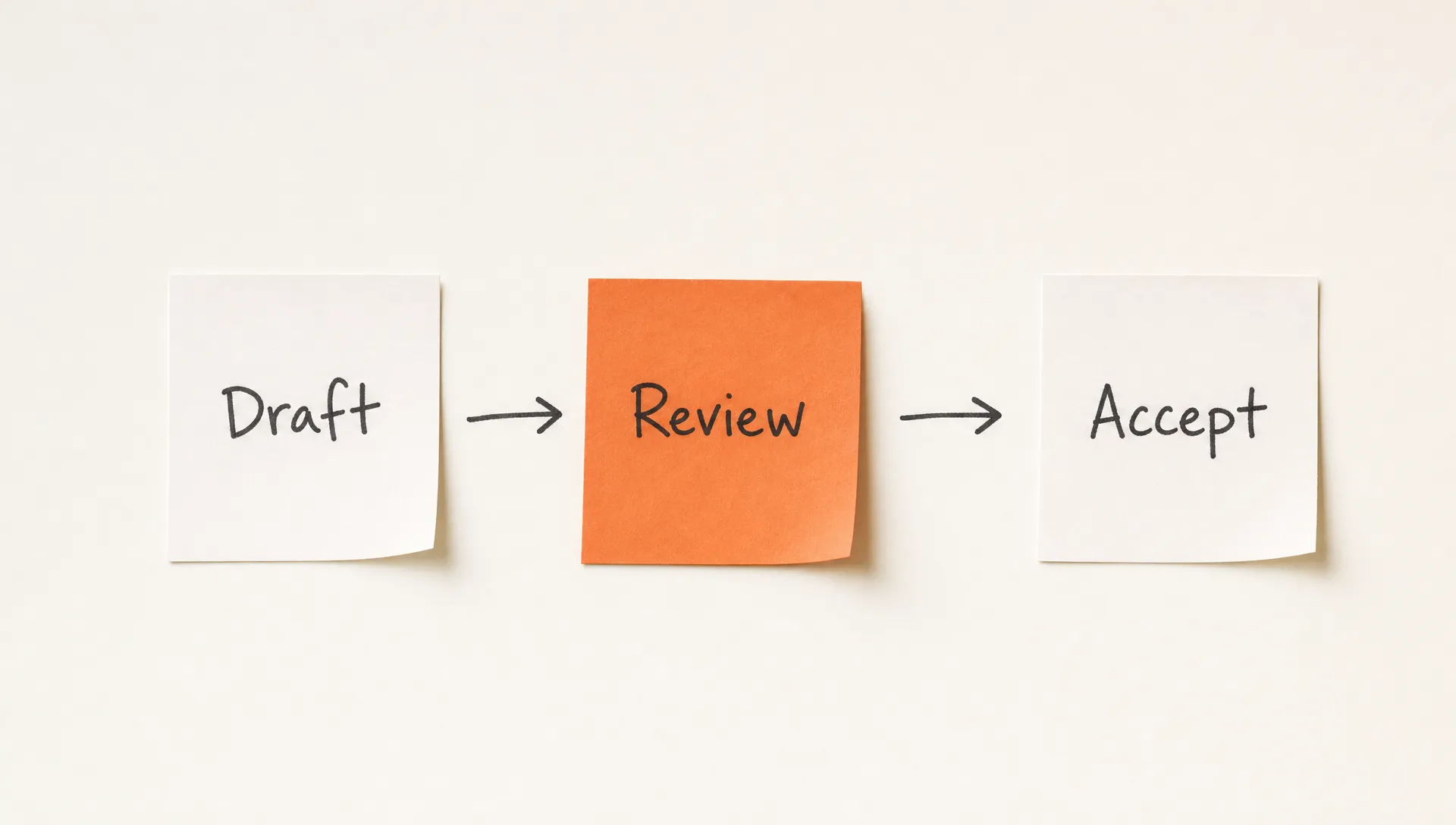
Ask to see the evidence attached to the evaluated change: the code difference, relevant test results, review findings and updated instructions. Agent output should pass through a visible review path before it reaches production.
A test written by a coding agent can repeat the same mistaken assumption as the implementation. Ask the engineer to explain how the tests reflect your acceptance criteria, including a failure case. Generated documentation also needs checking against what actually shipped.
The founder's role stays focused on product decisions and acceptance. Agents do the work. You make the decisions. The engineer remains responsible for reviewing the implementation and explaining technical trade-offs.
Do not compare providers by how many agents they run. Compare whether their process produces a change you can inspect and accept, with enough documentation for someone else to continue. More generated output creates no obligation for you to put it on the roadmap.
Ask what the changed workflow costs to run
A development proposal can explain the work required to ship a feature while leaving its operating costs unknown. Your v1 gives you a starting point for investigating those costs before expanding usage.
Ask providers of SaaS application development services to trace one completed workflow through the services it consumes. Depending on your product, that may include hosting, database activity, file storage, email, external APIs or model calls.
Where records already exist, separate observed usage from estimates. Where they do not, ask what telemetry should be added. An estimate should state its assumptions, including retries, failed jobs and background work that does not produce a successful user action.
For a feature that uses a model, record the model used, request volume, consumption and failure behavior. Check whether retries have limits and whether one user can trigger uncontrolled work. These are questions about product economics as well as implementation.
The useful output is a connection between an action in your product and the resources it consumes. That gives you a basis for pricing decisions and usage limits as real behavior becomes visible.
You do not need an elaborate reporting screen for the evaluation. A written calculation tied to actual logs, with gaps clearly marked, can tell you whether the provider understands what the feature will cost to operate.
Compare proposals after the evidence is in
Once providers have examined the same task, compare their proposals against the same acceptance criteria. Separate the change you requested from optional work, unresolved dependencies and responsibilities after release.
Good SaaS application development services should make those boundaries understandable before you commit to a larger roadmap. Use an evidence table rather than a score based on the presentation.
| Compare | Look for |
|---|---|
| Understanding | Findings tied to your v1 and chosen task |
| Scope | Included work, exclusions and unresolved assumptions |
| Acceptance | A user-visible result and a defined checking method |
| Ownership | Company-controlled accounts and a workable handover |
| Responsibility | A named person accountable for review and release |
| Continuity | A clear arrangement for defects and later changes |
Keep the public website separate from application responsibility. A managed website service such as PageTend describes design, hosting and updates for a website. That scope differs from maintaining your product's user accounts, permissions and application data. If a proposal includes both, separate them before comparing it with product development work.
The evaluation also cannot settle every ongoing obligation. Our guide to what development services should include after launch covers the continuing responsibilities. Here, your decision is narrower: has this provider earned responsibility for the next accepted change?
Frequently asked questions
Can I evaluate a provider if I cannot read the code? Yes. With SaaS application development services, you can evaluate the clarity of findings, observable product behavior, account control and acceptance evidence. An independent engineer can review the code-specific claims if you need another technical view. You still decide whether the proposed work serves the product.
Should I ask several providers to implement the same change? You can start by comparing written approaches to the same task. Implementation involves additional access and coordination, so define a separate scope before anyone changes the application. Do not let multiple providers edit the same environment without an agreed process.
Does a working v1 rule out a rewrite? No. A product can work while containing limitations that block its next requirement. Ask for demonstrated blockers, an alternative that preserves the current product and the risks of moving users or data. The recommendation should follow those findings.
What if my v1 only exists in an app builder? Use the running product, its workflows and its export capabilities as the evaluation material. Ask the provider to show what can remain, what cannot be transferred and how continuity would work before recommending replacement.
Choose one workflow to evaluate this week
Before you contact another provider, record one important journey through your v1. Write down the change you need, the behavior that must remain intact and how you will recognize completion. Confirm who controls the repository and live accounts.
That packet gives your comparison of SaaS application development services a concrete starting point. Even if you keep developing the product yourself, it leaves you with a clearer next task and a visible list of unknowns.
Archer Scaling AI helps early-stage SaaS become AI-native. It builds and runs the systems that develop, market and sell the SaaS so the founder's time goes to the decisions. The AI-native assessment starts with seven days of read-only discovery across the company and codebase, ending in a written report and plan. The development retainer then centers on one accepted deliverable each week.
For a conversation about your company, your current v1 and what needs an owner next, book a free intro call.