Content Ops for Agencies: A Practical Setup Guide
Build practical content ops for agencies with intake, briefs, QA, approvals, reporting, and AI automation that protects delivery margin.
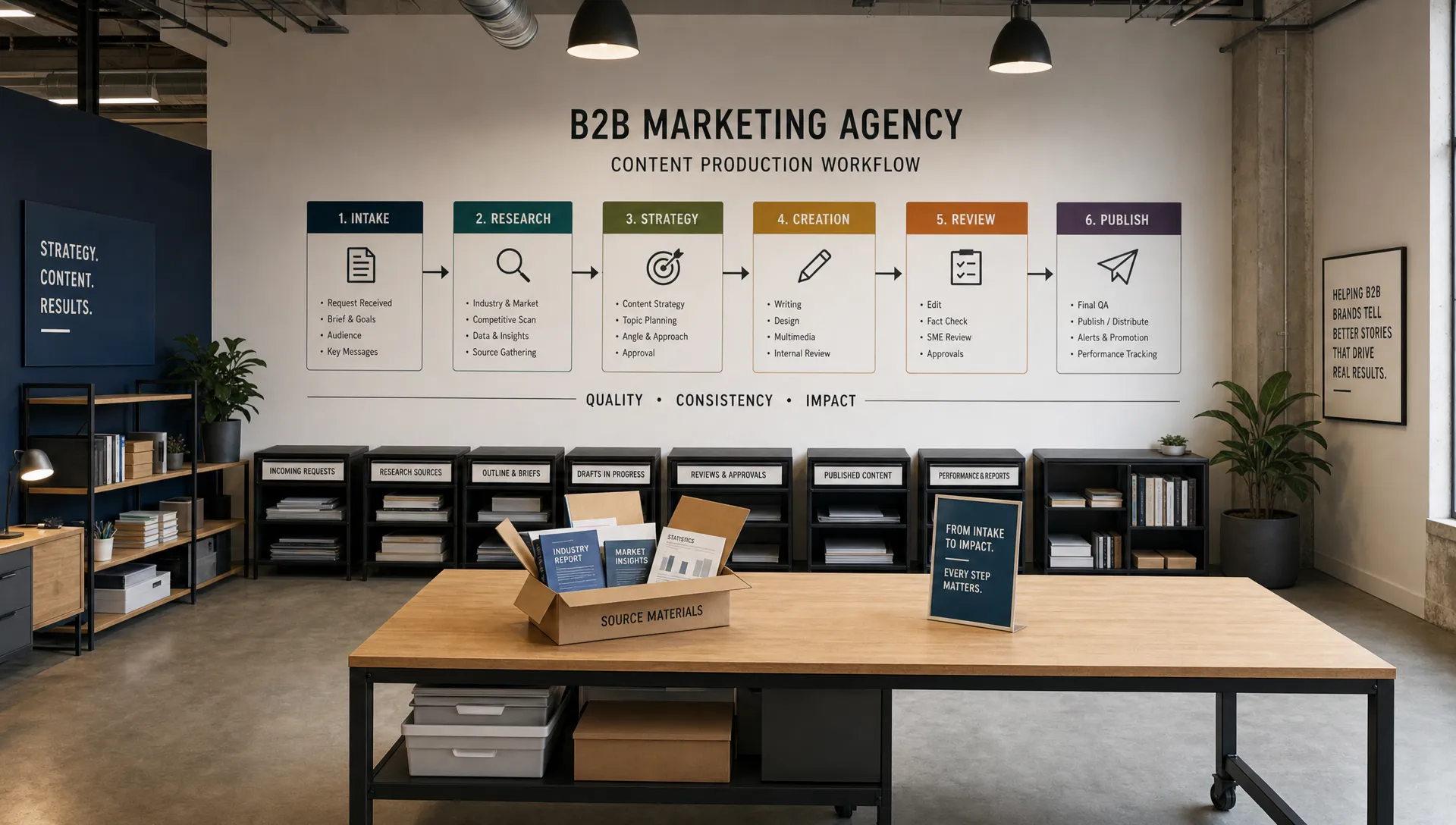
Content production usually breaks in the gaps, not inside the writing document.
A strategist waits on intake details. A writer starts with a vague brief. A client leaves feedback in three places. An account manager updates a tracker after the fact. The work still gets delivered, but every hidden handoff taxes your margin.
That is the real job of content ops for agencies: create a repeatable delivery system that turns client inputs into published, measured content without relying on heroic project management every week.
This guide walks through a practical content ops setup for B2B marketing agencies. It is not a theory piece about editorial calendars. It is a build plan for the operating layer behind intake, briefing, production, review, approvals, publishing, reporting, and improvement.
What content ops means for an agency
Content ops is the system that governs how content work moves from request to result. For an agency, that system has to do more than keep articles on schedule. It must protect scope, reduce rework, make quality consistent, and keep delivery profitable across multiple clients.
A strong agency content ops setup answers seven questions:
- What work do we accept, and what work requires a scope change?
- What information must exist before production starts?
- Who owns each stage of the workflow?
- What does “ready for review” mean?
- Where does client feedback go?
- How do we know whether the content worked?
- Which repetitive steps can AI or automation safely handle?
A helpful mental model is logistics. Companies that coordinate freight forwarding, warehousing, trucking, and 3PL services do not win by moving one package faster in isolation. They win by designing reliable handoffs, clear routing, and predictable status visibility. Agency content works the same way. The output may be creative, but the delivery model needs operational discipline.
The minimum viable content ops stack
Before buying another tool, define the operating layers. Most agencies already have enough software. The problem is usually that the tools are not connected by clear rules.
| Content ops layer | Purpose | Minimum viable standard |
|---|---|---|
| Service menu | Defines what the agency sells and delivers | Content types, turnaround times, revision limits, and exclusions are documented |
| Intake | Captures client and campaign context | No work starts without required inputs |
| Briefing | Converts strategy into production instructions | Every asset has a clear audience, angle, goal, and source material |
| Workflow | Shows stage, owner, and blocker | One source of truth exists for every deliverable |
| QA | Protects quality before client review | Checklist covers strategy, accuracy, brand, formatting, and SEO where relevant |
| Approval | Controls feedback and signoff | Feedback is consolidated in one place with clear deadlines |
| Reporting | Connects output to performance | Results are reviewed and used to improve future briefs |
This is the foundation. Once these layers are clear, AI can speed them up. Without them, AI usually makes the mess move faster.
Step 1: Define your content service menu and margin rules
Content ops starts with the offer. If every client gets a custom version of the service, your operations will always feel chaotic.
Create a simple service menu that lists each deliverable your agency regularly produces. For example, this might include SEO articles, case studies, email sequences, LinkedIn posts, landing pages, newsletters, sales enablement assets, or ad creative variants. For each deliverable, document what is included, what is excluded, and what changes the price or timeline.
The goal is not to make your agency rigid. The goal is to make exceptions visible. Custom work can still happen, but it should be priced and scheduled as custom work rather than quietly absorbed by the delivery team.
A practical margin rule might look like this: if a deliverable requires new interviews, original data analysis, legal review, executive ghostwriting, or more than the standard revision cycle, it needs a different production path. That path may require more time, more senior input, or a scope adjustment.
This is where content ops directly supports profitability. If you want a broader view of operational systems that protect agency margin, Archer Scaling AI has covered this in more detail in its guide to agency marketing systems that protect your margin.
Step 2: Build one intake process that production can trust
Weak intake creates expensive downstream problems. Writers compensate with assumptions. Strategists repeat questions. Account managers become translators. Clients feel like they already answered something, even if the team never received the usable version.
A good intake process should capture the context needed to make production decisions, not just administrative details.
At minimum, your intake should cover:
- Client business model and target segments
- Campaign or content goal
- Offer, product, or service being promoted
- Primary audience pain points
- Required sources, examples, and proof points
- Brand voice preferences and banned claims
- Subject matter expert access
- Approval stakeholders
- Publishing destination and format requirements
- Deadline, priority, and dependency notes
The most important rule is simple: intake must be complete before work enters production. If your team routinely starts before the required inputs exist, your workflow is not a workflow. It is a hope-based queue.
This is also one of the best places to use AI carefully. AI can summarize client inputs, identify missing fields, turn call transcripts into structured notes, and draft a first-pass brief. But a human owner should still approve the brief before production starts.
Step 3: Standardize the brief before you standardize the workflow
Many agencies try to fix content ops with a better project board. That helps, but only after the work itself is defined clearly.
The brief is the contract between strategy and production. It should be specific enough that a qualified writer, designer, editor, or producer can execute without guessing what the asset is supposed to accomplish.
A practical agency content brief includes:
- Objective: What should this asset achieve?
- Audience: Who is it for, and what do they already believe?
- Funnel stage: Is this awareness, evaluation, conversion, retention, or sales support?
- Core message: What is the main idea the asset must communicate?
- Angle: What makes this piece different from generic content on the same topic?
- Evidence: What sources, examples, data, or client proof points should be used?
- SEO notes: Target query, search intent, internal links, and SERP observations where relevant
- Brand constraints: Tone, terminology, claims to avoid, and compliance considerations
- CTA: What should the reader do next?
If your agency produces a high volume of written content, the brief is where you gain or lose the most time. For a deeper pipeline-specific angle, see this breakdown of how content agencies build faster content pipelines.
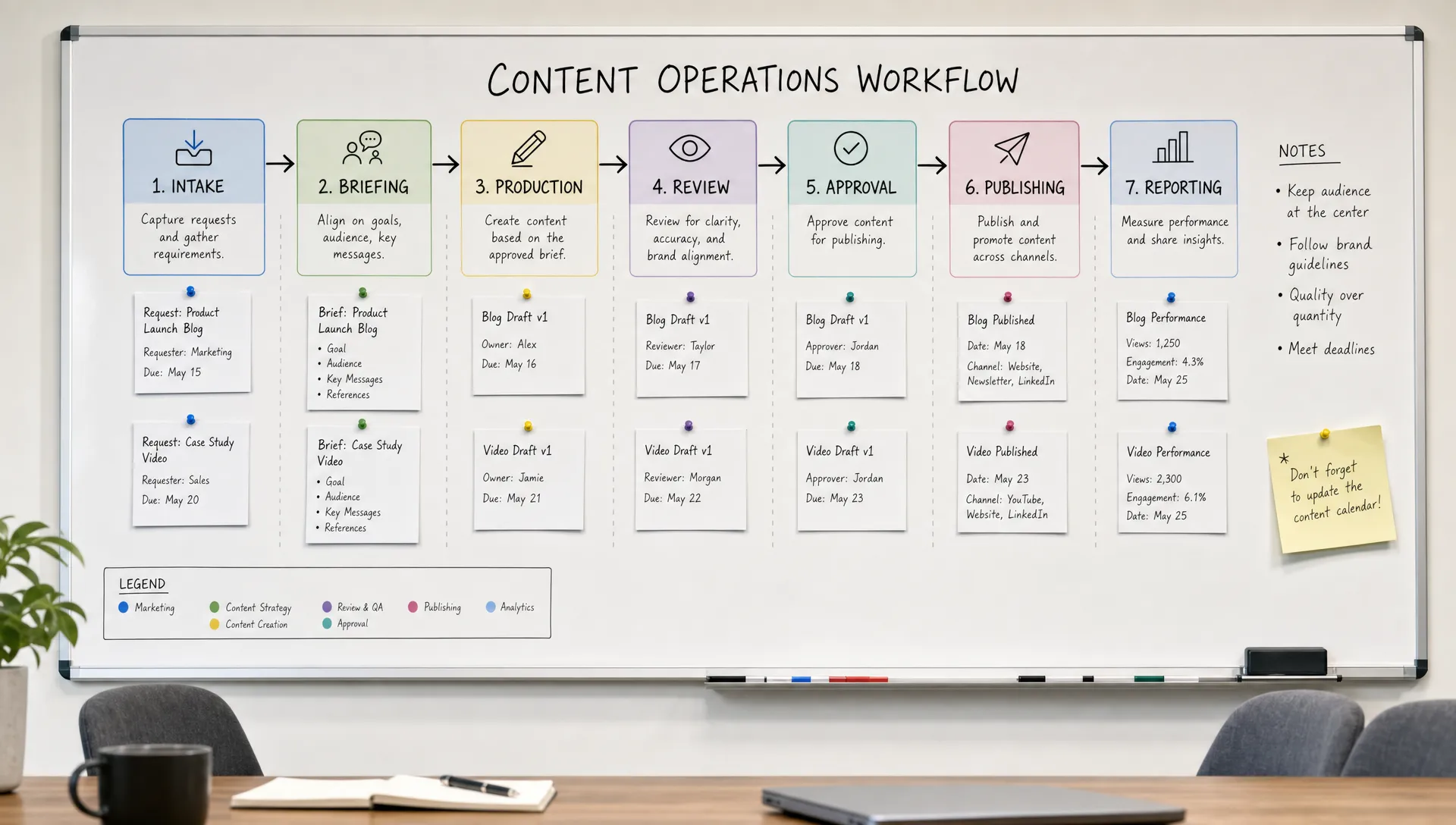
Step 4: Map the workflow with clear stage gates
Once the brief is standardized, map the actual movement of work. Avoid vague stages like “in progress” if they hide multiple handoffs. A useful workflow should show who owns the next action and what qualifies the work to move forward.
| Stage | Owner | Ready to start when | Done when |
|---|---|---|---|
| Intake review | Account lead or strategist | Client inputs are submitted | Missing details are resolved or flagged |
| Brief creation | Strategist or content lead | Intake is complete | Brief is approved internally |
| Production | Writer, designer, or producer | Brief and assets are available | Draft meets brief requirements |
| Internal edit | Editor or content lead | Draft is submitted | Quality checklist is complete |
| Client review | Account lead | Internal QA is complete | Feedback is consolidated |
| Revision | Producer and editor | Feedback is clear and in scope | Final asset is approved |
| Publishing or handoff | Ops or account lead | Final approval is received | Asset is live or delivered |
| Reporting | Strategist or analyst | Performance data is available | Insight is added to future planning |
The key is to make invisible work visible. If “client review” actually includes stakeholder chasing, feedback consolidation, scope checks, and approval reminders, document that. Otherwise, your delivery team will keep paying for that complexity with time.
Step 5: Create reusable templates and asset libraries
Templates are not about making every client sound the same. They are about reducing unnecessary reinvention.
Your content ops system should include templates for the repeatable parts of delivery. For an agency, this usually means intake forms, content briefs, outlines, editorial QA checklists, interview guides, reporting summaries, revision notes, and client approval messages.
You should also maintain asset libraries that help producers move faster without asking the same questions repeatedly. These libraries may include approved value propositions, product descriptions, customer proof points, brand terminology, competitor notes, past high-performing content, and internal linking targets.
This is one of the cleanest use cases for AI ops. Instead of asking AI to “write a blog post” from scratch, use it to retrieve approved context, summarize source material, classify content by funnel stage, draft structured outlines, and check whether a draft follows the brief.
The difference matters. AI should support your operating system, not become a shortcut around it.
Step 6: Add QA gates that reduce rework
Rework is one of the biggest hidden costs in agency content delivery. It often comes from unclear strategy, poor source handling, rushed editing, or feedback that arrives too late.
A QA gate gives the team a standard definition of quality before the work reaches the client. The checklist does not need to be long, but it does need to be used consistently.
A strong content QA checklist should verify:
- The asset matches the approved brief
- The audience and funnel stage are clear
- Claims are supported by approved sources or client knowledge
- The structure is easy to follow
- The opening creates a reason to keep reading
- The CTA matches the intended next step
- Brand voice and terminology are aligned
- SEO requirements are handled naturally where relevant
- Formatting meets the publishing destination requirements
- Feedback from previous cycles has been addressed
The best QA gates are positioned before expensive review moments. For example, review the outline before the full draft. Review the draft internally before client review. Consolidate client feedback before revisions begin.
This is especially important for agencies serving multiple stakeholders. A messy review process can turn a good draft into a margin drain.
Step 7: Build a feedback system, not a feedback scavenger hunt
Client feedback should not live across email threads, Slack messages, comments in a document, meeting notes, and project board updates at the same time. That creates missed edits, duplicated revisions, and tension between the account team and production team.
Choose one place where feedback becomes official. It can be a document, project management task, form, or approval tool. The format matters less than the rule: production only acts on consolidated feedback.
This one rule can change the economics of your content operation. It prevents writers and editors from responding to every stakeholder in real time. It gives account leads a clear role as feedback filter. It also makes scope creep easier to identify.
When feedback comes in, sort it into three categories: in-scope corrections, strategic changes, and new requests. Corrections should be handled. Strategic changes may require discussion. New requests should become new work, not invisible additions to the existing deliverable.
Step 8: Connect reporting back to planning
Content ops is incomplete if reporting only proves that work happened. A monthly report that lists published assets, rankings, traffic, clicks, or engagement may satisfy a client update, but it does not automatically improve the operation.
The stronger approach is to connect reporting back to future content decisions. That means turning performance data into better briefs, sharper angles, stronger CTAs, and more focused distribution.
| Metric area | What it can reveal | Content ops response |
|---|---|---|
| Production cycle time | Where work slows down | Fix intake, review, or approval bottlenecks |
| Revision count | Where expectations are misaligned | Improve briefs, QA, or stakeholder signoff |
| Publish consistency | Whether the workflow is realistic | Adjust capacity planning or scope |
| Organic performance | Whether the topic and intent match demand | Refine SEO research and content structure |
| Conversion behavior | Whether the asset supports the next step | Improve CTA, offer alignment, or internal linking |
| Client feedback trends | Where recurring confusion appears | Update templates, onboarding, or approval rules |
This is where agencies often underuse their own data. Every delivery cycle produces operational signals. If those signals do not update the system, the same problems repeat under a new client name.
Step 9: Automate the safest workflows first
The best automation candidates are not always the flashiest. In content ops, the safest first automations are usually repetitive, rules-based, and easy for a human to review.
Good candidates include intake completeness checks, meeting transcript summaries, brief pre-fill, task creation, status updates, internal link suggestions, content inventory tagging, report narrative drafts, and approval reminders.
Riskier candidates include final strategic recommendations, unsupervised publishing, claims-heavy copy, executive thought leadership, and anything involving regulated or sensitive topics. Those may still use AI, but they need tighter human review.
A useful rule for agency leaders is this: automate the handoff before you automate the judgment. If the team constantly loses time moving information between tools, chasing missing inputs, or reformatting updates, fix that first. Archer Scaling AI makes a similar case in its article on what a marketing agency should automate first.
A 30-day content ops rollout plan
You do not need to rebuild the agency in one quarter. A practical rollout can start with one service line, one client segment, or one recurring deliverable.
| Timeframe | Focus | Outcome |
|---|---|---|
| Days 1 to 5 | Audit current delivery | Identify bottlenecks, rework patterns, and margin leaks |
| Days 6 to 10 | Define service menu and scope rules | Clarify what is standard, custom, and out of scope |
| Days 11 to 15 | Build intake and brief templates | Create required fields and approval rules before production |
| Days 16 to 20 | Map workflow and QA gates | Assign owners, stage definitions, and review checklists |
| Days 21 to 25 | Add light automation | Automate low-risk handoffs, reminders, and summaries |
| Days 26 to 30 | Pilot with real client work | Measure cycle time, revision count, and team adoption |
The pilot matters. Do not judge the system in a workshop. Judge it on a real deliverable with real client inputs, real feedback, and real deadline pressure.
After the pilot, ask three questions: Where did the workflow reduce ambiguity? Where did the team bypass the system? Where did the system create unnecessary friction? Then adjust before rolling it out more broadly.
Common content ops mistakes agencies should avoid
The first mistake is treating content ops as an admin function. Admin support can help maintain the system, but the design of the system affects strategy, quality, scope, and margin. It needs leadership attention.
The second mistake is automating before standardizing. If the intake process is inconsistent, automation will simply distribute inconsistent information faster. Standardize the path first, then automate the repeatable steps.
The third mistake is building for edge cases. Your system should handle the 70 to 80 percent of work that repeats. Edge cases can have escalation paths. If you design the entire workflow around unusual projects, the standard work becomes too heavy.
The fourth mistake is ignoring adoption. A perfect workflow that the team does not use is not an operating system. Keep the first version simple enough that people can follow it during a busy week.
The fifth mistake is failing to define ownership. Every stage needs a clear owner. Shared visibility is helpful, but shared ownership often means no ownership.
The practical content ops scorecard
Use this scorecard to evaluate whether your agency is ready to scale content delivery without adding unnecessary headcount.
| Question | Green flag | Red flag |
|---|---|---|
| Is intake complete before work starts? | Required fields are enforced | Producers chase missing context mid-project |
| Are briefs consistent? | Every asset has objective, audience, angle, and evidence | Brief quality depends on who wrote it |
| Are workflow stages clear? | Each stage has an owner and done criteria | “In progress” hides multiple handoffs |
| Is feedback consolidated? | One official feedback source exists | Comments arrive across multiple channels |
| Is QA standardized? | Checklists are used before client review | Quality depends on individual memory |
| Does reporting improve the next brief? | Insights feed planning | Reporting is only a client-facing recap |
| Are automations supervised? | AI handles repeatable support tasks with review | AI creates more output without operational control |
If you see more red flags than green flags, the issue is not that your team is lazy or that you need to hire immediately. The issue is that the operating system is underbuilt.
Frequently Asked Questions
What is content ops for agencies? Content ops for agencies is the operating system behind content delivery. It includes intake, briefing, workflow management, production, QA, approvals, publishing, reporting, and improvement loops.
How is content ops different from project management? Project management tracks work. Content ops defines how the work should move, what information is required, who owns each stage, how quality is checked, and how results improve future production.
When should an agency invest in content ops? Invest when delivery depends too heavily on individual memory, revisions are increasing, client feedback is scattered, deadlines are slipping, or margins are shrinking despite strong demand.
Can AI run content ops by itself? No. AI can support content ops by summarizing inputs, drafting briefs, checking completeness, creating tasks, and preparing reports. The agency still needs clear rules, human review, and accountable owners.
What should agencies automate first in content ops? Start with low-risk handoffs such as intake checks, transcript summaries, task creation, reminders, report drafts, and content inventory tagging. Automating these steps usually improves margin before automating creative judgment.
Build content ops that protects margin
Content ops is not just a cleaner calendar. It is how an agency turns strategy into repeatable delivery without burning senior time on preventable chaos.
If your agency has the demand but delivery is getting heavier, Archer Scaling AI can help install and run the AI ops layer behind your workflows. The process starts with a paid Margin Teardown that identifies the roadmap and three automation moves, with a risk-reversed offer if the teardown does not deliver.
You can learn more about the system at Archer Scaling AI.