B2B PR Agencies Need a Better Way to Track Approvals
For a pr agency b2b team, learn how to track approvals, decision rights and handoffs so client reviews stop burning delivery margin.

If you run a B2B PR agency and your approval tracker is still a mix of Slack pings, email replies and “final final” docs, you already know why a “pr agency b2b” workflow breaks down. The work is not hard because your team lacks judgment. It gets hard because nobody can see who has approved what, what changed since the last review and which stakeholder is quietly holding the whole account hostage.
Approvals are one of those delivery problems that look small until they hit margin. A press release waits on legal. A contributed article waits on the founder. A media comment gets rewritten by product after the account manager already sent it for client review. Each delay creates more status chasing, more context switching and more late work passed back to the delivery team.
Approval tracking is a margin problem, not admin cleanup
Most B2B PR shops treat approvals as client service housekeeping. That is why the process ends up living in inboxes and account manager memory. The real cost is deeper: every unclear approval creates rework, missed windows and extra coordination that rarely shows up cleanly on a time report.
For a pr agency b2b team, the risk is not just a late asset. It is the repeated labor around the asset: finding the latest version, restating the ask, interpreting vague feedback, reminding the client who needs to respond and calming the internal team when the deadline moves again.
That work usually lands on your best account people. They become human routers. They know which client legal team needs two days, which founder rewrites everything at night and which product lead only comments in Slack. That knowledge is useful, but it is also fragile. When it lives in one person’s head, delivery quality depends on their bandwidth.
A better approval system should reduce the number of moments where a senior person has to stop and reconstruct history.
What a “pr agency b2b” approval workflow has to track
A useful tracker does more than say “pending.” Pending with whom? Pending on what decision? Pending since when? Pending because the client has not opened it, because legal disagreed with a phrase or because your team sent the wrong version?
That level of detail matters because PR approvals are rarely one-step decisions. Messaging, quotes, claims, timing and distribution can each have a different approver. A CEO may approve the quote but not the technical claim. Legal may approve the claim but ask for softer wording. Product may approve accuracy but object to positioning.
| Approval field | What it captures | Why it protects delivery |
|---|---|---|
| Asset owner | The internal person responsible for the piece | Prevents duplicate chasing and unclear handoffs |
| Current approver | The person or team holding the decision now | Makes follow-up specific instead of general |
| Approval type | Brand, legal, technical, executive or timing | Separates taste feedback from required clearance |
| Version under review | The exact draft, quote or asset being reviewed | Stops people approving an old file |
| Open decision | The one thing needed before work can move | Keeps reminders from becoming vague check-ins |
| Next action | What happens after approval or rejection | Helps production keep moving without another meeting |
This can live in Airtable, ClickUp, Asana, Notion or even a clean spreadsheet. The tool matters less than the operating rule: no asset moves forward unless the tracker says what decision is needed and who owns it.
The handoff from account management to production is where approvals get blurry
Approval chaos often starts before the client ever sees the work. The account manager briefs production with the client’s goal, but not the approval path. Production drafts the asset, sends it back and then waits while the account manager figures out who needs to sign off.
In a pr agency b2b account, the approval path should be part of the brief. If a contributed article needs SME, legal and executive approval, the writer should know that before drafting. If a media pitch can only use pre-cleared language, that constraint belongs in the brief, not in a comment after the draft is done.
This is the same principle behind reducing revision loops in other agency workflows: define the decision before you ask for feedback. If stakeholder feedback often derails work in your shop, this related breakdown on how agencies can keep feedback from derailing production is worth reading through that lens.
A simple rule helps: every handoff should include the next approval gate. Not a status label. A gate. The person receiving the work should know what must be true before the asset can move to the next stage.
Client approvers need less choice and more context
Clients do not always delay approvals because they are careless. Often, they are reacting to a messy ask. They receive a draft with no clear decision, no deadline context and no explanation of what kind of feedback is useful. Then three people respond to different things.
If you want faster approval, narrow the client’s job. Ask for one decision at a time when possible. Separate “is this accurate?” from “do you like the tone?” and “may we send this?” Those are different reviews.
This matters even more with expert-led clients. A health, finance or professional services client may need to protect claims, credentials and risk-sensitive language. For example, a practitioner-led website such as a Nantwich nutritionist covers topics where wording around support, health outcomes and personal guidance needs careful review. That same pattern shows up in B2B PR when a client’s expert has to approve technical nuance before the agency can pitch or publish.
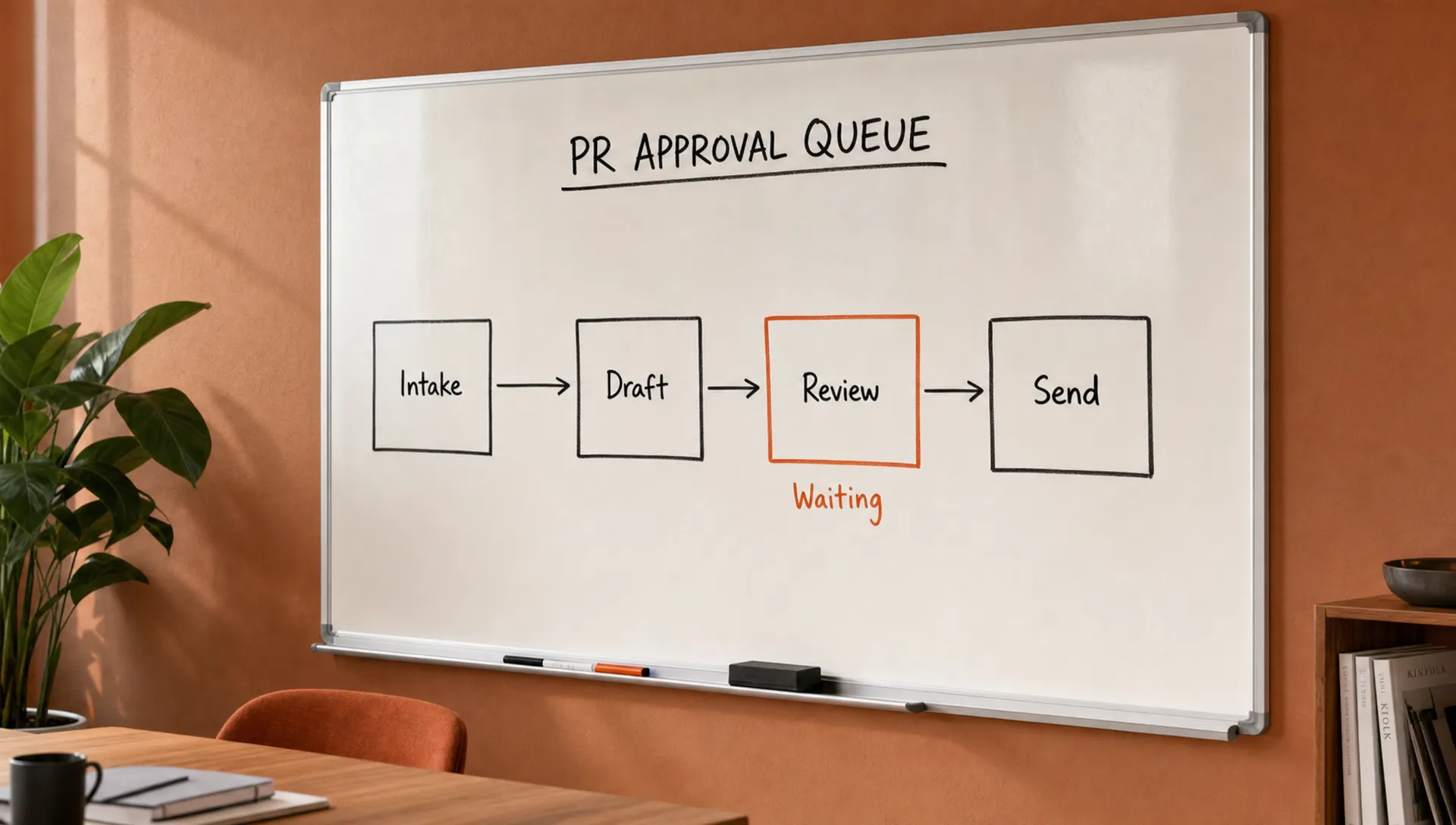
The client-facing approval request should make the review job obvious. Instead of “let us know your thoughts,” send a note that says what changed, what is not up for debate, what decision you need and what happens after approval.
That small change removes a lot of opinion noise. It also gives your account manager a cleaner reason to follow up when the client misses the window.
Where AI can help without taking over judgment
Approval tracking is a good place for AI when the task is reading, sorting and summarizing, not making the final call. The system can scan a Slack thread, email chain or document comments and pull out the current blocker. It can draft a follow-up based on the open decision. It can compare two versions and show what changed since the last approval.
The right role for AI in a pr agency b2b workflow is to reduce the coordination load around human decisions. It should not decide whether a quote is legally safe or whether a journalist pitch is strategically sound. Your team still owns judgment. The system should help them spend less time hunting for context.
A practical setup might do three things in the background. First, it watches for approval-related messages and updates the tracker when a client replies. Second, it creates a short status summary for the account manager before the daily check. Third, it flags items that have no clear owner or no defined next action.
This is close to the broader ops layer covered in this piece on how a B2B public relations agency can use AI ops, but the approval lane deserves its own attention because it touches almost every deliverable.
Build the tracker around exceptions, not perfect behavior
The mistake is designing an approval process that assumes everyone will follow it. Clients will still reply in the wrong thread. A founder will text feedback to the partner. Legal will send a marked-up PDF instead of using the shared doc. Your system has to absorb that mess without making the account team start over.
That means your tracker needs an exception path. When feedback arrives outside the normal lane, someone should be able to log the decision, attach the source and update the asset status in under a minute. If that takes too long, people will skip it.
For a pr agency b2b delivery team, the standard is not perfect documentation. The standard is whether the next person can see the latest approved position without asking around.
Keep the tracker boring. Use plain status names. Avoid custom fields nobody checks. Do not make account managers fill out ten fields to record one approval. The system should make the right behavior easier than the workaround.
The weekly review should focus on stuck approvals
Approval tracking only works if someone looks at it with a delivery lens. A weekly review should not become a long account status meeting. It should answer three questions: what is stuck, who owns the next move and which approval pattern is repeating across clients?
If three accounts are waiting on technical reviewers, the issue may be intake. If legal rewrites every press release late, the issue may be pre-approved language. If executives reopen approved drafts, the issue may be decision rights.
The goal is to remove recurring drag from delivery, not just chase this week’s late items. Over time, the tracker becomes a map of where your agency burns hours.
That map helps you decide what to systemize next. Maybe you need a pre-approved quote library. Maybe you need a standard legal review packet. Maybe you need client onboarding to capture approval roles before work begins. The tracker shows where the fix belongs.
Frequently asked questions
What should a B2B PR agency track for client approvals? Track the asset, version, current approver, approval type, open decision, deadline context and next action. The point is to make the next move visible without asking the account manager to reconstruct the thread.
Can AI fully manage PR approvals? No. It can read messages, summarize changes, update trackers and draft reminders, but your team still needs to own judgment around positioning, risk, client relationships and media timing.
Why do approval processes fail inside agencies? They usually fail because the process depends on memory. If approval paths, decision rights and version history live in email or Slack, the system breaks as soon as work gets busy.
How can a pr agency b2b team start fixing approvals this week? Pick one recurring deliverable, define each approval gate and track every open decision in one place for the next two weeks. Do not start with every account at once.
What to do next this week
Choose one deliverable that regularly gets stuck, such as press releases, bylines, award submissions, analyst comments or executive quotes. Map the approval path from draft to send. Name the approver at each stage, the decision they own and the proof that approval happened.
Then remove one vague status from your process. Replace “with client” with a specific line: “awaiting legal approval on claim language,” “awaiting CEO approval on quote” or “awaiting product confirmation on technical detail.” That alone will make follow-up cleaner.
At Archer Scaling AI, Raine Soriano installs and runs AI ops systems for marketing agencies, including the approval, reporting and handoff workflows that sit behind client delivery. If you want to talk through where approvals are burning time inside your agency, book a free 30-minute intro call. It is a conversation about how work moves through your agency and where the system should carry more of the load.