B2B Brand Management Gets Harder as Client Teams Grow
B2B brand management breaks when client teams grow. Learn how agencies protect margin with clearer handoffs, approvals and brand memory.

B2B brand management starts to strain when the client side stops being one clear voice. The founder is still in the mix, but now sales, product, customer success and leadership all send notes, each with a different version of what the market needs to hear. Your agency is judged on brand consistency even when the inputs arrive through scattered calls, docs, Slack threads and last-minute comments.
Your team probably understands brand. The coordination layer around the work just did not grow with the account. Every new stakeholder becomes another chance for rework, delay and margin bleed unless the agency has a cleaner way to capture decisions, reuse context and protect the work from casual opinion.
Why B2B brand management gets harder as client teams grow
Early in an account, brand work can feel controlled. You ask a founder or marketing lead what the company stands for, what customers care about and which competitors they want to move away from. The source of truth is narrow enough to hold in a strategist's head.
Then the client team grows. Sales brings live objections from calls. Product brings roadmap nuance. Customer success brings complaints and use cases. Leadership brings investor language, market ambition and old preferences that never made it into the deck.
None of these people are wrong. They are close to different evidence. The agency's job becomes less about producing more assets and more about reconciling partial truths without burning senior time on every disagreement.
That is where many agencies get squeezed. The account is bigger, but the operating system is still built for a smaller client team.
The real cost shows up in coordination hours
Brand complexity rarely appears as one obvious fire. It hides inside small tasks that feel harmless on their own: rewriting a headline after a sales note, changing a case study claim after product review, rebuilding a deck because an executive disliked language they had never approved in the first place.
When B2B brand management depends on memory and good manners, senior people become the glue. They remember which phrase the CEO hated, which proof point legal allowed and which positioning line sales actually uses. That works until the same people are also needed for strategy, QA, hiring, account health and client calls.
This is the same root cause behind many B2B branding revision loops. The client thinks they are giving helpful feedback. The agency experiences it as churn because the decision trail is missing.
The margin hit is simple. More people touch the work, more context has to be restated and more hours vanish into coordination that clients rarely value as a line item.
Start with a source of truth production can use
A brand source of truth should not be a museum for polished strategy slides. It should answer the questions writers, designers, account managers and reviewers face during production.
Good B2B brand management needs reusable assets that are short enough to apply in live work. If your team has to dig through a long deck before every draft, they will eventually rely on memory. That is when drift starts.
| Production asset | Question it answers | How it protects delivery |
|---|---|---|
| Message architecture | What do we say first, second and later? | Keeps drafts from inventing hierarchy every time |
| Proof library | Which claims can we support? | Reduces back-and-forth over vague credibility points |
| Terminology list | Which words are preferred or banned? | Prevents small language debates from reopening |
| Approval map | Who decides which kind of feedback? | Stops every stakeholder from editing everything |
| In and out examples | What feels on-brand or off-brand? | Gives reviewers a shared reference point |
For technical or operations-heavy clients, precision matters even more. A client like a 3PL logistics provider in the UK has brand meaning wrapped inside specific service language: order fulfilment, pallet storage, same-day transport, returns management and proof of delivery. If a writer treats those as interchangeable service words, the brand starts to feel generic or inaccurate.
Decide who can approve what before creative work starts
More stakeholders do not have to mean more authority. The mess starts when everyone can comment on anything and the agency has no agreed way to sort taste from strategy, accuracy or compliance.
B2B brand management slows down when approval happens only after the work looks finished. By then, every comment feels expensive because the team has already built around assumptions. Approval gates should happen earlier, before design polish or final copy creates emotional attachment.
Use decision rights that match the type of feedback:
- Strategy approval belongs to the person accountable for positioning and market direction.
- Message approval belongs to the person accountable for customer-facing language.
- Product or service accuracy belongs to the subject matter owner.
- Final asset approval belongs to the client lead who can accept the tradeoffs.
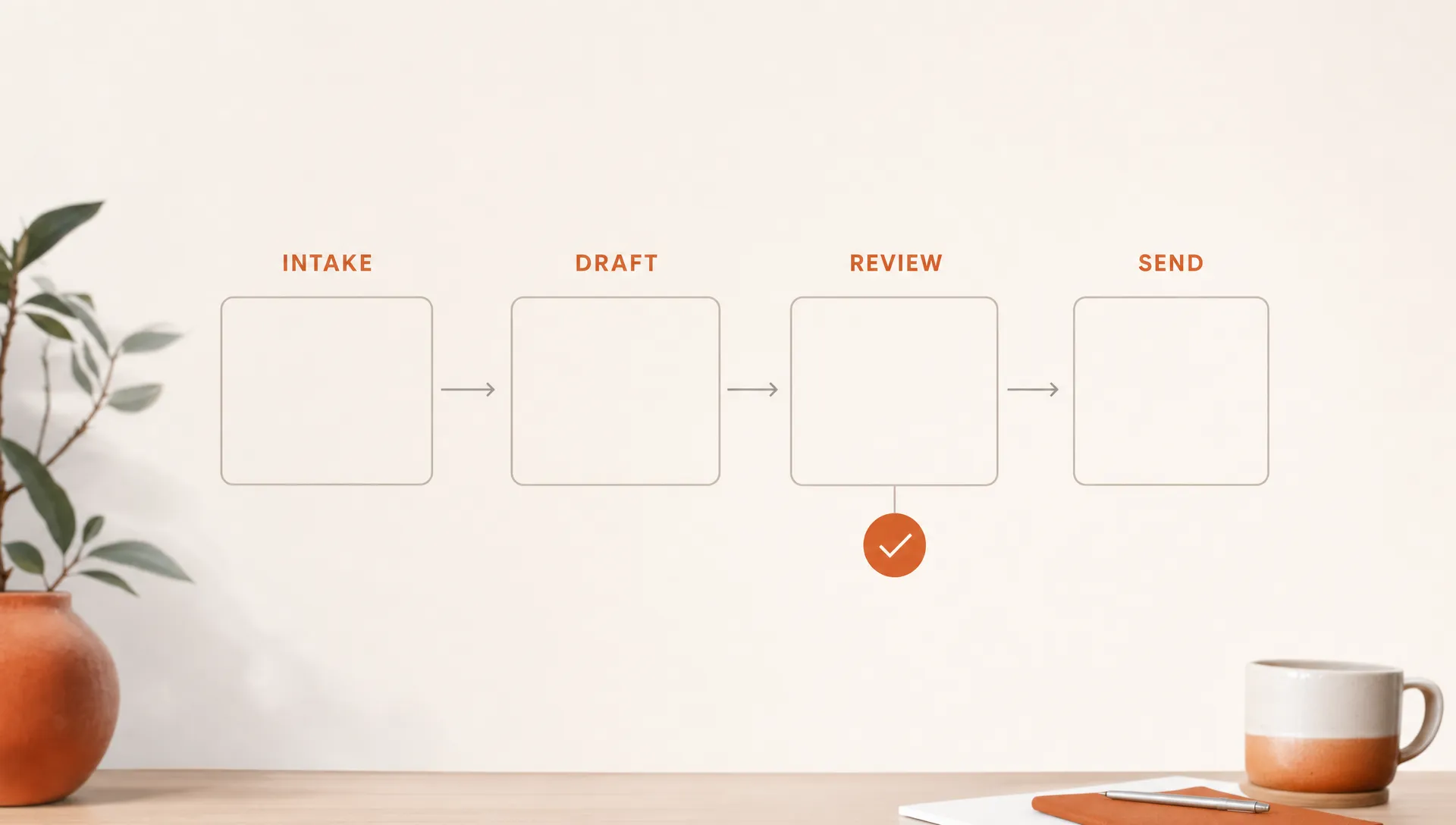
This is also where agencies can reduce rework with clearer intake and decision rights. You are not trying to make clients less involved. You are making their involvement easier to process without turning every review into a committee rewrite.
Use AI for brand memory, retrieval and first-pass QA
AI is useful when the work involves reading, comparing, tagging and retrieving information faster than a person can do it manually. That matters in brand operations because growing client teams create more raw input than a strategist can keep organized without help.
In B2B brand management, AI can support the boring but expensive parts of the workflow: summarizing stakeholder calls, extracting approved language, flagging unsupported claims, comparing a draft against terminology rules and grouping feedback by decision type. It can also prepare a review packet that shows what changed, who requested it and which open questions still need a client answer.
That does not mean handing taste or strategy to a machine. The senior person still owns judgment. The machine handles the retrieval and comparison work that would otherwise eat time between meetings.
The practical test is simple. If a task requires taste, persuasion or final accountability, keep it with a human. If a task requires finding, sorting, checking or formatting known information, it is a candidate for systemization.
Keep scope creep visible before it becomes resentment
Growing client teams create reasonable extra requests. A sales leader wants a one-pager. Product wants a tighter feature narrative. The CEO wants investor language folded into the website. Each ask can make sense in isolation.
As B2B brand management pulls in more departments, the agency has to separate normal collaboration from unpriced expansion. The problem is not the extra idea. The problem is when extra ideas become invisible work inside the same retainer.
A simple change log helps. Track the source of the request, the reason behind it, the affected deliverables and whether it changes the approved scope. You do not need to turn every small note into a contract fight. You do need enough visibility to explain why a timeline moved or why the account is consuming more senior time than planned.
This protects the relationship as much as the margin. Clients are usually more reasonable when they can see the operational effect of their own internal growth.
Reporting should show decision health, not just deliverables
Most brand status reports focus on assets: pages drafted, decks designed, guidelines delivered, campaigns queued. That is useful, but it does not show whether the account is becoming harder to run.
Strong B2B brand management reporting should also show decision health. Which approvals are pending? Which claims are still unverified? Which stakeholder comments conflict with prior direction? Which deliverables are blocked because the client team has not resolved an internal disagreement?
This kind of reporting changes the conversation. Instead of the agency saying the client is slow, the report shows the actual handoff that is stuck. Instead of the client feeling surprised by delay, they can see how their own review process affects delivery.
For the agency owner, this also gives a better view of capacity. If an account looks profitable on retainer but requires constant senior interpretation, the delivery system is carrying risk that the invoice does not show.
Frequently asked questions
Why does B2B brand management get harder when client teams grow? More stakeholders create more inputs, more opinions and more approval paths. The agency has to preserve brand consistency while sorting sales feedback, product nuance, executive preference and customer language into one usable system.
Should every client stakeholder be allowed to comment on brand work? They can contribute, but they should not all have the same decision rights. A useful process separates strategic feedback, accuracy feedback, legal or compliance feedback and taste-based comments before production moves too far.
Where can AI help without taking over brand strategy? It can help with call summaries, brand memory, claim checks, terminology checks, feedback grouping and review packet prep. Humans should still own positioning, taste, client judgment and final approval.
How do agencies protect margin on growing brand accounts? They protect margin by making intake, approval, QA, change tracking and reporting more explicit. The goal is to reduce hidden coordination work before it becomes senior time that no one planned for.
What to do next this week
Pick one active brand account where the client team has grown or become harder to manage. Look at the last two rounds of feedback and mark where time was lost: missing context, unclear authority, conflicting comments, unsupported claims or late approvals.
Then choose one workflow to tighten. Do not rebuild the whole account at once. Create a better approval map, a sharper proof library or a basic change log. The fastest progress usually comes from removing one repeated handoff problem that everyone has learned to tolerate.
If B2B brand management is already eating more delivery time than it should, the next move is to turn one messy workflow into a maintained operating system. Archer Scaling AI installs and runs AI ops systems for marketing agencies, starting with the agency's own intake, reporting, follow-up, SOP and production handoffs. If you want to talk through where the coordination load is showing up in your agency, book a free 30-minute intro call. It is a conversation about your operations, not a sales call.