Artificial Intelligence and Marketing Need Human QA
Artificial intelligence and marketing can protect agency margin only with human QA. Build checks for intake, reporting, handoffs and reviews.

Artificial intelligence and marketing have already met inside most agencies, usually in the messy middle of delivery. A strategist asks for research, a copywriter drafts faster, an account manager turns a report into commentary and everyone feels the speed gain until the first bad assumption reaches the client.
You are not trying to remove human judgment from the work. You are trying to stop using senior judgment on cleanup that a better workflow could have caught earlier.
Where artificial intelligence and marketing break without QA
The first failure point is rarely the draft itself. It is the missing context around the draft: which client voice matters, which offer is current, which metrics changed, which compliance line cannot be crossed and which promise the account lead already made on the last call.
Most agency teams start by asking tools to write, summarize or research. That works for low-risk internal prep. It gets shaky when the output moves into client-facing work without a checkpoint. The real issue is that artificial intelligence and marketing compress production time without automatically improving context.
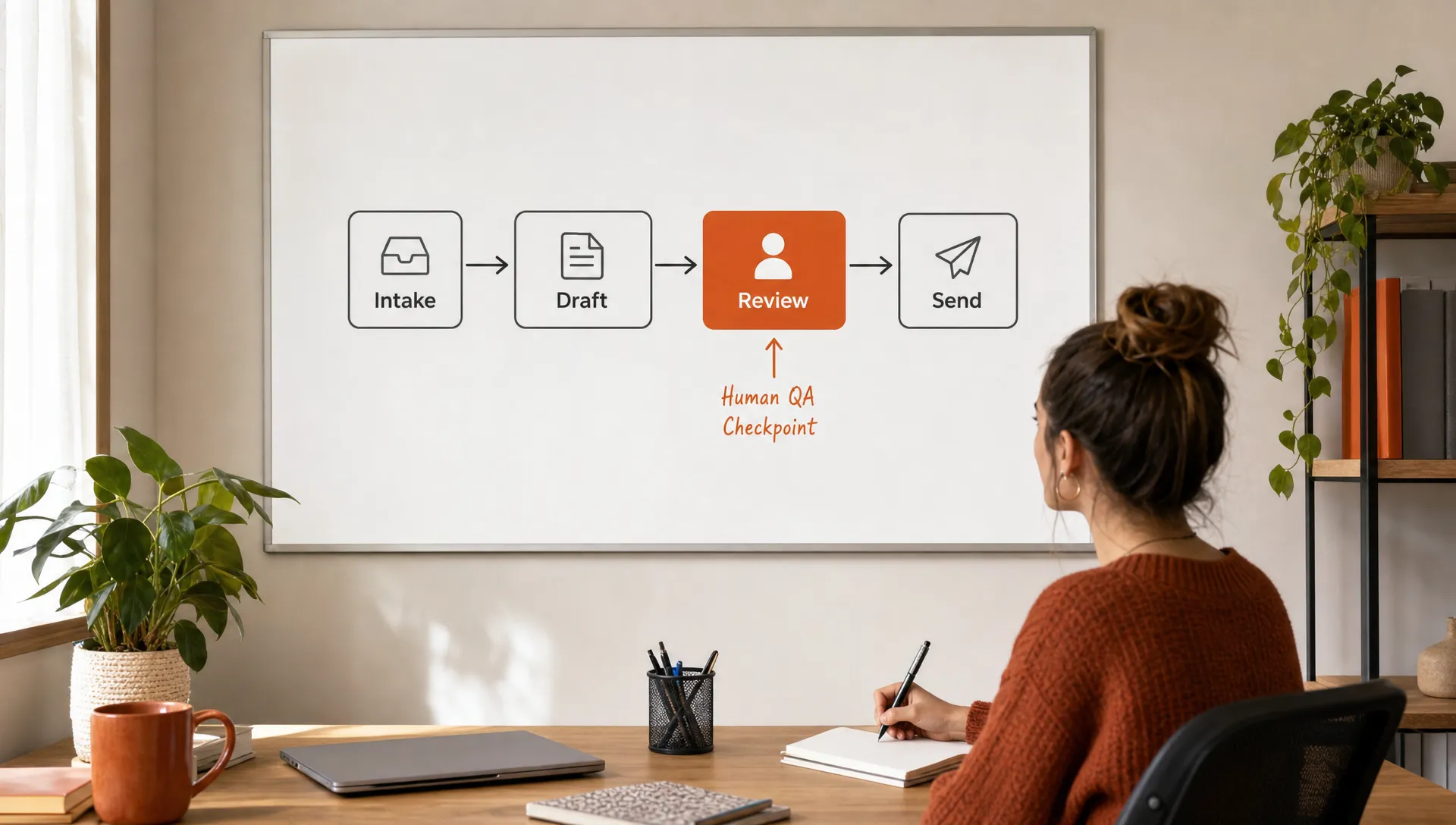
Human QA is the layer that checks whether the work is true, useful and safe to send. It should not mean a founder rereads everything at midnight. It should mean each workflow has a clear point where a person reviews the exact thing a machine is most likely to miss.
QA protects margin as much as client trust
A bad draft is annoying. A bad handoff is expensive.
If a report summary misreads the metric that matters, the account manager burns time rewriting it. If an onboarding summary misses a key product line, strategy starts from the wrong place. If a CRM follow-up goes to the wrong segment, someone has to explain what happened and rebuild confidence.
For an agency, artificial intelligence and marketing create value only when speed does not turn into rework. The margin gain comes from cutting repetitive labor while keeping senior people focused on judgment, client nuance and commercial risk.
The trap is informal QA. You tell the team to check the work, but nobody owns the check. Review then becomes personality-driven. Your strongest operator catches problems because they care, while newer people assume the tool must be right because it sounds polished.
That does not scale. QA has to be designed into the workflow before volume rises.
Build QA around decisions, not drafts
The easiest mistake is reviewing every generated asset as if all risk is equal. A social caption for an internal brainstorm does not need the same review as a client-facing quarterly report. A first-pass competitor summary does not need the same review as a recommendation that changes budget, positioning or scope.
A practical QA layer starts with decisions. Ask what the output will cause a human to do next. If it only helps a team member think, a light review may be enough. If it shapes a client conversation, triggers a follow-up or changes production priorities, it deserves a stronger check.
That is why artificial intelligence and marketing should be wired around approval points, not around tool access. The workflow should say when a draft becomes a recommendation, when a summary becomes client-facing and when a task is allowed to move without senior review.
A related breakdown of where marketing work needs human review covers the risk by workflow area. The operating question is narrower: who checks the output, what are they checking and what happens if it fails?
Use a simple risk map before you build automation
A risk map keeps artificial intelligence and marketing tied to agency economics instead of tool novelty. You do not need a complex governance program. You need a visible agreement on which work can move fast and which work needs a human stop.
| Workflow point | Machine can prepare | Human must confirm | Risk avoided |
|---|---|---|---|
| Client intake | Summaries, research notes and open questions | Business model, offer, priorities and missing context | Strategy built on shallow assumptions |
| Research | Source collection and theme extraction | Source quality, relevance and client-specific nuance | Confident but weak recommendations |
| Content or creative draft | First draft, angles and variant ideas | Brand fit, factual accuracy and claim strength | Polished work that says the wrong thing |
| Reporting | Metric summaries and issue flags | Causality, client explanation and next action | Reports that create confusion |
| CRM follow-up | Suggested next steps and message drafts | Segment, timing and promised context | Wrong message to the wrong person |
Make pre-checks happen before a human reads the work
Human QA should not mean the reviewer starts from a blank page. The system should prepare the review packet so the human can judge quickly.
For example, a reporting workflow can flag unusual metric movement, pull the source data and draft a plain-language note for the account manager. The human then checks whether the note explains the right thing. They are not hunting across tabs to understand what changed.
Artificial intelligence and marketing move faster when the system prepares evidence before the reviewer opens the work. A content workflow can include source links, claim notes, client voice examples and a list of assumptions. A follow-up workflow can show the last interaction, the intended recipient and why the message is being suggested.
This is also how you should evaluate tools. A polished demo does not tell you whether the tool can survive your agency’s actual handoffs. A better test is a real workflow with messy inputs, deadlines and review rules, which is why it helps to test marketing software against a real delivery task before rolling it out across delivery.
Put human QA at handoffs that burn hours
The best review points sit where context changes hands. Intake becomes strategy. Strategy becomes production. Production becomes QA. Reporting becomes client commentary. Follow-up becomes a CRM update. Each handoff is a place where a small miss can turn into wasted hours.
When artificial intelligence and marketing touch client work, the expensive mistakes usually happen at these handoffs. A machine can summarize a kickoff call, but a human should confirm the strategic implications before the team builds a plan from it. A machine can draft client reporting notes, but an account lead should confirm the story before it goes out.
This matters even more for agencies serving technical or local service clients. A page for a drain and sewer specialist like TapTech’s drain and sewer service cannot be treated as generic local content. Service area, emergency language, equipment claims and safety-sensitive wording need a human check because the client’s real-world work is specific.
The same pattern applies across niches. A DTC agency may need QA around claims, offers and inventory context. A PR shop may need checks around names, titles and approved messaging. A paid media agency may need review around budget notes and performance interpretation.
Assign QA ownership before volume rises
If artificial intelligence and marketing make your team faster, the next bottleneck will be ownership. More drafts, summaries and recommended actions move through the shop. Without clear review roles, the work piles up with whoever has the most context.
Do not make QA everyone’s vague responsibility. Assign the review based on the risk in the output.
- Facts and sources: The person closest to research or analytics checks whether the work is accurate.
- Client fit: The account lead checks whether the output matches client context, preferences and current priorities.
- Brand and voice: The creative or content owner checks whether the work sounds like the agency’s standard and the client’s market.
- Commercial risk: A senior lead checks anything that affects scope, budget, strategy or promises made to the client.
This keeps senior people out of low-risk cleanup while still protecting the moments that can damage trust. It also gives newer team members a clear path for what to check, instead of asking them to use judgment they have not built yet.
Measure the QA layer by rework, not vibes
A QA layer is working when the same errors stop repeating. You should see fewer client-facing corrections, fewer Slack threads asking for missing context and fewer late-stage rewrites caused by bad inputs.
Artificial intelligence and marketing should make the review trail easier to see. If every output includes the source, the assumption and the intended next step, you can spot where the workflow breaks. Maybe the intake form is too loose. Maybe reporting data is being pulled before it is cleaned. Maybe the content prompt is fine, but the approval criteria are unclear.
Do not judge the system by whether the first draft feels impressive. Judge it by whether the team can move work forward with less confusion. The goal is lower coordination weight, not more artifacts.
Frequently asked questions
How much human QA does artificial intelligence and marketing need? It depends on risk and visibility. Internal prep can usually run with lighter checks. Anything client-facing, data-based, claim-heavy or tied to strategy should have a named human reviewer before it moves forward.
Should senior people review every AI-assisted output? No. Senior review should be reserved for judgment, client risk and commercial decisions. Routine checks can often sit with the person closest to the workflow, as long as the review criteria are clear.
Can QA itself be automated? Parts of it can. A system can check for missing source links, required fields, unsupported claims, incomplete briefs and unusual data movement. A person still needs to judge whether the output makes sense for the client and the moment.
Where should an agency start? Start with one repeatable workflow where errors create rework. Client onboarding, reporting commentary and first-draft content are common candidates because they touch many roles and create visible delays when context is missing.
What to do next this week
Treat artificial intelligence and marketing as a delivery system, not a collection of side tools. Pick one workflow that burns time every week. Write down the handoffs, the current failure points and the exact review that would have prevented the last few rounds of rework.
Then add one human QA checkpoint before the work becomes client-facing or triggers action. Keep it small. One reviewer, one checklist, one definition of pass or fail. If that reduces confusion, apply the same pattern to the next workflow.
Archer Scaling AI installs and runs AI ops systems for marketing agencies, with the goal of protecting delivery margin without making your billable team maintain another internal project.
If you want to talk through where human QA belongs in your agency’s operations, book a free 30-minute intro call. It is a conversation about your operations, not a sales call.